While we still are in a pandemic, I’m not doing another series of offseason newsletters. That shit was way too much work and I’ve somehow gotten even busier than before at FOX40. I’m doing the 10 p.m. show (M-F) now and this shit is hard, especially because we’re incredibly short-staffed (I have no writers for the majority of the week). Even so, I couldn’t resist putting a little something together for the draft, partially because I miss football and partially because somehow I actually miss talking to you fuckers.
Don’t worry, this won’t just be me listing off a bunch of stats and history about the draft (although that does take a substantial portion of the newsletter). I have some important league announcements to make regarding our own draft in late August/early September. There’s also something I’m revealing to anyone outside my family/coworkers for the first time. See, there’s plenty of reason to not just ignore my hard work.
MAKING A MOCKERY
Looking back, I didn’t do that badly for my first ever mock draft. I got a lot of the Top 10 and Top 15 correct. After that it was pure anarchy, but still. Let’s see if I can improve this year.
1. JAGUARS: Trevor Lawrence (QB, Clemson) — The latest “no shit” first overall pick, the long-haired QB is unquestionably the best player in the draft. But whether or not he can succeed with a washed up college coach and an overall shitty situation in Jacksonville remains to be seen.
2. JETS: Zach Wilson (QB, BYU) — I still don’t know how he leapt up to become the second-best QB on the board, but here we are. Only Robert Saleh’s presence is preventing me from writing this off and simply wondering which QB New York will be taking three years from now.
3. 49ERS: Justin Fields (QB, Ohio State) — While he isn’t totally polished, he has more than enough pedigree and can sit behind Jimmy Garoppolo to learn San Francisco’s offense. The other remaining QBs would be way too much of a reach, especially since they traded up there.
4. FALCONS: Kyle Pitts (TE, Florida) — This pick (and the one before it) will be key to how the rest of the draft plays out. Atlanta at this point takes by far the best overall player left and sets the pieces in motion for a potentially insane offense (though the defense still needs a lot of work).
5. BENGALS: Penei Sewell (OT, Oregon) — Joe Burrow proved he has the potential to be Cincinnati’s franchise star for the next decade and a half. They just need to stop letting him get knocked on his ass during every play. Taking the best offensive lineman available is a good start.
6. DOLPHINS: Ja’Marr Chase (WR, LSU) — Miami needs a new weapon to help keep Tua Tagovailoa’s development going. But which WR in a low-key intriguing class should they take a chance on? I say they go with the guy with the great skills and fewest injury/physical concerns.
7. LIONS: Jaylen Waddle (WR, Alabama) — It’s a two-man battle in the top WR race, with the player not picked one spot above going here instead. Detroit has more than one big hole to fill when it comes to pass catchers and can do a lot worse, especially if all injuries heal up properly.
8. PANTHERS: Rashawn Slater (OT, Northwestern) — Carolina can go a lot of different ways here, but giving Sam Darnold time to thrive and making Christian McCaffrey’s job a bit easier are most important. Shoring up the offensive line with a great prospect will help accomplish both.
9. BRONCOS: Trey Lance (QB, North Dakota State) — There’s no way Denver doesn’t take a QB here, even after the Teddy Bridgewater trade (he for sure has a lower ceiling than whoever they take). Between this, Pat Mahomes, and Justin Herbert, I fucking hate the AFC West.
10. COWBOYS: Patrick Surtain II (CB, Alabama) — Oh my goodness someone remembered defense exists! Surprisingly it’s Dallas, who struggled mightily on the defensive side of the ball. They take one step closer to solving at least some of their woes with their new DB of the future.
11. GIANTS: Kwity Paye (DE, Michigan) — While it’s a pick for need and a bit of a risk, that defense still needs some help on the edge. This would probably be a different pick if Jaylen Waddle was still on the board and/or New York didn’t throw a bucket of money at Kenny Golladay.
12. EAGLES: DeVonta Smith (WR, Alabama) — Philadelphia has two massive holes it needs to fill: WR and CB. Even though they just took a pass catcher in the first round last year, I have them returning to the well this year in order to give Jalen Hurts the help he needs to succeed.
13. CHARGERS: Jaycee Horn (CB, South Carolina) — While protecting Justin Herbert should be Los Angeles’ priority, Brandon Staley may want to build up the defense, especially coming from a strong defensive background. Picking one of the top DBs in the draft would do that.
14. VIKINGS: Alijah Vera-Tucker (OT, USC) — Even though the two best offensive lineman have already gone, Minnesota definitely needs to upgrade its line in order to help out both Kirk Cousins and Dalvin Cook. Someone who’s described as “one of the cleanest, safest picks” is a good start.
15. PATRIOTS: Mac Jones (QB, Alabama) — To me, this match makes too much sense. New England needs a future QB and could select the eventual heir of the rebuilt Death Star. However, given everyone has this guy being taken 12 spots earlier, this will probably be Justin Fields.
16. CARDINALS: Caleb Farley (CB, Virginia Tech) — With Patrick Peterson going to Minnesota on his new boat made out of money, Arizona is suddenly in great need of a new CB. Even if two of them have already gone, this could likely end up being a secretly deep draft at the position.
17. RAIDERS: Jeremiah Owusu-Koramoah (LB, Notre Dame) — I give no shits how badly they downgraded their offensive line for some reason, Las Vegas needs defensive help like I need to get laid. A versatile LB who can bring some much-needed help in pass coverage will be a start .
18. DOLPHINS: Teven Jenkins (OT, Oklahoma State) — Part two of Miami’s “Protect Tua at all Costs” plan involves some actual protecting. Taking someone who can start right away on their offensive line and make it even better will do wonders to completing their stunning turnaround .
19. FOOTBALL TEAM: Micah Parsons (LB, Penn State) — Washington is an intriguing team with a lot of different directions to take. But given the many questions surrounding their offense, it may be more prudent to upgrade their defense with arguably the best LB in the whole draft.
20. BEARS: Christian Darrisaw (OT, Virginia Tech) — Chicago has… a lot of questions. They could get a replacement for Kyle Fuller, a weapon for Andy Dalton/Nick Foles, or even a future QB. But picking up a solid piece for the offensive line could solve multiple problems at once .
21. COLTS: Azeez Ojulari (LB, Georgia) — There aren’t too many spots where Indianapolis needs to improve its already great defense. But some help on the edge is always appreciated. Getting a freak of nature who apparently is also a natural leader would be pretty good, too.
22. TITANS: Asante Samuel Jr. (CB, Florida State) — Even though it may be a tad early for him to go, Tennessee is in desperate need of DBs. They can do much worse than someone who is extremely versatile on the outside and has the pedigree of an NFL star (just look at his old man).
23. JETS: Greg Newsome II (CB, Northwestern) — Robert Saleh isn’t just trying to rebuild New York’s on-field performance, but culture as well. This pick will do both by providing a leader as well as someone who won’t bite on a Hail Mary while covering the fastest WR in all of football.
24. STEELERS: Najee Harris (RB, Alabama) — Honest question — with James Conner gone, can anyone name Pittsburgh’s starting RB? It’s Benny Snell, but they can do a whole lot better. Dipping into Alabama’s rushing factory, they take their potential future star in the backfield.
25. JAGUARS: Jaelan Phillips (LB, Miami) — With the addition of Sunshine into a low key promising offense, Jacksonville now turns to take care of the opposite side of the ball. They could do a lot worse than arguably the best EDGE player in the draft to help bring Sacksonville back.
26. BROWNS: Christian Barmore (LB, Alabama) — Holy shit it feels weird to see Cleveland picking so late in the first round (and not via a trade). They can add to their turnaround by picking up someone who can get to the QB and take some pressure off Myles Garrett at the same time.
27. RAVENS: Kadarius Toney (WR, Florida) — Whenever anyone complains about Lamar Jackson’s passing ability, his supporters always bring up the fact that he has no WRs. So let’s see what happens when Baltimore gives him a seriously speedy deep threat to throw towards.
28. SAINTS: Jamin Davis (LB, Kentucky) — Even with the departure of Drew Brees, New Orleans needs to ramp up the defensive side of the ball. With good coaching, this pick could turn into the future playmaker of the defense, especially with his physical features and versatility.
29. PACKERS: Rondale Moore (WR, Purdue) — Although this pick comes with a lot of risk (and may not be one of the elite pass catchers of this class), a bigger risk would be a pissed off Aaron Rodgers requesting a trade or retiring because Green Bay failed to draft another WR yet again.
30. BILLS: Ifeatu Melifonwu (CB, Syracuse) — If Buffalo wants to take that final step, their defense needs to return to form. Tre’Davious White can lock down one side of the field. Why not give him a partner in the secondary that can use his length and explosiveness to do the same?
31. RAVENS: Alex Leatherwood (OT, Alabama) — Having just traded Orlando Brown to Kansas City (seriously guys what the actual fuck?), Baltimore suddenly needs to restock its offensive line. Alabama has a plethora of massive human beings to pick from, so let’s go with one of them.
32. RAIDERS: Trevon Moehrig (FS, TCU) — THAT’S RIGHT BITCHES IT’S MY FIRST EVER MOCK DRAFT TRADE! Las Vegas trades back into the first round to get some much-needed secondary help and a partner for Johnathan Abram. I’m sad because this won’t actually happen.
RUBEN’S RANKINGS
TOP 10 GREATEST NFL DRAFT CLASSES
With a potentially generational talent and several other top prospects at QB, arguably the best TE prospect since Rob Gronkowski, some of the best offensive and defensive members of one of the best college football teams ever, and a litany of other defensive talent, the NFL Draft Class of 2021 has the makings of being something special. Of course, we won’t really know whether or not these picks will truly pan out until at earliest five years (more likely ten years) from now. Plus, the class of 2021 has some incredible competition to be considered the best ever. Let’s take a look at the best draft classes in NFL history — with a twist. Because I will inevitably come across whichever failed player the Raiders drafted and am apparently a masochist (I’m a Raiders fan after all), I will also list the first pick the Silver and Black made in each draft.
HONORABLE MENTION: 1967/69
Arguably the best three-year draft stretch took place from 1967-69, which happened to be the first three drafts since the AFL-NFL merger agreement. Bubba Smith went first in 1967, followed by the likes of Bob Griese, Floyd Little, Alan Page, Gene Upshaw, Lem Barney, and Willie Lanier. Two years later, O.J. Simpson and Joe Greene highlighted a stacked Top 5, with Roger Wehrli, Ted Hendricks, Mercury Morris, and Charlie Joiner following in later picks and rounds. A total of 23 HOFers were drafted from 1967-69, with one of those years (spoiler) making the final list.HONORABLE MENTION: 1993
Although its Top 5 didn’t exactly feature slouches with the likes of Drew Bledsoe and Garrison Hearst, the 1993 NFL Draft’s true talent came later. Willie Roaf and Jerome Bettis were drafted towards the end of the Top 10, while Michael Strahan, Will Shields, and John Lynch were taken in the second and third rounds. The class also featured a “what could’ve been” in Robert Smith, solid players like Lincoln Kennedy and Troy Brown, and a pair of solid if not spectacular QBs in Mark Brunell and Trent Green. Dana Stubblefield was also taken, but we’ll gloss over that.
HONORABLE MENTION: 2001
Speaking of players with controversial off-field actions, Michael Vick was the first pick of the 2001 NFL Draft. But there are others whose HOF talent did pan out. LaDainian Tomlinson and Steve Hutchinson are already there, while Drew Brees, Steve Smith, and Reggie Wayne will join them eventually and Justin Smith and Richard Seymour have intriguing cases to join as well. Santana Moss, Deuce McAllister, Todd Heap, and Travis “Derrick” Henry were also taken. In addition, the Cincinnati Bengals’ took their WR duo of the 2000’s: Chad Johnson and T.J. Houshmandzadeh.
10. 1989
Unquestionably, the claim to fame for the 1989 NFL Draft is its first five picks. The second choice — Tony Mandarich — was one of the biggest draft busts in NFL history. But the other four — Troy Aikman, Barry Sanders, Derrick Thomas, and Deion Sanders — all made the HOF. In addition, both players named Sanders are among the GOAT debate for their position. So how in the hell is 1989 only at No. 10 on this list? Well, look outside the Top 5 and you won’t find much else. Steve Atwater is the only other HOFer and the total of five is fewer than many on this list (and some that didn’t make the cut). That doesn’t mean there wasn’t any talent taken later on. Wayne Martin, Eric Metcalf, Andre Rison, Donnell Woolford, Bobby Humphrey, and (controversially) Steve Walsh were also taken in the first round. Steve Wisniewski, Daryl Johnston, and Mark Schlereth were drafted in the later rounds. Still, this year was clearly top heavy. But it’s a little bit like Kate Upton, boasting a top so impressive you can’t think of anything else and get caught staring at it a lot.
RAIDERS’ FIRST PICK: Jeff Francis (QB, Tennessee) — Round 6, Pick 140
(The Raiders had traded the 11th overall pick to the Bears [who drafted Donnell Woolford] and another pick for Willie Gault and traded their 2nd round pick [which became Daryl Johnston] and others to the Cowboys for Steven Wisniewski.)
9. 2011
The only reason the 2011 NFL Draft is so low on this list is because there are plenty of players still in the league. But give it another 5-10 years and this class could rise up at least another five spots. The Carolina Panthers didn’t fuck up when picking between what was thought of at the time as a competitive QB class by drafting Cam Newton first overall. Newton’s eventual nemesis, Von Miller, was taken next. The next several picks saw the likes of Julio Jones, Patrick Peterson, A.J. Green, Marcell Dareus, Aldon Smith, and J.J. Watt selected. There are at least two future HOFers in that group. Cameron Jordan, Ryan Kerrigan, Robert Quinn, Mike Pouncey, Mark Ingram, Muhammad Wilkerson, and Cameron Heyward were also picked in the first round. The later rounds were highlighted by guys like Richard Sherman, Andy Dalton, Colin Kaepernick, Kyle Rudolph, Rodney Hudson, Randall Cobb, Torrey Smith, Justin Houston, and Jason Kelce. When everything is said and done, this could end up being the best draft class of the new millennium.
RAIDERS’ FIRST PICK: Stefen Wisniewski (C, Penn State) — Round 2, Pick 48
(The Raiders had traded the 17th overall pick to the Patriots [who picked Nate Solder] for Richard Seymour two years earlier.)
8. 2004
There’s something about drafts filled with drama surrounding QBs that makes certain classes legendary. We’ll get to another one later, but let’s start with the 2004 NFL Draft, which of course will be highlighted by its three iconic QBs. Eli Manning and Ben Roethlisberger each won two Super Bowls, which Philip Rivers might be the best QB to never play in the big game. But they’re not the only future HOFers taken in the same year — Larry Fitzgerald and Jared Allen were selected as well. Sean Taylor seemed on track to the Hall as well before he was murdered. There were plenty of other Pro Bowl-caliber players taken in the first round, including DeAngelo Hall, Jonathan Vilma, Will Smith, Vince Wilfork, Steven Jackson, Roy Williams, and Benjamin Watson. Later rounds saw guys like Chris Snee, Bob Sanders, Darnell Dockett, Matt Schaub, Michael Turner, and Andy Lee selected. Of the first eight players taken in this draft, seven of them made at least one Pro Bowl and three are bound for Canton. Guess which one is the odd man out.
RAIDERS’ FIRST PICK: Robert Gallery (OT, Iowa) — Round 1, Pick 2
(Oh it gets worse from here.)
7. 1996
You could not have gotten off to a better drafting start than the Baltimore Ravens did. The 1996 NFL Draft didn’t even have a proper Ravens jersey to give to players, but Baltimore knew how to spot talent. With their two first round picks, they selected Jonathan Ogden (fourth overall) and Ray Lewis (26th overall), two franchise icons and HOFers. But the Ravens were far from the only team to strike gold that year. This class was particularly notable for its WR success, with names like Keyshawn Johnson, Marvin Harrison, Terrell Owens, Amani Toomer, Muhsin Muhammad, and Joe Horn being selected. LB was also a strong suit — in addition to Lewis, Zach Thomas, Tedy Bruschi, Simeon Rice, and Kevin Hardy were drafted that year. HOFer Brian Dawkins, Eddie George, Mike Alstott, and Lawyer Milloy also had their names called. Interestingly, while the previous entry was defined and somewhat carried by its QBs, the 1996 draft remains the last one to not see a QB taken in the first round (Tony Banks had the honor of being the first picked).
RAIDERS’ FIRST PICK: Rickey Dudley (TE, Ohio State) — Round 1, Pick 9
(At least the Raiders picked a Pro Bowler — sixth rounder La’Roi Glover.)
6. 1985
No one knew it at the time, but when the Buffalo Bills took Bruce Smith first overall in the 1985 NFL Draft, they not only took the future all-time NFL leader in sacks but also saved them from ridicule for passing on arguably the best football player ever. Even then, they had a shot at pick 14. The Minnesota Vikings also get a break for taking HOFer Chris Doleman fourth overall. But that’s it, because it somehow took until pick 16 for the San Francisco 49ers to snatch up Jerry Rice. Shoutout to the New York Jets (Al Toon) and Cincinnati Bengals (Eddie Brown) for drafting WRs ahead of Rice. Funnily enough, Buffalo would draft their own HOF WR (Andre Reed) in the later rounds, along with Frank Reich. Those are the main points for the 1985 class, although they’re far from the last. Kevin Greene also made the HOF as a fifth round pick. Superstar QBs Bernie Kosar and Randall Cunningham were chosen after the first day. William Perry, Herschel Walker, Jay Novacek, Steve Tasker, and Doug Flutie were also big names that were selected.
RAIDERS’ FIRST PICK: Jessie Hester (WR, Florida State) — Round 1, Pick 21
(Two HOF WRs and four more that made at least one Pro Bowl. None went to the Raiders.)
5. 1968
Remember that three-year stretch from 1967-69 of incredible drafts? If you were able to do basic math, you’d have figured out the 1968 AFL/NFL Draft was the one to make the cut. Eight HOFers were selected that year, including both the first and third overall picks — Ron Yary and Claude Humphrey. Bob Johnson (the Cincinnati Bengals’ first ever draft pick), Russ Washington, and Fred Carr (all AFL All-Stars/NFL Pro Bowlers) rounded out the Top 5. The rest of the draft was full of talent as well — Larry Csonka, Curley Culp, Charlie Sanders, Elvin Bethea, and Cecil Turner were also among those taken. In addition, Marlin Briscoe — the first black starting QB ever in American professional football — was taken in the 14th round. But this draft was singled out for one other, quite important reason — the Oakland Raiders did phenomenally (after the first round, anyway). In this draft alone, the Silver and Black added Ken Stabler, Art Shell, and George Atkinson — three Raiders legends who would help the team win its first Super Bowl years later.
RAIDERS’ FIRST PICK: Eldridge Dickey (QB, Tennessee State) — Round 1, Pick 25
(Who gives a shit the Raiders got Ken Stabler, Art Shell, and George Atkinson in one draft. Knowing this, the next entry on this list gives me even more pain.)
4. 2007
Sigh. The 2007 NFL Draft class has been called by some the best collection of talent in the past 25 years. It’s easy to see why. Two of the Top 3 overall picks — Calvin Johnson and Joe Thomas — are among the best to ever play their position and might’ve been even better had their talent not been squandered by shitty teams. The rest of the next few rounds read like the Pro Bowl rosters for the 2010’s. Adrian Peterson, Patrick Willis, Marshawn Lynch, Darrelle Revis, Greg Olsen, Joe Staley, and Lawrence Timmons all went in the first round, which also featured the likes of Ted Ginn Jr., Reggie Nelson, Jon Beason, and Brandon Meriweather. Later rounds saw guys like Paul Posluszny, Eric Weddle, Zach Miller (see, the Raiders didn’t fuck that one up!), Sidney Rice, LaMarr Woodley, Ryan Kalil, Jacoby Jones, and Marshal Yanda be selected. This draft was so insanely stacked that it ranks this high despite its incredibly awful QB class, with the likes of Brady Quinn, Kevin Kolb, and John Beck. I don’t think I’m forgetting a single QB here.
RAIDERS’ FIRST PICK: Fuck you
3. 1957
The Green Bay Packers did everything right by selecting Paul Hornung first overall in the 1957 NFL Draft. Hornung would go on to win four NFL titles and the first Super Bowl, be named league MVP, and be named to the HOF. Yet incredibly Hornung is not the best RB of his draft class. That honor goes to the man taken five spots after him — Jim Brown. Brown and Hornung are two of nine HOFers that make up their draft class. Those include two iconic QBs of their era — Len Dawson and Sonny Jurgensen — along with Don Maynard, Jim Parker, Tommy McDonald, Henry Jordan and Gene Hickerson. Another great QB of his era, John Brodie, was taken before all of them except Hornung. There were two other players who are best known for their careers off the field. Jack Pardee is the only man to coach teams in the NFL, USFL, CFL, and WFL. Jack Kemp — an AFL MVP, two-time champion, and seven-time All-Star — became a congressman, Pres. George H.W. Bush’s Housing Secretary, and the 1996 Republican Vice Presidential nominee.
RAIDERS’ FIRST PICK: N/A
(The Raiders didn’t exist yet. Good thing, too — we would’ve fucked the pick somehow.)
2. 1981
George Rogers did pretty well for a first overall pick. He was a three-time Pro Bowler and two-time First-team All-Pro, led the NFL in rushing TDs and yards, and won a Super Bowl. However, Rogers holds the dubious distinction of being the only player taken ahead of Lawrence Taylor in the 1981 NFL Draft, which is in all likelihood the greatest defensive draft in league history. In addition to Taylor (arguably the best defender of all time), six of the draft’s seven HOFers were on the defensive side of the ball. Ronnie Lott and Kenny Easley were also taken in the Top 10, while Mike Singletary, Howie Long, and Rickey Jackson were picked in the later rounds. There were also plenty of other defensive Pro Bowlers selected that year. But 1981 didn’t just have defense — Russ Grimm prevented the offense from getting shut out of the HOF. Cris Collinsworth and Mark May (better known for their commentary careers) were also drafted, in addition to QBs Neil Lomax and Wade Wilson. This draft may have been the best ever… if not for two years later.
RAIDERS’ FIRST PICK: Ted Watts (CB, Texas Tech) — Round 1, Pick 21
(I’m not mad — we got Howie Long.)
1. 1983
There has been no other draft as iconic, controversial, dramatic, and talent-packed as the 1983 NFL Draft. A record six QBs were taken in the first round, most notably Todd Blackledge, Tony Eason, and Ken O’Brien. There was also this guy named John Elway who was drafted by the Colts, should’ve been traded to the Raiders, and was eventually sent to the Broncos. Jim Kelly was drafted by the Bills, fucked off the USFL for a bit, then lost four Super Bowls with the Bills. Dan Marino was passed up by his hometown Steelers and spent the next 17 years making them pay for it. Elway, Kelly, and Marino make up only three of that draft’s eight HOFers. Jim Covert and Richard Dent played a key role in the 1985 Bears’ success. Eric Dickerson broke records. Bruce Matthews and Darrell Green became legends in Houston and Washington, respectively. Other players taken include Roger Craig, Dave Duerson, Leonard Marshall, Mark Clayton, and Greg Townsend. From top to bottom, 1983 saw a draft class better than any before or since.
RAIDERS’ FIRST PICK: Don Mosebar (C, USC) — Round 1, Pick 26
(Given Don Mosebar made three Pro Bowls and Greg Townsend is the franchise’s all-time sack leader, I saw we did well. Also, the Raiders won the Super Bowl that year, so suck it.)
#THROWBACKTHURSDAY
ON THIS DAY IN NFL HISTORY:
Then again, despite the apparent talent up for grabs tonight, no one really knows how a player’s career will pan out. Take for example what happened 15 years ago today. On April 29, 2006, one of the weirdest drafts (both at the time and in hindsight) in NFL history saw plenty of surprises. Heading into the draft, all eyes were on three players — Reggie Bush, Matt Leinart, and Vince Young. Bush — the reigning Heisman Trophy winner and arguably the most exciting college football player ever — was surrounded by a level of hype not seen for anyone else since (except for maybe Joe Burrow) and widely expected to go first overall. Leinart — the Heisman winner from the year before — was one of the best QB prospects in years and was following his predecessor, Carson Palmer, into the pros. Young — who had led Texas past Bush and Leinart’s USC in maybe the best college football game ever — had seen his stock rocket up since that championship game win. The trio were the talk of the draft, but there were plenty of other big prospects. D’Brickashaw Ferguson had risen up the boards due to his great play and his amazing name. A.J. Hawk was considered a Pro Bowl LB prospect. Vernon Davis had an outstanding combine and was the clear top TE. Jay Cutler was an intriguing QB option outside of Leinart and Young.
There was another player who ended up shaking the draft more than anyone else. The Houston Texans had the first pick and were expected by many to take Bush. There was also a substantial group of fans wanting the team to put David Carr out of his misery and draft the local QB Young. But in the days leading up to the draft, rumors began to spread that the Texans were leaning towards NC State DE Mario Williams instead. Those rumors were confirmed on the day before the draft, when Houston announced they had signed Williams to a six-year, $54M deal. The news caused an uproar across the league, with many in the media claiming the Texans had made one of the worst mistakes in draft history. It also caused everyone else to redo their plans, especially the New Orleans Saints, who had the second pick. Some had predicted them to draft Leinart or Young as insurance in case their big free agent signing, Drew Brees, didn’t properly recover from a torn labrum. But the Williams pick made their choice much easier, with the Saints welcoming Bush into what was predicted to be an improved offense under new coach Sean Payton.
The shocks didn’t stop there. The Tennessee Titans had the third pick and were now expected to take Leinart. Offensive coordinator Norm Chow had been in the same position at USC when Leinart won the Heisman. But instead, Tennessee picked up Young and immediately raised a lot of eyebrows. That was later compounded when the Titans picked Bush’s backfield partner, LenDale White, in the second round. As for the first round, the story was now how far Leinart would fall. Ferguson (New York Jets), Hawk (Green Bay Packers), and Davis (San Francisco 49ers) went off the board next, while the Oakland Raiders (apparently content with Aaron Brooks and Andrew Walrer) passed on Leinart as well. After the Buffalo Bills and Detroit Lions also said no, Leinart finally went tenth overall to the Arizona Cardinals, who had Super Bowl MVP Kurt Warner. Surprisingly, Cutler was taken with the very next pick by the Denver Broncos, who traded up to make the pick despite making the AFC Championship Game the year prior.
To say each of these teams had mixed results is quite an understatement. Williams somehow ended up not being a bust for Houston, enjoying a solid 11-year career that saw him set the Texans franchise records for sacks and forced fumbles (both marks were later surpassed by J.J. Watt). Bush was far from his electrifying potential, although he was part of the Saints’ resurgence under Brees and Payton. Interestingly, Marques Colston — taken with the fourth-to-last pick in 2006 (250 picks after Bush) — had the better and more impactful career. However, Bush does have something only one other Top 11 pick that year has: a Super Bowl ring. Bush’s college teammate, Leinart, would get to the Super Bowl, albeit as a backup. Warner’s own resurgence relegated Leinart to a backup and took the Cardinals to Super Bowl XLIII, where they would come up short to the Pittsburgh Steelers and 2006’s 25th overall pick, Santonio Holmes. Leinart and Young (who to be fair made two Pro Bowls) also never came close to living up to their hype, with both of them later admitting that they didn’t put as much effort into their careers as they should. Cutler (who became a meme for smoking and not giving a shit) wound up being by far the statistically best QB from the 2006 draft, with much of his best work coming for the Chicago Bears. Speaking of meme QBs, Brodie Croyle (the only QB to go winless in more than ten starts in NFL history), Charlie Whitehurst (Clipboard Jesus), and Tavaris Jackson (the only QB in this draft to play in and win a Super Bowl) also were taken in 2006.
Given the hype surrounding the big names and their subsequent lackluster careers, the 2006 draft is often called a major disappointment, and somewhat rightfully so. However, to say that the class was without stars is quite simply inaccurate. Going back to the Top 10, Davis was one of the best TEs in the league during his tenure, while Ferguson and Hawk had lengthy careers with the Jets and Packers, respectively. But the real success came outside the Top 10. Right after Cutler, the Baltimore Ravens picked the Great Wall of Tonga, otherwise known as Haloti Ngata. Antonio Cromartie, Tamba Hali, Johnathan Joseph, DeAngelo Williams, Marcedes Lewis, Joseph Addai, Nick Mangold, and Mathias Kiwanuka all went in the first round. Devin Hester, Greg Jennings, Maurice Jones-Drew, Andrew Whitworth, Tim Jennings, and DeMeco Ryans were picked in the second round, while Brandon Marshall, Elvis Dumervil, Kyle Williams, Antoine Bethea, Rob Ninkovich, Owen Daniels, Jahri Evans, Stephen Gostkowski, Corland Finnegan, and Delanie Walker went in the later rounds. Hell, Brent Grimes, Miles Austin, Matt Prater, Tramon Williams, and Donald Penn went undrafted. While maybe not HOF-worthy, there was still plenty of All-Pro and Pro Bowl talent across the board in 2006.
So what does all of this prove? While 2006 was a bit of an outlier, it’s also perhaps the biggest proof that talent evaluation is far from a perfected process and you never truly know just how well a prospect will do. Unless of course the Raiders are involved, which means 90% of the time the first round pick will be a complete failure. Who did the Raiders take in the enigma draft of 2006? That would be Michael Huff, a bust who was taken one pick before fellow SS Donte Whitner. While it’s unclear if they would’ve prefered Leinart or Cutler, the Raiders passed on both at No. 7 because they had their big free agent signing Aaron Brooks and a reliable backup in Andrew Walter (that last sentence was written through gritted teeth). Sure, Oakland could’ve gone for Cromartie or Joseph to give prime Nnamdi Asomugha a partner, but they were still rolling with the previous year’s first round pick, Fabian Washington — taken one spot above Aaron Rodgers. With Huff following Washington and 2004’s second overall pick Robert Gallery into a squad that had at best three good players (Asomugha, Randy Moss, and Warren Sapp), the 2006 Raiders were a major dumpster fire that went just 2-14. But that was good enough to earn the top overall pick in the 2007 draft, where the Raiders finally answered their QB needs by picking…
… you know what? I need to bitch for a minute.
DRAFTLY RAIDERS RANT
You know what one of the worst parts of being a Raiders fan is? All of the losing? One playoff appearance since my sister was born? Last season? Nope. What’s worse than all is that I can never get excited that anything will change, especially with the draft. It doesn’t matter who’s being the regime at the time. Rarely will the Silver and Black hit on a first round pick — even when they do, the time they spend on the team is limited. All of those names I’ve listed in the past couple sections only tell part of the story.
In honor of his induction into the HOF this year, here’s a list of every first round draft pick the Raiders have made since taking Charles Woodson fourth overall in 1998:
1998, Pick 23 — Mo Collins (OG, Florida): mediocre lineman who spent 6 years in the NFL
1999, Pick 18 — Matt Stinchcomb (OG, Georgia): could never stay healthy
2000, Pick 17 — Sebastian Janikowski (K, Florida State): it doesn’t matter that he was one of the best in the league, the Raiders will always be mocked for taking a K in the first round
2001, Pick 28 — Derrick Gibson (SS. Florida State): drafted because he was fast, made three INTs in his six-season career
2002, Pick 17 — Phillip Buchanon (CB, Miami): had a decent nine-year career, spending only a third of it with the Raiders
2002, Pick 23 — Napoleon Harris (LB, Northwestern): has spent more time as an Illinois state senator than he did as an NFL player
2003, Pick 31 — Nnamdi Asomugha (CB, California): holy shit a pick that actually worked out — one of the best Raiders players of the millennium
2003, Pick 32 — Tyler Brayton (DE, Colorado): not great but not bad either — mostly known for kneeing Jerramy Stevens in the nuts
2004, Pick 2 — Robert Gallery (OT, Iowa): only Todd Marinovich is considered a bigger (literally and metaphorically) draft bust as a lineman
2005, Pick 23 — Fabian Washington (CB, Nebraska): nah we don’t need Aaron Rodgers, we’ve got Kerry Collins — but draft Andrew Walter in the third round just in case
2006, Pick 7 — Michael Huff (SS, Texas): as I mentioned this draft ended up being kind of a crap shoot so I can’t be too pissed
2007, Pick 1 — JaMarcus Russell (QB, LSU): fine I said his name
2008, Pick 4 — Darren McFadden (RB, Arkansas): honestly not a bad choice, but just could never stay consistently healthy
2009, Pick 7 — Darrius Heyward-Bey (WR, Maryland): the stereotypical Al Davis pick, and not in a good way
2010, Pick 8 — Rolando McClain (LB, Alabama): after this point I wasn’t upset we wasted the next two first round picks on Carson Palmer — we would’ve fucked them up anyway
2013, Pick 12 — D.J. Hayden (CB, Houston): a perfect example of the previous point
2014, Pick 5 — Khalil Mack (LB, Buffalo): a pick so perfect even the Raiders couldn’t mess it up — on track to be the best Raider since Charles Woodson until we traded him
2015, Pick 4 — Amari Cooper (WR, Alabama): for all of his drops, he’s still arguably the best WR the Raiders have had since Randy Moss — oh god that’s depressing
2016, Pick 14 — Karl Joseph (FS, West Virginia): maybe the second go-around with the Raiders will be better (it won’t)
2017, Pick 24 — Gareon Conley (CB, Ohio State): not even in the NFL anymore
2018, Pick 15 — Kolton Miller (OT, UCLA): somehow one of our most solid picks in decades
2019, Pick 4 — Clelin Ferrell (DE, Clemson): a longer reach than Manute Bol
2019, Pick 24 — Josh Jacobs (RB, Alabama): please don’t trade him in a few years like you did with Mack and Cooper
2019, Pick 27 — Johnathan Abram (SS, Mississippi State): has the potential to be great if he ever gets his head out of his ass
2020, Pick 12 — Henry Ruggs (WR, Alabama): has the unfortunate potential of turning into a stereotypical Al Davis pick
2020, Pick 19 — Damon Arnette (CB, Ohio State): I still don’t know who he is
Unless Ferrell, Abram, Ruggs, and Arnette drastically improve, I count five good picks (six if you count Kolton Miller) made in the first round in the past 26 selections. That’s a success rate of less than 20%. One of those picks was Seabass, who let’s be honest was a K taken in the first round. The other four are Asomugha (should’ve been a Raider for life), Mack, Cooper (both traded within four seasons of being drafted), and Jacobs. So basically there’s at least a 95% chance that the Raiders either shit the bed in the first round (and have to pray someone like Maxx Crosby blossoms out of nowhere from the later rounds) or trade their rare good pick in just a few years.
I have literally no faith that the draft can have any positive change, which is particularly depressing because this year there MUST be change within the Silver and Black. 2018 was just shit. 2019 saw a promising start slip away in the second half of the season. 2020 was 2019 on steroids, magnified to the greatest, shittiest extreme. We’re approaching the halfway point of Jon Gruden’s massive contract and all we have to show for it are two embarrassing collapses. This is a make-or-break year for the team, especially Derek Carr.
So far, Las Vegas has hired Gus Bradley as defensive coordinator (the milkiest of milktoast hires), added Yannick Ngakoue (a genuinely good move), and added a bunch of players highlighted by Quinton Jefferson and Solomon Thomas (not exactly household names). Sure I love Kenyan Drake, but our biggest issue wasn’t a backup for Jacobs. One of our biggest issues is now offensive line, because we decided to trade Trent Brown, Rodney Hudson, and Gabe Jackson for some fucking reason. Instead of using all available resources to upgrade our biggest need (defense), the Raiders will probably spend their first round pick on an offensive lineman, trying to solve a problem we invented for ourselves. Knowing our draft luck, he’ll probably be mediocre at best.
Amazing that probably won’t be our biggest fuckup of the offseason.
You know a sports team fucked up badly when my news director orders me to write a story about what they’ve done in my news block… on one of the biggest news days of the year.
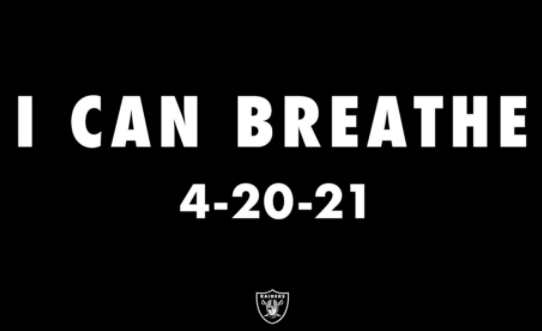
So… after the verdict in the Derek Chauvin trial, the vast majority of corporate America put out a bunch of statements and social media posts celebrating the jury’s decision, pretending they care about minorities, and giving minimal effort to appear to be on the right side of history without actually putting effort into addressing the issues that caused the situation in the first place. That includes the Raiders, who tweeted out the above image (in case you can’t see it, the message reads: “I CAN BREATHE 4-20-21.”
Now, there are generally three categories these post-trial messages fall into. First are the ones who look like they genuinely put some thought into appearing like they genuinely care. Second are the ones who put the minimal effort into making the minimal effort (like just tweeting “Black lives matter” or something). Then there are the ones that either tried to get too deep or too cute, missing the mark on both fronts. The Raiders one falls into that category.
Immediately, people started shitting on the team for being tone deaf and cringe. Then it came out that Mark Davis himself had come up with the idea, inspired by something George Floyd’s brother had said after the verdict (that was confirmed in a statement by the Floyd family supporting what the Raiders said). But that hasn’t stopped people from shitting on Davis and the team, with some even saying that Davis doesn’t understand race relations and doesn’t get black people.
I honestly would believe that for every NFL team owner except for Davis, and not because of blind homerism. Historically, the Raiders franchise has been the most progressive in the league when it comes to race and equality in general. Only one franchise put forth the first minority starting QB, first minority head coach, first minority Super Bowl-winning head coach, second black head coach (and first since the 1920’s), and the first female CEO in American professional football. None of those moves happened because of social pressure or trying to be on the right side of history. These decisions don’t even include supporting Art Powell and various other players during the 1963 game against the New York Jets and the other historic accomplishments by Raiders players of color. Al and Mark Davis may not always make smart decisions (have you seen the draft picks I’ve listed in this section?), but they operate by the heart and with the best of intentions. Apart from the Green Bay Packers (owned by their literal fans), no other team has an owner that’s more “of the people” than Davis. Name me one other owner who willingly goes to Hooters and rocks that fucking haircut.
By the way, RIP to Mike Davis. Thank you forever for Red Right 88.
Anyway, let’s talk about something less controversial.
NOT-SO-SUPER LEAGUE
Alright since you motherfuckers didn’t get it in the group text, let me spell out why exactly soccer’s European Super League was a galactically shitty idea.
Imagine one day the Dallas Cowboys, New England Patriots, New York Giants, Los Angeles Rams, San Francisco 49ers, New York Jets, Atlanta Falcons, Chicago Bears, Philadelphia Eagles, and Houston Texans said “fuck the NFL” and decided to form their own “Super Football League.” They’ll play each other every year for the SFL title, along with whatever two best NFL teams qualify for the final two spots. There won’t be any games against their historic rivals or even a draft — they’ll just play SFL teams and sign whatever big name free agent players they want because who wouldn’t want to play with the biggest and best teams? Wouldn’t that be an incredibly stupid idea that would wreck the foundations of the league those teams have played in and (mostly) had success with for decades?
Just a few weeks ago, seemingly out of nowhere, 12 European soccer clubs — Real Madrid, Barcelona, Atletico Madrid, Manchester United, Manchester City, Liverpool, Chelsea, Arsenal, Tottenham, Juventus, Inter Milan, and A.C. Milan — announced they were breaking away from the UEFA Champions League to form their own Super League. Three other clubs (TBD) would join, with five more qualifying from other leagues each year. Every Super League club would play each other and then determine a champion, which would obviously be the best team in the world. Surely, the biggest and best teams playing each other each year is something the fans crave and would definitely be into, right?
Turns out, the answer was a resounding “NO.” Shit hit the fan, soccer broke for a few days, and almost as quickly as it was announced the Super League idea fell through. But why was it such a bad idea to begin with? Why did these clubs go for it and think it would work? Was something like this inevitable? What happens next?
Let’s start with the football comparison I made at the beginning, which some might say compares apples to oranges. To a certain extent, they’re right. There is no promotion or relegation in the NFL or in fact any U.S. sports league (the worst teams stay in the league no matter what). In foreign soccer, the worst clubs get relegated to the league below (which sends up its best few teams as well). There is also no “champions league” for really any sport but soccer. The best teams from each league compete in a continent-wide tournament every year, with the winner of the European version (UEFA) considered the best team in the world due to both prominence and an overall quality. To that point, European teams have won 13 of the 17 total FIFA Club World Cups (a tournament of all global “champions league” winners) ever played.
But the NFL-soccer comparison isn’t as far fetched as you’d think. It would be if the Super League idea were about competition. But it’s not. You might’ve looked at those NFL teams I mentioned and been puzzled. The Cowboys, Patriots, 49ers, and Giants might not be surprising, but the Bears and Rams are a bit of a stretch and what the hell are the Jets, Eagles, Falcons, and Texans doing there? If this was about the best franchises ever, where are the Pittsburgh Steelers, Green Bay Packers, Las Vegas Raiders, Washington Football Team, or hell even the two most recent Super Bowl champions? Those teams were chosen carefully — they represent the vast majority of the Top 10 most valuable NFL teams and are situated in the Top 10 biggest media markets in the U.S. They’ll have more eyes on them then just about any set of ten football teams in the country. More eyes means more money.
That — not overall success — was the barometer for Super League admission. To be fair, some of the biggest soccer clubs in Europe are big because they’re successful. The ultimate measure of success is winning the Champions League. Four of the Champions League’s Top 5 winningest clubs (Real Madrid, A.C. Milan, Liverpool, and Barcelona) and seven of the Top 10 (Manchester United, Inter Milan, and Juventus) make up the majority of those teams and are worthy. But all of the other five — Chelsea, Manchester City, Arsenal, Tottenham, and Atletico Madrid — combine for exactly one Champions League win, which came in 2012.
If you’re going to tell the history of European soccer, you have to go beyond England, Spain, and Italy. Germany’s Bayern Munich — winner of six Champions League crowns — was not among the Super League squads, nor were Ajax of the Netherlands (four titles) or Portugal’s Benfica and Porto (two each). Nottingham Forest (which hasn’t competed in England’s top flight division in the current millennium) has won the Champions League more often than Chelsea, while Borussia Dortmund, Aston Villa, Celtic, Marseille, Feyenoord, PSV Eindhoven, Hamburger SV, Red Star Belgrade, and even Steaua Bucuresti (had you even heard of half of these clubs before reading this newsletter?) have each won more Champions League titles than Arsenal, Manchester City, Tottenham, and Atletico Madrid combined.
So why did those five clubs get the nod ahead of others historically more deserving? Well for the four English clubs, it’s because they play in the Premier League — the most popular, most watched, and richest soccer league in the world. If clubs can simply keep playing in it — not even win it — their value will explode. According to Forbes, nine of the Super League squads fall in the Top 11 most valuable soccer clubs in the world (including all six English teams). Literally the only reason Manchester City is good is because a bunch of rich arab people bought the club. Chelsea is owned by a man who’s as wealthy as he is impatient with managers (11 since 2011). Arsenal and Tottenham enjoy the spoils of being in London. Atletico became competitive at the right time, riding the coattails of Lionel Messi’s Barcelona and Cristiano Ronaldo’s Madrid to become one of only 13 soccer clubs valued at over a billion dollars.
To be fair, rumors of who the three TBA Super League clubs would be included Bayern, Dortmund, Ajax, and Porto (along with Paris Saint-Germain). While we may never know exactly who were in the plans (all of those clubs spoke out against the league, albeit after the backlash), all of them had reasons for not being included. PSG would’ve been a logical choice, if the club’s owner didn’t also own beIN Sports, which has the Champions League’s broadcasting rights until 2024. Few people outside of Portugal and the Netherlands give a shit about Portuguese and Dutch soccer, ruling Ajax and Porto out. Bayern and Dortmund play in Germany, which means each club is governed by a 50+1 ownership rule. That means club members own 50% of all shares plus one share, protecting clubs from the influence of investors (the Packers are definitely Bayern in my NFL analogy). Fans of those clubs would’ve never gone for the Super League, no matter how badly the investors would’ve wanted it.
But obvious corporate greed aside, why would fans be THAT upset about the Super League? Well, being a part of this selective cross-continent league would’ve had a drastic impact on the (already badly proportioned) spending balance on domestic leagues. Ownership resources and finances aside, each team in each league has a theoretical even chance of qualifying for European competition, which isn’t a given and must be earned by finishing in the top spots at the end of the year. This exclusive Super League (where 75% of the clubs have no chance to be relegated) would create a large stream of guaranteed revenue no other clubs have access to. That creates a blatant financial imbalance, making it even more difficult for any non-Super League club to win the league or get into European competition. Oh, and each Super League club would’ve gotten 3.5 billion euros to offset the impact of the pandemic.
What makes the greed even crazier is that the current model of European soccer is already making these guys insane boatloads of money. I mentioned the financial figures for these 12 clubs earlier — how do you think they got there? The Premier League began the true commercial globalization of soccer, which has only grown to behemoth proportions in the following decades. These 12 clubs in particular have milked that cash cow to become virtually untouchable. Apart from Leicester City’s miraculous 2015-16 season, all Premier League titles since 1995 have been won by the English Super League teams (except for Tottenham, obviously). The last time La Liga was won by someone other than Real, Atletico, or Barcelona was in 2004, while 2001 was the last time anyone but Juventus, Milan, and Inter won Serie A outright. These clubs are already kicking tremendous ass and dominating financially. But while the titles have largely been theirs, other teams have managed to sneak into Champions League qualifying spots in recent years and take some of the thunder away from the bigger clubs. The Super League is essentially insurance against smaller clubs being able to sit at the big kids’ table.
Then there are the moral aspects of forming a Super League. Unlike in the U.S., European fans can often go to most away games (if they can afford tickets) due to the close proximity of each city. By spurning their domestic leagues and focusing on European competition, more games will be played beyond their borders, meaning fans will have a tougher time getting to games. Don’t get me wrong — those stadiums would’ve been full anyway by either rich fans or international travelers. I say this as a neutral fan who attended a PSG-Bayern Champions League match in Paris in 2017 — the Super League is more catered to global fans who will either pay a lot of money to attend matches or watch them on TV. Those international fans are being put in front of fans in the places these clubs are actually from, who are finding themselves even more priced out of watching their favorite sports teams.
In addition to local fans, some of the main aspects and ideals of these clubs were being shat on. Forget the complete middle finger given to more than 100 years of domestic competition. By forsaking the Champions League, these clubs were letting go of their history. Real Madrid’s identity is being the biggest and greatest club in all of the world — they make that claim by pointing out they’ve won far more Champions League titles (13) than any other club. To their fans, winning the Champions League is more important than winning La Liga. Real’s president, Florentino Perez, was the chairman of the Super League. Manchester United was one of the first English clubs to embrace playing in Europe, at a time when the country’s governing soccer body refused to accommodate their clubs who were playing in continental tournaments. As a result, United was involved in a plane crash while returning home from a match in Belgrade — the Munich air disaster killed 23 people, including eight players. Ten years later, United would be the first English Champions League winner. United’s co-chairman, Joel Glazer, was a vice-chairman of the Super League. John Henry of Liverpool (more Champions League wins than any other English club), Andrea Agnelli of Juventus (more Champions League Final losses than any other club), and Stan Kroenke of Arsenal were the over vice-chairmen.
So there were plenty of reasons for fans and other clubs to be legendarily pissed about the Super League. Those in charge of the 12 clubs catastrophically underestimated the backlash they would receive from the idea. Mass protests by fans of each club were held. Former players (most notably Gary Neville), managers, and pundits alike lambasted the decision. The Premier League, La Liga, and Serie A threatened to expel each of the clubs. The five Super League clubs still in European competition (Real, Chelsea, City, United, and Arsenal) were threatened with being disqualified. UEFA and FIFA threatened that all players on Super League clubs would be banned from playing in the European Championship and World Cup. The world of soccer stopped still for several days as the biggest, smelliest piece of shit hit the sharpest, fastest blades of the fan. I have honestly never seen soccer fans so united on one side of any particular issue, even racism. It’s no wonder that within a matter of days, each of the 12 clubs pulled out of the Super League and issued corporate, half-assed apologies to their fans.
So what happens now? Certainly, things can’t go back to normal. As of this writing, the domestic leagues are still threatening punishment (point deductions or worse) for the Super League clubs. Multiple executives have stepped down as a result. Fans are clamoring for current ownership to sell the clubs. What’s more, the root of the problem is still at hand. The domestic leagues and governing bodies don’t exactly have spotless records when it comes to greed and corruption. All of the Super League drama is coming as a proposal to further expand the Champions League (a move not supported by most players and fans). While it would certainly be a lesser evil than the Super League, it’s still an evil nonetheless.
To bring all back to the NFL, the Super League may have more of an impact here in America than you’d think. Manchester United is owned by the Glazer family, which also owns the Tampa Bay Buccaneers. Stan Kroenke (who owns Arsenal) is the owner of the Los Angeles Rams, along with the Denver Nuggets, Colorado Avalanche, and Colorado Rapids. While Tottenham isn’t owned by an NFL team owner, its new stadium — Tottenham Hotspur Stadium — was specifically designed with a retractable turf field to host NFL games. Shad Khan — who owns the Jacksonville Jaguars and (as of now) Premier League club Fulham has spoken out against the Super League. Future NFL decisions and salary-related changes may happen as a result of the Super League.
I’ll end my soccer talk with this: Richard, you’re a fucking idiot.
STAT OF THE DRAFT
Fuck you, Tampa Bay. You completely bend over for Tom Brady and load up on players with questionable (putting it mildly) character in pursuit of a title. Then thanks to questionable calls and literally the worst game of the Pat Mahomes era, you actually get the ring and load up with literally everyone for another run. Just fuck you. Yes I’m bitter shut the fuck up.
This is such a unique situation that I have no idea where the Buccaneers will go in terms of drafting. My guess would be offensive line (for even more Brady insurance) or defensive line (you cannot have enough defensive line talent). Just know we’re locked in for at least two more Kansas City-Tampa Bay Super Bowl matchups. Welcome to Hell.
STEPPING UP
I told you there would be some league-related stuff to come in this newsletter!
The Epic League of Epic Epicness now has a decade under its belt. All of us have grown far from the broke college boys (except for Dad, obviously) we were when we started this. We’re now established adults doing responsible things like buying homes, having kids, and getting married or involved in lengthy relationships (except for me, obviously). My point is, we’re not babies anymore — so let’s do some grown-up things. Let’s step things up a little bit.
One idea I’ve had for a while is the idea of a destination draft, where all of us make a trip to some destination and have a vacation/draft. We’ve always either met up at someone’s house or Buffalo Wild Wings (or in the case of this past year done a socially distant video meeting). With things opening up and people getting vaccinated (I get my second Pfizer dose one week from today), let’s kick off the second decade of our league in style. Let’s go somewhere, preferably a place with wifi — we’ll still do the draft online (I want everyone to be in person but I recognize there will be limitations for some people).
But the question now — where do we go? We could go somewhere we’d typically go for an extended weekend, like Wine Country, Pismo Beach, SoCal, or the Northwest coast. Still, I’d like to make it a bit more special and bigger than that — it’s a once-a-year thing. I thought about Las Vegas — the site of many past escapades and the home of our beloved Raiders. But we’re already planning to head there when the Raiders host the Baltimore Ravens that year (and we get to talk major shit with Ewing).
That’s when it hit me — Ewing! I mean Ewing didn’t hit me, this time. What I meant was that the reason it’s been forever since we’ve done a big in-person draft is Ewing’s been living out of town. While he’s been in SoCal a lot of the time, last year he moved to Chicago for school. All plans to visit were put aside due to the pandemic, with Ewing now just a few weeks away from relocating to Dallas for his residency (also congrats to Ewing for becoming an even more legit ambulance driver!). I hadn’t thought much about visiting Dallas previously, apart from staying there when I eventually go to a Texas Rangers game as part of my MLB ball park goal. But then I remembered that Dallas does have something interesting to see — the Cowboys.
So this is what I propose: a destination draft in Dallas, hosted by Ewing, who has already agreed to show off his eventual new home to us (I wasn’t going to be a dick and write this all up without asking him first). During our time there, we can catch that Rangers game (and maybe a Houston Astros game if we can find the time and trash cans), scope out the city’s apparently great beer scene, and eat a fuck ton of steak. This will be capped off by having our draft at AT&T Stadium (I will look at securing a private room) during a Cowboys preseason game.
Exactly when this would happen is determined on the NFL schedule, which will be revealed on May 12. Some other logistical things will need to be planned out, primarily be me. But I’ve learned from our other failed trips and Pac-12 football games to not make plans until I get a full commitment from my friends. Given that we’re all eager to travel and are much more financially stable than when we were young (and hopefully not flaky ass bitches anymore), I hope getting that commitment won’t be a problem. But I’m not doing shit unless you guys actually say you will go to Dallas with me.
I want this to be fun. I want our league to be fun and unique (hence these goddamn newsletters). I’d prefer my enthusiasm to be shared by everyone else in the league, or else what’s the point?
But a destination draft wouldn’t be the only new thing about our league this year. Turning to trophies, the championship trophy has since been updated to include every winner (TAYLOR FOR THE LAST GODDAMN TIME COME GET YOUR FUCKING TROPHY). But it will no longer be the only trophy in the league. To celebrate our second decade, I have commissioned a last loser’s trophy. One that’s as massive and humiliating as the indignation of finishing in last place. While the actual trophy isn’t ready yet, I can provide a preview in the form of concept art.
That’s only the start — I can’t show you the bottom of the trophy yet because it’s a spoiler. I can’t wait for the start of the season. I need that $350 to help with car stuff.
ONE LAST THING
How fast time flies. It was nearly seven years ago that a sudden crash forced me to get a new car. Enter the immaculate, cream-colored 2004 Volvo C-70. It was a good looking car with nearly as little miles on the odometer as space in the backseat and trunk. It was also (as I’d soon find out) expensive to repair, being a European car and all. But it stuck around and became by far my longest-owned car. But as the years went on, more and more things began to go wrong (to be fair I wasn’t taking the best care of it). It had gotten to the point where I would’ve sold it had there not been some quite noticeable cosmetic issues.
Then the past two months happened. As I was driving home from work one night, a plume of steam sprang from my engine. I managed to make it home and secure some coolant, only to find it had all drained from my car within minutes. A trip to Meineke later, I discovered there were some hoses and a fan belt that needed replacing. After spending my entire $600 stimulus card (and a few hundred dollars more) on repairs, the Volvo was good… for a few weeks. That’s when I went to drive to my mother’s house for lunch, only to discover I had a flat tire. A trip to Pep Boys later and after a diagnosis that all of my tires were essentially fucked, I had gotten four new tires. But everything was good again… for exactly one week.
While coming home from a trip to Target (and about to take a much-needed trip to the grocery store), even more steam came from my engine. I got it home and went to open the hood, only to be met with resistance — I couldn’t get the damn thing up. I managed to get the car back to Meineke, where it spent the next week. It took them several days to even get the hood open (they ended up straight up removing the clamp that holds the hood in place on the passenger’s side). Then they gave me the diagnosis — my radiator is fucked. So I now had another four-figure bill to pay so soon after another the hose/belt problem and the tire replacements. I had also spent at least $300 alone that week on Uber/Lyfts to and from work, along with Doordash fees (since I couldn’t get to the store to get food).
I had finally had enough, so I did something drastic. I did not get the radiator fixed — I just took the Volvo home after the hood thing was sorted out. The Volvo has now been retired and I am in the process of selling it (AKA praying someone pays me $2,000 for it).
In the meantime, there’a a new beast in town.
This is my new car — a 2012 Ford Focus Hatchback. It’s got a few more miles on it than I’d prefer, but it kicks all kinds of ass. It drives like a track car and is way more fuel efficient than what I had before (not to mention it has a shit ton more storage). The Focus also comes equipped with Sirius radio, bluetooth phone calling, settings I can control through the steering wheel, and automatic locks. Given my car history, all of these things are like space age technology to me. It’s like moving from Arco Arena to the Golden 1 Center — night and day.
Someday, when we’re fully vaccinated and this shit is over, we’ll be able to drive all over the place in this thing. At the very least, I won’t be embarrassed to pick up women in it! Now getting a woman to agree to go out with me… that’s another story.
Anyway, happy draft day everyone! Early congrats on Mac Jones to all you 49ers fans!
Ruben Dominguez
Commissioner, Epic League of Epic Epicness
2019 Champion, Epic League of Epic Epicness
 Ruben's Writings
Leave a comment