This is it — years of research and writing have led to this exact article. We’re going to go from the final four competitors to one ultimate winner of the World Cup of Hate, determining the greatest rivalry in all of sports. Going into the tournament, if you asked people who they thought would win, I’d wager that the top three answers would be three of the rivalries still remaining, with the fourth being at worst the “outside contender” most likely to win it all. These are unquestionably deserving semi-finalists, but which one will emerge as the best of them all?
Man, I don’t envy the poor bastard who has to compare and sort these epic rivalries. Oh shit, wait — that’s me! Fuck…
SEMI-FINALS
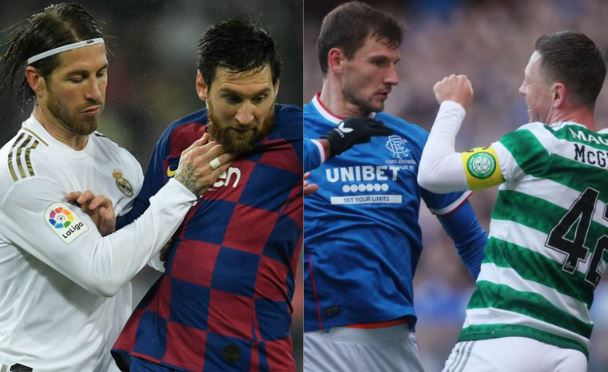
EL CLASICO (SPAIN) VS. THE OLD FIRM (SCOTLAND)
LENGTH
Holy fucking shit this is going to be a fucking war. I’m already nervous for this one and all I have to do for this category is look at numbers. In this case, El Clasico’s strong 1902 start and nearly 300 total matches played are somehow topped by an 1888 beginning and nearly 440 total editions of the Old Firm.
WINNER: THE OLD FIRM
ROOTS OF THE RIVALRY
Celtic and Rangers grew to represent opposing sides of pretty much every aspect of life, with everything from politics and socioeconomics to how you felt about the Queen (and later King) of England being impacted by the Old Firm. Barcelona has become a symbol of the Catalan way of life, which can find a polar opposite in everything represented by Real Madrid and has been a crucial part of El Clasico as a whole. Both of these rivalries extend far off the pitch and into everything else off it. I mean… how in the world can I pick between them? I won’t.
WINNER: EVEN
COMPETITIVENESS
When you consider this is the World Cup of Hate, you’d be hard pressed to find the word “friendly” without the context of sarcasm or prefixes like “non” and “un.” Friendly is another word for “exhibition game” and although you’d be equally hard pressed to call a match between any pair in this matchup “friendly,” these games have been played. 42 of them, in fact, have been played between Barcelona and Madrid, many of them in the early stages of the rivalry. Including exhibition games, Barcelona has a 16-win edge over Madrid, with draws a distant third. That’s competitive, but not quite as competitive as Rangers’ tiny four-win edge over Celtic (draws also way back in third). However, if you take away the exhibition matches, Madrid actually has a two-win advantage in official contests, which would be enough to take this section. But we must count all of those games, so this one goes to the Scots instead.
WINNER: THE OLD FIRM
MEMORABLE MOMENTS
While other rivalries have a shopping list of memorable moments, the Old Firm and El Clasico shop at Costco and have lists long enough to reflect that. Both rivalries have seen matches that decide league championships (along with cup finals). When it comes to the part in parenthesis, each rivalry has a historic ass-whooping with unique circumstances. Controversial transfers, hat tricks, last-minute winners, and other iconic battles litter both histories. Choosing between these two is like choosing between steak and lobster, or in my case steak sandwiches and lobster rolls (I love sandwiches). But in terms of pure on-field soccer stuff, one rivalry has slightly higher stakes, more insane moments, and fantastic finishes.
WINNER: EL CLASICO
SHITHOUSERY
Both of these rivalries have also seen heaping piles of shithousery to deal with. Each has been impacted by war, with El Clasico even having a dictator play a central role. Each has also seen plenty of brawls and shit-talking, with the Old Firm having multiple incidents of players mocking the opposition with controversial, nationalistic/religious gestures. Fiery responses to player transfers and general chaos have been parts of each rivalry as well. Ultimately, one rivalry embraces the chaos (including multiple incidents that led to actual legal action being taken) and has it more central to the sporting product than the other.
WINNER: THE OLD FIRM
COMBINED SUCCESS
Madrid and Barcelona got unlucky in this section in the quarter-finals, having to face two clubs that each rank in the Top 5 worldwide in terms of trophies won. Having got past that pair, they now face Rangers and Celtic… who also rank in the Top 5 worldwide in terms of trophies won. Once again, the math just isn’t in favor of the Spanish clubs.
WINNER: THE OLD FIRM
STAR POWER
The Old Firm’s only weakness just happens to line up with El Clasico’s biggest strength — this is the biggest mismatch in the matchup, even considering the ones with only counting involved.
WINNER: EL CLASICO
FAN SHENANIGANS
Both El Clasico and the Old Firm have been hugely impacted by fans. Both have made their voices heard over controversial player transfers (Luis Figo, Mo Johnston), had a memorable incident of throwing things (bottles and a coin), and gotten into plenty of interactions with players themselves (Carles Puyol, Paul Gascoigne). Fans of all four clubs involved have also consistently created some of the best atmospheres in all of soccer. But as far as having an impact on the rivalry, one pair of fan bases has been a bigger deal (though it’s damn close). From ripping up the field due to rumors of match-fixing in 1909 to breaking out in a mass brawl that drew comparisons to Apocalypse Now in 1980 to combining for no fewer than 360 police incidents (and forcing a referee to get stitches) in 1999 to getting into with with players on both teams as late as 2019, fans of the Old Firm clubs have been doing it a little bit longer, a little big better, a little bit crazier, and a little bit more dangerously.
WINNER: THE OLD FIRM
THE PEAK
As mentioned above, the Old Firm has had several iconic moments, each of which could be argued as the peak of the rivalry. However, apart from the initial flare-up, there was little more added on afterwards (most of the time) for either Rangers or Celtic. It never kept building to anything. Then you have the 18-day stretch in 2011 during which Madrid and Barcelona faced off four times — once in league play, once in the Copa del Rey final, and twice in the UEFA Champions League semi-finals. Each game was not only exciting in its own right, but it contributed to other sub-plots (individual competitions) and a greater threat of who would “win” the four-game series. We also got to see El Clasico four times in three weeks, which will probably never happen again.
WINNER: EL CLASICO
CURRENT STATUS
As a whole, both rivalries are in great shape — competitive and fiery as ever. But peel things back and both get more interesting. There have been five whole seasons since Rangers and Celtic resumed their Top 2 dominance in league play, though only one of those seasons (albeit an invincible one) went to Rangers. Celtic also recently had a six-match unbeaten run, though it was snapped in the most recent result. Meanwhile, though Madrid has been chugging along relatively smoothly, Barcelona has been battling a bit of a crisis, finishing a shocking third place in league play two years ago. While they have righted the ship (at least a little bit) by finishing Top 2 the past two years and winning the league last season, Barcelona is still dealing with some financial challenges (to be fair Madrid is as well kind of). So both El Clasico and the Old Firm are a bit shakier behind the surface. But there’s something else when it comes to the former (besides not being as evenly-matched on the field recently). With the departures of Karim Benzema, Sergio Busquets, Marco Asensio, and Jordi Alba, the players who starred in the Lionel Messi-Cristiano Ronaldo era of El Clasico are pretty much gone. We’ve definitely entered a new era of the rivalry, with plenty of young players ready to make their mark. That’s exciting — which in this case is enough to separate it from the same Old Firm dominance.
WINNER: EL CLASICO
LEVEL OF HATRED
What I’m about to say may piss some Spanish people off, so be prepared. While this category (like most of the rest of these) is extremely difficult to decide, I feel like one rivalry is “merely” an incredible battle between two eternal arch-rivals and the other somehow goes to an even higher level of hate. With some rare exceptions (especially pre-2012), Celtic and Rangers have largely been equals in Scottish soccer, with the hatred coming from trying to prove who’s the best of the best (along with every other aspect of life). Meanwhile, a large part of the rivalry has seen Barcelona looking to catch Madrid, due to everything from external factors to their own play. Some of those factors have challenged the Catalan way of life, giving Barcelona fans the extra ammo to hate Madrid more than anything. But when it comes to Madrid, I feel there’s been a notable part of supporters that have looked down on Barcelona (to a lesser extent but not dissimilar to the way they look at another Madrid club). Put it this way — as great as it was to see Madrid fans show respect to the likes of Diego Maradona, Ronaldinho, and Andres Iniesta at the Santiago Bernabeu, I can’t see a scenario where Barcelona fans would do the same for a Real player at the Camp Nou. Some may say that’s because a Madrid player hasn’t deserved such an honor, while others may say it’s because Madrid fans are classier. But either way, when going up against such a hate-filled duel like the Old Firm, it’s this side of El Clasico (which has done so much to help it in other areas) that lets it down in this section.
WINNER: THE OLD FIRM
TOTAL: THE OLD FIRM WINS 7-5
Holy shit, it happened! Arguably the favorite to win the entire tournament has fallen just before the final. While those who know and love El Clasico and its clubs may feel disappointed by this finish, just know that it took a rivalry unlike any other to take it down and that at worst, El Clasico will be the fourth-best rivalry in all of sports. Meanwhile, although it may seem like the Old Firm has just pulled off the upset of the competition, fans of the rivalry and its clubs may say that it’s not an upset at all. If anything, a rivalry that may not get the headlines others may receive has been validated and now looks to take the last step by winning the final.
I knew going in that this matchup was going to be tough to decide. Both of these rivalries have legitimate claims to be the best in the world and are deserving to make the final. In fact, you could make the argument that this matchup should’ve indeed been the final. However, there are two other rivalries that can make similar claims — one will have a shot to prove it.
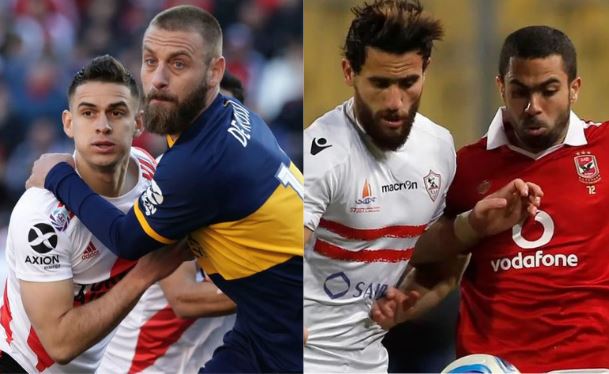
SUPERCLASICO (ARGENTINA) VS. CAIRO DERBY (EGYPT)
LENGTH
Another matchup that makes me wonder how the hell I’ll be able to pick between the two competitors starts with probably the closest call this section has seen in the entire tournament. The Superclasico started just four years before the Cairo Derby and has only been played a dozen more times. Still, it’s enough to get the point here.
WINNER: SUPERCLASICO
ROOTS OF THE RIVALRY
Boca and River began as fellow occupants of La Boca before River moved to the much more affluent Nunez district, which added a class divide to the already heated-up rivalry. But Al Ahly and Zamalek started out as complete opposites — the former representing the common people of Egypt and the latter being a haven for rich foreigners. The first big divide of the Superclasico was just one of the aspects of the Cairo Derby at the start.
WINNER: CAIRO DERBY
COMPETITIVENESS
The Cairo Derby’s biggest weakness sticks out again here, especially against an extremely competitive rivalry like the Superclasico. In fact, if you already haven’t, just count out the Cario Derby in this section from now on no matter what.
WINNER: SUPERCLASICO
MEMORABLE MOMENTS
It goes without saying that both of these rivalries possess enough memorable moments to fill out an encyclopedia. Both sets of rivals have fought for trophies, league and cup success, and intercontinental dominance. Both have reached the peak of any rivalry and even when the stakes are reduced to nothing but points, crazy shit has happened. While you can make the argument that the Cairo Derby has seen incredible moments play out for a longer stretch of time, the comparative density of the Superclasico and the diversity of these moments as a whole (as well as a slightly higher level of stakes) gives it the win here.
WINNER: SUPERCLASICO
SHITHOUSERY
Massive brawls, countless red cards, taunting of the opposition, and just general chaos have almost become expected when each of these rivals take the field against each other. The shithousery is simply on another level when it comes to both the Superclasico and the Cairo Derby. But while the combination of overall shithousery and highest stakes will help out the former soon, for now the latter gets the advantage when it comes to pure shithousery, with the rivalry seeing plenty of petty, problematic moments that were inspired from everything from pure sporting reasons to allegations of corruption and even political motivations.
WINNER: CAIRO DERBY
COMBINED SUCCESS
Both River and Boca represent the rivalry well in this category, with each contributing at least 70 trophies here. Zamalek, meanwhile, technically claims 76 of its own, though some of them are from default competitions. But even if we discount those, no matter what we have to throw in Al Ahly, the most successful soccer club in the world when it comes to silverware. With well over 100 honors of their own, the Egyptian clubs take the point here.
WINNER: CAIRO DERBY
STAR POWER
This is the Cairo Derby’s other notable weakness in this competition. While I won’t say to count it out here for the rest of the tournament just yet, you can definitely do so against a star-studded rivalry like the Superclasico.
WINNER: SUPERCLASICO
FAN SHENANIGANS
“Extreme” is a fantastic work to describe the fan bases of each of the four clubs. One club’s flag was burned at the first ever Superclasico, while both sides of the Cairo Derby are positioned in a way where supporting one makes the other your eternal enemy. Sadly, each rivalry has seen major, deadly stadium disasters as well as other off-field riots that have left violence and destruction in their wake. Fans of both rivalries have also been fueled by political turmoil and other unrest in their countries. Then we have the incredible atmospheres produced when both sets of rivals take the field, with scenes described like nothing else in club soccer. Much like the other semi-final, there’s one set of fans that not only have made a greater impact on their rivalry as a whole, but some of the most major events in the history of their country (and continent).
WINNER: SUPERCLASICO
THE PEAK
There’s a dream scenario for every rivalry that sees both competitors meet up in the final of the biggest competition they each can enter, which is whatever major continental tournament is available to them. Team A vs. Team B to decide who’s the best in the entire continent. Only three of the rivalries in the entire World Cup of Hate have been lucky enough to have such a scenario play out in real life. Two of them are the Cairo Derby and the Superclasico. So how do we compare? In 2018, Boca and River met in the Copa Libertadores Finals, which was the last edition to be played over two legs. The first leg (hosted by Boca) ended in a dramatic 2-2 draw. The second leg (which was supposed to be hosted by River) ended up being postponed due to Boca’s bus being attacked and players injured by pepper spray and other items, and was eventually played in Madrid (with River winning 3-1 in extra time). Two years later, Zamalek and Al-Ahly met in the CAF Champions League Final. This was the first time two clubs from the same country competed in any CAF competition final and the first final to be contested in a single game (the format would go back two a two-legged final three years later). Sadly, because of the COVID-19 Pandemic, the game was played behind closed doors, meaning no change for fan shenanigans. The game was decided by an 86th-minute goal by Al Ahly, which won 2-1. Looking at the two side-by-side, it’s impossible to pick a winner. While the drama between the Argentinian clubs was stretched over two legs, you can argue that the stakes were higher for the Egyptian clubs because it was just one game (which arguably had a greater historical significance for the continent). Although the 2018 edition was carried beyond legendary status due to fan involvement, I don’t feel like it’s right to punish the 2020 edition just because it had the bad luck of the pandemic impacting everything. In the end, we can’t ask anything more of a rivalry than what both did in these finals — doing so would be too nitpicky even for me.
WINNER: EVEN
CURRENT STATUS
When it comes to league and international success, both Al Ahly and Zamalek have seen new additions in recent years (especially for the former). River and Boca have each had their own league and continental success as well. However, the main difference comes from just how competitive both have been for those titles. River and Boca have much more evenly split league crowns during this time and have gone through each other more times in other competitions. Plus, head-to-head results have been much more even (and therefore exciting) than those of Zamalek and Al Ahly. Let’s also not forget that the literal most recent time (as of this writing) Boca and River have played, there was a stoppage time, match-winning penalty that led to a huge brawl and seven players being sent off.
WINNER: SUPERCLASICO
LEVEL OF HATRED
Nope. You know how I went into a huge paragraph about how even the rivalries are two sections above? Imagine how long this would be if I had to dissect whether or not the Cairo Derby or the Superclasico has more hatred. Fuck that shit.
WINNER: EVEN
TOTAL: THE SUPERCLASICO WINS 8-5
If there were any questions about whether the Cairo Derby got lucky to be in the semi-finals, it proved its mettle and then some, pushing a rivalry that had been the most unstoppable out of any in the entire tournament to the closest it had been to elimination. But while it put forward its best efforts, the Superclasico once again proves too much for even the next best to contend with and cements a cross-Atlantic title bout that looks set to be one for the ages.
We’ll get to the final in a minute. But first, there’s a unique aspect of the FIFA World Cup that most sporting events (even other soccer tournaments) don’t have. To make the semi-finals, you have to play five games — three in the group stage and two knockout stage rounds. Once you make the semi-finals, you’re guaranteed to play two more times, even if you fail to make the final. That other match is the third place play-off. While it’s the one match no one really wants to participate in, it still gives two sides a nice little reward for making it that far and allows one of them to end their campaign on a high note (and it helps fill the gap between the semi-finals and final). Because third place has technically been awarded since the first ever World Cup in 1930 and the match itself has been played since 1934, it would feel wrong not to do a spin-off of the tournament and ultimately complete one fewer match.
THIRD PLACE PLAY-OFF
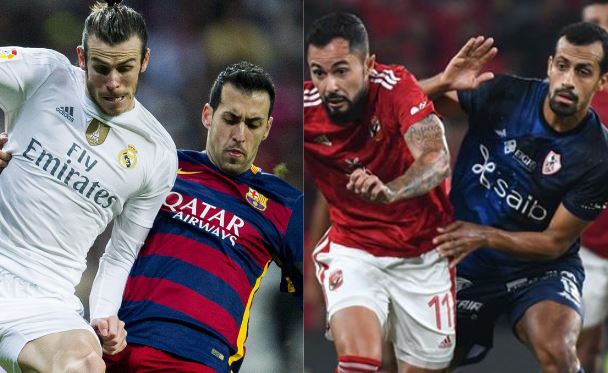
EL CLASICO (SPAIN) VS. CAIRO DERBY (EGYPT)
LENGTH
El Clasico has been going on for 15 years longer than the Cairo derby, although there have been just less than 50 more matches for the former than the latter. Still, that gets the point.
WINNER: EL CLASICO
ROOTS OF THE RIVALRY
El Clasico unexpectedly struggled in this section in the semi-finals, having to settle for a points split. Well, the Cairo Derby has pretty much the same sort of origin as El Clasico’s previous opponent. Al Ahly and Zamalek have spread their influence into basically all aspects of life. Barcelona has come to symbolize the Catalan way of life, which is most opposed by everything Madrid represents. Once again, I can’t call a winner here.
WINNER: EVEN
COMPETITIVENESS
Remember how I said to pretty much count the Cairo Derby out for this section from now on? Yeah… congrats to El Clasico.
WINNER: EL CLASICO
MEMORABLE MOMENTS
In the semi-finals, the Cairo Derby and El Clasico threw down some incredibly impressive moments in each of these two categories, which ended up being two of the closest calls in both matchups. To try and save a bit of time, each of these rivalries will win the same category for the same reasons described above.
WINNER: EL CLASICO
SHITHOUSERY
To continue the point in the previous paragraph, each rivalry has seen heaping piles of shithousery during its lengthy list of battles, both on and off the field. In the end though, one has barely enough ammo to declare it the winner.
WINNER: CAIRO DERBY
COMBINED SUCCESS
After feeling slighted in this section in the previous two rounds, El Clasico has to be breathing a sigh of relief now. Having already faced four of the Top 5 most successful clubs, Madrid (over 100 honors) and Barcelona (nearly 100 honors) can’t statistically do that again here. What’s more, Zamalek can only field around 70 trophies. But just when the Spanish clubs let out a sigh of relief, they realized they still have to face the final member of the Top 5 — No. 1. Al Ahly has well over 100 trophies, so much so that the combined total of the Egyptian clubs surpasses that of their opponents.
WINNER: CAIRO DERBY
STAR POWER
This may be the biggest mismatch in any section of the entire knockout stages. El Clasico is in another galaxy when it comes to star power compared to the Cairo Derby.
WINNER: EL CLASICO
FAN SHENANIGANS
The Cairo Derby and El Clasico’s semi-final opponent have a lot in common, including being incredibly strong in this section. In fact, both are so strong that — without getting into too much detail like before (it’s the third place match so I’m not going as hard), they manage to overtake the Spanish giants here.
WINNER: CAIRO DERBY
THE PEAK
For as great as the peak of El Clasico (the four Barcelona-Madrid matchups in 18 days in 2011) was, it can’t quite reach the peak of the Cairo Derby (the 2020 CAF Champions League Final), despite it including UEFA Champions League semi-final matches itself. That’s the power of the African Game of the Century for you!
WINNER: CAIRO DERBY
CURRENT STATUS
In terms of trophies, both rivalries have been playing out similarly in recent years. While Zamalek and Barcelona have won their own league titles and competitions, Al Ahly and Real Madrid have been even better, adding Champions League titles to their own collections. But when it comes to head-to-head matchups, El Clasico has been much more competitive (and therefore more exciting) than the Cairo Derby.
WINNER: EL CLASICO
LEVEL OF HATRED
There are few rivalries in the entire World Cup of Hate that I would describe as “dangerous,” giving me pause on wanting to attend a match in person due to the levels of hatred reached by the opposing set of fans. I would not hesitate if given a ticket to El Clasico, but would slightly hesitate if given the chance to go to the Cairo Derby. That makes the difference here.
WINNER: CAIRO DERBY
TOTAL: 6-6 TIE
Goddamn it, I was hoping to avoid this. Well believe it or not, picking between these two amazing rivalries isn’t too difficult for me. Although I’ve explained why its head-to-head results against Al Ahly aren’t nearly as embarrassing as they appear, Zamalek still just doesn’t win a lot in the Cairo Derby. In the end, even the incredible and hateful history between the two rivals and the jaw-dropping atmosphere created by the fans just isn’t enough — I need to not be shocked if one rival does something as simple as win. El Clasico has just as much (if not more) of everything else that makes a rivalry great and I wouldn’t be shocked if either Madrid or Barcelona win. At some point, the Cairo Derby’s biggest weakness was going to bite it in the ass — we have finally reached that point.
EL CLASICO WINS AND FINISHES IN THIRD PLACE
Now then, it’s time. We’ve traveled through every single continent that has a pro soccer team, combing through dozens of countries to find the greatest rivalry in soccer (and therefore all of sports). After several tough calls and cuts, 32 of the best rivalries in the sport were chosen and separated into eight groups of four. Two rivalries emerged from each group to qualify for the 16-spot knockout stages. They’ve since gone head-to-head until now, as the final two combatants remaining on the battlefield finally face off in a fight not just to determine overall supremacy when it comes to hatred, but also share their mutual disdain for England.
WORLD CUP OF HATE FINAL
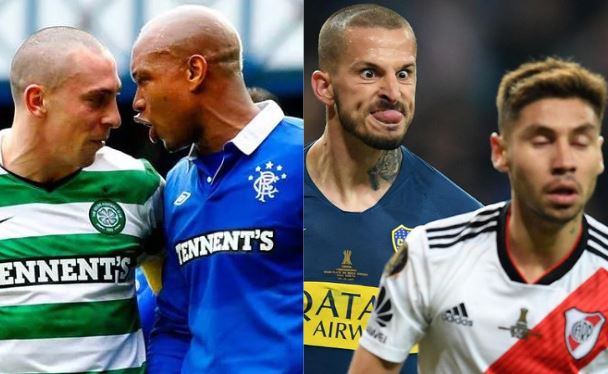
THE OLD FIRM (SCOTLAND) VS. SUPERCLASICO (ARGENTINA)
LENGTH
The final battle of this lengthy contest of hate begins like how the rest have — with simple math (something we all hate). While the Superclasico boasts nearly 260 matches since its beginning in 1913, the Old Firm was never going to lose this category no matter which rivalry it was up against, with nearly 440 matches played since 1888.
WINNER: THE OLD FIRM
ROOTS OF THE RIVALRY
Much like in its semi-final matchup, the Superclasico can only trace its roots back to a fraction of what its opponent can reach. While Boca and River introduced class differences to their close proximity and battle for titles, Celtic and Rangers have grown to represent two exact opposite sets of beliefs for pretty much everything in life — politics, societal norms, economics, religion, and much more. Simply put, the Old Firm has its roots in everything.
WINNER: THE OLD FIRM
COMPETITIVENESS
In addition to being two of the favorites going into the World Cup of Hate, both the Old Firm and the Superclasico are statistically two of the most competitive rivalries in the entire field. Boca has only tallied six more wins than River, which has just two more wins than draws. However, Rangers and Celtic are even closer, with just four wins separating the two rivals (and draws being a distant third) over a greater length of time and larger list of matches.
WINNER: THE OLD FIRM
MEMORABLE MOMENTS
To get to the final, you need a lengthy list of memorable moments. Both of these rivalries have lists as long as Harry Potter books (the later ones, at that). Boca and River and Celtic and Rangers have each battled for league championships, had back-and-forth drama, and other iconic moments. But while the Old Firm has had longer to create such legendary moments (and has taken advantage of that time), not only has the Superclasico been a bit more consistent in making those moments, but those moments have reached stakes not seen in Scotland.
WINNER: SUPERCLASICO
SHITHOUSERY
Heaping, steaming, smelly, Jurassic Park-sized pieces of shithousery can be seen throughout each of these rivalries. Plenty of brawls, red cards, shit-talking, and other violence can be seen across countless matches between these sets of rivals. But what really clinches this for any rivalry is the difference between how much of the extra content is driven by fan behavior (which to be fair is worth a point on its own) and how much each side leans into the shithousery. For the Superclasico, that’s where it falls ever so slightly short. Don’t get me wrong, there’s plenty of pettiness to go around — let’s not forget that Boca forced Coca-Cola to change the color of its advertising from black to red as to not have River’s colors on its home stadium. But the fact that the Old Firm seeps into pretty much all aspects of life allows for greater moments of shithousery in a greater number of areas. There are few ways in which Rangers and Celtic haven’t fucked with each other, with admittedly fucked up tones behind the messages. Still, that’s enough to get the point here.
WINNER: THE OLD FIRM
COMBINED SUCCESS
Although River and Boca have achieved at least 70 honors each, they’re going up against two titans when it comes to collecting silverware. Both Rangers and Celtic rank in the Top 5 in terms of all soccer clubs around the world in terms of trophies won, with more than 100 each.
WINNER: THE OLD FIRM
STAR POWER
The Superclasico definitely takes advantage of the Old Firm’s one major weakness. With all due respect to the great Scottish and overall unsung British soccer stars and heroes of the past and present, the likes of Diego Maradona, Alfredo Di Stefano, Juan Riquelme, Hernan Crespo, Carlos Tevez, Radamel Falcao, Martin Palermo, and Javier Mascherano.
WINNER: SUPERCLASICO
FAN SHENANIGANS
As mentioned earlier, certain sections see straight up fan input as a weakness. That’s the opposite here, which gives the Superclasico more than enough to shine through. This isn’t to say the Old Firm hasn’t been impacted by fans at all. From heated player-fan interactions to chants and jeers rooted in outside realms of life to the general violent nature of the game day experience, Celtic and Rangers fans have pretty much done it all (including being crazy enough to draw comparisons to Apocalypse Now). But not only have River and Boca fans done all of that as well, but the direct impact they’ve had on the rivalry, including arguably the greatest moments, is undeniable and enough to award the point.
WINNER: SUPERCLASICO
THE PEAK
Pick any time when Rangers and Celtic were at their best firm or any point where the Old Firm was at its hottest, most controversial, or most violent. No matter what you choose, it cannot match up with the peak of the Superclasico. That’s kind of an unfair ask and not an insult to the Scottish clubs in the slightest — few (if any) rivalries in sports have ever reached the level that Boca and River did when they met in the 2018 Copa Libertadores Finals. The utter madness that ensued will likely never be topped, even if the two rivals met in the final again.
WINNER: SUPERCLASICO
CURRENT STATUS
Both of these rivalries are in fantastic spots right now, with each set of rivals enjoying nice, long title streaks in league play and bringing home trophies. Things are also competitive between both sides, giving a nice sense of balance. However, one is just a little more competitive than the other right now. Celtic’s run of trophies (2021 aside) is significantly more impressive than Rangers’ despite a nice run in Europe by the latter. What’s more, if we take away the most recent Old Firm match, Celtic would be on a six-game winning streak. In comparison, if we take away the most recent Superclasico (which saw a stoppage time game-winning penalty, a huge brawl that took almost 20 minutes to sort, and seven players be sent off), then Boca and River are still more competitive head-to-head (not to mention the trophy distribution is much more even overall). It’s nitpicky, but come on we’re in the damn final.
WINNER: SUPERCLASICO
LEVEL OF HATRED
While this entire experiment has been sort of an ode to hate, animosity, bitterness, or whatever you want to call it, at what point does it become too much? I’ve mentioned the celebration of such hate as a double-edged sword elsewhere in this tournament, although honestly I’ve written so much I forget what I put and where I put it. But I bring it up once again because, ironically, both of these rivalries would be two cases you’d cite as sports fandom going way too far.
When it comes to the Old Firm, there’s a word that people like to throw around — sectarianism, which essentially means a political, religious, or otherwise cultural conflict between two groups of people. To make it perfectly clear, sectarianism is bad and ventures into the bad version of hate more in line with discrimination. Perhaps nowhere else in the modern world (outside of authoritarian regimes or other dictatorships) is sectarianism more clear or seen throughout society than Scotland, with Celtic and Rangers fueling those feelings. More than a few people have compared the love of a sports team to the devotion to a particular religion, with those lines blurred even more by Celtic and Rangers being so closely associated with Catholicism and Protestantism. This is why I’d been nervous going to an Old Firm match and why there is so much more violence surrounding it than other rivalries — it plays on other aspects of life. While such a thing is often celebrated, there’s definitely a dark side to all of it.
Then we have the Superclasico. While lacking the immediate connection with things like religion and politics, there are still several factors at play that cause the hate to go too far. I’ve mentioned throughout this process that South America is by and large the most passionate region when it comes to soccer and most things in general (though North Africa, Eastern Europe, and, yes, Scotland give it a run for its money). While there are various historical and socio-economic factors that have contributed to that, the end result is that there’s generally more unfortunate aspects of soccer that get brought to the surface. You could even make the argument that perhaps the greatest, most incredible moment in club soccer history — the 2018 Copa Libertadores Finals (which I’ve cited as the ultimate trump card) — was tainted by the fans. Even though it added to the lore somewhat, imagine a timeline where the second leg isn’t suspended for weeks and played across the Atlantic Ocean. Instead, Boca arrives safely and River hosts the second leg after all, leaving the ultimate legacy of the historic final to be what happened on the field (as it should have been). This altogether amazing, unforgettable peak could have been even better. Instead, fans went too far.
My point with all of this is that, much like whether or not it’s right to be celebrating this kind of hatred, is it right to go so far in-depth into that hatred that we can declare a winner? Of all 11 categories during the knockout/playoff round, I’ve declared the most “even” results in this section (as well as “current status,” but that one’s for other reasons). That’s because when it comes to judging pure hatred (which I guess is the entire fucking point of this whole thing), I feel the most uncomfortable ranking those feelings. I mean, if these two sides didn’t hate each other, their rivalry wouldn’t have been up for discussion. But that uncomfortable feeling is at its highest when the hatred seeps into that “too far” territory. That’s why, even though we’ve arrived at this section — the final one in the entire tournament — with the score tied, I can’t pick a winner.
WINNER: EVENTOTAL: 6-6 TIE
Well, this is the exact scenario I tried to avoid: all of my work and research and countless hours spent trying to make a subjective competition as objective as it can be, only for the final, ultimate decision to come down to a judgement call. In the end I can only blame myself. I put myself in this scenario and now I have to get myself through it.
When I look at these rivalries head-to-head, I naturally look at the history of everything between the two clubs on and off the field. In other words, I look at what has been. But I can’t help but wonder what could be, what if each of these rivalries hit their full potential. In some cases, these rivalries have pretty much done that, come close, or have the potential to reach that mark. The Superclasico is one of those rivalries, with what already was the biggest rivalry in South America reaching the apex in the aforementioned 2018 Copa Libertadores Finals between Boca and River. The Cairo Derby is another such rivalry, with Al Ahly and Zamalek meeting in the 2020 CAF Champions League Final. Hell, even the Super Match has reached its potential in terms of high stakes. But even if they haven’t reached that exact apex or even maxed out every category, rivalries that have gone far in this tournament — El Clasico, the Derby della Madonnina, the Uruguayan Clasico, the Paulista Derby, etc. — have at least come close. Rarely does a rivalry that, at least on paper, can be described as a heated regional battle make waves.
Except, the Old Firm. While constant duels for the Scottish Premiership, Scottish Cup, and other regional supremacy matters greatly to both Rangers and Celtic as well as the greater region at large, limiting the competition to just that for nearly 150 years can get a little stale. Plus, not a lot of people outside of Scotland or at best the British Isles really give a shit about those competitions. Given the length and prestige of the rivalry and both clubs that make it up, you’d figure they’d at least venture out to some continental competitions or something. While each club has won a European trophy and both in theory still have the potential to make a run (as evident by runs to the UEFA Europa League Final in 2003, 2008, and 2022), it would take a lot — a lot — of things to go right for the Old Firm to go fully European. Some of that is out of the clubs’ control, while some is. Basically, Celtic and Rangers are big fish in a little pond and are overall content to remain that way. There have been discussions about the two of them joining the Premier League, which would open them up to tougher competition but also expand the potential for bigger and more consistent success abroad. Doing so would also benefit Scottish soccer by giving every other club an actual chance at winning, making things more exciting. But those talks have never resulted in anything serious and a move remains unlikely to this day.
While you don’t need to play continental soccer to become a great rivalry (several rivalries that made the World Cup of Hate do not have such competition between their clubs), it does raise the stakes of that rivalry, giving it not only greater exposure but also more opportunities for iconic moments. In this regard, for as great as the Old Firm is (it’s in sudden death of the final for fuck’s sake), it can get even better. But I can’t judge a rivalry on its potential; I can only do so on what’s actually happened. The Superclasico has reached that potential and lit the soccer world on fire when it did, leaving a mark that will never be forgotten. That’s enough to separate it from the Old Firm and enough for me to declare it the champion.
THE SUPERCLASICO WINS THE WORLD CUP OF HATE
It was only fitting that the final matchup of this lengthy process, narrowing down the world’s greatest soccer rivalries to a final 32 and then eventually the last pair, came down to a split result and sudden death decision. While the Old Firm proved beyond a shadow of a doubt that its run to the final was deserved and it should be proud of its silver medal, ultimately the Superclasico proves to be the best of the best of the best, taking home the World Cup of Hate. It’s truly the ultimate sports rivalry, one without weakness and full of countless iconic moments, battles for silverware, drama, red cards, legendary figures, pettiness, amazing atmosphere, incredible fan support, and (most importantly) hate.

So without going in-depth (despite going in-depth throughout this entire process), using their overall placements and rounds they were eliminated in, here are my Top 10 Club Soccer Rivalries:
1. Superclasico
2. Old Firm
3. El Clasico
4. Cairo Derby
5. Uruguayan Clasico
6. Intercontinental Derby
7. Derby della Madonnina
8. Paulista Derby
9. Grenal
10. Kolkata Derby
HM: Derby della Capitale
HM: Derby of the Eternal Enemies
HM: El Super Clasico
Now, after all of this history, analysis, and comparison of soccer rivalries, let’s go back to the point I made before I even mentioned a specific rivalry. I said that soccer rivalries are by far better than even the best rivalries in other sports, particularly the major American ones. Given that we have finally made the determination as to which soccer rivalry is the best, let’s prove that point I made by measuring it against the best that the other sports can bring. That’s right, we’re not done comparing rivalries just yet!
With all due respect to Canadiens-Maple Leafs, Giants-Dodgers, Cubs-Cardinals, Flyers-Penguins, Steelers-Ravens, and the entire AFC West and NFC East, these are the competitors hoping to defend the honor of North American professional sports.
THUG FINALS
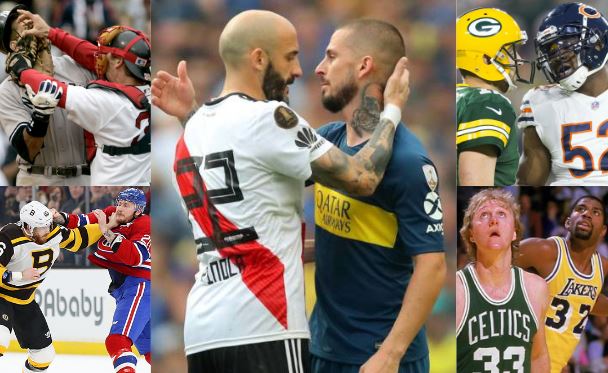
SUPERCLASICO (ARGENTINA) VS. BEARS-PACKERS (NFL) VS. RED SOX-YANKEES (MLB) VS. CELTICS-LAKERS (NBA) VS. BRUINS-CANADIENS (NHL)
LENGTH
Naturally, given that we’re comparing rivalries from different spots, some of these categories (especially the statistic-based ones) may be a bit skewed. That’s why the Superclasico (which is typically played just twice or three times a year due to it being soccer) ranks low here, despite Boca and River having nearly 260 matches played between each other since 1913. The only rivalry below it is Bears-Packers, which began in 1921 and has seen Green Bay and Chicago face off 206 times. Celtics-lakers may have begun in 1946, but Boston and Los Angeles have met 372 times (including playoffs), so it finishes third. Bruins-Canadiens has been a thing since 1924 and has seen a whopping 934 matchups since then. But all of them pale in comparison to Red Sox-yankees, which not only has the edge in terms of starting date (1901), but also times played with an astounding 2,324 games between Boston and New York. Side note: I just realized that three of the North American pro sports representatives include a team from Boston. That says something about Beantown being a source of sports hate. The New England Patriots are clearly slacking.
POINTS: RED SOX-YANKEES (5), BRUINS-CANADIENS (4), CELTICS-LAKERS (3), SUPERCLASICO (2), BEARS-PACKERS (1)
ROOTS OF THE RIVALRY
A lot of these North American rivalries have pretty basic roots, which are either geographic proximity, historical city rivalry, or just playing against each other a lot. That’s how the Superclasico (same city but economic divide between River and Boca) gets the edge in the category as a whole. As for the rest of the pack, Red Sox-yankees gets the edge due to the greater historical context, with New York and Boston being rivals dating back to the American Revolution (plus, you know, Babe Ruth). For the rest, we kind of just have to go by date, though Bears-Packers gets an extra edge due to an early matchup being the first in NFL history to have a player ejected for fighting. Bruins-Canadiens has been happening a bit longer than Celtics-lakers, so it gets the advantage of not being last.
POINTS: SUPERCLASICO (5), RED SOX-YANKEES (4), BEARS-PACKERS (3), BRUINS-CANADIENS (2), CELTICS-LAKERS (1)
COMPETITIVENESS
Even with some of the skewed statistics (soccer is the only sport on this list that regularly sees draws), the Superclasico still wins out in terms of historic competitiveness, with Boca having just six more wins than River, which has just two more wins than draws. Bears-Packers is a close second, with Green Bay having just a ten-win advantage over Chicago. When it comes to the last three, just doing that kind of math isn’t exactly the best way to calculate competitiveness, given the much different totals in games played. When measuring just win percentage, Red Sox-yankees and Bruins-Canadiens are extremely close, although the amount of draws actually comes back to bite the latter. Celtic-Lakers isn’t that far off, but it’s far enough to come last.
POINTS: SUPERCLASICO (5), BEARS-PACKERS (4), RED SOX-YANKEES (3), BRUINS-CANADIENS (2), CELTICS-LAKERS (1)
MEMORABLE MOMENTS
None of these rivalries are lacking in terms of memorable moments, which, remember, must be looked at from an objective perspective, not just that of an American sports fan only familiar with the four other sports and knows little about soccer as a whole. Objectively, the Sueprclasico’s major moments have been more memorable than the rest, though not by much. Celtics-lakers and Red Sox-yankees have both produced many iconic, legendary moments, though the former’s moments (and rivalry as a whole) have had a greater impact on the league itself. By virtue of having around three times as many games played due to how their respective sports work, Bruins-Canadiens has more such moments than Bears-Packers.
POINTS: SUPERCLASICO (5), CELTICS-LAKERS (4), RED SOX-YANKEES (3), BRUINS-CANADIENS (2), BEARS-PACKERS (1)
SHITHOUSERY
Pretty much the same feelings are felt in this section, though the group of four is mildly more difficult to separate While the Superclasico remains on top, Bruins-Canadiens should naturally be next because hockey has built-in shithousery. Celtics-lakers, Red Sox-yankees, and Bears-Packers then come next in that order. All in all, pro sports in America don’t have nearly the amount of shithousery that a lot of sports in other countries have around the world
POINTS: SUPERCLASICO (5), BRUINS-CANADIENS (4), CELTICS-LAKERS (3), RED SOX-YANKEES (2), BEARS-PACKERS (1)
COMBINED SUCCESS
Again, we’re going to have some skewed results, given that soccer (outside of MLS) doesn’t have playoffs or divisions and doesn’t award banners for those. But given that teams can enter multiple competitions/tournaments, I’ll allow league titles, conference championships, division titles, and non-division title playoff berths (plus President’s Trophies for the NFL) to count towards total honors. So which rivalries can top the nearly 150 combined total of the Superclasico? As I can best calculate, Bears-Packers adds up to 98, Celtics-lakers has 185, Bruins-Canadiens has 208, and Red Sox-yankees has 137. Again, this is far from an exact science, but fuck it we’ve already come this far.
POINTS: BRUINS-CANADIENS (5), CELTICS-LAKERS (4), SUPERCLASICO (3), RED SOX-YANKEES (2), BEARS-PACKERS (1)
STAR POWER
All five rivalries bring their A-game here. To separate these five, we have to look at not just their collection of star power, but just how many are among the short list for the all-time best roster or are even in the GOAT Conversation. The Superclasico has at least two GOAT contenders in Diego Maradona and Alfredo Di Stefano, to go along with a healthy lineup of other great players. Football is a little bit different, not only because of positions having much different roles but because the one Boston-area team not in this matchup has ruined a lot of NFL GOAT conversations. Still, Bears-Packers can throw out Vince Lombardi, Mike Ditka, Bart Starr, Dick Butkus, Brett Favre, Devin Hester, Aaron Rodgers, and the 1985 Bears in general. The other three rivalries are a little more elite. Bruins-Canadiens can’t claim the hockey GOAT (Wayne Gretzky stands alone), but Maurice Richard (the GOAT before the GOAT), Bobby Orr, Guy Lafleur, Ray Borque, Jean Beliveau, Patrice Bergeron, Henri Richard, Phil Esposito, Jacques Plante, Cam Neely, Henri Richard, Zdeno Chara, Ken Dryden, and Eddie Shore aren’t too bad themselves. Celtics-lakers also can’t claim the GOAT (fuck you, lakers fans — LeBron James isn’t better than Michael Jordan), but pretty much everyone on the “best ever” list except for Jordan, Hakeem Olajuwon, Oscar Robertson, and Steph Curry has played for their Boston or Los Angeles. That includes the aforementioned James, as well as Kobe Bryant, Larry Bird, Magic Johnson, Bill Russell, Kareem Abdul-Jabbar, Shaquille O’Neal, and Wilt Chamberlain. But then we have Red Sox-yankees, with both teams not only claiming the close consensus baseball GOAT (Babe Ruth) and a contender for GOAT pitcher (Roger Clemmens), but also names etched in baseball history like Carl Yastrzemski, Mickey Mantle, Ted Williams, Joe DiMaggio, Pedro Martinez, Derek Jeter, David Ortiz, Mariano Rivera, Carlton Fisk, Yogi Berra, Wade Boggs, Alex Rodriguez, and Dwight Evens — plus technically guys like Rickey Henderson and Randy Johnson. As you can see, there are plenty of greats to choose from.
POINTS: RED SOX-YANKEES (5), CELTICS-LAKERS (4), BRUINS-CANADIENS (3), SUPERCLASICO (2), BEARS-PACKERS (1)
FAN SHENANIGANS
None of the other four rivalries have even been able to sniff the level of shenanigans reached by the Superclasico and its supporters. The only one to see any kind of a mass brawl is Bruins-Canadiens, when the Richard Riot of Montreal broke out, an incident which should be more widely remembered if not for hockey not being as popular in the U.S. as it is in Canada. There have also been some incidents of fan violence during Red Sox-Yankees, although those are minor in comparison. Celtics-Lakers hasn’t really seen any major fan incidents, although Boston fans are credited with inventing the famous “Beat LA!” chant that’s been copied across the American sports scene. If we’re being technical, Bears-Packers has the greatest fan impact of any rivalry here (and any major rivalry in American sports) due to Green Bay being fan-owned and thus everything the franchise does being fan-impacted. But I’m not getting that technical.
POINTS: SUPERCLASICO (5), BRUINS-CANADIENS (4), RED SOX-YANKEES (3), BEARS-PACKERS (2), CELTICS-LAKERS (1)
THE PEAK
As I might’ve mentioned a few times, the Superclasico has arguably the biggest peak in club soccer history — the epic 2018 Copa Libertadores Finals between Boca and River. With Bears-Packers existing entirely within the same division, Green Bay and Chicago cannot meet for the NFL’s top prize and have only even faced each other in the playoffs twice. While either of those moments can be called the peak (especially the 2010 NFC Championship Game), I’d go for the stretch in the mid-1980’s when Chicago was at its most dominant (memorably using William Perry as a RB against Green Bay in 1985) but saw a chance at back-to-back Super Bowls disappear when the Packers’ Charles Martin delivered a dirty hit on Jim McMahon, ending the Bears QB’s season. Although Bruins-Canadiens has seen several Stanley Cup Finals matchups (mostly won by Montreal and none since 1978 due to both teams being put in the same conference), the peak is undoubtedly the Richard Riot of 1995, when a series of violent confrontations against Boston saw Montreal’s Maurice Richard nearly arrested and then suspended for the rest of the season (which caused Canadiens fans to literally riot). Celtics-lakers is the most common NBA Finals matchup, so take your freaking pick. My pick is the height of the Magic-Bird era of the NBA — the stretch from 1984-87 when Boston and Los Angeles met in three NBA Finals (part of a decade-long span where at least one team made the finals). For Red Sox-yankees, the back-to-back 2003-04 ALCS matchups defied all expectations — first, New York won the 2003 series with a walk-off HR in Game 7 after noted moron Grady Little left Pedro Martinez in too long. The following year, the Red Sox became the first (and as of this writing only) MLB team to win a seven-game series after going down 3-0, as Mario Rivera blew two straight saves, David Ortiz became God in Boston, Alex Rodriguez was fully exposed as a bitch, and the Red Sox won 4-3 en route to their first World Series title in 86 years. Can you tell that I’m a Red Sox fan?
POINTS: SUPERCLASICO (5), RED SOX-YANKEES (4), CELTICS-LAKERS (3), BRUINS-CANADIENS (2), BEARS-PACKERS (1)
CURRENT STATUS
The Superclasico is as strong as ever, with River and Boca fighting for league championships, gunning for more continental glory, and literally brawling with each other to the tune of seven red cards. On the other hand, the fate of the other eight teams are a little more uncertain. The Bears have been on a notable decline in recent years, with the Packers recently overtaking them as the NFL’s winningest franchise and beating them to the point where Aaron Rodgers openly referred to “owning” them. However, a combination of Rodgers’ departure from Green Bay (and uncertainty surrounding Jordan Love) and the rise of Justin Fields has Chicago fans hopeful for future success (at the very least against their rivals). The Celtics and lakers came close to a 13th NBA Finals meeting last season and have been among the best teams in the NBA in recent years. But while recent matchups brought controversy due to some vintage ref ball, there are still more questions than answers around both teams’ immediate future. Although Montreal recently made the Stanley Cup Finals and Boston has been among the NHL’s best teams for years (breaking the record for most points and wins last season, only to hilariously choke in the first round of the playoffs), Bruins-Canadiens has been extremely lopsided, with the Bruins on a ten-game winning streak. Even Red Sox-yankees (apart from some unexpectedly heated regular season games), two years removed from a Wild Card win by Boston, is dealing with some uncertainty. Boston has lost some valuable pieces and New York is not only in the middle of a nearly 15-year World Series appearance drought, but also the worst season anyone can remember (having recently been swept by the Red Sox at home).
POINTS: SUPERCLASICO (5), RED SOX-YANKEES (4), CELTICS-LAKERS (3), BEARS-PACKERS (2), BRUINS-CANADIENS (1)
LEVEL OF HATRED
For all that’s happened between the other four sets of rivals, none of them can touch the hatred spewing from the Superclasico. But that doesn’t mean the hatred of the other four is ice cold. Boston and New York will hate each other forever, with Red Sox fans chanting “yankees suck” even if they aren’t involved in the game. While the Celtics and lakers have more recently been involved in other hate-filled feuds (being in opposite conferences doesn’t help), there’s always hate brewing between the two. The same can be said for Bears-Packers, though the hatred is a little more apparent due to more frequent matchups (and the Aaron Rodgers “I own you” thing). Bruins-Canadiens will also be hateful, although the teams (Boston in particular) entering a new era has kind of diminished that.
POINTS: SUPERCLASICO (5), RED SOX-YANKEES (4), BEARS-PACKERS (3), BRUINS-CANADIENS (2), CELTICS-LAKERS (1)
TOTAL: SUPERCLASICO (47), RED SOX-YANKEES (39), BRUINS-CANADIENS (31), CELTICS-LAKERS (28), BEARS-PACKERS (20)
As expected, the Superclasico easily emerges on top of the best from the top North American sports, with only Red Sox-yankees (probably the majority of people’s choice when asked to name the biggest sports rivalry in the country) even coming within single digits. Point proven.
But wait, I hear you say — when you made that initial point, you included the caveat of college sports rivalries perhaps getting close to soccer’s level. That’s true — not only did I remember, but I’ve also assembled the best of the best college sports rivalries to take on the Superclasico. Given that by and large football brings that passion out the most and it’s tough to choose the best college football rivalry, all but one of the challengers will be from college football. I also included one college basketball rivalry that is clearly the best of the bunch.
With all due respect to USC-UCLA, Pittsburgh-West Virginia, Indiana-Purdue, Kentucky-Louisville, Cincinnati-Xavier, Syracuse-Georgetown, the ACC in general, Michigan State, Oklahoma State, and Notre Dame, here we go again.
THUG FINALS 2
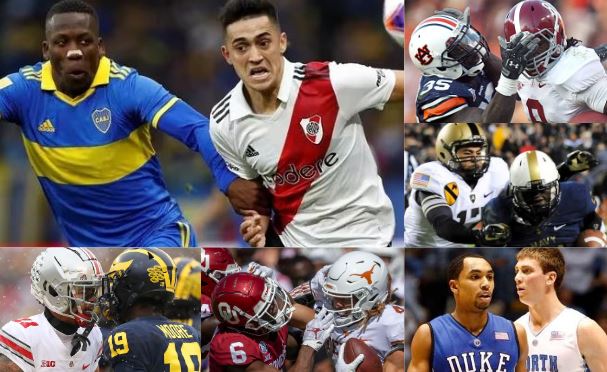
SUPERCLASICO (ARGENTINA) VS. THE IRON BOWL (COLLEGE FOOTBALL) VS. THE GAME (COLLEGE FOOTBALL) VS. ARMY-NAVY (COLLEGE FOOTBALL) VS. RED RIVER SHOOTOUT (COLLEGE FOOTBALL) VS. CAROLINA-DUKE (COLLEGE BASKETBALL)
LENGTH
For the last time, the Superclasico has been played nearly 260 times since 1913. That start date is beaten by every other rivalry here except for Carolina-Duke. However, because of the nature of college football scheduling (those rivalries rarely if ever happen more than once a year), both the soccer and college basketball rivalries have been played way more often. In fact, Boca and River and Duke and UNC are just one game off from each other’s totals, so I’ll give the latter the advantage due to getting more done in less time. As for the football rivalries, Army-Navy has the oldest start date at 1890 and most meetings at 123. The Iron Bowl has the next start date at 1893, but has the fewest total meetings with 87, so it finishes last. The Game and the Red River Shootout (I know it’s technically the Red River Showdown, but it will always be the Shootout to everyone who follows it) each have 118 meetings. The tie goes to Oklahoma and Texas, which began playing three years after Ohio State and Michigan did.
POINTS: CAROLINA-DUKE (6), SUPERCLASICO (5), ARMY-NAVY (4), RED RIVER SHOOTOUT (3), THE GAME (2), IRON BOWL (1)
ROOTS OF THE RIVALRY
Most of these rivalries are based on some geographic rivalry, whether the two combattants are even in the same state or not. The Superclasico is by far the closest, with Boca and River each based in Buenos Aires (with the added class divide thing as well). UNC and Duke are just eight miles apart and also have vastly different structures and cultures within their universities. Alabama and Auburn are within the same state and became rivals pretty much because there was little else to do besides beat the shit out of each other. Oklahoma and Texas represent two different states that have a long-standing regional rivalry (they also get points for having the game played at a neutral site in the Cotton Bowl). Ohio and Michigan also have a regional rivalry [side note: my dad and I were once flying to Detroit from Seattle when we struck up a conversation with a woman from Michigan. We mentioned we’d be staying the night in Detroit, then continuing onto Cleveland. She then gave us a look of disgust and said, “Ohio? Uh, I don’t even want to breathe your air!” before actually walking away. True story.]. That largely comes from the Toledo War, which was still in the mind of many when Ohio State and Michigan first squared off. Only Army and Navy have a different background for their rivalry, with games between the two serving both as sporting contests and training for actual military combat.
POINTS: ARMY-NAVY (6), SUPERCLASICO (5), CAROLINA-DUKE (4), THE GAME (3), RED RIVER SHOOTOUT (2), IRON BOWL (1)
COMPETITIVENESS
Can any of these other rivalries get closer than the Superclasico’s six wins between competitors (and overall difference of eight between most common and least common result)? Not quite, but they get close. Navy has just eight more wins than Army (to go with seven ties), Michigan has only nine more wins than Ohio State (plus six ties), Alabama has 12 more wins than Auburn (with one tie), and Texas has a 13-win edge over Oklahoma (five ties). The only one that seems a bit lopsided is Carolina-Duke, with UNC having 26 more wins, mostly due to Duke not being worth a damn until Mike Krzyzewski showed up.
POINTS: SUPERCLASICO (6), ARMY-NAVY (5), THE GAME (4), IRON BOWL (3), RED RIVER SHOOTOUT (2), CAROLINA-DUKE (1)
MEMORABLE MOMENTS
While the Superclasico gets the nod when it comes to memorable moments, Carolina-Duke comes a surprisingly close second, if only because they’ve played a similar amount of games and thus have had the chance to make as many memories. While the Iron Bowl’s crazy games may arguably be slightly more insane than that of the Game, the former’s suspension (which we’ll talk about in a second) means less time to make moments. The Red River Shootout is narrowly behind, with Army-Navy bringing up the rear.
POINTS: SUPERCLASICO (6), CAROLINA-DUKE (5), THE GAME (4), IRON BOWL (3), RED RIVER SHOOTOUT (2), ARMY-NAVY (1)
SHITHOUSERY
No matter what kind of shithousery these college rivalries throw out, they can’t compete with the steaming pile left behind by the Superclasico. But that doesn’t mean the other stenches aren’t powerful. For example, the Iron Bowl has seen so much shithousery that a moment when an Alabama player ran out onto the field from the sidelines to tackle an Auburn player is somehow an underrated moment. Let’s not forget that things got so crazy in (checks notes) 1906 that the matchup was suspended for 41 years. The Game has its own fair share of shithousery, with the Ten Year War (and the years right before and afterwards) providing enough to put it in the top half of this section. The Red River Shootout has seen allegations of spying from both sides to go along with the chaos on the field. Army-Navy may have seen plenty of history, but not so much controversy compared to the rest. As for Carolina-Duke, you bet there are plenty of fights, trash talking, and other shenanigans.
POINTS: SUPERCLASICO (6), IRON BOWL (5), THE GAME (4), CAROLINA-DUKE (3), RED RIVER RIVALRY (2), ARMY-NAVY (1)
COMBINED SUCCESS
More math — can any rivalry beat 140 combined honors and give the Superclasico a run for its money? For the football rivalries, we’ll count claimed (and recognized) national championships, CFB Playoff appearances, other bowl game wins, and conference (and division) titles. We’ll also include the Commander-in-Chief’s Trophy for Army-Navy. For the basketball one, national championships, Final Four appearances, NCAA Tournament berths, and both regular season and conference tournament titles count. Given those stipulations, here are the results in descending order: Carolina-Duke (240), The Game (239), Red River Shootout (218), Iron Bowl (175), Army-Navy (51). Get your shit together, Army-Navy.
POINTS: CAROLINA-DUKE (6), THE GAME (5), RED RIVER SHOOTOUT (4), IRON BOWL (3), SUPERCLASICO (2), ARMY-NAVY (1)
STAR POWER
You already know the Superclasico can throw out Diego Maradona, Alfredo Di Stefano, and plenty of others. But what about the others? It’s important to note that we can’t take the pro careers of these athletes into consideration. Only their time in college counts. So Carolina-Duke doesn’t get automatic points for the basketball GOAT, though Michael Jordan is also one of the best college basketball players ever. Christian Laettner, James Worthy, Bobby Hurley, Vince Carter, Grant Hill, Bob McAdoo, J.J. Redick, Tyler Hansbrough, Shane Battier, Antawn Jamison, Jason Williams, Sam Perkins, Elton Brand, Jerry Stackhouse, Danny Ferry, Brad Daugherty, and Zion Williamson aren’t bad company as well. Throw in three coaching GOATs in Dean Smith, Roy Williams, and Coach K. When it comes to football, Michigan can’t take the NFL GOAT in Tom Brady (who didn’t have a bad college career, however). But the Game as a whole can claim Archie Griffin, Charles Woodson, Eddie George, Desmond Howard, Orlando Pace, Tom Harmon, Woody Hayes, Bo Schembechler, Urban Meyer, and Lloyd Carr (fuck three out of the last four guys). Billy Sims, Earl Campbell, Sam Bradford, Vince Young, Adrian Peterson, Roy Williams, Ricky Williams, Brian Bosworth, Colt McCoy, Lee Roy Selmon, Tommy Nobis, Bud Wilkinson, Brian Orakpo, Barry Switzer, Darrell Royal, Bob Stoops, and Mack Brown can all suit up for the Red River Shootout. The Iron Bowl can claim two coaching GOATs in Paul Bryant and Nick Saban (Ralph Jordan and Pat Dye are no slouches, either), as well as a lengthy list of CFB and pro greats like Bart Starr, John Heisman, Joe Namath, Bo Jackson, Ken Stabler, Cam Newton, Derrick Henry, Pat Sullivan, Julio Jones, and Daniel Carlson. As for Army-Navy, I’m gonna be honest with you — apart from Roger Staubach and Dwight Eisenhower (for very different reasons), there’s really no one recognizable to most college football fans on either all-time roster. Sorry to the old people reading this.
POINTS: CAROLINA-DUKE (6), THE GAME (5), IRON BOWL (4), SUPERCLASICO (3), RED RIVER SHOOTOUT (2), ARMY-NAVY (1)
FAN SHENANIGANS
Fans of all of these rivalries do their part to create some incredible atmospheres and environments. Of course, not only does the Superclasico do this without having visiting fans in the stadium (or else the two sides would beat the shit out of each other), but both fan bases have sparked riots, a stadium disaster, shootings, multiple pepper spray incidents, and other incidents of violence. The only thing any of the other fan bases have done is when an Alabama fan poisoned the famous oak trees at Toomer’s Corner after Auburn’s 2010 Iron Bowl win. Carolina-Duke also stands out because of the Cameron Crazies, for better or worse. Just in terms of pure atmosphere I’ll go with the Game next, then Army-Navy with the whole “singing second” aspect of the game. The Red River Shootout finishes last, if only because of Oklahoma’s stupid fucking fight song that’s the only thing the band knows how to play.
POINTS: SUPERCLASICO (6), IRON BOWL (5), CAROLINA-DUKE (4), THE GAME (3), ARMY-NAVY (2), RED RIVER SHOOTOUT (1)
THE PEAK
I don’t know if I’ve mentioned this before, but in 2018, Boca and River met in the Copa Libertadores Finals, a series of matches considered not just the peak of the Superclasico, but all of club soccer. Because their combatants play in the same conference, most of these rivalries haven’t had more than a few years’ chance of meeting for a championship (due to the introduction of the CFB Playoff). The only one that in theory could’ve seen the ultimate game played for decades is Carolina-Duke, which finally met in the Final Four two seasons ago (the fact that it was Coach K’s final game also easily makes it that rivalry’s peak). While they haven’t met for a national title, you can make the argument that from 2009-13, the winner of the Iron Bowl decided the champion. Alabama and Auburn won the rivalry game and the championship each of the first four years, with the streak only broken by Auburn’s last-minute title game loss in 2013. All that happened that season was the Kick Six, so no big deal. The Game has a few contenders for its peak, namely the Ten Year War, the 2006 No. 1 vs. No. 2 Game of the Century, and right now, given Michigan and Ohio State just came within a combined few minutes of meeting in the national title game. The Red River Shootout also has multiple good options, such as the 1963 No. 1 vs. No. 2 game, the heated 1976 game attended by President Gerald Ford, 1984’s No. 1 vs. No. 3 game, the 2008 Big XII title controversy, or the 2018 Big XII Championship Game (the first time since 1903 Texas and Oklahoma played twice a year). As for Army-Navy, it’s either the epic 1963 game that took place shortly after President John F. Kennedy’s assassination or the 2016 Army win that snapped a 14-game Navy winning streak.
POINTS: SUPERCLASICO (6), IRON BOWL (5), THE GAME (4), CAROLINA-DUKE (3), ARMY-NAVY (2), RED RIVER SHOOTOUT (1)
CURRENT STATUS
The Superclasico is as hot as ever, with several straight league titles and the whole seven red cards, brawl, and stoppage time game-winning penalty in the most recent game thing. The Game is almost as hot, with Michigan on a rare winning streak over Ohio State, both schools making the CFP last season, and are both ranked in the Top 3 to begin this season. Alabama is right behind them at No. 4 and is once again a title contender. But Auburn is… going through some stuff right now. Plus, the Iron Bowl has gone Alabama’s way recently, with three wins in a row and seven in the past nine games (Auburn’s only two wins coming at home). Last year, Texas broke a four-game losing streak to Oklahoma and is actually ranked ahead of their rivals (11 to 20) to start this season. But while the Red River Shootout is competitive, most of the news is coming from off the field, with both schools closing out their tenure in the Big XII in favor of the SEC. But at least both are faring better than Army and Navy — while the two academies have split their last four matchups, Army-Navy just doesn’t have the heat it once did. There are also some questions surrounding Carolina-Duke, as both schools are in Year 2 of a new era following recent retirements of Roy Williams and Coach K. While Duke has (on paper anyway) remained fairly consistent, UNC went from NCAA runner-up and Coach K career killer to not even making the NCAA Tournament. But at least the rivalry is still strong and competitive, with Carolina and Duke trading win streaks of two or three at the most.
RESULTS: THE GAME (6), SUPERCLASICO (5), CAROLINA-DUKE (4), RED RIVER SHOOTOUT (3), IRON BOWL (2), ARMY-NAVY (1)
LEVEL OF HATRED
Oh man… how the hell do I separate this? I mean, I know which will be first and which will be last. But what about the other four? Fuck it, this is what I’ve got.
POINTS: SUPERCLASICO (6), IRON BOWL (5), THE GAME (4), CAROLINA-DUKE (3), RED RIVER SHOOTOUT (2), ARMY-NAVY (1)
TOTAL: SUPERCLASICO (56), CAROLINA-DUKE (45), THE GAME (44), IRON BOWL (37), ARMY-NAVY (25), RED RIVER SHOOTOUT (24)
Although the college rivalries certainly brought it, the Superclasico proves once again it’s on another level when it comes to pretty much everything.
So now that we’ve finally crowned a winner of the World Cup of Hate (determining the best rivalry in soccer and, therefore, the world of sports), we’re finally done, right? No more reading up on the history of everything and all of these comparisons that have gotten so out of whack that we’re comparing different sports and levels of sport? Well, not quite. There’s one more aspect of sports rivalries I want to talk about before all is said and done.
Throughout this entire process, I’ve researched or at the very least looked at dozens upon dozens of rivalries from across the world. One thing that the vast majority of these rivalries had in common was that they had a nickname, something to call it other than “Team A-Team B Rivalry.” Unfortunately, most of these names were either generic or extremely similar to other names. Those can fit into three categories. The first is the “[Insert name of city] Derby,” usually the name of the city both clubs call home (i.e. the Cairo Derby, North London Derby, Kolkata Derby, Sydney Derby, or Derby de Lisboa). Then we have “Eternal Derby,” which is the name of at least three rivalries I’ve mentioned so far and almost entirely exclusive to Eastern Europe. Other versions include the Derby of the Eternal Enemies or something about the two clubs being enemies for a really long time. Then we have the names that include some version of the word “Clasico.” From El Clasico to the Superclasico to the “[Insert country name here] Clasico” to even Le Classique/Canadian Classique. Yes, I know that “Clasico” basically means “Derby” in Hispanic/Latin Terms. I just need something other than “Country/City/Region/Super Clasico/Derby” for once. All of this is ultimately why I decided to include the country of origin for each rivalry in parenthesis whenever they were introduced — to make it abundantly clear which Clasico or Derby or Eternal clash I was talking about. All of this repetition has ruined these kinds of names for me, with names being some of the only weaknesses of these rivalries. They don’t sound cool enough to fit a rivalry of that nature.
But not all rivalries are like that. Some rivalries, in fact, have creature, clever, badass names that immediately add an extra element to them. Now while these names weren’t something I was taking into consideration at any point during this process, I was taking notes for this exact purpose, so I could shout out the few unique rivalry names in sports. So to close out the World Cup of Hate and sound the final note on rivalries in soccer, I want to acknowledge the best rivalry names I’ve encountered throughout this experiment.
TOP 10 CLUB SOCCER RIVALRY NAMES
Warning: I love puns, so any spoofs of the generic names listed above will get extra credit in my eyes. I’d also like to acknowledge the Canadian Classique — although I included it in the examples of generic “Clasico” rip-offs, it also has a second, much more badass name: the Derby of Two Solitudes. However, I can’t include it because it’s not the most common name for the rivalry. Because I’m limited to ten entries and a few honorable mentions, I can’t fit every cool name in this list. So shout out to the Railroaders Derby (Lokomotiv Plovdiv-Lokomotiv Sofia), Clasico del Astillero (Barcelona-Elemec), Clasico de Slim (Pachuca-Leon), Intercontinental Derby (Galatasaray-Fenerbahce), Distance Derby (Perth Glory-Wellington Phoenix), Derby della Lanterna (Genoa-Sampdoria), O Classico dos Milhoes (Flamengo-Vasco da Gama), Two Capitals Derby (Kairat-Astana), Black Rooster Derby (Sao Raimundo-Sul America), Derby del Sole (Roma-Napoli), and Princess Derby (Bahia de Feira-Fluminense de Feira).
HONORABLE MENTION: ROSES RIVALRY (ENGLAND)
The Roses Rivalry takes its name from the War of the Roses (which is sometimes what the rivalry is referred to), a series of civil wars fought between Lancaster and York in the 15th century for control over the English throne. Lancaster (now Lancashire) and York (now Yorkshire) still have a strong regional rivalry, one that’s carried over to Manchester United (Lancashire) and Leeds United (Yorkshire). When English hooliganism was at its height in the 1970’s, perhaps no rivalry in the world was as physical and violent as the Roses Rivalry. Not only did Manchester take exception to Leeds’ rough and dirty style of play (giving it back to them in spades), but fans of the two clubs would often violently clash off the field. Even though Leeds’ lengthy spell out of England’s top flight coincided with the curtailing of hooliganism across the country, both clubs still have a soft, sore spot for each other. Although each club has its own other series of rivals, Manchester and Leeds will forever be linked through hatred.
HONORABLE MENTION: DEFENSIE DERBY (SURINAME) / UNIFORMED DERBY (SINGAPORE)
While the above rivalry’s name was inspired by war, these two take inspiration from those who strive to keep the peace. Let’s go to Suriname first — in 1926, Sportvereniging Nationaal Leger (SNL) were founded as a way for members of the country’s military to stay in shape while building camaraderie. Three years later, SNL made it to the first ever Surinamese Cup Final, where they lost to another peacekeeping-based club from the capital city of Paramaribo. That would be Politie Voetbal Vereniging (PVV), the club of the local police force. The Defensie Derby was born that day, with PVV and SNL battling each other on the field while assisting each other in fighting evil off it. Meanwhile in Singapore, the Lion City Sailors (representing the police force) and Warriors FC (representing the armed forces) have faced off in different forms for the past 40 years. The Uniformed Derby began in its current form in the 1990’s and has been going strong. Since both rivalries have essentially the same roots, I decided to include each one.
HONORABLE MENTION: CLASSICO MAJESTOSO (BRAZIL)
How do you show that your rivalry is a cut above the rest? You can reference how long the rivalry will last by using a word like “Eternal.” You can use an amplifier like “Super” or “Major” as a prefix. You can also just compare your rivalry to the ultimate example of stateliness, dignity, and beauty. That’s what sportswriter Thomaz Mazzoni did when he first described the clash between Corinthians and Sao Paulo as the Classico Majestoso (Majestic Derby). This is one of the biggest rivalries in Brazil and was in contention for the World Cup of Hate, though another rivalry with Corinthians in it ultimately got the nod. Interestingly, both clubs have red, black, and white as their colors. I don’t know if “majestic” is the word that comes to mind when you think of that combination — maybe “majestically evil,” especially given that the rivalry has seen plenty of controversial moments, fights, and other shithousery. Nevertheless, the Classico Majestoso is among the best of the Brazilian rivalry names, which are creative if not a bit repetitive.
HONORABLE MENTION: CLASICO DEL BUEN FUTBOL (COSTA RICA) / CLASSICO DE TECNICA E DISCIPLINA (BRAZIL)
Another way you can show off your rivalry is to literally put what makes it so good in the name. Take, for example, the Clasico del Buen Football (Classic of Good Soccer). This rivalry sees two of Costa Rica’s top soccer clubs — Deportivo Saprissa and Club Sport Herediano — square off in a somewhat lopsided battle in favor of the former. But no matter how the final score shakes out, you know what you’re getting when it comes to the on-field quality; you’ll be seeing plenty of good soccer. In Brazil, Nautico and America get even more specific when it comes to what you’ll see on the field. Their rivalry, the Classico de Tecnica e Disciplina (Classic of Technique and Discipline), appears to signify everything against what makes a good rivalry: chaos and wild action. But apparently this is yet another feisty Brazilian battle, with the name seemingly just applying to Nautica, which has won a whopping 62% of all matches. Given that both rivalries go incredibly specific when it comes to their names, I figured they both needed to appear here.
HONORABLE MENTION: WIENER DERBY (AUSTRIA)
Okay, okay… I know that not only is this the local spelling of Austria’s capital city (which everyone knows is Vienna), but this name technically falls in one of the boring categories ([Location name] Derby) I described above. But come on! It’s called the Wiener Derby! It has the word “Wiener” in the name! How is this not No. 1? Fine… not only have I spent a paragraph talking about this rivalry already, but the technical restrictions mean I can’t go full force. The dick jokes must be sacrificed. But there’s another rivalry when it comes to another kind of snake.
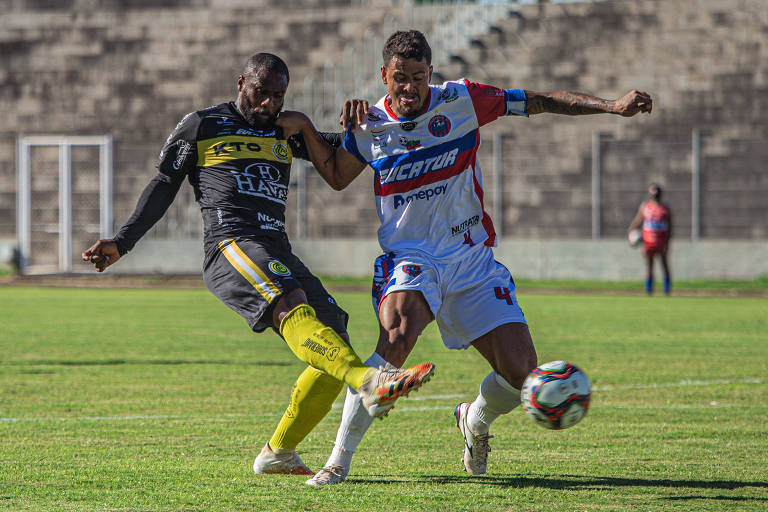
10. CLASSICO DO VENENO (BRAZIL)
Deep within the heart of Brazil’s Amazon lies several species of snake. On the other side of the country is the state of Parana, which hosts two soccer clubs with ties to the reptile. Cascavel CR and FC Cascavel (take a wild guess which city they’re from) contest the Classico do Veneno (The Poison Derby), otherwise known as the Classico das Serpentes (The Snakes Derby). Both names are badass, though I’m going with the first one because it’s a little more appropriate for the typical hatred and animosity when it comes to a soccer rivalry, especially a Brazilian one. The other name comes from the fact that Cascavel CR was formed from a merger of several clubs (one of which was Cascavel Esporte Clube, which was nicknamed “Serpente”) and FC Cascavel literally has a snake on its badge. Another interesting aspect of this rivalry is that both participants were technically founded in the 21st century, making the Classico do Veneno one of the youngest battles we’ve talked about in any kind of detail in this entire experiment.
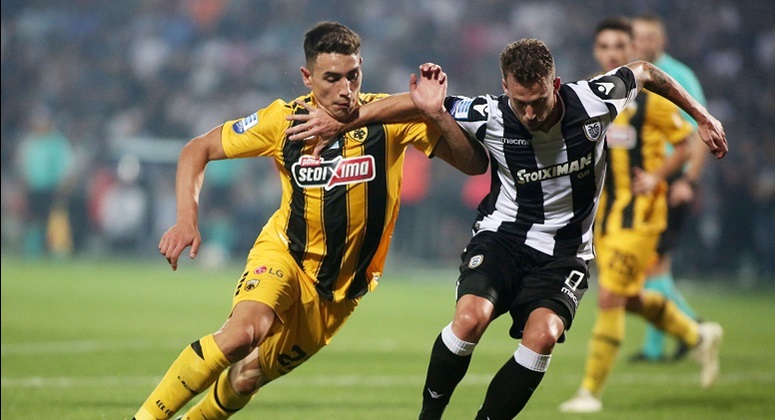
9. DOUBLE-HEADED EAGLES DERBY (GREECE)
Of all the derbies named after random yet specific objects (coffee, princess, black roosters, snakes, parents and grandparents, various colors, lighthouses, the sun), this one has to be the most oddly specific. However, it may also be the easiest to determine its namesake. Both AEK Athens and PAOK Thessaloniki use the same emblem (a double-headed eagle) on their badges (representing the Byzantine Empire), although AEK’s is black and yellow and PAOK’s is black and white. The Double-Headed Eagles Derby is one of the largest in Greece and the most famous between clubs from the country’s two-biggest cities. Unlike the Greek rivalry that made the World Cup of Hate, things have largely remained heated only on the field for this rivalry. That changed when AEK and PAOK met in the 2017 Greek Cup Final, which was disputedly moved out of Athens to a place much closer to Thessaloniki. The next year, AEK won the league title after being given three points by the court (and POAK being deducted three points).
8. ENCONTRO DAS NACOES (BRAZIL)
The rivalry between Corinthians and Flamengo has a few different names, the most badass being Encontro das Nacoes (Meeting of the Nations). However, both clubs have been trying to promote the rivalry as the “Biggest Derby in the Americas,” which may be a corporate name but is somewhat accurate, at least when it comes to everyone involved. It’s somewhat unusual in Brazil for rivalries to develop between clubs from different states. However, due to various battles for success and other issues (like Flamengo recently signing two of Corinthians’ best players), both clubs have developed animosity for each other. Both clubs have massive fan bases and represent the two country’s most populous cities, Sao Paulo (Corinthians) and Rio de Janeiro (Flamengo), meaning a lot of eyes are watching. But don’t think this rivalry is just about numbers. Corinthians’ ex-president has claimed Palmeiras (whose rivalry with Corinthians finished in the Top 8 of the World Cup of Hate) and Flamengo are the club’s biggest rivals.
7. HOLY WAR (POLAND)
As I was scanning the depths of Wikipedia for rivalry names, I came across a surprising amount of allegedly unique names that were used more than once. The Political Derby, Eternal Derby, and even the Grandfather Derby had multiple entries. Perhaps even more surprisingly one that I thought would be copied was the Holy War. But unless I’m mistaken, the only one with that name (and it’s badass either way so I’m keeping it), is Poland’s famous battle between Wisla Krakow and KS Cracovia. Both clubs are the biggest in Krakow and reportedly the oldest clubs period in Poland that still exist. The Holy War (take a wild guess where that name came from) is, to put it mildly, incredibly fucking intense, with both stadiums being less than a kilometer apart and atmospheres on par with any other worldwide. It was a contender to make the World Cup of Hate, but it didn’t get in because, if you can believe it, the fans are too crazy. There’s a whole lengthy essay on Polish ultras waiting to be written, but just Google it if you have any questions.

6. OLD FIRM (SCOTLAND)
We’ve talked about the Old Firm once, twice, or six times already, so I won’t bore you with needless repetition (fucking finally, I hear you say). But the one part of Celtic and Rangers’ epic rivalry we haven’t really discussed is its name. There’s some dispute about how and why “Old Firm” was born. Many cite the clubs’ first ever match, in which the commentators referred to both sides as “like two old, firm friends” (ironic given where things stand today). There’s also a satirical cartoon from 1904 depicting an elderly man with a sandwich board reading “Patronise The Old Firm: Rangers, Celtic Ltd,” highlighting the commercial benefits of the rivalry (some things never change). It may also reference Rangers and Celtic being two of the original 11 members of the Scottish Football League back in 1890. No matter where it came from or how it spread, the Old Firm is still a solid, unique name for a rivalry. I don’t even have to know anything about it to realize the two sides of something called the Old Firm probably don’t like each other.
5. BIG BLUE (AUSTRALIA)
As mentioned above, I love a good pun — this rivalry definitely satisfies those requirements. The Big Blue is fueled by the rivalry between Australia’s two largest cities — Sydney and Melbourne — was actually a contender to be the country’s World Cup of Hate representative. But while it fell just short, it got a Top 5 finish here. In addition to being based in the two largest cities, Sydney FC and Melbourne Victory are two of Australia’s most successful and supported clubs (and have met three times in the A-League Grand Final, with Sydney having a 2-1 edge). They’re also both blue, with their primary colors making it a bit difficult on the eyes whenever they share the field. But the blue doesn’t stop there — it’s also the color of each clubs’ respective states and “blue” is Australian slang for fight/brawl/heated argument. The Big Blue, therefore, is a pun on many levels. Tobias Funke would be proud. Also, I know this wasn’t their intention, but “Big Blue” is a famous course from the F-Zero franchise (which I love), so more bonus points there.
4. HELL IS REAL DERBY (UNITED STATES)
Spoiler alert: the next three rivalries are all recent and all from the U.S. I would ask you to forgive my bias, but all of them are objectively awesome and unique. That’s especially the case for the Hell is Real Derby, which plays upon the regional rivalry between the Ohio cities of Columbus and Cincinnati. The name comes from a Christian highway billboard located on I-71 between the two cities. The rivalry didn’t begin until 2017, but that first match is a major reason why the Hell is Real Derby exists today. FC Cincinnati was founded in 2015 and immediately became one of the most popular minor league clubs in history. Two years later, Cincinnati made it to the Fourth Round of the U.S. Open Cup, drawing the Columbus Crew. In the first ever soccer matchup between the two cities, Cincinnati scored a famous upset victory, with the positive fallout playing a big role in the club’s promotion to MLS, where they battle the Crew to this day. The clubs’ MLS Next Pro teams also have a rivalry, which they call “Heck is Plausible.”
3. EL TRAFICO (UNITED STATES)
One year after the above rivalry had its first ever match, LA Galaxy and LAFC faced off for the first time. It was MLS’ second attempt at an inner-city derby in Los Angeles, after the failed Chivas USA experiment. Unlike its doomed predecessor, this rivalry has been incredible from the outset, defined by high-scoring, close matches featuring fantastic goals and mutual player and fan animosity. It’s already become one of the best soccer rivalries in the U.S. and threatens to surpass the California Clasico as the Galaxy’s biggest. Such a prolific rivalry (with plenty of star power to suit its city) deserves an iconic name. Although the league initially pushed “Los Angeles Derby” (boring), overwhelming fan opinion quickly gave it the name El Trafico. Again, I love puns and this one is great. It’s a clever play on the classic (heh) but over-used “Clasico” name without actually using the word. It’s totally fitting, referencing Los Angeles’ famously terrible traffic. Goddamn it, El Trafico is making a NorCal native compliment something from LA.
2. LA CHANCLASICO (UNITED STATES)
Perhaps the dumbest pun on this entire list, La Chanclasico is the only rivalry in this entire escapade about women’s soccer. Last year, both Angel City FC and San Diego Wave debuted in the NWSL, with fans looking for a name for the newest SoCal rivalry. An Angel City fan came up with La Chanclasico, a homage to the famous disciplinary tactic used by Hispanic/Latino mothers and the region’s Hispanic/Latino community. She even made a trophy of a golden chancla to be awarded to the winning team. It’s an original idea rooted in the fandom and fucking hilarious. So why isn’t it No. 1? You see, this rivalry shouldn’t exist, because the Wave should be in Sacramento. Wave owner Ron Burkle was part of Sacramento Republic FC’s MLS expansion bid, which included a NWSL expansion franchise as well. However, Burkle left the bid for dubious reasons, throwing it in jeopardy and taking the NWSL franchise to San Diego with him. What I (born and raised in Sacramento) am saying is that Ron Burkle is a cocksucker.
1. DERBY OF LOVE (AUSTRIA)
In a sport full of rivalries packed with hatred, violence, and other kinds of chaos, the Derby of Love certainly stands out. First Vienna and Wiener Sport-Club are two of the oldest and most successful clubs in Austrian soccer history. However, since the late 1950’s both clubs have fallen from grace, living in the lower leagues for decades. In the early 2000’s, First Vienna and Wiener Sport-Club met for the first time at the regional level. Instantly, there was a spark. Both clubs had seen a new wave of fans from the left/student side of life who had never experienced the hatred of the top division. They each felt a kinship with each other and have since formed something beautiful. Unlike most rivalries in soccer, the fans sing together and for each other (and use the same entrance/exit), absolutely no animosity exists, and both clubs work together to speak out against hate. Also, shout out to FK Teteks and FK Vardar of North Macedonia, who compete in the Brotherhood Derby (based on both clubs/fans having the same ideologies).
So, to end this entire novel-long adventure across world soccer, in which we looked at some of the most hateful, vulgar, petty, violent, spiteful, chaotic, bloody, and sometimes outright evil instances of animosity, competitiveness, hostility, hooliganism, and vengeance that exists in the most lengthy, illustrious, historic, legendary, iconic, and passionate rivalries in the sport (and all of sports in general), we profile two clubs whose relationship is so healthy, wonderful, different, and overall progressive for the beautiful game that their “rivalry” literally has the word “love” in it? That’s how this all ends, with the antithesis of everything we’ve talked about? Really?
Thanks, I hate it.
 Ruben's Writings
Leave a comment