The trek across Europe’s road of soccer hatred continues. Last time, we touched on the clubs and rivalries that even the most casual of American sports fans have heard about. This time, we still mention teams that people should probably know, but also some that many don’t. But ask any soccer fan to name ten big rivalries and there’s a good chance they name one of (if not all) these four derbies. While the rest of our European journey will take us east, let’s start with one more rivalry from the British Isles, specifically Scotland. While Scottish soccer hasn’t really been relevant for several decades, the country is home to a rivalry that quite simply defies sports. It may contain more passion and hatred than every NFL rivalry combined. At the very least it’s up with El Clasico in the Top 5 favorites to win the entire World Cup of Hate.
The Old Firm (Scotland)
Celtic F.C. vs. Rangers F.C.
“Old Firm games, sometimes unbelievable. Often uncompromising. Always unmissable. This game is what it’s all about. It’s why players play. It’s why supporters support. And it’s why referees referee.” — Ian Crocker, Scottish soccer commentator
Everything that could possibly cause hatred — politics, religion, economics, nationalism, social ideology, culture, sectarianism, proximity — is at play in the Old Firm. Throw in constant battles for success and many controversial on-field moments and the rivalry between Celtic F.C. and Rangers F.C. is one of the fiercest in all of sports, going far beyond the game of soccer.
If you’ve ever heard anything about Scottish soccer, it’s likely been something about either Celtic or Rangers. Those are by far the two most popular and successful soccer teams in the country. They are also two of only five pro soccer clubs in the world to win 100 or more major championships. There have been 127 seasons of top flight soccer in Scotland, with either Celtic or Rangers winning the championship 108 times and every single title since 1985. Aberdeen is the last non-Old Firm team to win the title, a fact I only know because Sir Alex Ferguson won with Aberdeen right before joining Manchester United. Hell, I’ve done extensive research for this rivalry and still can only name like four other Scottish soccer clubs. The level of dominance Celtic and Rangers have reached in Scotland is insane, so naturally their rivalry would be created based on being each other’s only competition for success, right? Not by a long shot. There are plenty of rivalries that come along just because they’re by far the two best teams. The Old Firm is not one of them. It represents not just soccer, but life itself.
HISTORY:
More than 150 years ago — in 1872 — brothers Moses and Peter McNeil and friends William McBeath and Peter Campbell decided to form a soccer club. Reportedly drawing inspiration from a rugby annual (a sort of yearbook thing), they named that club Rangers. Being located in the largest city in Scotland (Glasgow), Rangers were soon quickly involved with early soccer success in the country. In 1876, they had their first player (Moses McNeil) represent Scotland in international competition. A year later, Rangers reached their first ever Scottish Cup Final. After the first leg ended in a draw, they for some reason refused to turn up for the replay. Rangers would win their first trophy — the Glasgow Merchants Charity Cup — the following season. The club largely dominated the local Glasgow scene in the years that followed, but soon got some competition in November 1887, when Marist Brother Walfrid decided to form a soccer club in order to raise money for the impoverished Catholic community in Glasgow. The idea was inspired by the founding of another team, Hibernian, two years earlier out of the immigrant Irish population in Edinburg. In fact, Hibernian lent a lot of guest players to the club in the early years. As a tribute to both his Scottish home and Irish roots, Walfrid decided to name his new club Celtic. A year later — on May 28, 1888 — Celtic faced Rangers for the first time, winning 5-2 in a friendly match. In fact, the two clubs were largely described as friends in their early years.
The Scottish Football League was formed in 1890, with Rangers and Celtic among its first crop of teams. Both immediately had success. Rangers and Dumbarton finished even on points at the top of the table, with both being declared champions after a playoff match ended 2-2. Celtic then went on a run of three titles in four years. By the end of the 19th century, Celtic had won four Scottish League titles and three Scottish Cups, with Rangers also winning three Cups and two league crowns. But Rangers won the league in 1899, doing so again over the next three years. However, their run of dominance came to an end (for a decade, anyway) due to a tragic incident at their home ground of Ibrox Park. The venue was hosting its first international match (between Scotland and England) on April 5, 1092 when a section of the West Tribune Stand collapsed, dropping between 200-300 people onto the concrete floor below. 25 people were killed as a result (although the match still continued). The disaster forced Rangers to rebuild their three-year-old home, financing the project by selling some of their best players. Celtic (who by this time had moved into their current home of Celtic Park) took advantage, winning six straight Scottish League titles between 1905-10.
The first decade of the 20th century also saw the first ever Scottish Cup Finals between Celtic and Rangers. In 1904, Jimmy Quinn scored a hat trick to lead Celtic to a 3-2 win, but the match’s biggest impact happened off the field. A satirical cartoon published before the final was the first to refer to the Celtic-Rangers matchup (which was starting to happen much more frequently and bring in a lot of interest and money) as “The Old Firm.” The growing commercialization of the budding rivalry came to a head five years later, when the two sides met in another Scottish Cup Final… well more than just “another” anyway. The first final ended 2-2, prompting a replay a week later. That match also ended in a draw, this time 1-1. But while the crowd expected extra time to be played, the rules at the time only called for that if the second replay ended in a draw. The lack of extra time (coupled with rumors that the results were being rigged to increase ticket revenue) led to the crowd storming the pitch, tearing down the goalposts and setting the wooden ticket boxes on fire. In total, more than 100 people (including police officers and firefighters) were injured. As a result, both Rangers and Celtic requested a second replay not be scheduled, with the trophy being withheld altogether. Looking at the grand scheme of things though, it was clear that on the field, the Old Firm was becoming a battle of highly successful and competitive clubs. Then things got political.
In 1912, Belfast-based shipbuilding company Harland and Wolff (which built the RMS Titanic) decided to open a new yard in Glasgow, due to instability in Ireland (Belfast would become the capital of the newly-formed Northern Ireland a decade later). Along with them came many workers who not only were of Scottish descent, but also Ulster Protestant (Harland and Wolff had anti-Catholic hiring practices at the time). I don’t want to get too far into a religious discussion (it’s messy and I don’t know a lot about it), but for those who don’t know Protestants and Catholics really, really, really don’t like each other. Given that Celtic was founded as a way to raise money for Glasgow’s Catholic community and had become a sort of symbol for those people, the shipbuilders adopted Rangers (which happened to be the closest to the yard itself) as their favorite club. As a result, their Belfast-based beliefs (loyalism to the United Kingdom and conservatism overall) became rooted within Rangers supporters and eventually the club itself. Starting in the 1920’s, there was an unwritten rule that Rangers would not knowingly sign a Catholic player. All of this only stoked the flames of Celtic fans, who by contrast were more Irish-based (a similar migration from Glasgow to Ireland in the late 1970’s led to a huge swell of Celtic fans), anti-U.K., and left-leaning. While Celtic themselves never had an anti-Protestant policy, there was still a definite pro-Catholic mindset that largely exists to this day. There will unfortunately be much more about the off-field stuff later on. But now let’s get back to the pitch.
Rangers eventually got back to their league-dominant form, winning Scottish League titles from 1911-1913. But then Celtic struck back during World War I (the league kept playing during that time), winning five of six titles from 1914-1919. However, the start of the 1920’s saw Bill Struth take over as Rangers manager after William Wilton’s death. All Struth did was lead Rangers to 14 Scottish League crowns and six Scottish Cups from 1921-1939. Comparatively, Celtic only won a handful of titles during the 1920’s and 1930’s. But they still made their mark on the history books, thanks to Jimmy McGrory. From 1922-37, McGrory became the iconic Celtic player, finishing with the most career goals (522) and most goals in one season (57) in club history. McGrory is also the all-time leading goalscorer in top flight British soccer with 550 goals and holds the British top flight record for hat tricks (55). There’s another record that was set during World War II, although it doesn’t technically count. While the war was being fought, several unofficial leagues were formed, including the Southern Football League. It was there that Rangers beat Celtic 8-1, although because it wasn’t an official Scottish League competition it doesn’t go in the record books.
The two decades that followed the end of World War II produced some of the least consistent and sporadic results for the Old Firm, as well as both teams individually. Rangers continued their pre-war dominance, winning ten of the first 18 post-war Scottish League titles to go with nine of the first 19 Scottish Cups. But even their domination had some holes — Rangers never won more than two titles in a row and finished as low as fifth during that time. Yes, every other soccer club would take those results, but this is the level of dominance we’re dealing with in Scotland. But these results were far above what Celtic put together. Under McGrory (who returned as manager in 1945), Celtic were extremely odd. The club did not finish in the Top 4 of the league until 1954, finishing as low as 12th during that span.
While that drought was broken with a Scottish League title in 1954 and a few Scottish Cups, Celtic would finish all over the middle of the table, although they did produce some memorable results. In 1953, Celtic beat Arsenal and Manchester United en route to winning the Coronation Cup, a one-off tournament to celebrate Queen Elizabeth II ascending to the throne. While Celtic finished fifth in the league (with Rangers winning) in 1957, Celtic recorded the biggest official win in rivalry history, beating Rangers in the Scottish League Cup Final 7-1, which remains a record margin for a major domestic final in all of British soccer. But overall, inconsistency reigned, with McGrory leaving Celtic after an eighth-place finish in 1965. That was a bizarre year overall, as Rangers finished fifth, the most recent time (and just the second ever apart from 1903) where neither club ended up in the Top 4. Perhaps such a wild season was needed to snap the two clubs (particularly Celtic) back into dominance.
Jock Stein took over as Celtic manager in 1965 and immediately found success. A Scottish Cup title came in the months ahead, followed by the club’s first Scottish League championship the following year. But it was the next year — 1967 — that saw not just the greatest season in Celtic history, but the most successful in the history of Scottish soccer. Celtic won every competition they entered, including the Scottish League, Scottish Cup, Scottish League Cup, and Glasgow Cup. But that wasn’t all — in 1967, Celtic did something no other Scottish club has come close to doing since: win the UEFA Champions League. Stevie Chalmers’ match-winning goal in the 84th minute gave Celtic a 2-1 victory over Inter Milan and made them the first ever British club and first club outside of Spain, Portugal, and Italy to be champions of Europe. The Celtic squad was given the nickname “Lisbon Lions,” after the city where the final was held. This remains the only Champions League win by a Scottish team (Celtic also reached the final in 1970, but lost to Feyenoord on a late extra time goal).
Rangers began the 1970’s with another tragedy at Ibrox — this time a large-scale crushing that claimed 66 lives. A benefit match was held featuring the Scotland XI against — of all things — a joint Rangers and Celtic team. Rangers did recover from the tragedy and managed to find some European success of their own, winning their only continental title with the European Cup Winners’ Cup in 1972. However, it came at a cost — clashes between Rangers fans and police led to pitch invasions and Rangers being banned from European competition for a year. As a whole, this was definitely Celtic’s era, with the club winning nine straight league titles from 1966-74, along with six Scottish Cups in that span. However, after two straight eras of one-sided dominance, the Old Firm (and Scottish soccer as a whole) was about to get competitive.
In 1975, Rangers finally broke Celtic’s stretch of dominance over Scottish soccer, winning their first league title in 11 years. After another title the following season, Rangers and Celtic would trade first place finishes until 1980, which was notable for two things. First, the two sides met in the Scottish Cup Final, which saw a Celtic win turn into arguably the worst fan brawl in Old Firm history. Then, someone besides Rangers and Celtic won the league. With the exception of two Celtic league titles, the first half of the 1980’s saw unprecedented parity in Scottish soccer. Under Sir Alex Ferguson, Aberdeen won its first title in 25 years in 1980. Three years later, Dundee United won the Scottish League for the first and only time in their history out of nowhere. That was followed by two more titles for Aberdeen, a feat that got Ferguson the gig at Manchester United. It was the first time in history that neither Celtic nor Rangers had won the league for three years in a row. I guess the Old Firm clubs took this personally, because 1985 remains the last year any club not named Celtic or Rangers won Scotland’s top flight.
Celtic was the first Glasgow club to reclaim the title, doing so in both 1986 and 1988. But 1986 was a much more pivotal year for Rangers, thanks to Graeme Souness (I told you to remember that name). The midfielder joined Rangers as a player-manager that year, being sent off in his first game in charge. But Souness rebounded to win the league in 1987, setting about rebuilding the club by taking advantage of a situation down south. After the Heysel Stadium disaster, all English clubs were banned from European competition from 1985-1990. Souness was able to lure top English players to Rangers (thanks to his Liverpool connections) with the promise of continental competition. But it was in 1989 that Souness made his biggest and most controversial signing, one that changed Rangers, the Old Firm, and Scottish soccer forever.
The player in question was Mo Johnston, a controversial former Celtic player who had left for Nantes two years earlier and vowed he would never return to Scotland. Two years later, Johnston held a press conference to announce he was returning to his old club after all. But just a few days later, Rangers announced they had signed Johnston, which was major news for several reasons. First, it was the second time Johnston had gone back on his word in a matter of days. Second, he was going to his former club’s biggest rival. Third (and perhaps most notably), Johnston was Catholic. As I mentioned earlier, Rangers is a heavily Protestant club that at the time had an unwritten rule to never knowingly sign a Catholic player. The religion issue and other factors in the Old Firm rivalry was also being heightened by (among other things) The Troubles and violence spreading across the British Isles. So to say the signing was controversial was the understatement of the decade. However, Souness was defiant, vocally supporting the signing and insisting that religion was not an issue for him. While this did lead to the unwritten rule going away (although Rangers still don’t exactly have a flood of Catholics fighting to play for them), the signing still left both Rangers and Celtic fans angry.
But for Rangers, the proof was about to be in the pudding. Johnston scored a late Old Firm winner to endear himself to Rangers fans. 1989 also saw Rangers win the league, which would soon become a trend. Souness led Rangers to two more league titles before leaving for Liverpool in 1991. Walter Smith took over as manager and kept the momentum going, winning six more league championships and guiding Rangers to within one goal of reaching the UEFA Champions League Final in 1993. For those keeping score, that’s nine straight Scottish League titles stretching from the late 1980’s to the mid/late 1990’s, equaling Celtic’s run of consecutive titles in the 1960’s/70’s. So what was Celtic doing during this time? For the most part, just trying to survive. The club went on a deep slide during the 1990’s, so much so that in 1994 the Bank of Scotland informed Celtic that it was several million pounds in debt. In fact, Celtic was reportedly minutes from being declared bankrupt when businessman Ferguson McCann acquired controlling shares of the club from the family dynasties that had controlled it since its inception. McCann reconstituted the club as a public limited company and oversaw the redevelopment of Celtic Park. Celtic was on much better financial footing and in 1998 was able to prevent Rangers from winning ten league titles in a row.
Celtic’s resurgence kicked off a period of about a decade and a half that saw arguably the most mutually competitive Old Firm squads — both at home and abroad. From 1996-2012, Rangers and Celtic finished either first or second in the Scottish League in all but one season (2006, when Rangers finished third by one point). Each club won exactly seven league titles from 1997-2012, often in repeating patterns. Rangers’ two crowns in 1999 and 2000 were followed by two from Celtic from 2001-02. Then Celtic’s three-peat from 2006-08 were succeeded by Rangers’ own trio from 2009-11. During this time, Rangers also became the first club in the world to win 50 domestic league championships. The two also dominated the cup fixtures, combining to win all but five Scottish Cups and all but three Scottish League Cups (Rangers holding the edge in both categories). The two sides also had success in Europe, with both reaching the UEFA Europa League Final. In 2003, Celtic lost 3-2 in extra time to Porto, while five years later Rangers fell 2-0 to Zenit Saint Petersburg. The only difference was in fans — Celtic were given Fair Play Awards from both FIFA and UEFA for their behavior during the 2003 Final, while some Rangers fans took part in riots during the 2008 Final. But this stretch of mutual success was about to come to a shocking and sudden end, one brought about by arguably the most impactful event in the history of domestic Scottish soccer.
Nearly 20 years after their rivals narrowly survived major financial turmoil that put them on the brink of bankruptcy, Rangers found themselves in the same position. After regularly posting losses during the 1990’s and 2000’s, Rangers owed between 25-30 million pounds to the bank in 2009 (a situation not helped by the financial crisis happening at the end of the decade). Despite several desperate attempts to salvage things (I’m not nearly financially knowledgeable enough to explain the full situation), in 2012 the club suffered a full collapse, leading to the liquidation of Rangers as a commercial entity. The sporting assets were acquired by a new company, which meant the Rangers name and history could continue, albeit technically as a brand new club. However, the new club needed permission from the other Scottish Premier League clubs to adopt the league membership of the old company. The clubs (including Celtic) voted 10-1 against the proposal. Eventually, an agreement was made for the new Rangers to begin league play — all the way down in the Scottish Football League Third Division, the fourth tier of the Scottish soccer league system. Starting with the 2012-13 season, Rangers would have to win promotion all the way to the top flight.
The impact on the Old Firm was immediate. Rangers and Celtic were the only two clubs to never be relegated from the Scottish top flight league. That meant for the past 120 years, Celtic and Rangers had faced off on the pitch in some form. With both clubs in different leagues for the first time since the formation of the Scottish Football League, there were no guaranteed meetings, with only a matchup only possible through the luck of a cup draw. Given that the now fourth-tier Rangers (who had to sell off their best players in order to finance themselves) had to do a bit of winning to get to Celtic, this was a long shot and in fact proved to be too much to ask. 2013 was the first year in more than 120 years to not see a match played between Celtic and Rangers. But even if Rangers had been able to make a cup run, it wouldn’t have mattered for some fans. Many fans have made the argument that Rangers as a club “died” in 2012, with the rivalry going along with it. These people consider the new company to be an entirely new team, a “new Rangers” with the same colors, stadium, supporters and some players as before. Rangers supporters are often referred to as “zombies” and some Celtic fans don’t even acknowledge Rangers as Rangers. In 2015 — when the two sides did eventually meet again — a group of Celtic supporters took out a full-page newspaper ad announcing their club would soon play its first game against “new Rangers.” The status of Rangers — as well as the Old Firm as a whole — has become one of the biggest factors of the rivalry.
In 2013, Rangers began to rebuild itself on the field and win back its top flight spot. They won the Third Division that year and the Scottish League won the following year. After a third place finish in the Scottish Championship in 2015, Rangers won the league in 2016 and ended a four-year wait to reclaim its top flight status. What they found was pure and total domination by Celtic, who had enjoyed not having to worry about the one club that could keep them in check. Not surprisingly, Celtic had won all four Premiership titles in Rangers’ absence, but the return of their rivals only proved how far the gap between the two still was. While Rangers finished third in the 2016-17 Scottish Premiership, Celtic went unbeaten domestically, winning the league, Scottish Cup, and Scottish League Cup. Their 34-0-4 league record (to go with a 47-0-4 domestic record) cemented themselves as the first ever undefeated top flight team in Scottish soccer history and earned the nickname “invincibles.” Their run of form continued through the rest of the 2010’s and into 2020, when the COVID-19 pandemic forced the stoppage of sports as a whole. Celtic (13 points clear of second place Rangers at the time) were declared league champions, their ninth top flight title in a row (tying the all-time Scottish record).
But just when it seemed Celtic had finally reached unrivaled dominance, something funny happened: Rangers returned from the pandemic with a vengeance. In 2018, Steven Gerrard took over as Rangers manager and got off to a 12-game unbeaten start. Although Rangers lost the league to Celtic, Gerrard managed to inflict the first Old Firm defeat in 13 matches for then-Celtic manager Brendan Rodgers (Gerrard’s old manager at Liverpool). A good run at the end of the 2020 season has continued in incredible ways this year. In the first weekend of March, Rangers clinched its first Scottish top flight title in ten years, preventing Celtic from claiming an unprecedented tenth straight crown). They did so without a single defeat (matching Celtic with their own “invincibles” squad) and had only conceded nine goals in 32 games when they mathematically clinched the league. To say this came out of nowhere is an understatement (especially since Gerrard has now done what he couldn’t do in 17 seasons at Liverpool: win the league). But it also came at the perfect time, re-igniting competition into a rivalry that suddenly looks like it finally has life again.
MAJOR ON-FIELD MOMENTS:
NO TROPHY FOR YOU
It’s quite interesting that the only Scottish Cup Final where a trophy was not awarded was played between the two Scottish clubs with the most trophies. Two legs were not enough to decide a winner, with a 2-2 draw in the original final being followed by a 1-1 draw a week later. But at the time, the Old Firm was first becoming a true money-maker, creating thoughts that the results were being manipulated to create more rematches (like boxing). So as the replay drew to a close, angry fans stormed and ripped up the Hampden Park pitch. Afterwards, both Celtic and Rangers asked that another replay not be scheduled. Also, for some perspective on how long soccer has been played in Scotland, the 1909 edition was the 36th edition of the Cup.
JOHN THOMSON TRAGEDY
Born the year of the trophy-less final, John Thomson would also become a notable part of the rivalry, for tragic reasons. The 22-year-old was becoming a star goalkeeper for Celtic, often playing through pain to make spectacular saves. Unfortunately, as Thomson went for a save in a 1931 Old Firm match, he accidentally collided with Rangers striker Sam English, suffering a fractured skull and ruptured artery. Thomson was rushed to a hospital, where he suffered a major convulsion. Doctors tried an emergency operation, but Thomson died that night. The match ended 0-0 and English — who was cleared of any responsibility for the accident — was forever traumatized.
A BRITISH RECORD ASS-WHOOPING
Hampden Park — Scotland’s national stadium — has seen plenty of history in its life. Situated about the same distance from Ibrox and Celtic Park, it’s become a third home for the Old Firm, especially with the amount of finals Rangers and Celtic contest. But the 1957 Scottish League Cup Final will forever stand out for the utter domination Celtic laid down against their rivals. Celtic were only up 2-0 at halftime, but then proceeded to score five goals (three from William McPhail) in the second half to trounce Rangers 7-1 and claim another trophy. Not only does this remain the most lopsided Old Firm score, but also the most lopsided major British soccer cup final ever. It also spawned a song sung by Celtic fans to this day: “Hampden in the sun.”
TEN MEN WON THE LEAGUE
The 1978-79 Scottish League came down to the wire, with Celtic needing just one point from their final match (naturally an Old Firm showdown) to clinch the trophy. But things could not have started off worse, with Rangers up 1-0 and Celtic down to ten men in the second half. However, the depleted Celtic squad was about to write itself into history, scoring two straight goals to take a shocking 2-1 lead. Rangers were not done, scoring again to make it 2-2 and threatening to get the winning goal late. That goal did come, but it was Celtic who scored it before adding another one in the final minutes. The 4-2 score wound up being the final total, with Celtic clinching the league title. The match remains one of the most famous in club history.
APOCALYPSE GLASGOW
The Old Firm has seen plenty of fan violence during its time. But nothing has arguably topped what happened after the 1980 Scottish Cup Final. The battle between Rangers and Celtic went into extra time, where Celtic prevailed 1-0. Afterwards, some Celtic supporters climbed over the ten-foot-high fence around the pitch to celebrate with the team. One fan ran across the field and kicked the ball into the goal, causing some Rangers fans to climb over themselves. This led to a massive brawl described by the match commentator as “like a scene out of Apocalypse Now.” More than 200 arrests were made and both clubs were fined 20,000 euros. The riot also led to all alcohol sales being banned at Scottish soccer games, a ban that remains in place today.
A COMEBACK AND A COURT CASE
A match so insane it has its own Wikipedia page, the 1987 result between Celtic and Rangers had much more to it than a 2-2 scoreline. Just 17 minutes into the match, a scrum led to Celtic’s Frank McAvennie and Rangers goalkeeper Chris Woods being red carded. Celtic then went up 2-0 before Rangers’ Terry Butcher picked up his second yellow card, sending his club to nine men. But somehow Rangers fought back, scoring to make it 2-1 before finding a last-minute equalizer from Graham Roberts, who celebrated with fans (who were making sectarian chants) after the game. But the final whistle did not mean the end of the drama. McAvennie, Woods, Butcher, and Roberts were charged with breach of the peace and had to appear in court later.
FIVE UNANSWERED BEGINS NINE STRAIGHT
As the 1988-89 season began, Celtic were defending league champs and had won the double. But Rangers were out to change the tide. It didn’t look promising for the first Old Firm clash of the season, with Celtic scoring just a few minutes into the contest. However, Rangers would soon give a preview of what was to come, scoring five unanswered goals, including a fantastic volley from Ray Wilkins. The 5-1 final was Rangers’ biggest Old Firm win in 28 years and their second-widest margin of victory against Celtic ever in official matches. Rangers would take the momentum earned from this match and do exactly what they intended: turn the tide. Rangers would reclaim the title en route to equaling Celtic’s record of nine consecutive league crowns.
JUDAS WINS IT LATE
Mo Johnston etched himself into Old Firm lore in 1989, when the former Celtic striker became the first openly Catholic player to sign with Rangers. While Celtic fans were naturally pissed about the signing for competitive reasons (calling him Judas and Le Petite Merde [the Little Shit]), Rangers fans were also upset over the whole religion thing. Even team kitman Jimmy Bell made Johnston arrange his own kit and withheld chocolate bars from him. It seemed nothing could make Johnston popular with Rangers fans, at least until four months after his signing. In his first Old Firm match with his new club, Johnston scored with just three minutes left to give Rangers a 1-0 win. While Rangers fans now liked him, Celtic fans disliked him more.
NOT SO FRIENDLY FLUTE
Shortly after the mercurial and controversial Paul Gascoigne joined Rangers in 1995, he caused controversy by celebrating a goal by miming playing a flute. That’s a reference to the flute-playing of the Orange Order, an extremely Protestant and sectarian group based in Northern Ireland. Gascoigne claimed he was ignorant of the meaning at the time. But three years later, Gascoigne was warming up on the sidelines of Celtic Park and the home fans were taunting him. So to get back at them, Gascoigne brought back the flute gesture, sparking outrage and almost starting a riot. The response was so vicious that Gascoigne even received a death threat from an IRA member. Gascoigne was also fined 20,000 euros by Rangers for the incident.
THE SHAME GAME
Rangers made Old Firm history in 1999, clinching the Scottish League title with a 3-0 win at Celtic Park. But even that incredible result was overshadowed by the violence that took part on and off the pitch. No fewer than 360 police incidents took place before, during, and after the game, with 113 arrests and one stabbing. The most notable incident happened on the field, when referee Hugh Dallas issued Celtic’s Stephane Mahe a red card. Someone in the crowd threw a coin at Dallas, hitting him in the head. Dallas — who also issued a controversial penalty to Rangers shortly after — got four stitches at halftime and had a brick thrown through his home window afterwards. Dallas also sent off two other players before blowing the final whistle.
DEMOLITION DERBIES
At the start of the new millennium, Celtic and Rangers did something unique even for the Old Firm — trade major ass-whoopings. In August of 2000, Celtic got off to an astonishing start, taking a 3-0 lead over Rangers in the first 11 minutes. Celtic would add three more, including a magical goal from Henrik Larsson (arguably the best ever in any Old Firm match), to log a 6-2 thrashing of their rivals. The win continued Celtic’s unbeaten start to the season, which lasted for another three months. Then Celtic traveled to Ibrox, where Rangers reversed the margin of victory from the last Old Firm. The match was tied at 1-1 with about a half hour left, but Rangers then scored four unanswered goals to win 5-1, earning revenge in quite a stylish fashion.
LOVENKRANDS’ LATE WINNER
Going into the 2002 Scottish Cup Final, defending champion Celtic were looking for revenge against Rangers, who had beaten them in the final three years earlier. John Hartson put Celtic up early, but Peter Lovenkrands quickly evened things up. In the second half, Bobo Balde put Celtic up again, although Barry Ferguson evened things up about 20 minutes later. All signs pointed to extra time being played, but Lovenkrands decided to break Celtic hearts instead. Getting his head on a Neil McCann cross, Lovenkrands found the back of the net for a 90th minute winner, giving Rangers the 3-2 victory and denying Celtic a chance at a league and cup double. Fun fact: Hugh Dallas was the referee for this match, if Celtic wasn’t pissed enough.
LATE DRAMA AND A DAMN GOOD GOAL
With Celtic four points back of Rangers in mid-April 2008, the Old Firm match at Celtic Park was hyped up even more than usual. Somehow, the match surpassed all of that buildup. Celtic got on the board first thanks to an absolute thunderstrike from Shunsuke Nakamura, who can rightfully challenge Henrik Larsson for the best Old Firm goal. However, Rangers evened things up in the second half and despite being taken down to ten men looked like they would earn a draw. But then a quick throw-in led to Jan Vennegoor of Hesselink (yes that’s his real name) heading home a winner in the third minute of stoppage time. The 3-2 victory pulled Celtic to within one point of Rangers in the league, which Celtic would eventually win by three points.
THE BROONY IS BORN
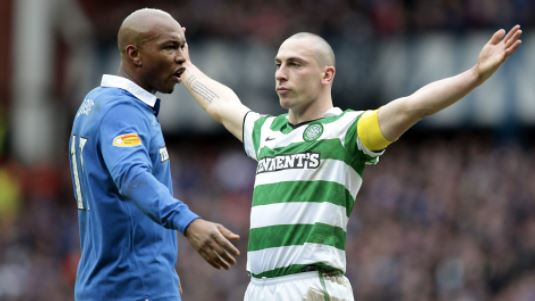
While the drama of league cups is traditionally reserved for finals, the 2011 Scottish Cup Fifth Round tie between Celtic and Rangers produced two memorable results. Jamie Ness put Rangers up in the third minute, although Kris Commons equalized before 20 minutes were up. Then Celtic went down to ten men and conceded a penalty to go down 2-1. Things remained that way until the 65th minute, when Scott Brown scored a rare goal to even it up. Brown went right to El Hadji Diouf (the two were getting into it all day) and raised his arms up in celebration. The gesture has since become known as The Broony and remains popular for the Celtic faithful. For Celtic, the 2-2 draw felt like a win. But it was still a draw, meaning a replay was needed.
THREE RED CARDS IN THE FIFTH ROUND
What the 2011 Scottish Cup Fifth Round replay between Celtic and Rangers lacked in goals, it more than made up for in red cards and overall animosity. The trouble started when Steven Whittaker was sent off in the 36th minute. Mark Wilson put Celtic up early in the second half, before Madjid Bougherra picked up Rangers’ second red card of the match. With the result decided, both teams resorted to hard tackling. As the final whistle blew, El Hadji Diouf (who had been involved in a halftime tunnel scuffle with Celtic assistant manager Johan Mjallby) argued with the referees and was issued his second yellow card. To top things off, Celtic manager Neil Lennon and Rangers manager Ally McCoist got into a furious exchange during the handshake.
THE 3-0 FUNERAL
One of the most humiliating days in Rangers history marked the end of a major era. In the final Old Firm of the 2011-12 season, Celtic easily trounced Rangers 3-0. But the bigger story was what was happening off the field. With Rangers suffering a financial collapse, they were about to be sent to the lowest level of the Scottish League. Those at Celtic Park did not let Rangers go quietly into the night, unfurling a massive tifo of the Four Horsemen of the Apocalypse and seeing their rivals off with the song “When Will I See You Again.” No one knew it would be three full years before Rangers and Celtic would see each other again, with many making the case that with the “death” of Rangers, it was indeed the last true Old Firm between the old enemies.
SEMI-FINAL UPSET
Until Rangers made it to the Scottish Premier League, the only chance of an Old Firm match was in cup matches. Celtic had trounced Rangers in the Scottish League Cup semi-final in 2015, but Rangers were out for revenge the following year. The two were drawn together in the Scottish Cup semi-final at Hampden Park, where it was clear things would go differently than last time. Rangers went up 1-0 early, but Celtic equalized and held on for extra time. That process repeated in the extra frame, which ended 2-2 and brought in penalties. Seven rounds were needed, with Tom Rogic absolutely sailing his kick to give Rangers the victory. They would lose to Hibernian in the first ever Scottish Cup Final without a single Premier League team.
UNWELCOME BACK
Perhaps the anger over the Scottish Cup semi-final upset remained with Celtic when they hosted Rangers for the first Old Firm league match in four years. But Celtic Park would prove to be an unkind host during Rangers’ return to the top flight. The chief architect of Rangers’ misery was Moussa Dembele, who scored a hat trick (the second goal being particularly fantastic) for Celtic, the first the Old Firm has seen in 50 years. To make matters worse, Rangers went down to ten men in the final 15 minutes and conceded a stoppage time goal to transform the contest into another memorable 5-1 scoreline. The Celtic Park crowd also released some pent up anger, unveiling a massive tifo referencing Ireland’s struggle for independence from the U.K.
HANGING ON AT IBROX
In March of 2018, Celtic were holding onto a six-point lead over Rangers as the season wound down. But a showdown at Ibrox loomed, with Rangers needing a win to stay alive in the title race. Josh Windass (lol) put the hosts up in the third minute, but Tom Rogic equalized just a few minutes later. Daniel Candeias put Rangers up again soon after, although Moussa Dembele evened things up just before halftime. In the second half, Rangers would get a golden chance at closing the gap when Celtic were reduced to ten men. Indeed, the winning goal came just 12 minutes after the red card. But it was Celtic who scored it, with Odsonne Edouard putting the final tally on a 3-2 win that effectively sealed another Scottish Premier League championship.
ENDING THE DROUGHT
With 2018 coming to a close, Rangers had yet to defeat Celtic since the Scottish Cup semi-final upset in 2016 and had only won one Old Firm in nearly a decade. But things finally broke Rangers’ way just before 2019 began. Powered by a raucous Ibrox crowd, Rangers dominated the match for the first time in a long time. In fact, things could’ve been a rout had it not been for the several excellent saves from Celtic goalkeeper Craig Gordon. However, Gordon couldn’t save everything, as Rangers managed to eke out a 1-0 victory thanks to a goal from Ryan Jack right at the half hour mark. While it was a win by the smallest margin, it was a win nonetheless and proved to be a precursor to the tide finally changing once again in the famous rivalry.
BROWN VS. EVERYONE
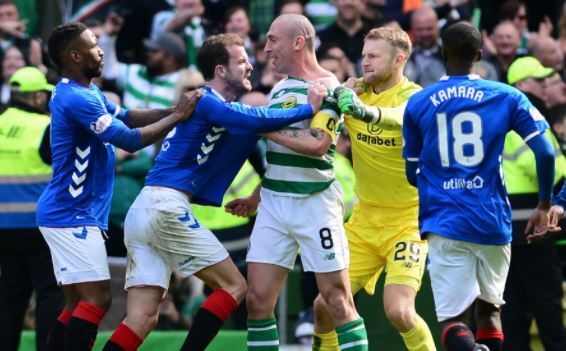
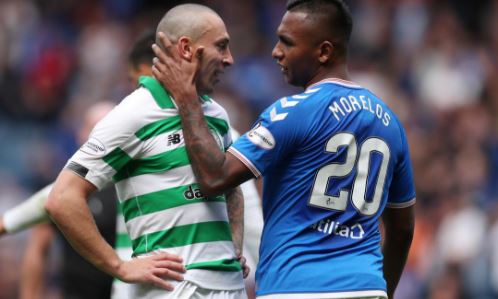
If Scott Brown wasn’t already hated by Rangers and their fans, a March 2019 Old Firm showdown clinched it. The match was a crucial one, with Rangers needing a result to reel in Celtic at the top of the table. During the match, Alfredo Morelos was sent off for elbowing Brown in the head, reducing Rangers to just ten men. The match was still even at 1-1, until Celtic scored the eventual winner in the 86th minute. In the aftermath, Ryan Kent at worst punched and at best shoved Brown in the head with a closed fist, which was actually missed by refs on the field (Kent was punished later). After the match, Brown was confronted by Andy Halliday for celebrating in front of Rangers fans. Brown was later charged by the FA for his actions.
STATISTICS:
HEAD-TO-HEAD RECORD
Celtic: 166
Rangers: 169
Draw: 102
LEAGUE CHAMPIONSHIPS
Celtic: 53
Rangers: 55 (record)
SCOTTISH CUP
Celtic: 41 (record)
Rangers: 34
SCOTTISH LEAGUE CUP
Celtic: 21
Rangers: 27 (record)
UEFA CHAMPIONS LEAGUE
Celtic: 1
Rangers: 0
UEFA CUP WINNERS’ CUP
Celtic: 0
Rangers: 1
NOTABLE FIGURES:
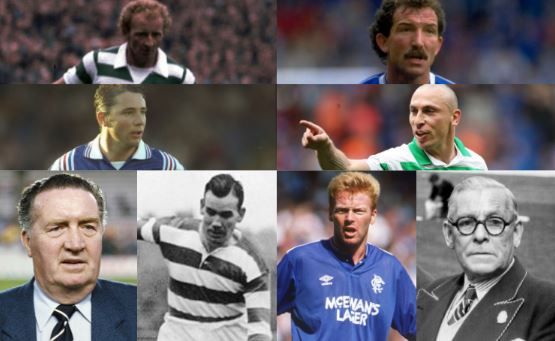
WILLIE MALEY
In 1897 (ten years after their founding), Celtic finally decided to put someone in charge of their team during games. Willie Maley was the first manager in Celtic history and held that position until 1940. That’s more than 42 years, the second-longest managerial reign in the history of professional soccer. During that time, Maley led the club to 16 league championships and 14 Scottish Cups. Interestingly, Maley never worked with his players during training — he watched games from the directors box and informed players of the starting lineup via the newspaper.
JIMMY MCGRORY
It’s been nearly a century since Jimmy McGrory first laced up his cleats for Celtic. During that time, no one has been able to surpass what he did for the club — or Great Britain. With 522 goals, McGrory is the all-time Celtic leading goal scorer. He also holds the all-time record for goals (550) and hat tricks (55) by anyone in the history of top flight British soccer. All of that was done with a legendarily powerful, almost horizontal header despite him being 5’6″. But his impact on Celtic didn’t stop there, as McGrory went on to manage the club for nearly 20 years.
BILL STRUTH
There’s always some nervousness when choosing a new manager. Well Rangers can at least say they can’t possibly do better than their choice to succeed William Wilton, their first ever manager who died in a boating accident. But through tragedy came triumph. Just the second manager in club history, all Bill Struth did during his 34 years in charge of Rangers was win more Scottish league titles (18) and Scottish Cups (10) than any other manager ever. Struth is honored with his own stand at Ibrox, which also features a portrait of Struth in the trophy room.
JOCK STEIN
As a player, Jock Stein already had a successful career, making more than 100 appearances for Celtic and winning a few trophies. But it was what he did as the club’s manager that truly made him a legend. During his time in charge, Stein assembled the greatest team in Celtic history, becoming the manager of the first ever British side to win the UEFA Champions League (and the only Scottish team to do so). After his spell at Celtic, Stein went on to become the manager of Scotland’s national team, a position he held until his death during a match in 1985.
BILLY MCNEILL
It takes a lot to become the most legendary figure in the history of a club like Celtic, but Billy McNeill certainly has a compelling case. The defender played his entire 18-year career for Celtic, serving as captain during their 1967 UEFA Champions League triumph and setting the club record for most appearances with 822. McNeill went on to manage and be an ambassador for the club, totaling more than 60 years of some affiliation with the club. In 2015, McNeill’s image was forever honored with a bronze statue of his likeness installed outside Celtic Park.
JOHN GREIG
Similar to Billy McNeill, perhaps no one in Rangers history is held in more regard than John Greig. With 755 appearances, no one has put on a Rangers jersey more than Greig, who spent his entire 17-year career with the club, then after retiring proceeded to serve as manager for another five years and director for several years afterwards. He was such an important figure that the club’s memorial to those who died in the 1971 Ibrox disaster included a statue of then-captain Greig. In 1999, Greig was voted as the “Greatest Ever Ranger” by the club’s supporters.
JIMMY JOHNSTONE
In 2002, Celtic supporters held their own poll to decide the club’s greatest ever player. The winner: Jimmy Johnstone, who dreamed of playing for Celtic ever since he was a ballboy for the club. He dribbled around milk bottles to hone his skills and wore pit boots to gain speed. Those early efforts paid off, scoring 129 goals and playing 515 games for the club. Johnston was a key member of the famous Lisbon Lions from Celtic’s golden era and was nicknamed the “Flying Flea” by the press. Not surprisingly, Johnstone has his own statue in front of Celtic Park.
SANDY JARDINE
Born William Pullar Jardine, this next player got the name Sandy from the color of his hair. For 16 years, the sandy-haired right back defended the Rangers’ goal with great success, winning 14 trophies — including the UEFA Cup Winners’ Cup. Only John Greig had more appearances for Rangers than Jardine, who represented the club 674 times. After his playing career ended, Jardine went on to work for Rangers’ public relations and retail departments. Three months after Jardine died of liver cancer in 2014, the Govan Stand at Ibrox was renamed in his honor.
ALLY MCCOIST
All Ally McCoist did during his career was score goals, with his total of 260 being the fifth-most in the history of top flight Scottish soccer. Combined with domestic and international cups, McCoist’s 355 goals make him by far the most prolific scorer in Rangers history. He also sits third behind John Greig and Sandy Jardine for most appearances for Rangers, putting on the club’s jersey 581 times. Unfortunately for McCoist, he was manager of Rangers when the club went down to the fourth tier, although he did take them to the second tier before resigning.
GRAEME SOUNESS
Throughout his long and controversial career, Graeme Souness made a major mark on soccer in Scotland. A former Scottish national team captain, Souness began his managerial career when he joined Rangers as player-manager in 1981. Despite being sent off just 34 minutes into his competitive debut, Souness led Rangers to three league titles for four Scottish League Cups during his time in charge. But the biggest impact on the club came off the field, when he ended Rangers’ no openly Catholic player rule by signing former Celtic player Mo Johnston in 1989.
MO JOHNSTON
No former Celtic player is hated by the club’s fans as much as Mo Johnston. After winning a league and Scottish Cup title with Celtic, Johnston left in 1987, claiming he would never return. But not only did he reverse his decision two years later while claiming he’d go back to Celtic, he then proceeded to sign with Rangers. As if this wasn’t enough to piss off Celtic fans, Johnston then scored a late winner for Rangers in his first Old Firm match against his old club. In the end, Johnston ended up winning as many pieces of silverware with Rangers as he did with Celtic.
WALTER SMITH
After Graeme Souness left Rangers in 1991, the manager’s role fell to Walter Smith, who was assistant manager to Sir Alex Ferguson for Scotland at the 1986 FIFA World Cup. Smith learned from both Ferguson and Souness to lead Rangers to great success. From 1991-98, Rangers won seven league titles, three Scottish Cups, and three Scottish League Cups. After leaving in 1998 as seven-time defending league champ, Smith returned to Rangers in 2007, winning eight more trophies in four more years and leading the club to the 2008 UEFA Europa League Final.
HENRIK LARSSON
One of the few Old Firm legends to not be born in the British Isles, the Swedish Henrik Larsson nonetheless deserves his spot on the list. Larrson may have played for a handful of other clubs (including Barcelona), but he had by far the most statistical success as a member of Celtic, where he ranks third behind Jimmy McGrory and Bobby Lennox on the goal scoring list. Of all of those goals, perhaps the best and most memorable came during Celtic’s 6-2 thrashing of Rangers. Celtic fans have bestowed the nickname “King of Kings” to Larrson for his play.
ARTUR BORUC
While not the best goalkeeper Celtic has ever seen (although far from one of the worst), Artur Boruc has a special place in the hearts of fans for a different reason: he’s a devout Catholic. Nicknamed the “Holy Goalie,” Boruc made enemies of Rangers fans for crossing himself in front of Rangers supporters, for which he was cautioned by police. He later would wear a t-shirt of the Pope against Rangers and parade around Ibrox after a loss with a flag celebrating Celtic’s league title. He also attended a Rangers match against his old club Legia Warsaw in the stands.
SCOTT BROWN
While Celtic has plenty of icons from the olden days, Scott Brown is pretty much the modern day club legend. Celtic’s captain from 2010-21, Brown is one of only seven players to ever make more than 600 appearances for the club (and will likely finish second all-time when his career is over). Brown has also made more appearances in European competitions than any other player in Celtic history. In addition, Brown gave Celtic and their fans a new way to mock Rangers by inventing the Broony celebration thanks to his memorable confrontation with El Hadji Diouf.
KENNY MILLER
Kenny Miller will not decorate the record books of either Old Firm club, he is one of five post-World War II players to appear for both Celtic and Rangers. Miller began with Rangers, but left in 2001 and returned five years later as a member of Celtic. Of course, his first goal with his new club came against his old one. Incredibly, Miller would leave in 2007 and return to Rangers a year later, becoming the first player to cross the Old Firm divide twice since the 1890’s. Miller is also the only player to score in the UEFA Champions League for both Celtic and Rangers.
FAN INVOLVEMENT:
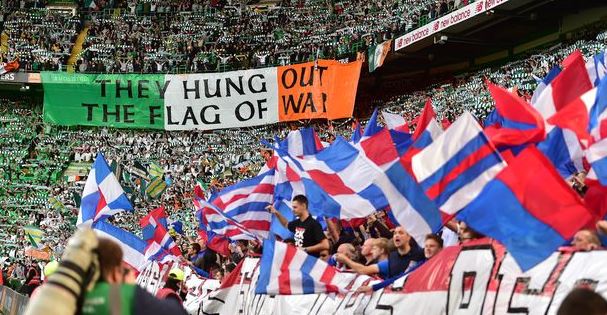
To say fans have had an impact on the Old Firm is a bit like saying the events of the 2016 Presidential Election had an impact on political tensions in the U.S. Perhaps no rivalry in all of sports is as deeply rooted in all aspects of life as the one between Celtic and Rangers. Religion (Catholic vs. Protestant), politics (loyalist vs. republican), national identity (British rule vs. independence), social ideology (conservatism vs. socialism), and economics (rich vs. poor) have been at play throughout the Old Firm’s history. This is also taking place in a region of the world that is not unfamiliar with civil war and domestic terrorism. Sectarianism is rampant throughout that history, although in more modern days that has decreased. However, the roots of these ideologies remain with the clubs, which have become symbols of the causes dearest to their fans’ hearts. Interestingly, rather than the Scottish flag (where both clubs are from), often during games Rangers fans will fly the Union Jack while Celtic fans wave the Irish tricolor. These dueling ideologies have also resulted in the creation of a popular play — Singin I’m No a Billy He’s a Tim — about a Celtic and a Rangers fan being forced to watch the Old Firm while handcuffed together behind bars.
All of this bleeds together to create one hell of a match day atmosphere that at best provides a legendary background to iconic moments and at worst boils over into danger. Multiple Old Firms have led to fans charging the field and brawling, which also leads to hundreds of arrests off the field. Let’s not forget one of those riots led to a 40-year (and counting) ban on alcohol at all Scottish League matches. There have also been incidents of fans being provoked by players (Paul Gascoigne and Artur Boruc) as well as those on the field being the victim of violence (Hugh Dallas). An activist group that monitors these kinds of things found that violent attacks increase nine-fold over normal levels on Old Firm weekends, while sadly domestic abuse also increases as well. In 1994, Celtic fans were banned from Ibrox after repeated incidents of vandalism that Celtic refused to take responsibility for. The ban was rescinded after one match and the Scottish Football League passed a resolution preventing clubs from invoking similar bans in the future. In 2000, a Rangers midfielder was involved in a violent brawl with Celtic fans at a hotel after being sent off during an Old Firm match.
Matches between the two clubs naturally bring about the biggest crowds of the season. Due to both clubs having two of the largest stadiums in Scotland as their home, they each often rank in the Top 20 list of best-attended soccer clubs in all of Europe. For Rangers, this attendance rate did not take a dip even when they were in the fourth tier. In 2018, Rangers announced they would be cutting the ticket allocation for Celtic fans at Ibrox from 7,000 to just 800, with Celtic doing similar in response and ending the tradition of both clubs offering a generous part of their seats to rival fans. The first Old Firm match after this was at Celtic Park. While many more home fans were able to attend, they still had to be segregated from visiting fans due to the threat of violence. Minutes before kickoff, the main access road into Celtic Park was closed, leading to thousands of fans being trapped inside a narrow walkway. Crushing ensued, with some fans scaling the walls and fences to escape. One fan fell from the wall and was hospitalized, while four others were treated at the scene.
SUMMARY:
While Scottish soccer hasn’t exactly been world class for the better part of the past 50 years, the country’s most famous rivalry is arguably the fiercest in the entire sport. Whenever Celtic and Rangers share the field, more than a century of bitter hatred sprouted from competition and violence on the field, as well as deep-rooted and complicated societal conflict, spews over to create a scene unlike any other in sport. The Old Firm is more than just a game — it’s war.
The next stop on our European journey is equally familiar with hatred, conflict, and war, although it has much better soccer. Germany is one of the most successful soccer nations in the entire world at the individual, domestic, and international level. World Cups, Champions League crowns, and Player of the Year honors flow through the country as freely as beer and sausages (damn it now I want to go back to Germany). However, there’s one part about German soccer that makes it different than most other countries: it’s main rivalry. For various reasons, the fiercest and most notable rivalries often involve either a country’s capital city or its most successful clubs. Mexico City, Madrid, and London are just the capital cities I’ve mentioned so far that have rivalries that make the list, while each country included in this list so far has contributed at least one rivalry that features its most accomplished team.
But that’s not the case for Germany. The country’s top flight league, the Bundesliga, began in 1963, during which time there were two Germanies. The country had been split into East Germany (influenced by the Soviet Union) and West Germany (territories occupied by the U.S., U.K., and France) after World War II. While East Germany had its own league (Football Oberliga DFV), there were multiple leagues in West Germany. When the Bundesliga was formed in West Germany, 16 clubs were chosen as members, although only one (Hertha BSC) was from the capital city of Berlin. Well, Berlin is the capital of Germany now and has been since reunification in 1990. But at the time, Berlin itself was divided into two cities (West Berlin and East Berlin), both of which were located in East Germany (yes West Berlin was surrounded by East Germany — international politics is complicated). Part of the economic and sociological impact this had on the divided city was found in soccer, with several clubs being formed and only one in particular (Hertha) being well funded. Although the two Berlins did end up producing their own prominent clubs (Hertha and Union Berlin), because of the literal divide between the two sides they didn’t meet until after reunification. Even after that, Hertha largely stayed in the Bundesliga while Union lingered in the lower divisions. But recently, for the first time ever Union made it to the Bundesliga, where their now-heated and emerging rivalry with Hertha is truly taking shape. However, it’s not ready to call itself the country’s best yet.
Then there’s the complicated question: what about Bayern Munich? The German powerhouse, which won the pandemic-interrupted UEFA Champions League in 2020, is unquestionably the biggest club in the entire country. Bayern leads all clubs with 31 Bundesliga titles, more than half of the all-time total. For further perspective, no other club has won more than five. Bayern also has won the country’s annual cup — the DFB Pokal — 20 times, with the second-most successful club winning it just six times. That Champions League crown was Bayern’s sixth, three times the amount of all other German clubs put together (and the third-most of any club in Europe). This dominance is partially due to their great academy and partially due to the fact that when it comes to buying star players, they’re like the new york yankees on steroids (heh). When any other club goes on a run and seriously challenges them for a title over a few years, Bayern simply buys their best players and eliminates the threat. People often refer to the rivalry between Bayern and Borussia Dortmund (known as Der Klassiker) as the best in Germany. I am a Dortmund fan (disclaimer alert) and freely admit there is no rivalry, at least a competitive one. It’s only based on recent success (during which the 2013 Champions League Final happened) and ended with some of Dortmund’s best players (Robert Lewandowski, Mario Gotze, and Mats Hummels) either leaving for Bayern in the offseason or the years to come. There is no true rivalry on Bayern’s part — everyone just hates them (more on that later).
So if Germany’s best rivalry doesn’t offer the history and prestige of its capital or the success and high stakes of its biggest club, what can it offer? To be brief: one of the fiercest rivalries in all of soccer and at worst a dark horse contender to take the entire World Cup of Hate.
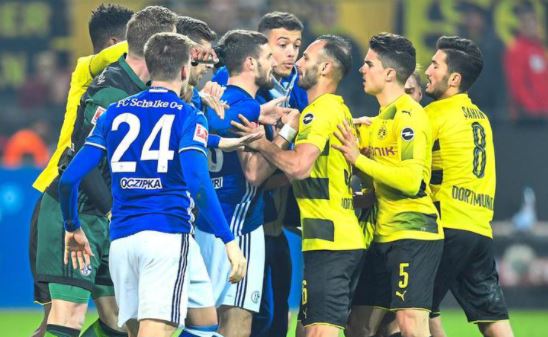
The Revierderby (Germany)
Borussia Dortmund vs. FC Schalke 04
“It’s a pretty special atmosphere. If you look people in the eye around here then you will feel straight away what ambition there is to win the derby. The fans tell you things like, ‘come on, we’ve got to win the derby! We want a derby win!’ Everybody’s really looking forward to it. The atmosphere in this game is just unique.” — Pierre-Emerick Aubameyang, former Dortmund striker
The Revierderby, Germany’s best and fiercest derby, showcases arguably the best atmosphere in soccer and brings everything — incredible comebacks, legendary moments, continental success, utter betrayal, deep-rooted hatred — you’d expect for a proper rivalry. Oh, and it’s potentially about to go through a seismic shift.
While Berlin is by far the most populated city in Germany and other large cities like Munich, Frankfurt, Hamburg, Hanover, and Stuttgart also have plenty of people and prestige, the largest urban area is actually the Ruhr valley — located in the western part of the country near the border with the Netherlands. If you’ve never heard of the Ruhr area, I don’t blame you. Despite all of its residents, there is quite frankly fuck all to do there. The vast majority of the region has not only been dedicated to industry (coal mining in particular), but was also one of the most heavily damaged areas in Germany during World War II. In fact, there are really only two good reasons to ever visit the area.
Despite not having a lot to attract tourists, crowds flock to the Ruhr valley every year (well, except for this past year obviously) from all over the world to watch the region’s two best soccer clubs, who happen to be the second-most and third-most popular teams in all of Germany. When they’re not duking it out in the Revierderby (named after the several rivers [like the Ruhr and Rhine] that flow through the area), Borussia Dortmund and FC Schalke 04 are busy winning most of everything Bayern Munich can’t and developing world class players. Part of their appeal is the utterly spectacular atmospheres at each of their matches, created by the fact that there’s a lot of people and not a lot to do in the area besides watch soccer. That much concentrated passion naturally leads to a lot of hate for anyone who doesn’t like their favorite team. As it turns out, Dortmund and Schalke really don’t like each other.
HISTORY:
Fußballclub Gelsenkirchen-Schalke 04 e.V. began life in 1904 as Westfalia Schalke, the end result of a group of high school students in Gelsenkirchen wanting to form their own soccer club. Their first colors were those of two future German soccer giants: yellow and red. Five years later, Ballspielverein Borussia 09 e.V. Dortmund (what the hell do they feed names in Germany?) was born when a group of young men upset with the Catholic church-sponsored group called Trinity Youth decided to form their own club. The local priest (described as stern and unsympathetic) was reportedly blocked at the door of Zum Wildschutz, the pup where the group gathered to put the club together. They took their name Borussia from a brewery in Dortmund and donned blue and white striped uniforms with a red sash (the colors of their current two biggest rivals).
For the first 15 or so years of their existence, the two clubs meddled around in the local leagues, with Schalke partnering with a local gymnastics club at multiple points before and after World War I. By the time 1925 rolled around, both clubs had established themselves on the local scene, adopting their current yellow and black (Dortmund) and blue and white (Schalke) color schemes. It was also the first year Dortmund and Schalke faced off on the field, with Schalke winning 4-2 at a neutral site in the city of Herne. The result wasn’t surprising, as Schalke had grown into the regional power of the time and Dortmund was only modestly successful in local leagues. Two more matches over the next two years were also won by Schalke, including a 7-2 victory in 1927. This would be the last meeting between the two until 1936. While Dortmund continued to toil in the local leagues (at one point being close to bankruptcy), Schalke built a shiny new stadium and won their first West German title the same year of Dortmund’s financial worry. Even a months-long ban for exceeding salary levels didn’t stop Schalke’s rise in popularity, which was about to be helped by something else entirely.
In 1933, the Nazi party took power in Germany, with the Third Reich restructuring sports across the country. That included soccer, with the formation of the Gauliga system. Each German state was given its own top flight league, with the Gauliga Westfalen covering (among other places) the Ruhr valley. The Gauliga system (along with pretty much everything in Germany) ground to a half after the Nazi’s defeat in World War II, with the leagues shutting down in 1944. I noted that Schalke had established themselves as the team of the region. For further proof: they won every single Gauliga West title (all 11 of them), only losing six matches the entire time (none of them at home). Led by the dynamic duo of Fritz Szepan and Ernst Kuzorra, Schalke also took home six national championships and their first DFB-Pokal during this incredible era. In fact, Schalke’s dominance led to them being used by the Nazi party as a propoganda piece as an example of “new Germany.” I’m not bringing up the pro-Nazi support my favorite German club’s arch rival just out of spite — it was factually a product of and influenced by Schalke’s success.
Conversely, Dortmund’s president was replaced when he refused to join the Nazi party and some club members who used its offices to produce anti-Nazi pamphlets were executed. It’s then not surprising that Dortmund struggled to make its mark nationally. While they did finish in the Top 3 in five of its eight years in the Gauliga Westfalen, Dortmund was still far behind Schalke, especially when it came to the Revierderby. The two clubs faced off 16 times in the Gauliga Westfalen, with 14 of those being won by Schalke. including a 9-0 result being followed by a Revierderby record 10-0 victory for Schalke. It took Dortmund until 1943 — 18 years after their first meeting — for Dortmund to record their first win over Schalke, a slim 1-0 victory. With a record of 17-1-1 in their first 20 years of competition, it seemed Schalke didn’t really have much of a rivalry with Dortmund, given that rivalries have to be two-sided. But the hate definitely brewed during this time, particularly on Dortmund’s part. Schalke’s dominance sparked anger and over from Dortmund being continuously beaten by their regional rival, a fact that Schalke certainly didn’t let their rivals forget. But things would soon change competitively.
After World War II, both Dortmund and Schalke (like most organizations in Germany) were dissolved in an attempt to distance everything from the Nazis. There were brief talks of merging the two clubs, but Schalke reentered live as Schalke 04 and Dortmund as Ballspiel-Verein Borussia (BVB). The Gauliga system went away entirely, replaced by the Oberliga, which was still regionally divided (though the regions were much larger). Both Dortmund and Schalke were placed in the Oberliga West, which began play in 1947. That year, Dortmund had done something previously unthinkable: beat Schalke for the Westphalian Cup (the regional cup). That long-awaited strike back at their rivals was the major breakthrough BVB had been waiting for and the club carried the momentum to the national scale. Where Schalke dominated the Gauliga Westfalen, Dortmund grabbed the early edge in the Oberliga West. All three of the first league titles would go to Dortmund, a streak stopped by, of course, Schalke. Three more league titles would follow in the 1950’s, the latter two leading to Dortmund’s first ever national West German championships. Of course, the streak was stopped by Schalke, who won the national crown in 1958. That was the club’s first title in 16 years (an incredible drought for a club like Schalke) and seen as a sign Schalke would go back to its national dominance. Spoiler alert: that wouldn’t happen. It also didn’t fix the Revierderby trend, as Dortmund only lost seven of its 32 matches against Schalke during the Oberliga era.
While West Germany’s top flight soccer had been played in several regional leagues (with the winners meeting to decide a national champ), East Germany had been operating with a single national league for nearly 15 years. In 1962, the top West German soccer officials met at the annual DFB convention at the Westfalenhallen in Dortmund. The end result: the creation of the Bundesliga, the first West German national top flight league. Five teams from Oberliga West were chosen, including 1. FC Koln (the four-time defending champ) as well as Dortmund (who won the last non-Bundesliga national title in 1963) and Schalke. (Side note: two of the Oberliga West clubs not put in the top flight were Bayer 04 Leverkusen and Borussia Monchengladbach, two current Bundesliga mainstays). While neither Revierderby club would find national league success for quite a while, Dortmund did manage to win its first DFB-Pokal (as well as the 1966 European Cup Winners’ Cup) during the mid 1960’s. BVB also took eight of the first ten meetings with its Ruhr area rivals. But things would begin to turn in the late 1960’s and early 1970’s, which saw the line forever crossed in terms of the rivalry and soccer as a whole.
A 1-0 Schalke win in 1968 proved by the start of a Dortmund victory drought when it comes to the Revierderby (no wins for ten years). But the following year saw something perhaps even more impactful. Back-to-back eras of dominance spewed hatred and resentment from each set of fans against each other. However, there had yet to be a particularly violent or outrageous incident to bring the rivalry up to legendary level. That changed in 1969, when a raucous crowd (many people had snuck in) led to the stands at Dortmund being too full to contain everyone. Some people had to stand at the side of the field, with police officers and their dogs standing on the side of the field to try to keep control. But Schalke scored the opening goal, the crowd was into such a frenzy that some people went onto the field itself. One of the security dogs got excited and bit the next thing it saw, which happened to be Schalke player Friedel Rausch’s ass. Because no substitutions were allowed at the time, Rausch got bandaged up and was given a tetanus shot at halftime, allowing him to finish the 1-1 draw. The bite meant much more than a pain in the ass — it catapulted the Revierderby into a new level of crazy. That was proven at the very next meeting between these two clubs, before which Schalke brought in (I shit you not) four actual goddamn lions from a nearby zoo for pregame activities.
While the previous two years had brought major headlines on the pitch, it was a headline off the field that sent shockwaves through West German soccer in 1971. After the season it was revealed that several matches had been fixed, including a 1-0 Schalke loss to Arminia Bielefeld. Several Schalke players (who had sworn an oath to their innocence) and board directors had been paid to throw the game. Those players — which included national team members Klaus Fischer, Klaus Fichtel, and Stan Libuda — were banned from soccer for a significant time. To this day, Dortmund fans and others refer to Schalke as “FC Meineid” (FC Perjury). But while Schalke was getting paid to lose, Dortmund was losing money and games at the same time. This resulted in Dortmund being relegated in 1972 and no Revierderby matches being played until 1976, when BVB returned to the Bundesliga. Still, things weren’t all bad for them in the 1970’s. 1973 saw the opening of Dortmund’s current home ground: Signal Iduna Park, better known as the Westfalenstadion. Since then, it’s become one of the most famous soccer stadiums in the entire world due to its incredible atmosphere. With a capacity of over 81,000, it’s the largest stadium in Germany (and the fifth-largest in all of Europe) and the second-largest soccer stadium in the entire continent (behind only Barcelona’s Camp Nou).
As a whole, the 1970’s and 80’s were not particularly kind to either Dortmund or Schalke. Though the former had made it back to the Bundesliga, its financial problems were far from over. Another relegation in 1986 was barely avoided with a playoff victory over Fortuna Koln. However, three years later Dortmund finally got some new silverware, winning the 1989 DFB-Pokal followed by the DFL-Supercup (which came against Bayern Munich). Schalke meantime experienced two of its own relegations, going down in 1982, returning in 1984, and slipping back down in 1988. But if that wasn’t enough, the region these clubs call home experienced some terrible times of its own during this era. The period was one of economic turmoil for the Ruhr valley, with many coal mining plants and other businesses shutting down. With people out of work, they looked to their soccer teams for happiness. But while you might think the whole Dortmund and Schalke losing a lot thing would dampen that support, you’d be wrong. In fact, quite the opposite happened. This period saw the fan devotion for both clubs increase even more, which didn’t even seem possible at the time. What’s more, these fans would be rewarded with a reversal of fortune once Schalke returned to the Bundesliga in 1991.
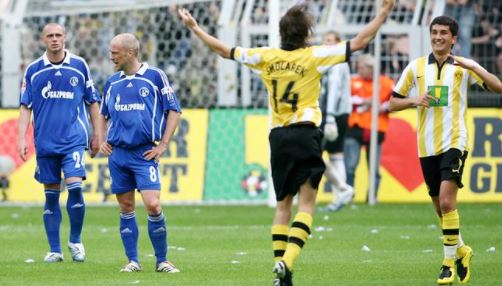
The 1990’s saw Dortmund and Schalke each become Bundesliga contenders for the first time in their history. Under new manager Ottmar Hitzfeld, Dortmund finished tied with VFB Stuttgart for first in 1992, but lost out due to goal differential (a 5-2 defeat to Schalke didn’t help). The following year, Dortmund reached the UEFA Europa League Final. Although they lost to Juventus, Dortmund used the much-needed prize money to sign several players who would take them back to the top. Led by European Footballer of the Year Matthias Sammer, Dortmund won its first Bundesliga title and first German top flight crown in 1995, a year that also saw a DFL-Supercup win. Back-to-back victories in both followed in 1996, with the Bundesliga crown giving BVB a spot in the 1996-97 UEFA Champions League. That campaign saw Dortmund’s greatest ever achievement, reaching the Champions League Final at the Olympiastadion in Munich. Their opponent: Juventus, the defending champs. As notable underdogs, Dortmund shocked Europe and got revenge for 1993, topping Juventus 3-1 and claiming their first ever Champions League crown, just the third German club to do so. They then became the second German to win the Intercontinental Cup.
Dortmund’s win meant that the greatest pieces of European and world club soccer silverware (all three of them) were being kept in the Ruhr valley. I say three because 1997 also saw Schalke achieve its own first European trophy, going on an unexpected run in the Europa League. The “Euro Fighters,” led by manager Huub Stevens, eked out a different Italian club — Inter Milan — on penalties to claim the Europa League crown. That meant the 1997-98 Revierderby matches would be played between the two titleholders of Europe. Schalke would get the edge in the next two contests, with a 1-0 win being followed by a 2-2 draw that simply had to be seen to have been believed (and resulted in the first ever Bundeslige goal scored by a goalkeeper in open play). Schalke would also close out the millennium strongly by being the focus for the comedy film Fußball ist unser Leben (Football is our Life), in which a Schalke fanatic gets involved with kidnapping and bets his house that the team’s star player will score in the final match. Well when I say strongly… I mean it apart from the fact that Fußball ist unser Leben was considered by some critics to be one of the worst German comedies ever.
The 2000’s began with a bang for Schalke, which claimed back-to-back DFB-Pokals in 2001 and 2002. But the decade was more notable for historic heartbreak, as Schalke came within one spot of winning its first German top flight title since 1958 four different times from 2001-10. The greatest pain came in 2001, when they needed to beat Unterhaching and have Bayern Munich lose to Hamburger SV on the final day to win the title on goal difference. Trailing 3-2 with 20 minutes to play, Schalke scored three times to do their part and win 5-3. Then, word came through that HSV had scored to go up 1-0 over Bayern in the final minute. Schalke fans stormed the field, believing they had won the league. Then the Bayern-Hamburg match was put on the stadium jumbotron and fans saw the unthinkable happen. During a Bayern attack in stoppage time, HSV goalkeeper Mathias Schober thought an opposing player had taken a shot. It turned out to have been a back pass from his own player, so when Schober picked it up in the box, the whistle blew and Bayern was awarded an indirect free kick in the penalty area. Off the kick, Patrik Andersson would score his only goal ever for Bayern, giving them the title and sending Schalke and its fans into pure sadness. Two twist the knife even further, not only was former Dortmund manager Ottmar Hitzfeld now in charge of Bayern, but Schober was a former Schalke player who had been loaned to HSV that season.
Things only got worse the following season when Dortmund (who in 2000 became the first and so far only publicly traded club on the German stock market) claimed their third Bundesliga title. But after a defeat in the 2002 Europa League Final, Dortmund’s fortunes would slide. Poor financial management (not helped by poor stock showings) led to the club nearly going bankrupt in 2005. Hans-Joachim Watzke was appointed club CEO and began streamlining BVB, evoking pay cuts and selling the Westfalenstadion’s naming rights to Signal Iduna (interestingly those naming rights expire this year). While these changes would pay dividends in the years to come, for the immediate future Dortmund had to settle for mediocrity. Still, there were some memorable moments, particularly in 2007 when Dortmund beat Schalke, who had been on top of the table for three months, 2-0 on the second-to-last matchday of the season. The result dropped Schalke to second, where they would finish behind VFB Stuttgart.
At the start of the 2010’s, Dortmund and Schalke were suddenly at the peak of their powers. After narrowly missing out on the league title in 2010, Schalke claimed the DFB-Pokal in 2011 and made an incredible run to the semi-finals of the Champions League, losing to Manchester United. But the real revelation was Dortmund, who had suddenly returned to world-beater form under the guidance of Jurgen Klopp. The new manager had taken over in 2008 and transformed the club thanks to a roster packed with some of the best young players in soccer. Names like Robert Lewandowski, Mario Gotze, Mats Hummels, Lukasz Piszczek, Jakub Blaszczykowski, Shinji Kagawa, and Ivan Perisic led Dortmund to the Bundesliga crown in 2011. The following season, Dortmund defended their league title (setting a new points record in the process) and claimed the DFB-Pokal, becoming one of just four German clubs in history to achieve the Bundesliga/DFB-Pokal double. In 2013, Dortmund used its firepower to reach the Champions League Final, squaring off with Bayern Munich in the first ever all-German final. A late and bizarre goal saw Bayern win the final, a result made all the worse when Gotze left for Munich in the offseason (Lewandowski and Hummels would join him in the near future). At least Schalke could sympathize with their rivals, having seen goalkeeper Manuel Neuer (a club icon and captain who was the hero of their 2011 European run) also leave for Bayern.
Since then, Dortmund has maintained their status as one of the best clubs in Germany and Europe, even with more players and Klopp himself leaving the club. However, they’ve yet to either win the league (the 2012 title was the last Bundesliga crown to date not won by Bayern) or even reach the Champions League semi-finals (although their 2017 exit may have been due to the fact that their team bus was bombed before their first leg against Monaco). Meanwhile, Schalke are still searching for their first top flight crown since 1958, although they’ve had some decent European success in that time (aside from losing 10-2 on aggregate to Manchester City in 2019). But things have recently taken a dramatic turn. Schalke is in the midst of a financial crisis, which wasn’t helped by the pandemic. After somehow pulling a second place finish out of its ass in 2018, Schalke finished 14th the following year and 12th in the pandemic-influenced 2020 season. The club has been forced to sell off notable players and fallen way behind their rivals in terms of competition (Schalke hasn’t even scored against Dortmund since 2019).
Then, just two years ago, something unthinkable and amazing happened: SCHALKE GOT RELEGATED. The season began with a 8-0 loss to Bayern Munich and went straight downwards. It took until the 15th match of the season for Schalke to see its first win and avoid setting a new record for the worst start to a season in Bundesliga history. It took until March for Schalke to achieve a double-digit point total. After a 5-0 loss to VfL Wolfsburg, Schalke had a -50 goal differential — the next worst in the entire league was -25. Schalke also set a Bundesliga record for most managers, having gone through five different ones during the doomed campaign. The end result was bar none the worst season in Schalke’s long and storied history. Dortmund didn’t exactly help their rivals, sweeping Schalke by a combined 7-0.
In the 2021-22 season, for the first time since 1990, the Revierderby was not played. Although Schalke would return after just a year off, they were relegated again this past season. While this won’t help Schalke’s situation, it may also be detrimental for Dortmund depending on how long Schalke remains below them. Apart from the annual Bayern Munich beating, the Revierderby is by far the biggest and most profitable matchup of the year for both clubs (not to mention Bundesliga broadcasting). Both clubs could lose a notable amount of money and viewership from this.
Let’s use Hamburg — the team that handed Bayern the title away from Schalke in 2001 — as an example. Going into the 2017-18 season, HSV was the only club to have never been relegated from the Bundesliga (even Bayern spent time in the second division). However, financial hardships, mismanagement, and poor performances led to several years of narrow escapes. Finally in 2018, HSV’s long run ended, as they dropped to the 2. Bundesliga for the first time ever. While many thought they would bounce right back, it took them until this past season to make their return to the Bundesliga. Ironically, this ended up helping Hamburg’s own intense rivalry with FC St. Pauli (a largely lower league side) grow even more. But if Schalke takes this long or even longer, it won’t be beneficial at all for their rivalry. Barring scandal or a collapse of monumental proportions, Dortmund is not getting relegated. Therefore, the burden is on Schalke to get its shit together and make the Revierderby a regular thing again.
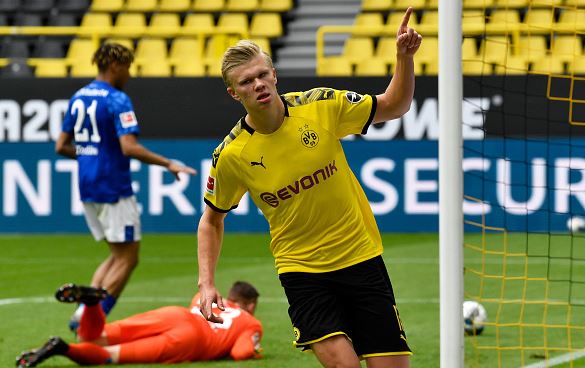
MAJOR MOMENTS:
THE FOG OF WAR
Going into their first clash of the 1966-67 Bundesliga season, Dortmund had won five straight contests against Schalke, including a 7-0 victory earlier in 1966. But then something interesting happened before kickoff — a heavy fog descended onto the field, making it incredibly tough for players to see what was happening. In fact, referee Gerd Henning exhausted himself during the match because he had to constantly run after the ball in order to see what was happening. So did the fog help Schalke’s chances? Technically yes, at least in comparison to the 7-0 win. BVB only won 6-2 this time around, setting history in the process. Lothar Emmerich scored a hat trick for Dortmund, becoming the first and incredibly only player to do so in a Revierderby game.
DOGS, FLOWERS, AND LIONS OH MY
While there had already been plenty of hatred brewing between the two sides, Dortmund and Schalke really began to show their teeth in 1969. Some 40,000 fans (well more than what the stadium could fit) packed the stands for a Revierderby match that saw Hans Pirkner open the scoring for the visitors. The Dortmund fans had such a visceral reaction that some fans stormed the pitch. Police officers were present, with one K-9 accidentally biting Schalke’s Freidel Rausch in the ass. Rausch played on after a tetanus shot and received 500 Deutsche Marks and a bouquet of flowers from Dortmund as an apology. For the next Revierderby, Schalke rented four trained and tame lions and brought them on the field for the most bizarre pregame scene ever.
ENDING THE DROUGHT AT THE DEATH
From the late 1960’s to 70’s, Dortmund failed to record a win against Schalke for nearly ten years. The first ever Revierderby at the Westfalenstadion provided some hope with a 2-2 draw, but BVB had to wait until the following year to break the drought. Manfred Burgsmuller put the hosts up early, but Klaus Fischer (whose previously lifelong ban for his involvement in the 1971 match fixing scandal had been reduced to just one year) even things up just before the half hour mark. Things remained even for nearly an hour, but with three minutes remaining Lothar Huber fired home the winner for Dortmund to give the home squad a long sought-after win. It also wound up being part of a 16-year unbeaten streak against Schalke at the Westfalenstadion.
RETURNING IN STYLE
Through four matches of their return Bundesliga campaign in 1991, Schalke had only scored three goals. The fifth match was the Revierderby — played in front of over 70,000 fans who had been waiting years for a crack at Dortmund. Ingo Anderbrugge brought those fans to a frenzy by putting Schalke up 1-0 in just the second minute. While Dortmund tied things up and went into halftime tied 1-1, Schalke exploded for four goals in the second half (including three in the final 20 minutes) to record an astounding 5-2 victory. The score was actually 3-1 before the final five minutes, which saw a Dortmund goal answered by two Schalke goals. The loss would prove to be a “what if” for Dortmund, who finished tied for first in the league but lost on goal differential.
HISTORY MADE IN DRAMATIC FASHION
Before he became a top flight winner with Dortmund (and the top national team goalkeeper), Jens Lehmann made Bundesliga history and left his mark on the Revierderby as a member of Schalke. Lehmann’s club were trailing to Dortmund 2-2 at the Westfalenstadion, seemingly headed for another road defeat. But Schalke managed to fight back, making it 2-1 deep into the second half. Schalke was still trailing in stoppage time when they earned a corner kick, which was likely their last chance of the match. So Lehmann left his net and went into the Dortmund box. A deflection somehow found Lehmann, who fired the ball into the back of the net to make it a 2-2 draw. Lehmann also became the first ever Bundesliga goalkeeper to score in open play.
TWO REDS AND SOME SAND
The 2003-04 Bundesliga season was a down one for both Dortmund and Schalke — neither managed to qualify for the UEFA Champions League or even the Europa League. But that didn’t mean the Revierderby was any less feisty. Take the January contest at the Westfalenstadion for example. That match saw the number of red cards double the amount of goals. Tomas Rosicky was sent off in the 42nd minute to put the hosts down a man, while Schalke joined them when Thomas Klasener was issued a red card in the 73rd minute. Through all of this, a single goal seemed unlikely. But then Ebbe Sand struck, scoring in the 89th minute to give the visitors a sudden road victory and leave the home fans with a particularly unpleasant feeling inside.
UPENDING A CHAMPIONSHIP
It had been nearly 50 years since Schalke earned top flight glory. But in 2007, they seemed destined to finally end the drought, having been on top of the Bundesliga for three months going into the final two weeks of the season. But one old obstacle stood before them: Dortmund at Signal Iduna Park. Although Dortmund was at the time a mid-table club, anything can happen in a rivalry. As it turns out, something did indeed happen. In a season where BVB finished with more losses than wins, they defeated Schalke 2-0 to deal a last-minute blow to their rivals’ title hopes and send VFB Stuttgart one point clear at the top. Schalke could still had won the league if Stuttgart stumbled on the final day. But they held on to keep Schalke’s lengthy drought intact.
THE THREE-GOAL COMEBACK
Jurgen Klopp’s first Revierderby was absolutely wild, which would also be a good description of his time in charge of Dortmund. But it was looking like pure agony for most of the time. Schalke went up 2-0 at Signal Iduna Park before halftime and were leading 3-0 with under 25 minutes remaining. Then, BVB suddenly roared into life. Neven Subotic got Dortmund on the board before Alex Frei made it 3-2 just a few minutes later. Things got even more interesting when Schalke saw two red cards just three minutes apart, reducing them to nine men. Schalke still looked like they were going to hang on for the improbable victory. But with two minutes left, Frei found the back of the net once more, completing the memorable comeback for the 3-3 draw.
FAHRMANN THE MAN IN PENALTIES
Another thing that makes the Revierderby unique among these rivalries is that the two clubs involved rarely meet outside of league competition. There have been only six DFB-Pokal games between the two, none after the Round of 16 and none since 2000. In fact, the only time BVB and Schalke have ever faced off for a piece of silverware happened in 2011, when the former won the Bundesliga and the latter won the DFB-Pokal. That locked the two sides in for a DFL-Supercup matchup, a competition Dortmund had won each of the previous three times it had won the Bundesliga. The match itself was not that exciting, ending in a scoreless draw. Schalke goalkeeper Ralf Fahrmann would save two penalties to lead his side to a rare new trophy.
DORTMUND’S DYNAMIC DUO
Dortmund’s squads in the 2010’s were seemingly full of superheroes. But two really came to play during a 2015 Revierderby match. Dortmund had dominated the game, but somehow Schalke had managed to keep them off the scoreboard. But in the 78th minute, Pierre-Emerick Aubameyang finally broke through, which was impressive considering he had been stashing something behind the goal. Aubameyang celebrated by whipping out a Batman mask and putting it on. He was joined by Marco Reus, who pulled out a Robin mask of his own to create an iconic image. The dynamic duo each found the scoreboard, as Reus followed up a Henrikh Mkhitaryan goal with one of his own to make it a 3-0 Revierderby win, and a super one at that.
THE FOUR-GOAL COMEBACK
More than nine years after Dortmund’s incredible comeback from down 0-3, Schalke provided an answer, one-upping their rivals in the process. Late in 2017, Dortmund came out of the gates on fire, going up 4-0 within 25 minutes and sending the tens of thousands of BVB fans at Signal Iduna Park into a frenzy. Normally this would already be enough to secure a win. But rivalries are rarely normal. Still down 4-0 with less than a half hour to play, Schalke got two goals within a four-minute span, then got another gift when Pierre-Emerick Aubameyand was sent off seven minutes later. The deficit was cut to 4-3 with four minutes remaining, then deleted completely when Naldo scored a header deep into stoppage time to complete the unbelievable 4-4 draw.
TITLE HOPES TAKE A HIT
For the entire 2018-19 Bundesliga campaign, Dortmund and Bayern Munich were neck and neck, although Bayern had drawn closer with a 5-0 win over Dortmund in April. But near the end of the month, Dortmund still had the top spot on the table going into a home Revierderby match with four games remaining. Dortmund quickly went up 1-0, but Schalke equalized from the penalty spot a few minutes later and then went up 2-1 in the 28th minute. With a half hour to go, things fell apart for Dortmund. Red cards to Marco Reus and Marius Wold sandwiched a third goal by Schalke, meaning Dortmund was down by two men and two goals. The match would end in a 4-2 Schalke victory and Bayern would go on to win yet another Bundesliga title.
BACK FROM THE PANDEMIC
When the COVID-19 Pandemic stopped sports around the world, it happened to halt the Bundesliga schedule right before the Revierderby. So when German soccer was given the clear to resume, it made it even more special that the very first match in the entire country would be Dortmund against Schalke at Signal Iduna Park. It also proved symbolic of the situation, as the match was played without any of the 80,000 fans who typically provide the iconic atmosphere. We can only imagine the noise the crowd would’ve made when Erling Haaland scored the opening goal or when Dortmund kept adding to the lead. The end result was an emphatic 4-0 win for Dortmund, but it was also a triumphant return to action for soccer fans worldwide.
STATISTICS:
HEAD-TO-HEAD RECORD
Dortmund: 65
Schalke: 71
Draw: 47
LEAGUE CHAMPIONSHIPS (BUNDESLIGA)
Dortmund: 5
Schalke: 0
LEAGUE CHAMPIONSHIPS (TOTAL)
Dortmund: 8
Schalke: 7
DFB-POKAL
Dortmund: 5
Schalke: 5
DFL-SUPERCUP
Dortmund: 6
Schalke: 1
UEFA CHAMPIONS LEAGUE
Dortmund: 1
Schalke: 0
UEFA EUROPA LEAGUE
Dortmund: 0
Schalke: 1
UEFA CUP WINNERS’ CUP
Dortmund: 1
Schalke: 0
INTERCONTINENTAL CUP
Dortmund: 1
Schalke: 0
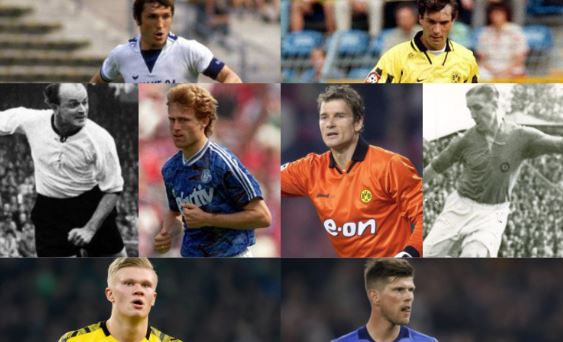
NOTABLE FIGURES:
ERNST KUZORRA
Undoubtedly one of the two greatest Schalke players ever (and he’s not No. 2), Ernst Kuzorra absolutely lit the early days of German soccer on fire. Even factoring in all of the players from the Bundesliga era, Kuzorra remains Schalke’s highest ever goalscorer — by more than 200 goals — and is second in all-time appearances. Not bad for a kid from Gelsenkirchen. Because Kuzorra wasn’t interested in politics and had a Slavic-sounding name, he was one of the few Schalke players of his era who couldn’t be used as a propaganda piece by the Nazi party.
FRITZ SZEPAN
The Scottie Pippen to Ernst Kuzorra’s Michael Jordan, Fritz Szepan is widely considered the second-greatest player in Schalke history. Slightly behind Kuzorra’s total in both goals and appearances, Szepan was a fellow Gelsenkirchen boy who found great success with his home club. While Kuzorra was the goal scorer, Szepan was more of a creative player, one who could make key plays and passes (and even play defense when needed). He later served as both manager and president of Schalke. By the way, Szepan and Kuzorra were brothers-in-law.
ALFRED PREISSLER
The first truly great Dortmund player, Preissler was part of BVB’s first truly successful clubs. Preissler began with Dortmund in 1946 and — after a brief departure from 1950-51 — remained until 1959. During that time, Preissler established himself as Dortmund’s all-time leading goal scorer with 174 — a mark that still comfortably stands. Preissler’s scoring ability was key to Dortmund winning back-to-back German championships in 1956-57. Preissler remains a club icon, with his image plastered across Signal Iduna Park, which he never got to play inside.
FRIEDHELM KONIETZKA
Nicknamed “Timo” due his supposed resemblance to Soviet commander Semyon Timoshenko, Friedhelm Konietzka scored plenty of goals during his time with Dortmund. In fact, Konietzka remains in the Top 5 of Dortmund’s all-time scoring list. His efforts were key for Dortmund’s final pre-Bundesliga championship and the DFB-Pokal-winning squad in 1965. But Konietzka has another, even more memorable individual achievement. Dortmund faced SV Werder Breman in the first ever Bundesliga match in 1963, scoring the first ever recorded goal in league history.
KLAUS FICHTEL
To break a Schalke record set by Ernst Kuzorra, you have to either score a shit ton of goals or play in a shit ton of games. The latter was the case for Klaus Fichtel, an absolute rock of a defender. Between 1965 and 1980, Schalke could count on Fichtel patrolling its back line. At the age of 34, Fichtel left for Werder Bremen, but four years later returned to Schalke and continued to play for another four years. When he retired at age 43, he was (and still is) the oldest player in Bundesliga history and Schalke’s all-time record holder for most appearances — with 556.
KLAUS FISCHER
Klaus Fischer is known for three things. The first is his incredible bicycle kick goal during extra time of West Germany’s 1982 FIFA World Cup semi-final win over France. The second is his goal scoring prowess for Schalke — with 226 goals he is by far the club’s greatest modern era goal scorer and only behind Ernst Kuzorra and Fritz Szepan for most in club history. The third (and unfortunately the worst one for Schalke fans) is his involvement in the 1971 Bundesliga match fixing scandal, resulting in bans for him and several others (including Klaus Fichtel).
MICHAEL ZORC
Arguably the most iconic player in Borussia Dortmund history (and not just for his trademark long hair), no one has worn the yellow and black more than Michael Zorc. From 1981-98, Zorc was a key Dortmund player, appearing in 572 games and scoring 155 goals (good enough for third-most all time). After toiling through the bad years of the 1980’s, Zorc was rewarded at the end of his career, as he captained Dortmund to UEFA Champions League and Intercontinental Cup victories. Zorc later served as the club’s sports manager during the last three league titles.
INGO ANDERBRUGGE
One of the few players to go between Revierderby clubs, Ingo Anderbrugge first began with Dortmund in 1984. After a poor season in 1988, Anderbrugge was let go, eventually signing with rival Schalke. All he did for them was score more than ten times as many goals as he did with Dortmund in less than five times as many games. In fact, Anderbrugge ranks fourth among the club’s Bundesliga-era scorers and sixth when it comes to appearances. Anderbrugge was also one of the Schalke players who converted their penalties to win the 1997 UEFA Europa league.
JENS LEHMANN
Jens Lehmann had one of the longest and most interesting careers a goalkeeper has ever put together. The first 11 years of that career were spent at Schalke, during which he made history with his last gasp tying goal in the Revierderby, the first of any keeper in the Bundesliga era. After a brief stint with A.C. Milan, Lehmann returned to the Ruhr valley — this time as a member of Dortmund. The move remains the most shocking in rivalry history, especially as Lehmann ended up winning something no Schalke player has since 1958: a top flight German title.
MATTHIAS SAMMER
Thanks to Dortmund’s success in the 1993 UEFA Europa League, the club was able to buy top notch talent to bolster the roster. One of those players was Matthias Sammer, a defensive midfielder who would end up being named the European Footballer of the Year in 1996. With Sammer leading Dortmund’s defense, the club went on an incredible tear, winning two straight Bundesliga crowns and DFB-Pokal titles. Sammer was also a key part of Dortmund’s run to the 1997 UEFA Champions League title. As manager, Sammer led BVB to the 2002 league crown.
HUUB STEVENS
Huub Stevens has quite a lengthy managerial career, taking the helm for ten different clubs in his career so far. His longest stint was with Schalke, with which he found his greatest success. Stevens led Schalke to its unexpected UEFA Europa League title in 1997, becoming an instant fan favorite. His time at Schalke ended in 2002… well at least for a little while. Stevens came back in 2011, but left again the next year. He’s since filled in as Schalke’s interim manager in 2019 and 2020, the latter tenure only being for two games (one of which amazingly was a win).
JURGEN KLOPP
Dortmund’s current span as one of the best clubs in the world can be traced back to 2008, when Jurgen Klopp was appointed manager. After dragging the club from financial trouble (thanks to getting the most from its cheap youth players), Klopp instituted an aggressive attacking style into Dortmund. The result was two straight Bundesliga titles (the latter being a record-breaking season), a DFB-Pokal, the first Bundesliga era domestic double, and a spot in the 2013 UEFA Champions League Final. Fuck you Liverpool for taking Jurgen Klopp away from Dortmund.
KLAAS-JAN HUNTELAAR
Arguably Schalke’s last truly world class player, Klaas-Jan Huntelaar sits only behind Klaus Fischer in the club’s Bundesliga scoring table (he also sits behind only Robin van Persie on the Netherlands national team’s all-time scoring list). Huntelaar’s longest stint of his career has been with Schalke (he signed in 2010) and during his time with the club it regularly competed with the best of the best in Europe. After leaving in 2017, Huntelaar returned to Schalke just this year, although at this point it looks like this is the last year of his lengthy and prolific career.
ERLING HAALAND
Erling Haaland is in his early 20’s and already one of the best goal scorers in the world. Haaland debuted for Dortmund in January 2020 as a sub, scoring a hat trick in 23 minutes. He hasn’t stopped scoring since then, setting multiple Bundesliga scoring records regarding youth and games played. One notable goal was the opener in Dortmund’s 4-0 Revierderby win, scoring the first goal in all of German soccer since the COVID-19 pandemic began. Sadly, Haaland has since left Dortmund to play for Manchester City. Fuck Manchester City.
FAN INVOLVEMENT:
Perhaps no rivalry on this list owes as much to the fans as the Revierderby. It’s one things to be successful — it’s another to have continuously feverish support from your fans no matter how bad you are. That has certainly proved to be the case for both Dortmund and Schalke, who each have fan bases that have stuck by through thick and thin on and off the field. The two fan bases have such deep hatred for each other that they can’t even bear to say their rival’s name, instead mockingly referring to them by their relative location to smaller, nearby towns. Dortmund is called “Ludenscheid-Nord,” while Schalke are known as “Herne-West.” But of course such intense hatred has led to some violent moments in the stands and off the field. However, both sets of supporters have since worked to keep things safe (if not still incredibly intense), while maintaining their legendary atmosphere. It also adds irony to the fact that the first Budnesliga match since the Pandemic was the Revierderby at Signal Iduna Park. While we got to finally have soccer back, the absence of this legendary atmoshpere reminds us of what’s going on.
If I may toot Dortmund’s horn a bit here, let me introduce you to arguably the most famous fan section in all of soccer: the Yellow Wall. The Southern Terrace of Signal Iduna Park (again, the fifth-largest stadium in all of Europe) is the largest free-standing grandstand in the entire continent. 25,000 fans pack the stands to create one of the most infomidating sights for opposing players. From seas of flags to massive tifos to other colorful displays, Dortmund constantly provides one of the best atmoshperes not just in Europe, but in all of world soccer. While Schalke’s Veltins-Arena can also provide memorable atmospheres and put on terrific displays, the larger Signal Iduna Park definitely has the edge in this one.
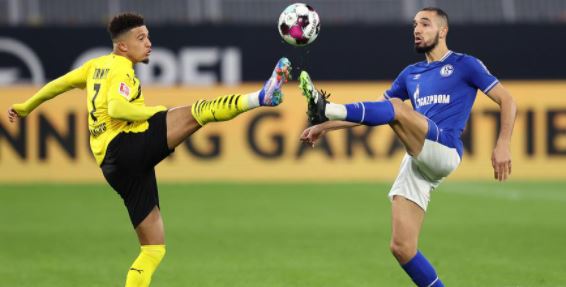
SUMMARY:
Germany’s biggest rivalry may not involve its best club or biggest cities, but it has enough of the essentials of a true rivalry — pure and utter hatred, passion, tight competition, incredibly atmosphere, and memorable moments — to stand with any other in the world. But thanks to a historically bad season and subsequent demotion, the Revierderby also has an uncertain future — as of now it’s unknown when Borussia Dortmund and Schalke 04 will play again consistently.
Making our way across Europe, we go from a country that’s won four FIFA World Cups… to a country that’s won four FIFA World Cups. Even with Germany on the world championship count is Italy, a country rich with soccer tradition and passion. Pasta, pizza, fast and expensive cars, olive oil, the mafia, the Colosseum — all are well-known Italian traditions. But soccer may be the most beloved and important part of Italian culture (apart from food anyway). Why else would Kicking & Screaming make its two best, most dominant players Italians? In fact, there is so much deep-rooted passion and hatred in Italian soccer that it’s impossible to choose just one rivalry. It’s also incredibly challenging to narrow it down to two (and impossible to do so without leaving at least three iconic rivalries off the list). But Italy is definitely deserving to be the second country in Europe to have two rivalries qualify for the World Cup of Hate (spoiler alert: only one other country besides the U.S., England, and Italy will send two rivalries to the tournament, and it’s not in Europe). At the end of the day, these next two rivalries immediately stood out to me as the best in all of Italy. Let’s start with the one with a bunch of stripes.
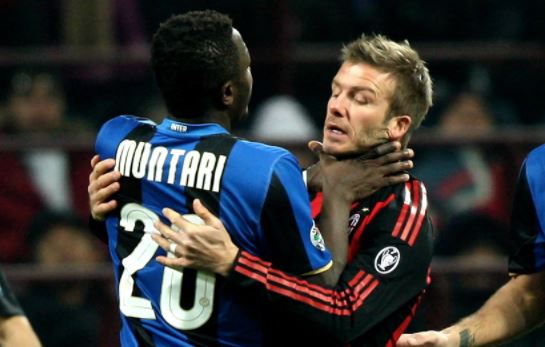
Derby della Madonnina (Italy)
Inter Milan vs. A.C. Milan
“You’re going to see something you can’t see anywhere else in the world, in any other city in the world. Just walking towards the San Siro for an evening match and you see the lights… it fills you up with a sensation I can’t describe. It’s like describing how it feels to become a father for the first time.” — Nima Tavallaey, Italian soccer journalist
The best of Italian soccer — the glitz and glamor, the success and silverware, the passion and performance, the stars and skill, the history and heritage — defines the Derby della Madonnina, which carries its own unique brand of hatred and atmosphere.
Both Inter Milan and A.C. Milan have a lot in common, least of which is the fact that their names include the city they’re based in (for future refenerence, I will say Inter when referring to Inter Milan and Milan when referring to A.C. Milan). Both clubs have iconic striped uniforms, which alternate black with their main colors red (Milan) and blue (Inter). Both clubs technically came from the same source. Many notable, iconic, world class players have suited up for each club — and some have suited up for both. The two clubs also share the same home ground (something unique for a derby): the legendary San Siro. Until this past season, both had won the same number of Seria A titles (as well as domestic trophies). Milan and Inter are like brothers — but like with most family dynamics there’s enough differences between siblings to spark tension and animosity, enough to fuel one of the most celebrated rivalries in all of sports.
HISTORY:
Among the many historic things in Milan is its church — the Milan Cathedral. Not only is it the largest church in Italy (and the fourth-largest chuch in the world), but it also may be the result of the longest construction project in human history. Construction began in 1386 and the final details were completed in 1965 — nearly 600 years later. About two-thirds through the building process, the cathedral was adorned with perhaps its most distinctive feature. Starting in 1762, artist Carlo Pellicani began work on a golden statue of the Virign Mary atop the cathedral. The work was complete in 1774, with the statue itself being dubbed the Madonnina. In addition to becoming a popular beauty piece, the Madonnina has become part of two traditions. The first is that no building may be higher than the Madonnina — replica versions of the statue have been put atop buildings that have been built at a greater height. The second is an equally golden soccer rivalry that carried the Madonnina’s namesake.
In 1899 — one year after the formation of Serie A as Italy’s top flight soccer league (although it was more region-based at the time) and 125 years after the Madonnina was completed — Associazione Calcio Milan was founded by Alfred Edwards and Herbert Kiplin as Milan Foot-Ball and Cricket Club. Taking inspiration from the devil (ironic given the whole cathedral bit in the previous paragraph), the club chose red (like fire) and black (like the feat they hoped to invoke in their opponents) for its colors. The club quickly reached success, winning its first Serie A title in 1901 and getting two more in 1906 and 1907. Then something cataclysmic happened. In 1908, a dispute over the fact that international players weren’t being given as much playing time at Milan as Italian players (ironic given that Edwards and Kiplin were English) led to several prominent club members breaking away. They decided to form a new club, drawing inspiration for its colors from the black and blue of the night sky and its name from the wish of allowing foreign players (as well as Italian players) to join without limits. Thus, Football Club Internazionale Milano was born.
The first ever Derby della Madonnina was held later that year in the final of the Chiasso Cup, which saw Milan win 2-1. But that was the height of the rivalry for a while, as the two sides played sporadically until 1926, when the Serie A (or Divisione Nazionale as it was called) was properly organized as a national league. In addition, the formation of Inter had an immediate impact on Milan’s performance. While Inter went on to win the 1910 national crown, Milan would not win another piece of silverware for an astonishing 43 years — which is insane if you know Milan today. That being said, Milan did win the Federal Cup — a national trophy that had replaced the league, which was suspended due to World War I. Inter meanwhile won the 1920 national crown, spurred on by the death of former captain/coach Virgilio Fossati, who was killed in action during the war. But the club too found themselves in trouble in 1922, needing to survive multiple playoff matches to stay in the top division.
1922 was an important year for another reason — it’s when Benito Mussolini became the Italian Prime Minister. During his 23 years in power (ended by his execution towards the end of World War II), Mussolini transformed Italy into a fascist state, establishing a dictatorship and making vast, shattering changes to the entire country. Some of those concerned soccer, arguably the most important of which leading to the creation of the next rivalry on our list. But for the Derby della Madonnina, both clubs were forced to change their names to strictly Italian. There was a greater change for Inter, which was forced to merge with Unione Sportiva Milanese, be renamed Societa Sportiva Ambrosiana, and wear red and white uniforms (to match Milan’s coat of arms). Although the blue and black uniforms came back the following year, the name would remain without “Inter” for another decade and a half. But Inter fans could at least fall back upon their success during that time period. which saw the club win another three league titles and its first Coppa Italia. Their great star was Giuseppe Meazza, often regarded as one of if not the best player in Italian soccer history. In fact, upon his death in 1979 the San Siro stadium was renamed in his honor. That stadium was created in 1926 and became Milan’s permanent home, although a 6-3 loss to Inter in a friendly to break in the field meant a rocky start.
After World War II ended (along with Mussolini and his fascism), things began to change for the rivalry. Not only were both clubs allowed to have their old names again, but Inter had become the second tenant at San Siro, making this derby unique in that both participants play at the same stadium. Things were also changing in terms of on-field product. Milan had suddenly gotten good, thanks in part to adopting the very ideology that created their biggest rivals: invest in international players. Swedes Gunnar Gren, Gunnar Nordahl, and Nils Liedholm formed the famous “Gre-No-Li” trio of strikers that led Milan to its first Scudetto in 44 years in 1951 (to be fair having Italians like Lorenzo Buffon and Cesare Maldini on their squad also helped a bit). Inter responded with back-to-back league titles in 1953-54, but Milan would add more crowns of their own in 1955, 1957, and 1959. Milan even reached the 1958 UEFA Champions League Final and were leading with less than 15 minutes remaining, but lost in extra time to Real Madrid. For the first time ever, both Milan and Inter were good at the same time. They were about to get even better — as the rest of Europe would soon find out.
At the start of the 1960’s both clubs had their iconic managers — Nereo Rocco (Milan) and Helenio Herrera (Inter) — and superstar players — Sandro Mazzola and Luis Suarez (Inter) along with Gianni Rivera and Jose Altafini (Milan). While most of those names would be gone by the time the 1970’s rolled around, they made sure to leave their clubs with plenty of silverware. Milan started things off with a league title in 1962, followed by a European breakthrough in 1963. Facing two-time defending Champions League winners Benfica, Milan prevailed 2-1 to become Italy’s first ever European winners. But Inter were quick to respond, thanks to an iconic squad known as “Grande Inter.” Herrera’s squad not only won the 1964 Champions League (defeating Real Madrid in the process), but won it again in 1965 (at the San Siro no less) and reached the final in 1967 (losing to Celtic). Serie A titles in 1963, 1965, and 1966 were also won, mainly by denying Milan in the process. Milan did strike back with one more Champions League, Serie A, and European Cup Winners’ Cup title each. The battle for Milan (and Italy in the process) had reached truly great heights — and impact. In fact, the Derby della Madonnina had a major influence on the Italian national team, with Mazzola and Rivera more often than not refusing to play together.

The success couldn’t last forever, with both clubs going through some rough times during the 1970’s and most of the 80’s. While oddly both clubs did well in the Coppa Italia (Milan winning three titles to Inter’s two) and still won some Serie A crowns (Inter earning two Scudetti to Milan’s one), this era would pale in comparison to the last one. Both clubs would combine for one Champions League appearance (an Inter loss to Ajax in 1973) and overall produce mediocre league results (Juventus also happened to be really good at the time). But Milan also had to deal with something else: being relegated (along with Lazio) due to an illegal betting scandal in 1980. Although they returned to Serie A the following year, they were immediately relegated again (this time due to poor play) in 1982. This all was a sign of tough financial times for Milan, which was among the worst years of its entire history. Little did anyone know that in just a few years Milan would enter its own golden era.
In 1986, Milan was bought by businessman and future three-time Italian Prime Minister Silvio Berlusconi. He brought in Arrigo Sacchi — a manager who had never played professionally and once worked as a shoe salesman — and signed the Dutch trio of Marco van Basten, Frank Rijkaard, and Ruud Gullit. Future Milan god Paolo Maldini was coming into his own, putting him on the back line with captain Franco Baresi, Alessandro Costacurta, and Mauro Tassotti. For the next decade, Milan trotted out arguably the greatest back line and overall defensive squad in soccer history. With the new offensive talent to go along with that, Milan were suddenly world beaters. From 1988-1996, Milan won three Champions League titles (including back-to-back crowns from 1989-90 and three straight finals from 1993-95), five Serie A titles, four Supercoppa Italiana titles, and three UEFA Super Cups. Under Fabio Capello (who replaced now-Italian national team coach Sacchi), Milan also had a 58-match unbeaten run and had their own “invincibles” season in 1991-92. Unquestionably, Milan was the best team in all of soccer during the late 1980’s and early 1990’s.
As for Inter, while they managed to squeeze in a Serie A title and Supercoppa Italiana in 1989, the domestic success during the next decade was slim. In fact, Inter finished just one point ahead of the relegation zone in the 1993-94 season. In response, Inter twice broke the world record transfer fee, paying $27M for Ronaldo in 1997 and $43M for Christian Vieri in 1999. But the 1990’s would prove to be the only decade in club history that Inter did not win a Serie A title, with Milan’s early decade dominance being followed by that of Juventus (Inter’s other biggest rival). Interestingly, Inter did manage to get some silverware, winning three UEFA Europa League titles during the decade. The start of the 2000’s saw a continuation of Milan’s great success. The lineup was bolstered by signings like Andriy Shevchenko, Filippo Inzaghi, and Gennaro Gattuso — as well as a young Andrea Pirlo (who came over from Inter no less). That last signing also happened a month after Milan recorded a 6-0 win over Inter, which remains a record Derby della Madonnina scoreline. Another Serie A, Coppa Italia, and Supercoppa Italiana title followed in the next few years, which also saw Milan reach two Champions League Finals, winning in 2003 (going through Inter in the semi-finals in the process. They then added Kaka — one of the generation’s greatest players — to their roster. It was around that time that Inter finally began to pick itself up, winning the Coppa Italia and Supercoppa Italiana in 2005 (the latter also won in 2006). However, something was about to happen that would change the fortune of both clubs — and rock Italy as a whole.
After the 2005-06 Serie A season concluded, it was revealed that several prominent Italian clubs had been part of a massive match fixing scandal. During the 2004-05 and 2005-06 seasons, club officials had telephone conversations with Italian soccer officials to influence referee assignments and put those who would make more favorable decisions for their club. The scandal — known as Calciopoli — largely implicated two-time defending league champion Juventus, along with Milan, Lazio, Fiorentina, and Reggina. As a result, Juventus was stripped of the 2004-05 title (which was left unassigned) and downgraded to last place for the 2005-06 season, which meant relegation to Serie B. Milan, Lazio (which was nearly relegated), and Fiorentina were each deducted 30 points from the 2005-06 standings. But these changes had huge consequences for Inter as well. Not only were their two greatest rivals disgraced, but due to Juventus and Milan’s point deductions, Inter (which finished third) had been awarded the 2006 Serie A title (their first since 1989). Juventus’ demotion also meant that Inter now held the honor of being the only Italian soccer club to never be relegated from the top flight division (a streak that currently sits at 106 years).
Despite the points deduction, Milan was still able to qualify for the 2006-07 Champions League, which it went on to win (along with the FIFA Club World Cup). However, that would prove to be (as of now) Milan’s last European hardware. Meanwhile, the Inter resurgence was in full swing. With Juventus out of the picture (for a year, anyway) and Milan starting the season with negative points, Inter claimed the Serie A title in 2007 as well. Three more Scudetti would follow next, meaning the final five Italian domestic titles went to Inter. With Jose Mourinho now in charge and fielding a lineup with the likes of Javier Zanetti, Samuel Eto’o, Wesley Sneijder, Diego Milito/Rocky Balboa, and Marco Materazzi (the guy who got headbutted in the 2006 FIFA World Cup Final), Inter made history in 2010. By claiming Serie A, the Coppa Italia, and an unexpected Champions League crown (taking out Chelsea, Barcelona, and Bayern Munich in the process), Inter achieved the first (and so far only) treble in Italian soccer history. That was followed up by the Supercoppa Italiana and FIFA Clup World Cup.
The following season, Milan claimed the Seria A title and Inter got the Coppa Italia, setting up the first ever Supercoppa Italiana between the two clubs. Milan defeated Inter 2-1 in a match that was played in Beijing for some reason. But just when things looked like the Derby della Madonnina would keep bringing in trophies, a new drought began. With the emergence of Juventus as the dominant Italian club of the 2010’s and the revival of clubs like Roma and Napoli, the only piece of silverware collected for ten years by the Milan clubs was the 2016 Supercoppa Italiana (won by Milan). Milan also went through yet another piece of financial controversy, being excluded from the Europa League for a year for violating Financial Fair Play regulations. Inter has held the edge when it came to the rivalry, although Milan won in cup play. That changed this past season, when Inter eliminated Milan from the Coppa Italia in an unexpectedly feisty affair. 2021 also saw Inter break Juventus’ stranglehold on Seria A and its tie with Milan for second-most league titles. That separation lasted for exactly one season, as Milan came back in 2022 to win Serie A and tie Inter with 19 titles. This past season Milan and Inter met in the Champions League semi-finals again, with the latter winning 3-0 on aggregate (before losing the final). While the past decade has been lackluster for both clubs, there’s a good chance these past couple of years sparked some life back into the Derby della Madonnina from both a competitive and personal perspective.
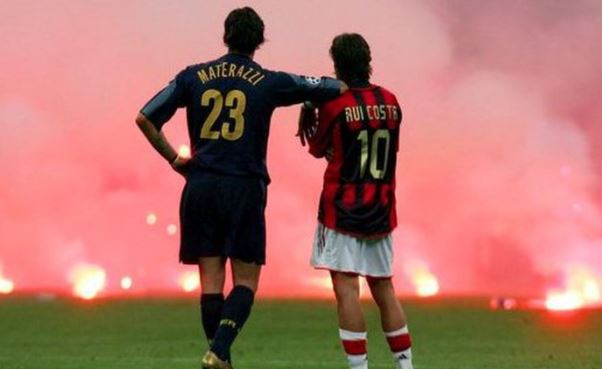
MAJOR ON-FIELD MOMENTS:
11 GOALS AND A COMEBACK
Arguably the greatest Derby della Madonnina took place in 1949, when Inter were considered heavy underdogs against their inter-city rivals. Milan quickly proved why they were favorites, taking a commanding 4-1 lead. But just when it seemed like Milan would run away with it, Inter struck back with two goals from Amadeo Amadei and Istvan Nyers’ second goal of the game to tie the score at 4-4. Benito Lorenzi then put Inter ahead 5-4, but Carlo Annovazzi tied things up at 5-5 with a rocket shot. The game had one more goal in it, with the winning strike coming from Amadei late. His hat trick secured an incredible 6-5 upset win for Inter. It remains the highest scoring game in rivalry history and one of only three times one side has scored six goals.
WHEN LIFE GIVES YOU LEMONS
One of the most bizarre stories you’ll see in any rivalry takes place in 1957, during a particularly heated contest in 1957. Inter’s Benito Lorenzi was fouled in the box, but no penalty was called. Just a few minutes later, a collision in the other box saw Milan be awarded with a penalty. As his teammates protested, Lorenzi noticed a lemon that had been thrown onto the field by a fan. He began to eat it, but thought of a better idea. While no one was looking, he placed the lemon underneath the ball at the penalty spot. Although the fans noticed, Milan’s Tito Cucchiaroni did not — his penalty kick sailed high as a result of the lemon, which Lorenzi allegedly kicked away afterwards. The game ended 1-0 to Inter and both teams brawled on the way off the field.
A BAKER’S DOZEN SECONDS
Before he would go on to become one of the most iconic players in Inter’s history, Sandro Mazzola broke through during the 1962-63 Serie A season, which the club won. It was during the second Derby della Madonnina of that campaign that Mazzola made rivalry history. At the kickoff, Beniamino Di Giacomo tapped the ball to Luis Suarez, who sent it to Mario Corso. The ball went down the line to Mazzola, who found Suarez. His first touch was a bit heavy, but Di Giacomo got a hold of the ball and sent it into the box, where Mazzola tapped it in. The whole sequence took just 13 seconds — the fastest goal in derby history — and not a single Milan player touched the ball the entire time. Despite the quick strike, the game would end 1-1.
ERASING THE DEFICIT
Despite the European success they had just achieve and were about to achieve, Inter hadn’t earned bragging rights against their rivals for five straight games during the 1964-65 season. In fact, Milan were eight points clear at the top of the league in January. But by the time the final Derby della Madonnina of the season rolled around, Inter had reduced the deficit to just three points. Hoping to seize the opportunity, Jair gave Inter the lead just five minutes into the match. Amarildo tied things up for Milan, only for two Inter goals to make things 3-1 with about 20 minutes left. Although Milan soon made it 3-2, a late brace from Sandro Mazzola gave Inter a 5-2 victory, which would prove to be vital — Inter ended up winning the league by just three points.
HATELEY’S HEADER
By the time 1984 rolled around, Milan were in Inter’s shadow. Milan’s last win against their rivals had come in 1978, a fact that was partially due to the club playing two seasons in Serie B. They desperately needed a win, although it certainly didn’t look likely when Alessandro Altobelli gave Inter a 1-0 lead early. Agostino Di Bartolomei managed to tie the match at 1-1, which was the scoreline at the hour mark. That’s when Franco Baresi won the ball back and found Pietro Paolo Virdis on the right side. Virdis whipped a cross into the box, where Mark Hatley rose above 1982 FIFA World Cup winning defender Fulvio Collovati and headed the ball past Italian soccer legend Walter Zenga to make it 2-1. That would be the final score, giving Milan their victory.
MILAN’S SENSATIONAL SIX
Usually for historic rivalries like the Derby della Madonnina, the most lopsided results come from long-forgotten early eras. Not in this case. In 2001, Milan put a thrashing on Inter that set an all-time record for ass-whoopings between the two clubs. Just two minutes into the contest, Gianni Comandi opened the scoring for Inter before adding a second goal with a header shortly after. Early in the second half, Federico Giunti made it 3-0, before Andriy Shevchenko netted a brace to make it 5-0. A few minutes later, Serginho wove through the Inter defense to add a sixth goal to complete the humilation. The 6-0 domination is the most lopsided match between these two clubs and one of the few times either club has put six goals into the net of the other.
FIGHTING FOR THE FINAL
The 2002-03 UEFA Champions League was dominated by Italy, with three Serie A clubs in the semi-finals. As luck would have it, one of those matchups was Milan against Inter, presenting an unusual situation: both legs being played at the same stadium. The first leg was a scoreless draw, while the second leg also ended in a draw — goals from Andriy Shevchenko and Obafemi Martins made the final score 1-1. However, because Milan was the designated home squad for the first leg and Inter technically hosted the second, Milan progressed through to the final on away goals. It was tough for Inter, especially as their two biggest rivals would meet in the first all-Italian Champions League Final. Milan would top Juventus in penalties after a 0-0 draw.
THE SEEDORF ROCKET
As the 2003-04 Serie A season wound down, Inter were hoping to hold onto their slim chances of catching Milan at the top of the standings. In the last Derby della Madonnina of the campaign, Inter got off to the exact start they desperately needed. Goals by Dejan Stankovic and Cristiano Zanetti put Inter up 2-0 at halftime. But Milan proved to be a tough out, as Jon Tomasson and Kaka scored within two minutes to even the count at 2-2. Things remained all square until five minutes remaining in the contest. That’s when Clarence Seedorf — who had moved from Inter to Milan two years earlier — decided to have a go from long distance, launching an absolute bomb into the Inter net. That gave Milan a 3-2 win and remains one of the best goals of the rivalry.
FLARE ATTACK
Inter and Milan haven’t met in European competition since 2005, although the most recent meeting endures. The first leg of their UEFA Champions League quarter-final battle saw Milan come away with a 2-0 victory. Inter’s hopes were seemingly dashed when Milan went up 1-0 in the second leg. This upset Inter fans, who proceeded to throw a metric shit ton of flares on the pitch. The sight of Marco Materazzi and Rui Costa looking on at the wall of fire before them (placed above) has since become one of the most iconic pictures in the history of soccer. Unfortunately, one of those flares hit Milan goalkeeper Dida, causing the referee to abandon the match. Milan was awarded a 3-0 win and went onto the semi-finals with a 5-0 aggregate victory.
ADRIANO THE HERO
Given what happened with the flares, the next Derby della Madonnina was sure to be quite emotional. It certainly was, arguably surpassing the atmosphere of any other match in the rivalry that didn’t involve on-field flares. Adriano put Inter up early, although a penalty gave Andriy Shevchenko the opportunity to even things up for Milan. Obefemi Martins gave Inter another lead in the second half, but a goal by Jakob Stam drew things level once again. Just when it looked like another draw was in store, Adriano proved to be the hero, scoring the winner with seemingly the final chance of the game. The stoppage time goal gave Inter a 3-2 victory, which also happened to be the club’s first Serie A win over their rivals in over theee years.
A SIGN OF THINGS TO COME
The 2009-10 season was Inter’s greatest ever, which should’ve been apparent by the second match of the season. Taking on Milan, Inter flexed the offensive power that would guide it to Serie A, Coppa Italia, and UEFA Champions League titles. Thiago Motta opened the scoring just before the half hour mark, followed by Diego Milito converting a penalty. Things soon got worse for Milan when Gennaro Gattuso was sent off just before halftime and Adriano made the score 3-0 with a stoppage time goal. Dejan Stankovic would complete the domination with another goal, as Inter recorded a 4-0 victory — one of their biggest ever over their rivals. While Inter would run rampant that season, it would take a year for Milan to get their awaited revenge.
THE ANSWER TO LIFE, THE UNIVERSE, AND EVERYTHING
Ahead of the final Derby della Madonnina of the season, defending Seria A champions Inter were trying to catch their rivals at the top of the standings. But this top of the table chash got off to a shocking start. Just 42 seconds after the opening kickoff, Alexandro Pato put the ball in the back of Inter’s net to give Milan a stunning lead. Just over an hour later, Pato was once again on the score sheet and doubling his squad’s lead. All hopes of an Inter comeback were dashed when Antonio Cassano converted a penalty. The end result was a 3-0 win for Milan and a season sweep of their rivals (who they would also beat in the 2011 Coppa Italiana). The three points proved to be vital, as Milan would win Serie A by just six points — with Inter in second.
MIGHTY MILITO & MICON
As the 2011-12 season ran down, Milan was clinging to a small chance of catching Juventus at the top of the standings. Unfortunately for them, Inter had other ideas. Diego Milito gave Inter the lead early, but a controversial penalty decision allowed Zlatan Ibrahimovic to even the score. Ibrahimovic made it 2-1 just over a minute into the second half, but Inter themselves were given two penalties, each converted by Milito to complete the hat trick. With Milan trying to salvage a draw, Inter instead put the dagger into their rivals thanks to an absolutely sensational lightning bolt of a goal from Maicon. The 4-2 Inter victory meant Milan could no longer catch Juventus, who were crowned Serie A champions — a result that didn’t exactly make Inter happy, either.
QUITE A FEISTY QUARTER-FINAL
Over the past decade, there have been worries the Derby della Madonnina has lost some of its passion and flare. Cue the 2021 Coppa Italia quarter-final meeing between Inter and Milan. Former Manchester United teammates Zlatan Ibrahimovic and Romelu Lukaku would take center stage, with chippiness between the two leading to them literally going head-to-head in a fiery confrontation. While Ibrahimovic opened the scoring, he would be sent off in the second half. A ten-man Milan soon conceded a penalty, which Lukaku converted to even the score. Things remained level until stoppage time, when Inter earned a free kick. Christian Eriksen sent the ball sailing into the Milan net to give Inter a dramatic 2-1 win and reignite fire into the rivalry.
SEMI-FINAL TURNS BLUE
20 years after their first UEFA Champions League semi-final matchup, Milan and Inter met again in that round of the competition. Not only were these two the two most recent Serie A champions, but this was the first time either club had advanced this far since the last time they won the final (2007 and 2010, respectively). Although Milan had just taken care of eventual Serie A champs Napoli in the previous round, Inter dominated the first semi-final leg, scoring twice in the first 11 minutes and securing a 2-0 win over the designated home squad. The second leg saw Inter continue to shut down Milan’s attack, adding a goal late in the contest to all but secure the tie. Indeed, the 1-0 win and 3-0 aggregate victory saw Inter move on.
STATISTICS:
HEAD-TO-HEAD RECORD
Inter: 89
Milan: 79
Draw: 69
LEAGUE CHAMPIONSHIPS
Inter: 19
Milan: 19
COPPA ITALIA
Inter: 9
Milan: 5
SUPERCOPPA ITALIANA
Inter: 7
Milan: 7
UEFA CHAMPIONS LEAGUE
Inter: 3
Milan: 7
UEFA CUP WINNERS’ CUP
Inter: 0
Milan: 2
UEFA EUROPA LEAGUE
Inter: 3
Milan: 0
UEFA SUPER CUP
Inter: 0
Milan: 5 (tied for record)
FIFA CLUB WORLD CUP
Inter: 1
Milan: 1
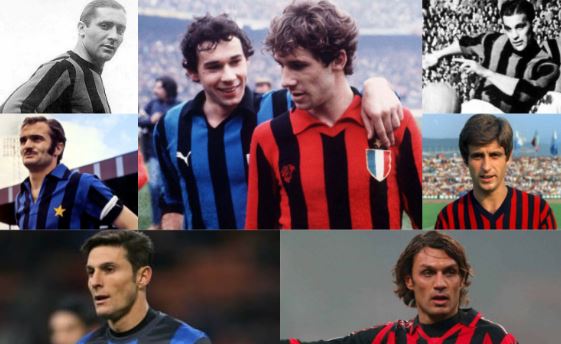
NOTABLE FIGURES:
GUISEPPE MEAZZA
The first truly great Italian soccer player, Giuseppe Meazza put his club and country on the map. During his 15 seasons with Inter, Meazza scored 284 goals — a club record to this day. Inter’s dominance in the 1930’s was largely due to Meazza’s effort and goal scoring prowess. Meazza was also incredibly successful for the national squad, leading Italy to FIFA World Cup victories in 1934 and 1938. Meazza is so widely regarded and celebrated as arguably the best Italian player ever that he received a unique honor: having the San Siro renamed in his honor.
GUNNAR NORDAHL
A part of Milan’s iconic “Gre-No-Li” trio of Swedish strikers, Gunnar Nordahl was the best and most successful of them all. While Nordahl only spent eight seasons with Milan, he managed to amass 221 goals in just 268 matches. Not only is Nordahl still the all-time leading goal scorer in Milan’s history, but by a long shot he’s the only player to score more than 200 goals for the club. Unsurprisingly, Il Cannoniere is the third-highest Serie A goal scorer ever and the highest non-Italian ever. His record for most goals in one Serie A campaign stood for an incredible 66 years.
NEREO ROCCO
While Nereo Rocco had a 15-year playing career that included an appearance for the Italian national team, his main contributions came while on the sidelines. Rocco is the longest-serving manager in Milan history — and the most successful. Under Rocco’s leadership, Milan claimed ten trophies, including two UEFA Champions League crowns, two Serie A titles, and three Coppa Italia victories. Perhaps even more important was what Rocco brought to Italian soccer tactically, being one of the first to embrace the Catenaccio system emphasizing strong defense.
HELENIO HERRERA
Helenio Herrera makes Jose Mourinho look like a humble, one-club manager. Before Herrera, no manager really claimed credit for his team’s success. But Herrera certainly did, making him the first managerial star in soccer history. To be fair, he deserved it. While he’s also well known for his stint with Barcelona, Herrera achieved his greatest success by leading the Grande Inter squad of the 1960’s, claiming back-to-back UEFA Champions League crowns and three Serie A titles. Also, whereas Nereo Rocco only used the Catenaccio system, Herrera invented it.
SANDRO MAZZOLA
Sandro Mazzola certainly had the genes of soccer royalty. His father, Valentino, was part of the Grande Torino squad who died in the Superga air disaster. Incredibly, Mazzola would go on to surpass his father’s legacy. Nicknamed “Poison,” Mazzola was the best player of the Grande Inter squad and along with Helenio Herrera led the club to its first European success. Mazzola remains fourth in Inter’s history for games played and goals scored. He was also known to annoy Milan fans, particularly during a heated game that ended up being decided by a lemon.
GIANNI RIVERA
Where Inter had Helenio Herrera and Sandro Mazzola, Milan had Nereo Rocco and Gianni Rivera. Dubbed Italy’s “Golden Boy” by the media, Rivera was an elegant and creative offensive playmaker, considered to be one of the best passers of all time. Third on Milan’s goals scored list and fourth for games played, Rivera was captain of the club for an incredible 12 seasons. Rivera also was a star on the Italian national team, representing his country at four FIFA World Cups and the 1960 Summer Olympics. Rivera also won the 1968 European Championship.
GIACINTO FACCHETTI
The definition of Inter’s model citizen, Giacinto Facchetti was the early definition of a one-club man. For 18 years, Facchetti protected Inter’s goal, becoming one of the greatest stalwart defenders of his era and of all time. Facchetti is third all-time on Inter’s games played list and one of only three players to record 600 games in the club’s shirt. Under Facchetti’s leadership, Inter won its grat collection of silverware in the 1960’s and 70’s. Faccheeti also served as Italy’s captain during its 1968 European Championship success — among other big tournaments.
GIUSEPPE BERGOMI
When Giancinto Facchetti retired in 1978, Inter had no idea the next iconic, one-club rock solid defender would join a year later. Nicknamed “Lo Zio” (the Uncle) due to his bushy eyebrows and impressive mustache that made him look like Borat, Bergomi somehow surpassed Facchetti’s legendary marks related to tenure at Inter. Only one man (we’ll get to him later) has played more games for Inter than Bergomi (756 total). Bergomi also retired with the records for most European games by an Italian and Derby della Madonnina appearances (both since broken).
FRANCO/GIUSEPPE BARESI
If you ever want a metaphor for the Derby della Madonnina, it’s the name Baresi. It’s the last name of two great Italian defenders. Guiseppe Baresi spent 18 years with Inter, becoming the club’s captain and ranking fifth on the club’s all-time games played list. He would unanimously be considered the best defender named Baresi if not for his younger brother, Franco, who somehow managed to surpass his brothers’s success — with the rival club. The 20-year Milan man, former captain, and club icon ranks second on his club’s all-time appearances list.
PAOLO MALDINI
It takes a lot to be unanimously considered the greatest player ever for a club with as much history and prestige as Milan. Paolo Maldini has more than enough to make that claim. For 25 years (the majority of which he served as club captain), Maldini was an unbreakable part of Milan’s back line. A seven-time Serie A champ and five-time UEFA Champions League winner, Maldini is by far Milan’s most capped player, with a staggering 902 appearances. Maldini’s efforts have left a great legacy as one of the greatest defenders to ever put on soccer cleats.
JAVIER ZANETTI
Inter’s greatest player of the modern era and perhaps of any era, Javier Zanetti was his club’s answer to Paolo Maldini for Milan. Joining Inter from his home of Argentina in 1995, Zanetti proceeded to spend the next 19 years with his new club, serving as captain for the majority of the time. With 858 appearances (more than 100 than Giuseppe Bergomi), Zanetti is Inter’s most capped player ever and the one who led them through their great 2009-10 season. Zanetti was also an icon for his home country, currently sitting second for caps for Argentina’s national team.
RONALDO
One of the greatest strikers and overall players in soccer history (as well as one of the fattest), Ronaldo simply does not give a fuck about club loyalty. One year after Barcelona broke the transfer fee world record to sign him, Inter broke it again to get him for five years. Ronaldo then left for Real Madrid in 2002, crossing the El Classico line. Five years later and not learning a single thing about rivalries, Ronaldo signed with AC Milan, crossing the Derby della Madonnina line as well. I put Ronaldo in this rivalry because his cleats are on display at the San Siro.
ANDRIY SHEVCHENKO
While the title of “greatest Ukranian soccer player ever” may not mean much to many, it actually understates how good Andriy Shevchenko was. While still far from Gunnar Nordahl’s record, Shevchenko ranks second on Milan’s scoring list with 175 and is the only one within 50 goals of the top spot. But Shevchenko does hold another big honor: the all-time leading scorer in the Derby della Madonnina (14 goals). Ukraine’s all-time top goal scorer played with Milan for eight seasons, winning the Ballon d’Or in 2004 and two UEFA Champions League titles with the club.
ANDREA PIRLO
One of the greatest passers and playmakers of all-time (earning the nickname “The Maestro), Andrea Pirlo might be Inter’s biggest ever regret. Pirlo signed with Inter in 1998, but somehow failed to break into the regular squad for three years. He was then sold to Milan, where Carlo Ancelotti was able to move him into proper position and transform him into a world class star. During Milan’s legendary 2002-03 season, Pirlo led Serie A in passes played, ball possession, successful balls, and successful passes. Prilo would leave for another rival (Juventus) in 2011.
GENNARO GATTUSO
As crucial as Andrea Pirlo was to Milan’s 2000’s success, he wouldn’t have done as well without Gennaro Gattuso as his midfield counterpart. Where Pirlo was composed and creative, Gattuso relied on energy, aggression, and hard tackling. Gattuso was renowned for his legendary fiery and competitive nature, with his leadership ability earning him the captain’s armband when Paolo Maldini was out and after his retirement. Gattuso also joined other Milan legends by becoming the club manager after his own career ended, although he’s now in charge of Napoli.
DIEGO MILITO
Often forgotten among the great Argentinian players of the new millennium, Diego Milito made a permanent impact on Inter despite being with the club for only five years. It’s no coincidence that Milito’s arrival in 2009 coincided with Inter’s greatest season ever. In the 2009-10 season, Milito scored 30 goals across all competitions, including two in the UEFA Champions League Final. Milito is also on the exclusive list of players to ever record a hat trick in the Derby della Madonnina. Across his professional career, Milito averaged a goal for every two appearances.
ZLATAN IBRAHIMOVIC
The best way I can desribe Zlatan Ibrahimovic is one of the generation’s most talented soccer players whose personality is that of Charles Barkley combined with Muhammad Ali. The controversial (he’s the guy who just criticized LeBron James for his activism) striker has been all over Italian soccer, starting with Juventus and becoming one of the rare players to then make the move to Inter. However, after years at other clubs Ibrahimovic is now at Milan (his second time there), where he refocused his anger and is starting fights with Inter’s Romelu Lukaku.
FAN INVOLVEMENT:
Make no mistake, there is genuine animosity between supporters of the two clubs. During the 1960’s and 70’s, the fans would often become quite a menace to players on the field (where else would Sandro Mazzola have gotten a lemon?). Things continued to escalate during the 1990’s and 2000’s, piling up to the point where flares thrown by angry Inter fans hit Milan’s goalkeeper and caused the abandonment of a UEFA Champions League match. It was during some of several matches like this where flares and fighting expanded from the ultras sections and into the general family stands. After a particularly dangerous incident, members of both ultras groups got together to create a new policy, one that changed the atmosphere completely.
Whereas other derbies in Italy and other rivalries involving Inter and Milan often cross the line between competitive nature and danger, the modern Derby della Madonnina has a unique atmosphere of intensity and passion, without any fear of things boiling over. Where with many rivalries you can’t talk to rival fans or even live with them, families are often split between Milan and Inter fans, with no animosity other than competitive shit talking. In a sense, the Derby della Madonnina has become the most American-esque major soccer rivalry in the world. But where some might think this takes away from the rivalry, what it does is turn the San Siro into something truly legendary on derby day. It helps attract fans from across Milan, Italy, and the rest of the world, helping the rivalry grow every day. Also, both sets of fans make badass tifos.
SUMMARY:
The Derby della Madonnina was born out of an ideological split and has since seen its two clubs achieve incredible success domestically and abroad, while featuring some of soccer’s biggest stars and Italy’s most memorable soccer moments. It features the best of what makes a rivalry great, with recenty history between the two clubs giving hope that Inter Milan and A.C. Milan can both return to world-beating form.
There’s one other thing about this rivalry I feel I should mention. Objectively, the Derby della Madonnina is exactly what I think a rivalry should be. In terms of everything from success to legendary players to competitive results to the glamor of the host city/stadium to even how the two uniforms contrast, it stands among any other rivalry in the world. But as I’ve mentioned throughout this experiment, the level of hatred between fan bases can often cross the line, with fights and on-field riots and racism and even death. While I would love to go to any rivalry game I’ve mentioned so far and have yet to mention, I can’t help but think I’d feel at least a slight hint of danger while in the stands. The modern day Derby della Madonnina is the lone exception. I said above that this seems the most American-esque major soccer rivalry and maybe the bias of that comparison is showing. But forgive me for thinking it would be nice to go to a sporting event without fearing for my life, not dealing with people who literally want to fight me and kill me because I happen to support their favorite team’s rival. I may think lakers fans or yankees fans are glory hunters whose heads are shoved so far up their own asses they can smell their own lunch as it’s being digested, but I don’t want to kill them. That’s going to far.
All that being said, this is the World Cup of Hate, which as the name implies means hatred is ket to winning. As much as I personally like the level of hatred for the Derby della Madonnina, the lack of match day animosity in comparison to other rivalries may hurt it in the long run. Only time will tell. Still, it’s got enough history, prestige, memorable moments, and hatred to unquestionably qualify for the final tournament. But that also means two great rivalries are excluded, both involving Inter and Milan’s other big rival and the biggest club in all of Italy: Juventus. Inter and Juventus contest the Derby d’Italia, one of the biggest and fiercest in the entire country. The Milan-Juventus rivalry is also one of the best in Italy, one that has an equally great impact on the country’s stock market. But not only does Juventus have the clear edge statistically against both clubs (especially Inter), it also dominates Italy, having won by far the most Serie A titles (36, or one more than Milan and Inter combined). Plus, Juventus is kind of hated by every club in Italy, especially Torino. The two Turin clubs contest the Derby della Mole, which (predictably) Juventus dominates. Juventus is simply too good and hated by too many clubs (they have like five major rivalries) to have any of its rivalries qualify.
No, the one other Italian soccer rivalry that qualifies for the World Cup of Hate does so in the completely opposite manner of the Derby della Madonnina. Imagine each rivalry graded statistically, with most of the stats related to success, silverware, world class players, glamor, and prestige that Milan and Inter have dumped instead into hatred and atmosphere. Where I mentioned the Derby della Madonnina as the one I’d likely feel most safe at, this rivalry falls on the opposite end of the spectrum. It’s history of hatred rivals even that of the city it’s based in.

Derby della Capitale (Italy)
A.S. Roma vs. S.S. Lazio
“In Rome it’s different. Only five Scudetti have ever gone to the capital. It’s all about the derby. In Rome, you are Roman. And you’re either Lazio or Roma.” — Aurelio Capaldi, Italian sports journalist
The Derby della Capitale contains some of the purest and deepest hatred in all of sports, forming the basis for a legendary rivalry that embraces passion, pride, and persistence — along with more than a bit of the dark side of soccer.
One of the biggest cities in Europe and one of the oldest and most important in all of human history, Rome is home to ancient marvels and the place where many basic practices and principles of society and civilization were created. However, one of the few things Rome is lacking is success in soccer. The city’s two biggest and most prestigious clubs — A.S. Roma and S.S. Lazio — have combined to win five domestic championships and one continental trophy. Seven clubs and five cities have won more Serie A crowns than Italy’s capital city. But even without the success, Rome demands the spotlight, putting Roma and Lazio’s fight center stage.
While Rome’s two clubs rarely have silverware to right for, they have something that’s become even more precious to have: bragging rights over the other. Both clubs have become territorial symbols of their city. Roma’s colors represent the Vatican City (yellow) and Imperial Rome (red), while its badge has associations with Mars (the Roman god of war) and the story of the foundation of Rome. Lazio’s sky blue color dates back to Ancient Greece, while their eagle mascot is the sacramed animal of Jupiter (the Roman god of the sky and lightning). Whoever wins the derby gets to have their symbols and colors represent the city.
With so few domestic titles ever being won by Roma and Lazio, the rivalry has become so important to win in order to give fans something to make the season worthwhile. In fact, the majority of Roman soccer fans will say they would prefer a win over their rivals to even a Scudetto. But while this single-minded focus on city superiority highlights the passion Italians have become well known for, it also has led to an almost unparalleled level of violence, animosity, and some even nastier behavior that turns the Stadio Olimpico (shared as a home stadium by the two clubs) into a war zone. Compared to the hatred between Roma and Lazio, Alabama and Auburn, Michigan and Ohio State, Duke and North Carolina, and Cal and Stanford are all the best of friends.
HISTORY:
Societa Sportiva Lazio was founded at the turn of the 20th century, being christened as Societa Podistica Lazio just nine days into 1900. For the first ten years of its life, Lazio was an amateur team. But when the Italian Football Federation began organizing championships, the club turned pro and were among the best clubs of the country. Lazio won the final of the national championship playoff three times from 1913-23, losing each time. But even so, Lazio was clearly the best major soccer club in all of Rome. The vast majority of their competition was about to be transformed, thanks to one of the biggest moves in Italian soccer history.
They say Rome wasn’t built in a day, but the Derby della Capitale was — thanks to Benito Mussolini. Italy’s Fascist dictator wanted a strong Roman club to challenge the dominance of Northern Italian clubs, so in 1927 he decided to create a unified team for all of Rome by combining all of the major clubs in the capital city into one mega club. However, one club resisted the merger: Lazio. Thanks to the influence of Fascist general Giorgio Vaccaro, Lazio was allowed to remain independent. However, the other three clubs — F.C. Roman, S.S. Alba-Audace, and Fortitudo-Pro Roma S.G.S. — were forced to merge into one. Remember that other major move by Mussolini I mentioned in the Derby della Madonnina seciont? This is it, and it led to the creation of Associazione Sportiva Roma, along with the Derby della Capitale. With its roots being resistance to a move by a literal dictator, it’s no wonder the hate between what was now Rome’s two biggest clubs began deep and fierce.
Even though Roma was founded in 1927, it would take until 1929 and the official formation of Serie A to see the first ever Derby della Capitale — a 1-0 road win for Roma. It would take another three years (Roma got off to a 4-0-2 start in the rivalry) for Lazio to get their first win over their new inner-city rivals. But just a year after that, Roma thrashed Lazio 5-0 — a result that still stands as the largest margin of victory between the two clubs. This scoreline was an indicator of Roma’s early dominance in the rivalry, with Lazio recording just two wins in their first 19 derbies (although one of those was the first ever Coppa Italia tie between the two clubs). The early edge was reflected in the domestic standings, with Roma consistently in the Top 6 and Lazio much closer to the bottom. But by the end of the 1930’s, fortunes had begin to reverse, with some of Roma’s best players from its founding retiring. From 1941-43, Roma recorded two 11th place finishes. Quite unexpectedly, the other season in that stretch saw Roma win Serie A, bringing home Rome’s first ever scudetto in 1942.
However, that would be the only piece of silverware for any Roman club for quite some time. In fact, Roma would go into an immediate tailspin. A series of finishes near the bottom of the table eventually resulted in Roma’s only ever relegation to Serie B in 1951. However, Roma went back up to Serie A the following year and went back to being a consistent Top 6 club. But it would be their rivals who would finally break Rome’s title drought. During the past decade, Lazio had seen mixed but consistent results. Three straight fourth place finishes followed by 10th, 11th, and 12th followed by back-to-back third place results followed by 12th, 11th, and 12th. Yet it was during their second 12th place season in that span when Lazio made an unexpected tournament run, winning the Coppa Italia — the first for Italy’s capital city. However, just a few years later Lazio would also be relegated to Serie B, where it would remain for two years.
The 1960’s would finally bring Roma new pieces of silverware. After winning their first international trophy with the Inter-Cities Fairs Cup in 1961, Roma brought home its first Coppa Italia in 1964. But the following season, financial problems finally caught up to Roma, with manager Juan Carlos Lorenzo announcing at one point that the club couldn’t afford to pay its players or even travel to its next match. Supporters held a fundraiser at the Sistine Theater, raising enough money to keep the club going. Bankruptcy was eventually avoided thanks to the election of new club president Franco Evangelisti. Four years later, roma would reward its fans’ efforts with another Coppa Italia victory, with Giacomo Losi setting a club appearance record that would stand for 38 years. As for Lazio, the decade saw them consinstently finish mid to bottom of the table, with a multi-year relegation at the end of the decade. Another relegation followed in 1971, although no one could’ve predicted what the next ten years would bring.
Incredibly, Lazio suddenly became title contenders once they returned to Serie A. After losing out on the title on the following day in 1973, Lazio rebounded by claiming its first ever scudetto in 1974. But just when it seemed like Lazio would start its first truly great run, tragedy struck. Manager Tommaso Maestrelli was diagnosed with liver cancer months after winning the title, passing away in 1976. One of his star players — Luciano Re Cecconi — was a part of another tragedy a month later when he jokingly shouted “this is a robbery” while standing with his hands inside his pockets at a friend’s jewelry shop. The store owner, who had his back to Re Cecconi, grabbed a gun and shot him, killing him. Yet another tragedy would occur during a Derby della Capitale in 1979, when Lazio fan Vincenzo Paparelli was hit in the eye and killed by a flare fired from the opposite end of the Stadio Olimpico by a Roma fan. Paparelli became the first fatality due to violence in Italian soccer history — he would not be the last, especially when these two rivals are involved. As if that wasn’t enough, Lazio would soon find themselves in the middle of a match betting scandal that sent themselves (along with A.C. Milan) back down to Serie B. Incredibly, things would soon be worse thanks to their rivals.
After a bleak 1970’s, Roma emerged as one of the top teams in all of Italy in the 1980’s. Under former Milan striking legend Nils Liedholm and with players suchas Bruno Conti, Roberto Pruzzo, and Falcao, Roma won back-to-back Coppa Italia titles in 1980-81. Roma narrowly lost the 1981 Serie A title thanks to a controversial officiating decision that negated a goal by Maurizio Turone against Juventus, turning a potential 1-0 win into a 0-0 draw. Roma would eventually get that elisive second scudetto two years later, their first in 41 years. The following season, Roma not only won another Coppa Italia but also made it to the 1984 UEFA Champions League Final, losing on penalties. Two more Coppa Italia titles would follow in 1986 and 1991, the latter year seeing them reach the UEFA Europa League Final (which they lost to Inter Milan). The following year saw something perhaps even more importance: the first team debut of future captain, club icon, and Roma god Francesco Totti.
1992 was significant for another reason. While Roma was having by far its most successful decade, Lazio was struggling to stay afloat. The club was stuck in Serie B following its scandal for three years, but in 1985 a last place finish saw them relegated again. Then, Lazio was hit with a nine-point deduction for another betting scandal involving player Claudio Vinazzini. It took two playoff wins for Lazio to avoid being relegated to Serie C. Lazio returned to Serie A in 1988, but were just kind of surviving. Then in 1992, Sergio Cragnotti became president of Lazio, injecting a much-needed source of cash and planning into the club. Cragnotti’s first big move was to bring in Paul Gascoigne from Tottenham Hotspur, which led to an increase in interest in Serie A in the United Kingdom. Stars like Juan Sebastian Veron, Christian Vieri, and Hernan Crespo were also brought in, working with homegrown talent like Alessandro Nesta.
After dealing with the Milan and Juventus juggernauts of the 1990’s, Lazio’s persistence finally paid off towards the end of the decade. A Coppa Italia and Supercoppa Italiana in 1998 was followed by international success — a UEFA Cup Winners’ Cup and UEFA Super Cup in 1999. That year also saw them lose the Europa League title to Inter. Another Coppa Italia and Supercoppa Italiana followed in 2000, along with Lazio’s second ever scudetto (and first in 26 years). The turn of the millennium also saw Lazio become the first Italian soccer club to be quoted on the stock market. But things couldn’t last forever. Cragnotti soon began to run out of money and in 2002, a financial scandal involving Cirio (the food company Cragnotti owned) forced him to step away from Lazio. As a result, the club was forced to sell off star players, including club captain Nesta (who would achieve great success with Milan). The downturn of Lazio in the early 2000’s coincided with the revival of their arch rivals.
Powered by captain Totti and a renewed roster filled with the likes of Aldair, Cafu, Vincenzo Montella, and Gabriel Batistuta, Roma responded to Lazio’s 2000 scudetto by winning Seria A in 2001, giving them their third and as of this writing the last for any Roman club. The Derby della Capitale played a big role in the result, with a 1-0 win by Roma (thanks to a Lazio own goal) helping them win the scudetto by two points. While this was a great achievement, it would also prove to be Roma’s only one in an era that could’ve seen so much more. During the 2000’s, Roma finished in the Top 2 of the league six times — more than any other decade. However, the 2001 season was the only one of those to see a first place result. From 2002-17, Roma finished second in Serie A nine times and runner-up in the Coppa Italia five times. Still, there were two more Coppa Italia wins and one more Supercoppa Italia (after 2001) crowns for Roma. While Roma also made headway in Europe (reaching the knockout stages of the Champions League), they were eliminated by English clubs, suffering particularly bad defeats to Manchester United. But most importantly, that period also saw an overall dominance by Roma in the Derby della Capitale, although there were some bright spots for Lazio.
In 2004 — a year that also saw a Derby della Capitale abandoned for an off-field incident (more on that later) — Lazio managed to recover from financial gloom to win another Coppa Italia. After being banned from competing in the Europa League due to the Calciopoli match fixing scandal, Lazio had to watch as Roma won the Coppa Italia in 2007 and 2008. But a chance for a Roma three-peat was ended, as Lazio won it (along with the Supercoppa Italiana) in 2009. Two more Coppa Italia and Supercopa Italia titles have followed, with the most recent for each coming in 2019. The 2010’s also saw the biggest Derby della Capitale to date, when Roma and Lazio met in the 2013 Coppa Italia Final (a 1-0 Lazio victory). Towards the end of the decade, Roma went out with a bang, seeing Totti become the all-time derby goal scorer before returing in 2017 and reaching the Champions League semi-finals in 2018 (scoring a remarkable comeback victory against Barcelona in the quarter-finals). But Lazio has recently been struggling with something else: COVID-19, resulting in fines and suspensions (including for the club president).
With neither club doing much to threaten for the Serie A title and the resurgence of the Milan clubs, the Derby della Capitale has instead focused on an unexpected part of the rivalry: the venue. Since 1953, Roma and Lazio have shared the Stadio Olimpico, a famous venue both in Italy and Europe. But over the past decade, both clubs have seriously looked at finding a new home. Despite the mayor of Rome rejecting the idea in 2017, Roma got approval for the construction of a new stadium — Stadio della Roma — to be moved into once their lease with the Stadio Olimpico expires. However, while the stadium was expected to be ready this past season, several delays (including the COVID-19 pandemic) have left the new stadium with an uncertain future. Meanwhile, Lazio (whose president Claudio Lotito claimed in 2018 that their new stadium would be built before Roma’s) is looking at creating the Stadio della Aquile. However, much like the Stadio della Roma, it’s future is unknown at this point. But should either stadium be built, it would mean the end of the shared stadium era of the rivalry, the atmosphere of which has been greatly helped by the Stadio Olimpico. Still, the Derby della Capitale has plenty of hatred to thrive at any venue.
MAJOR MOMENTS:
CHINAGLIA’S CELEBRATION
Giorgio Chinaglia led all of Serie A in scoring in 1973-74, helping Lazio win its first scudetto that season. By far his most memorable came in the first Derby della Capitale of the campaign. Both clubs were deadlocked at 1-1 as the game got closer to the final minutes. But it wouldn’t end in a draw, thanks to a strike from Chinaglia. After scoring what would prove to be the match-winning goal, Chinaglia ran over to the Curva Sud (Roma fans traditionally sit in the south side of the stadium, while Lazio fans sit in the Curva Nord — or north) and pointed at the opposing fans in his celebration. While Chinaglia got the last laugh, he received so many threats from Roma supporters that he carried a gun with him wherever he went in Rome after the match.
GAZZA’S LATE GASP
So far, the MVPs of this experiment are Graeme Souness and Paul Gascoigne. This will be the last time we hear Gazza’s name, although his contribution to the Derby della Capitale is just as memorable as his to the North London Derby and the Old Firm. After pissing off Lazio chief Sergio Cragnotti with a greeting of “Tua figlia, grande tette” (Your daughter, big tits), Gascoigne got on his good side against Roma, who were winning a typically tight 1992 contest 1-0 with just a few minutes remaining. Enter Gascoigne, who headed home a late cross to salvage a 1-1 draw and send the Lazio fans into pure elation. It was one of the few exciting moments of the derby in the early 1990’s, which saw seven straight draws — six of which finished exactly 1-1.
DOWN BUT NOT OUT
Arguably the best Derby della Capitale to date took place in 1998, while Lazio were fighting across Europe and Roma were starting to pick themselves up. Roma jumped on top early thanks to Marco Delvecchio, although Roberto Mancini soon evened things up for Lazio. In the second half, disaster struck for Roma, who saw Fabio Petruzzi be sent off following another goal from Mancini and one from Marcelo Salas. Down to ten men and trailing 3-1, Roma didn’t give up, with Eusebio Di Francesco clawing a goal back in the 78th minute. Just three minutes later, Francesco Totti would score his first derby goal, which ended up being the last in the 3-3 draw. The lost points would prove crucial for Lazio, who missed the scudetto by just one point.
LONG-AWAITED WIN
The 3-3 draw earlier in the 1998-99 season may have been a bit of a relief for Roma, but it didn’t end the bigger problem. Roma had not beaten Lazio in nearly five years. But there would be one more chance to do so that season and Roma would take full advantage thanks to Marco Delvecchio, who scored just 13 minutes into the match. Delvecchio would add one more to make it 2-0 Roma at halftime. Lazio fought back late, with Christian Vieri narrowing the lead to 2-1. But in the last minute ot the match, Francesco Totti found the back of the net to seal the 3-1 win for Roma. The victory not only ended Lazio’s derby dominance, but began a great stretch for Roma. Lazio would only defeat Roma once across the next seven years (14 total games).
OH NO, PAOLO
In claiming their first scudetto in decades, Roma needed every point they could get during the 2000-01 season, taking everything they could get to win Seria A by two points. Unexpectedly, two of their biggest points came courtesy of one of Lazio’s best players. During his time with Lazio, Paolo Negro was a great defender who won eight trophies. But in terms of the Derby della Capitale, he’s best remembered for something that wasn’t his fault. With Roma and Lazio tied 0-0 late, Alessandro Nesta tried to clear a ball out of the box. Unfortunately for Lazio, Negro was standing in the way. The ball went off Negro and into the net, the own goal being the only one in a 1-0 win. 21 years later, Negro is still taunted by Roma fans for the memorable error.
CASTROMAN THE HERO
Lucas Castroman spent the vast majority of his career in his native Argentina, with only four years playing in Italy. Three of those were with Lazio, though he is remembered more fondly by fans than some players who’ve spent five times as long with the club. That’s when happens when you hurt Roma and their chances to win the scudetto (which they did end up winning). In their second clash of the 2000-01 season, Roma jumped on top 2-0 less than ten minutes into the second half. But Lazio would not give up, with Pavel Nedved making things 2-1 in the final 15 minutes. That was still the scoreline five minutes into stoppage time. With seemingly the last kick, Castroman managed to find the equalizer for Lazio, stunning everyone with a 2-2 draw.
FOUR FOR VINCENZO
During his time with Roma, Vincenzo Montella scored goals as often as he had squabbles with manager Fabio Capello. But because he had a knack for scoring goals against Lazio, he was beloved by Roma supporters. No brighter did Montella shine than during a memorable 2002 encounter, when the defending Serie A champs dominated their rivals. Montella made history in the process, scoring four goals — a mark never before seen or since matched in any match between the two clubs. But what was starting to become a theme was Francesco Totti scoring against Lazio as well, adding one more goal. Only a penalty goal by Lazio made the result 5-1, preventing Roma from equalling the all-time record Derby della Capitale margin of victory.
ABSOLUTE CHAOS
Four minutes into the second half of the first Roma-Lazio clash of 2004, shit hit the fan. A rumor that a boy had been killed by a police car spread through the Stadio Olimpico (fueled by a white sheet covering a body spotted outside). Fans stormed the pitch in a riot, with Roma’s ultras asking Francesco Totti to stop the match. Totti went to referee Roberto Rosetti, who (after a chat with league officials) abandoned the game. As it turned out, the boy had not died, but rather had trouble breathing due to tear gas (the sheet was being used as a filter). After the postponement, fans and police clashed, resulting in 13 arrests, more than 170 people injured, and several fires being set. The match was eventually replayed, ending in a 1-1 draw with no crowd trouble.
ENCOURAGING FASCISM
Paolo Di Canio was one of Lazio’s great modern era players. Given that he is an admitted fascist, this does not do well to diminish Lazio’s troubling history with the far right side of the political spectrum. Nowhere was this more apparent than a 2005 Derby della Capitale match, when Di Canio found the back of the net in a 3-1 Lazio win. As part of his celebration, Di Canio (who has tattoos of Benito Mussolini and claims the dictator was “deeply misunderstood”) ran towards the Roma supporters and raised his right arm in a fascist salute. Thankfully for him (and quite frankly everyone involved) there was a huge pane of glass preventing Roma fans from getting at Di Canio, who to this day remains a celebrated figure by Lazio’s biggest fans.
DELIO TAKES A DIVE
One of Rome’s popular attractions is Janiculum Hill, which presents some of the best views in the entire city. It also includes a massive fountain that in 2006 became a new symbol of the Derby della Capitale. Before the first Roma-Lazio clash of the 2006-07 season, Lazio manager Delio Rossi promised fans that should his club win, he would jump in the fountain. I guess his players must’ve really wanted to see their manager get wet, because they responded with their largest win over their rivals in years. Cristian Ledesma, Massimo Oddo, and Massimo Mutarelli each scored as Lazio scured a 3-0 victory. Afterwards, during the cold December European night, the then 50-year-old Rossi dove into the Janiculum fountain with nothing on but a speedo.
VALON SECURES LATE VICTORY
The 2007-08 season was another one where Roma came achingly close to winning a fourth scudetto, finishing just three points behind Inter Milan at the top of the table despite ending the campaign on a nine-match unbeaten streak. Perhaps three more points in the tenth-to-last result could’ve changed things. As you might’ve guessed, that one came against Lazio. It was a typical back-and-forth affair, with Lazio answering a Roma goal to make it 1-1 at halftime. A second half Lazio goal was answered by Roma, with both clubs standing at two goals and three yellow cards each going into stoppage time. Those extra minutes gave Valon Behrami time to be a hero and redeem himself from an early mistake, scoring to give Lazio a dramatic 3-2 win.
KLOSE CALL
The final Derby della Capitale of 2011 was as chaotic and dramatic as usual. Roma jumped out to an early lead thanks to Pablo Osvaldo’s fifth minute goal and appeared to be in control early in the second half. But then Simon Kjaer saw red, taking down Cristian Brocchi in the box. He then saw literal red (a red card) and Hernanes converted the ensuing penalty to even the count at 1-1. Somehow, Roma managed to keep things even despite being down a man. But then in stoppage time, Lazio would break their rivals’ hearts again, thanks to Miroslav Klose (who happens to be the all-time top goal scorer in FIFA World Cup history). Klose found the back of the net three minutes into stoppage time to give Lazio another dramatic win three years later.
CAPITALE COPPA ITALIA FINAL
There have been many matches between Roma and Lazio in the past. But only a few have happened outside league play, with just one final. Of course, it had to be the Coppa Italia, the final of which is typically played in Stadio Olimpico. In 2013, Rome’s legendary derby also had silverware on the line, as Roma and Lazio met for the first time in the final of the competition. It was just the third ever derby to take place in the final of the Coppa Italia and it was hyped up as perhaps the biggest Derby della Capitale ever. However, for the most part the match was actually kind of boring. The trophy would end up going to Lazio, thanks to Senad Lulic’s goal. By the way, PSY performed “Gangnam Style” before the match and was mercilessly booed.
THE SELFIE DERBY
By the time 2015 rolled around, Roma icon Francesco Totti was in his last few years. However, he would prove that not only did he still have something left in the tank, but also he was in tune with the times. In the first Derby della Capitale of the year, Lazio jumped out to a 2-0 lead before a half hour had passed. But the second half belonged to Totti, who first found the back of the net in the 48th minute to make it 2-1. 17 minutes later, Totti scored again to even things up at 2-2 (which would be the final score). That second goal made history, with Totti becoming joint top goal scorer in the rivalry with 11 goals (tied with Dino Da Costa). To celebrate, Totti ran to a team official, grabbed his phone, and took a selfie with the Roma fans in the Curva Sud.
FIGHT TO THE FINISH
While Roma and Lazio had no chance to catch Juventus atop Serie A, both clubs were fighting for second place, which would mean an automatic spot in the UEFA Champions League. So when the Derby della Capitale rolled around with Roma in front of Lazio by a single point and just two games left in the season, there was a lot to play for. The Stadio Olimpico was tense throughout the match, which went 70 minutes without a goal. Then Juan Iturbe put Roma ahead, only for Lazio to equalize thanks to Filip Dordevic’s 81st minute goal. Of all the big names on both sides, it would be defender Mapou Yanga-Mbiwa to score the winner. His only goal in his only season for Roma gave his club a 2-1 victory and clinched a spot in Europe.
IT ALL BEGAN WITH A WATER BOTTLE
In December 2016, Roma scored a 2-0 win over Lazio. But the result was overshadowed by controversy on and off the field. Kevin Strootman opened the scoring for Roma — during his celebration he threw the contents of a water bottle at Lazio substitute Danilo Cataldo, who grabbed at Strootman in anger. Strootman went down and suddenly a mass brawl broke out along the Lazio bench, with Cataldo being given a straight red card. The brawl was cleared up, but the bad feelings lingered. After the match, Lazio’s Senad Lulic said that Roma’s Antonio Rudiger (who is black) was “selling socks and belts” two years prior. That term is extremely racist towards people of African descent and Lulic was given a suspension and fine as a result.
STATISTICS:
HEAD-TO-HEAD RECORD
Roma: 73
Lazio: 57
Draw: 66
LEAGUE CHAMPIONSHIPS
Roma: 3
Lazio: 2
COPPA ITALIA
Roma: 9
Lazio: 7
SUPERCOPPA ITALIANA
Roma: 2
Lazio: 5
UEFA CUP WINNERS’ CUP
Roma: 0
Lazio: 1
UEFA SUPER CUP
Roma: 0
Lazio: 1
INTER-CITIES FAIRS CUP
Roma: 1
Lazio: 0
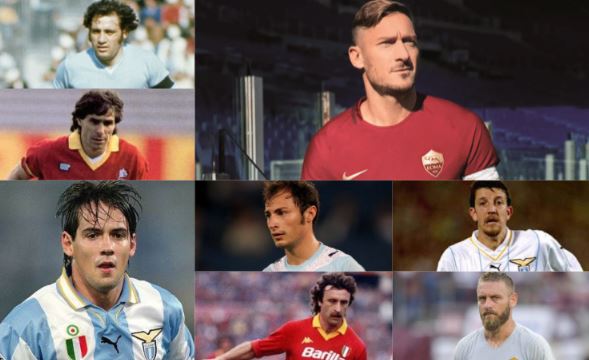
NOTABLE FIGURES:
FULVIO BERNARDINI
There have been people to be part of both Roma and Lazio, but no one has done it like Fulvio Bernardini. As a player, he made over 100 appearances for Lazio before joining Roma (after a spell at Inter Milan) just a year after its creation. Bernardini played in over 300 matches for Roma and — six years after his retirement — decided to get into managing and chose Roma as his first spot. Bernardini left Roma in 1950, but returned to Rome eight years later — this time as manager of Lazio, where he spent two seasons. Maybe it should be the Derby della Bernardini.
SILVIO PIOLA
One of the greatest Italian strikers of his or any other generation, Silvio Piola is high up on many record lists. Although he retired in 1954, Piola has still scored more goals (274) than any other player in Italy’s top flight history and made the fourth-most appearances ever. Piola also has a unique honor of being the top Siere A scorer for three different clubs: Pro Vercelli, Novara, and Lazio. He spent the most time with Lazio, making more than 200 appearances and putting 149 balls in the net. However, his record at Lazio may fall as sson as this year (more on that later).
AMADEO AMEDEI
Roma’s first truly great player, Amadeo Amadei got things started early. He made his Serie A debut at just 15 years and 280 days old (still a record) and by the time he was 18 he was a part of the Roma lineup. A prolific striker who could make acrobatic plays in the air or straight up take the ball from midfield and put it right in the net, Amadei appeared in around 300 matches for Roma, retiring as the club’s all-time leading goal scorer at the time. During his time with Roma, Amadei also did something much more important: help the club win its first scudetto.
DINO DA COSTA
Born in Brazil and playing the first seven years of his career with Brazilian club Botafogo, Dino de Costa made a new life in Italy, where he would eventually acquired citizenship. It helped that he became a Roma legend, which was impressive given that he only spent six years (less than half of his total time in Italy) employed by the club and ranks just tenth all-time on Roma’s goal scoring list. However, 11 of those 79 goals came against Lazio, making him a particularly useful weapon for Roma. Da Costa remains tied for most goals scored in Derby della Capitale history.
GIACOMO LOSI
Although he wasn’t born in Italy’s capital, Giacomo Losi was eventually earned the nickname “Core de Roma” (Heart of Rome). That’s what happens when you spend the entirety of your 14-year career with Roma. A hard-nosed defender, Losi retired having played 455 matches with Roma, a record that stood for 38 years. One of the most memorable of those games took place in 1961. With Roma locked at 2-2 with Sampdoria, Losi was injured, but stayed on due to Roma not having any subs. He ended up scoring the winning goal, endearing himself to Roma fans.
GIORGIO CHINAGLIA
When Lazio finally broke through to win its first Serie A title in 1974, it was thanks in large part to the foot of Giorgio Chinaglia. The leading scorer of the 1973-74 Serie A season, Chinaglia ranks fourth on Lazio’s goals scored list and quite frankly should’ve had much more for the club. However, he was lured away to an unexpeted place: the United States. Chinaglia would spend another seven years with the New York Cosmos, where he won four NASL titles and was the league’s all-time leading scorer. In 2000, Chinaglia was named Lazio’s greatest ever player.
GIUSEPPE WILSON
Giuseppe Wilson had a lot of names. He was born in England as Joseph but was referred to as Giuseppe due to his lengthy career in Italy, where he also earned the nickname “Pino.” The majority of that career was spent at Lazio, where he ranks third for all-time appearances with 394. But Wilson also has another distinction with Lazio: being one of the 15 named in the 1980 betting scandal that saw Lazio relegated. Interestingly, Wilson (who joined Lazio the same year as Giorgio Chinaglia did), ended up following Chinaglia to the New York Cosmos for one year.
BRUNO CONTI
Apart from two loans to Genoa, Bruno Conti spent his entire 18-year career with Roma. During those nearly two decades, Conti established himself as one of the greatest Italian midfielders of all time. One of the few players to make more than 400 appearances for Roma, Conti earned the nickname “The Mayor of Rome” during his time in Italy’s capital. Conto was a key figure during Roma’s first great era, winning the Serie A in 83 along with five Coppa Italia crowns. Conti was also quite an important member of Italy’s squad that won the 1982 FIFA World Cup.
BRUNO GIORDANO
Although he achieved his greatest success in terms of silverware with Napoli, it was with a different blue-colored club that Bruno Giordano truly made his name. Thought of as the heir to Giorgio Chinaglia, Giordano spent ten years terrorizing the opposition for Lazio. A one-time Siere A top goalscorer, Giordano also led Serie B in scoring following Lazio’s relegation due to the betting scandal (which he was a part of). Giordano remains a Top 5 all-time goal scorer for Lazio and is still the club’s all-time leader when it comes to goals scored in the Coppa Italia.
ROBERTO PRUZZO
Roberto Pruzzo first made a name for himself with Genoa, scoring 57 goals in 143 matches and claiming the Serie B scoring title in 1976. Roma bought Pruzzo for a then-record 3 billion lira and somehow ended up getting a deal for that kind of talet. Pruzzo was a key member of Roma’s squad during the 1980’s, winning a scudetto and four Coppa Italia titles. He also was the top goal scorer of Serie A three times, as well as the 1980 Coppa Italia. Pruzzo retired as Roma’s all-time leading goal scorer (138 goals), having been surpassed just once since then.
GUISEPPE FAVALLI
Lazio’s record-holder for appearances (401) until just this year, Guiseppe Favalli had some big shoes to fill. Ten years after joining Lazio, Favalli inherited the captain’s arm band following the departure of Alessandro Nesta. But Favalli was up to the task, having been one of the main anchors of the team that peaked at the turn of the millennium, winning a scudetto, three Coppa Italia titles, two Supercoppa Italiana crowns, and the UEFA Super Cup. While he was a fan favorite, Favalli was far from the most significant player to join a Roman soccer club in 1992.
FRANCESCO TOTTI
Seven kings presided over Ancient Rome, but it took until 1992 for the eighth king of Rome to emerge. For 25 years, Francesco Totti not only represented Roma and became club captain, but also evolved into the club icon, setting Roma records in Wayne Gretzky-esque fashion. In Roma’s history, Totti ranks first in appearances with 786 (170 more than second place) and goals scored with 307 (more than double the next best). Totti also scored 11 goals in the Derby della Capitale (tied for the most), often taunting Lazio with t-shirt messages during celebrations.
PAOLO NEGRO
For 12 years, Paolo Negro was an incredibly solid member of Lazio’s back like. Negro was vital to Lazio’s success in the late 1990’s and early 2000’s, winning several trophies and recording 377 appearances for the club — currently fourth-most all-time. However, what most Lazio fans (and crucially most Roma fans) remember about Negro was the infamous own goal during the final Derby della Capitale of 2000. The loan goal of the match helped and Lazio’s championship defense and gave Roma much-needed points en route to their most recent Seria A crown.
MARCO DELVECCHIO
Along with Gabriel Batistuta and others, Marco Delvecchio was part of the mid-1990’s additions to Roma’s squad that eventually took the club over the top. Delvecchio in particular endeared himself to Roma fans by scoring a lot against Lazio — his nine goals are third-most in the history of the Derby della Capitale, behind only Dino da Costa and Francesco Totti. Delvecchio also played for Italy’s national team, with his first goal coming in the Euro 2000 Final. While he didn’t end his career with Roma, Delvecchio currently works as a pundit for a Roman radio station.
VINCENZO MONTELLA
Speaking of turn-of-the-millennium additions to Roma and dicking on Lazio, Vincenzo Montella certainly made his mark on the Derby della Capitale. Montella’s eight goals are fourth-most in derby history, with half of those goals coming in one memorable 5-1 ass whooping of Lazio in 2002. Those four goals are a single-player derby record and doubled the amount he scored in his first ever meeting with Lazio in 1999. Every time he scored, Lazio fans had to deal with Montella’s trademark arms-spread celebration, which earned him the nicnkame “Aeroplanio.”
SIMONE INZAGHI
While his older brother, Filippo, had by far the better playing career as a member of Juventus and A.C. Milan, Simone Inzaghi still did well as a player — spending 11 years with Lazio (admittedly a lot of that time being on the bench). But Inzaghi is starting forge a successful legacy of his own, once again spending time on the Lazio bench — as manager. Inzaghi has been in charge since 2016 (after spending six years in charge of the youth squad, during which time he has guided the club to two Coppa Italia titles and two Supercoppa Italiana crowns.
DANIELE DE ROSSI
Whoever inherited Roma’s captaincy after the retirement of Francesco Totti was going to have some massive shoes to fill. It ended up going to Daniele De Rossi, who ended up being the only true choice. Totti’s midfield partner for more than a decade, De Rossi took after him when it comes to longevity. Only Totti has more appearances than De Rossi with 616 (161 more than Giacomo Losi in third place). De Rossi is also Italy’s fourth-most capped national team player ever and (along with Totti) was a key contributor to his country’s 2006 FIFA World Cup triumph.
STEFAN RADU
When Lazio signed Stefan Radu from Dinamo Bucuresti in 2008, they had no idea he would still be around in 2021. During that time, Radu has become an indespensible part of Lazio’s defense and a key contributor to Lazio’s haul of silverware over the past decade or so. But this year, Radu did something else what was completely unexpected at the time of his signing — become Lazio’s all-time leader in appearances. Just this April, Radu surpassed Giuseppe Favalli by playing in his 402nd match for Lazio, although he still has quite a while to catch Francesco Totti.
CIRO IMMOBILE
The appearances record may not be the only all-time Lazio mark to fall this year. Despite only joining the club in 2016, Ciro Immobile has risen up Lazio’s goal scoring ranks. He now sits only a few goals away from topping Silvio Piola’s record and becoming the first player to score 150 goals for Lazio. Immobile has also been Serie A’s top goal scorer twice, one behind Giuseppe Signori for most by any Lazio player. Given that Immobile is only 31 and recently signed a five-year deal to remain with Lazio, it may just be a matter of time before both records are his.
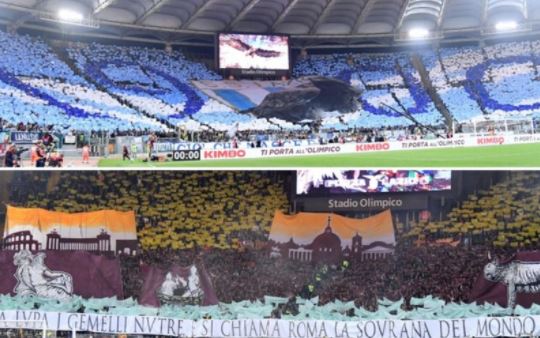
FAN INVOLVEMENT:
So… where the hell do we begin?
When Lazio refused to join the other three teams in the creation of Roma in 1927, it not only caused a divide between the clubs — it also created a divide among fans in Rome. Roma was hand crafted to be seen as a symbol of the city — from its colors to its logo to obviously the name. That drew the attention of the common people of Rome (not to mention the fans of the three clubs it took to make it). With Lazio refusing to join in, it seemed they were rejecting the very ideals of Rome, although Lazio fans will point out that they were simply fighting for their identity during a time that a fascist dictator was forcibly combining every other club in the city. It didn’t help that during the first Derby della Capitale in 1929, many Lazio fans were reportedly afraid to sit with the “working class” fans of Roma. Thus, Lazio fans felt they were being pushed out of their city, which is ironic considering the city of Rome lies in the Italian region of Lazio.
Whatever the reason, the Derby della Capitale is as explosive and volatile as any rivalry in sports. Remember the Derby della Madonnina, how despite the hatred Milan and Inter fans could easily be together and interact socially without any threat of violence? That’s not the case in Rome, where both Roma and Lazio fans say they can’t stand sitting next to a fan of a rival team, let alone having one in their family. When Alessandro Nesta moved from Lazio to Milan, he was shocked that he could go anywhere in the city without fear of being attacked by Inter fans (remember how Giorgio Chinaglia had to carry a gun with him after his celebration?). What separates the Derby della Capitale is not just the hatred, but the danger. Stabbings are so common at derby games, Roma and Lazio fans can teach Las Vegas Raiders fans a thing or two about knifework. There’s a reason this derby was the first in Italian soccer to see a fan death. I would like to attend every one of the rivalry matches in this whole experiment, but this one may be the one I would be most aprehensive about attending, especially by myself.
Part of what adds to the atmosphere inside and outside the Stadio Olimpico is the groups of ultras, which make up the Curva Sud (Roma) and Curva Nord (Lazio). Several years ago, plastic barriers were installed to divide each group in two and cut down on hostilities. For the first season, both sets of ultras protested by not showing up. Lazio ultras have since returned, but Roma ultras continue to protest. But even without the full sets of ultras in attendance, there’s still an incredible match day atmosphere thanks to the immense level of hatred between the two. But there’s a price to pay — and not just from the violence.
It’s an uncomfortable topic but it needs to be said here — there is a non-insignificant part of European soccer fans who are racist and/or fascist. While these fans are definitely in the vast minority, they are a quite vocal minority. It’s more common in Eastern Europe (more on that later), but Western and Central Europe have definitely had their problems. England, Germany (although not as badly as you’d think), Spain, and other countries have seen incidents in the past few decades. You can also make an argument that Italy has seen more problems than most. Perhaps it’s fitting that a derby founded by a decision by Benito Mussolini has seen more problems than most, with Lazio at the center of a disturbing amount of fascist fan incidents (it doesn’t help their image that they just signed Mussolini’s great-grandson to a senior team deal.
The main trouble comes from a Lazio ultra group called the Irriducibili, founded in the late 20th century and led by a particularly nasty man named Fabrizio “Diabolik” Piscitelli. The group announced its formation during a Derby della Capitale by unveiling a 50-foot banner that read “Auschwitz is your town, the ovens are your houses.” Another banner read “Squad of blacks, terrace of Jews.” The group targeted black Roma players with their racist abuse. In an interview, Piscitelli once said that his group specifically wanted to injure and kill the opposing fans. In 2017, Lazio fans left stickers of Anne Frank in a Roma jersey at the Stadio Olimpico, before hanging dummies in Roma jerseys from a pedestrian walkway at the Colosseum. The Irriducibili folded just a couple years ago, shortly after Piscitelli was literally assassinated in broad daylight in a Rome park (a man dressed as a runner shot him in his head). No culprit has been found and the murder was thought to be professionally organized.
But even with Piscitelli’s death and the Irriducibli’s demise, Lazio still have a massive fascism problem. While of course everything the group did was terrible and it just represented a vocal minority, the fact that this minority was allowed to exist and thrive for several decades is damning to Lazio. Let’s not forget when Paolo Di Canio saluted the Lazio ultras in a fascist manner. But while Lazio certainly has their share of the blame, they’re far from the only club with troublesome fans (Roma fans haven’t been perfect, especially when it comes to violence). Di Canio’s salute wasn’t his first controversial incident and not only was he able to have a 23-year playing career, but also be hired as manager by multiple clubs. While many European countries (and sports as a whole) have trouble with putting character above talent when filling out rosters (Arizona Cardinals general manager Steve Keim once said that it Hannibal Lecter ran a 4.3, they’d say he has an eating disorder), this sort of issue is becoming more and more prevalent in today’s age. It also remains an unfortunate part of the Derby della Capitale.
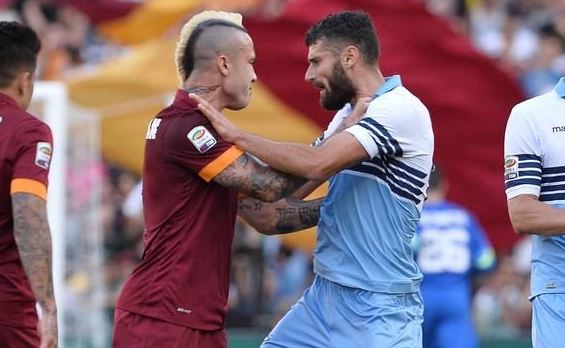
SUMMARY:
For all of its faults — the violence, the political controversy, the overall lack of trophies, the Derby della Capitale remains one of the greatest rivalries in soccer simply because it contains some of the best match day moments and purest forms of hatred out there. When A.S. Roma and S.S. Lazio face off, fanatical regional pride is on the line, with a simple objective — win at all costs.
While Italy has now reached is cap for World Cup of Hate participants, there are still several rivalries that deserve a mention. Roma has another great rivalry with another blue club, Napoli (who also don’t like Lazio a lot). Roma and Napoli contest the Derby del Sole (Derby of the Sun) and are often considered the two most popular clubs outside of Northern Italy. Fiorentina, Parma, Bologna, and Palermo each have a number of historic rivalries with each other and other clubs as well. Genoa and Sampdoria compete in an underrated and cool-sounding rivalry, the Derby della Lanterna. Recently, Atalanta and Brescia rekindled their unique rivalry, one that was also featured on COPA90. There are many more in Italy, but we have to move on.
We have now finally gotten past the halfway point of Europe and to the end of Part 4 of this experiment. But that doesn’t mean we’ve gotten past the good stuff completely. We end this section with one of the most intense, hate-filled, dangerous rivalries with legendary match day atmosphere. In the next part of Europe, we’re going to cover three more rivalries that can arguably top the Derby della Capitale when it comes to those categories. We have only just begun to dive into the insanity of soccer fans.
COMING UP IN PART 5: A big flag, political oppression, a bunch of long and complicated names, a suspension of all sports, a metric shit ton of flares, and a continental divide.
 Ruben's Writings
Leave a comment