
ASIA (4)
As we prepare to cross the 3/4 mark on our global journey of soccer hatred, our quest to fill out the World Cup of Hate takes us to Asia, the largest and most populous continent in the world. But despite the robust population and general love of sport, soccer hasn’t historically been the focus for many countries in the area. But Asia remains one of the biggest growing soccer hotbeds on Earth, with a growing sense of fandom and passion for their clubs/countries. Even in a place where traditionally soccer hasn’t been first, there are more than a few examples of true soccer hatred, with the history and animosity to challenge some of the best in the world. Let’s start with a rivalry that actually predates many in the World Cup of Hate.
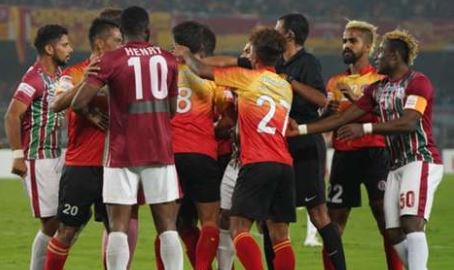
Kolkata Derby (India)
SC East Bengal vs. ATK Mohun Bagan FC
“The passion of the fans rubs off on the players. There aren’t many games in Asia that have such a rich legacy. Undoubtedly, it’s the biggest game in India, and fans of either club want to win.” — Paul Masefield, soccer commentator
This year, the Kolkata Derby is celebrating its 100th birthday — a century full of hatred, class warfare, drama, and intense passion. For the past 100 years, matches between East Bengal and ATK Mohun Bahan have dominated the second-most populous country in the world, along with the rest of the continent.
Widely considered one of the greatest — if not the greatest — derby in all of Asia, both clubs have dedicated fan bases across the continent and even the world. While the hatred and history between the two rivals is comparable to the best derbies in the world, many have drawn comparisons between the Kolkata Derby (also known as “Boro Match” [“Big Match”]) and the Old Firm. That means we get to talk about politics, immigration, and hooliganism! But while the tale of Celtic and Rangers is well known among soccer fans, the story of Bagan and Bengal deserves to be told just as much.
HISTORY:
The Bengal region of India — and the city of Kolkata in particular — is a hub of various cultures, religions, traditions, and ethnicities. What it took for all of those pieces to arrive in Kolkata also played a large role in establishing the dividing lines for this historic rivalry. It began in 1899, when three famous aristocratic Bengali families decided to form Mohun Bagan Athletic Club as a way for the native people of India to compete with clubs formed by the British (who were in charge of India at the time). Their first decade saw them achieve some local success, but their true breakthrough came in 1911. That year, Mohun Bagan became the first all-Indian club to defeat a British team for a major trophy, beating the East Yorkshire Regiment of the British Army in the IFA Shield Final. Reportedly, the 2-1 victory came even though most Bagan players had no shoes and the Regiment played with proper equipment. Mohun’s victory was a huge morale booster when it came to the Indian fight for independence and established the club as a symbol of Indian nationalism. So great was the reception of Mohun Bagan’s win that it contributed to the shift of the country’s capital from Kolkata to New Delhi that same year.
But while Mohun Bagan’s triumph created a sense of unity among Indians, Kolkata itself was far from unified. In 1920, Bagan faced off against fellow Kolkata club Jorabagan. For a reason that remains unknown to this day, Sailesh Bose — one of Jorabagan’s top players — was left out of the starting lineup. Jorabagan’s vice president, Suresh Chandra Chaudhuri, argued with club officials that Bose should be included. During the heated discussion, it was implied that Bose being from the eastern region of Bengal was the reason for his exclusion. That particular part of the area had a high population of immigrants, who were often treated like outsiders. Enraged, Chaudhuri stormed off with Bose and, a few days later, formed a new club named after the region where Bose was born — East Bengal Football Club. Unbeknownst to Bagan, their opponents alleged prejudice had created their future eternal rival. Not knowing what would become of either side, the first ever match between the two took place in 1921. A scoreless draw in the semi-finals of a tournament was followed by a replay, which Bagan won 3-0.
Both clubs played each other several times over the next few years, although those matches are largely considered unofficial by either side. In 1924, Mohun Bagan was in the IFA First Division, while East Bengal had finished second in the Second Division. At the time, only the top club in the Second Division gained promotion. However, the first place team was Cameroons “B” — Cameroons “A” was already in the First Division, so the promotion fell to Bengal. But it wasn’t so simple, as the IFA had a rule that only two Indian teams could be allowed into the top flight league — Bagan and Aryan FC were already in. In what would be a surprising turn of events, an IFA governing body meeting saw the nine British clubs (who had previously turned down other Indian clubs as a third team) decide to abolish the oppressive Indian club limit and allow Bengal to compete. Ironically, both Bagan (a club seen as the symbol of Indian nationalism) and Aryan opposed the decision for unknown reasons (it was alleged that it had to do with the whole immigrant thing). With a chip on its shoulder, Bengal made its First Division debut in 1925 and that season won the first “official” Kolkata Derby over Bagan 1-0.
Although each club would be firmly entrenched in the First Division for decades, it took a while for either side to collect their first pieces of silverware. Mohun Bagan was the most successful of the 1930’s, only losing once to East Bengal from 1933 to 1939 (winning 12 times — including once when Bengal straight up refused to show up, which would start a trend of walkover wins in the Kolkata Derby). That no-show also gave Bagan its first ever league title. Three years later, Bengal got on the league championship board, winning their first IFA Shield as well the following year. Thus began the decades-long battle of the two clubs battling for the league crown each year. Two straight Bagan titles from 1943-44 were broken up by Bengal, who achieved the double by winning the IFA Shield as well. Bagan finally broke their 34-year IFA Shield drought in 1947 and made it two straight the following year. That 1948 season also saw Bengal become the first Indian club to beat a foreign club on home soil, beating the Chinese Olympic XI 2-0. As both clubs began to collect trophies, something happened that would unknowingly feed the fire of this rivalry for decades to come and draw comparisons to another major derby overseas.
On top of its competitiveness on the field, what separates the Old Firm is the historic political and nationalistic battle between Celtic and Rangers fans. Various economic events and immigration movements from things like the Easter Rising and The Troubles helped shape that legendary animosity. A similar situation happened in 1947 with the Partition of India, which led to the country’s long-awaited independence. But a part of that was the division of the larger British India into the country of India and what was at the time the Dominion of Pakistan. That dominion was later split into the country of Pakistan (to the left of India) and the country of Bangladesh (to the right of India). However, that Bangladesh/Pakistan territory directly divided the Bengal region, with the eastern part being cut off from the west (which was still in India). As a result, a huge population of now non-Indians were forced to leave their homes and flee to the western part of the city. This led to rivalries between the immigrants and natives in every sphere of life, from economics to education to, yes, soccer. Immigrants saw East Bengal as a source of hope and identity, which only fueled the nationalism of Mohun Bagan fans. The Kolkata Derby had grown from purely a sporting one to one that impacted and represented life itself.
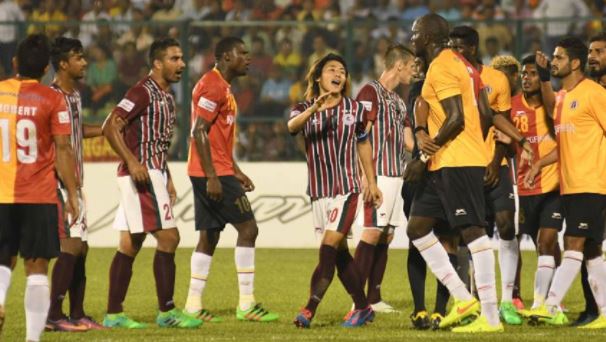
As for the action on the field, those immigrant fans had arrived just in time to see East Bengal’s Pancha Pandavas unite. The five-man attacking unit of K.P. Dhanraj, Pansanttom Venkatesh, Ahmed Khan, Appa Rao, and P.B.A. Saleh led Bengal to 11 trophies from 1949-53. The group also helped Bengal gain some foreign support through tours in Romania and the Soviet Union. That streak was broken when Venkatesh left for Mohun Bagan and saw Bengal’s rivals win the league so badly, they failed to show up for the return leg in 1954. That would set the precedent for a dominant Bagan stretch during the 1960’s, who won five of the first six league titles (including four straight from 1962-65) and six of ten overall in the decade. That number was originally seven, though the Kolkata High Court ruled Bagan’s 1968 league triumph to be null and void. Bengal countered with four IFA Shields in seven years, but Bagan countered with a memorable shield win in 1969 thanks to manager Amal Dutta’s then-revolutionary 4-2-4 formation. But as the calendar turned to the 1970’s, it was time for Bengal to take over, but not without a few more controversies to add to the rivalry.
In 1972, the two rivals once again met in the IFA Shield Final, with Mohun Bagan taking an early 1-0 lead. However, heavy rainfall forced the suspension of the match (to the chagrin of Bagan), wiping out the current result in favor of a replay. The IFA decided on a second date, which Bagan said was not acceptable because two of their best players would be unable to play due to office commitments (soccer was still a part-time job in India). The IFA refused to move the date of the replay, so Bagan refused to show up, giving East Bengal the trophy. This was part of a stretch from 1970-75 that saw Bengal lose just once to their rivals and in fact go on a 1932-day unbeaten streak against Bagan. That run included six straight league titles (plus another in 1977) and the most lopsided margin of victory in the history of the Kolkata Derby — a 5-0 Bengal win in the IFA Shield Final. The win was so humiliating that some Bagan players literally spent that night on a boat in order to escape the wrath of their fans. One of those fans, Umakanta Palodi, committed suicide after the game. In his suicide note, he wrote that in the next life, he would be born as a Bagan player and will take revenge for the 5-0 loss.
Unfortunately, further tragedy awaited both sets of fans just a few years later. On August 16, 1980, Mohun Bagan and East Bengal met for another Kolkata Derby at Eden Gardens stadium. Bagan had caught up to their rivals, winning three trophies in 1978. Just a few months earlier, the two sides had ended a bitter Federation Cup Final clash tied at 1-1, with both teams declared joint winners. About an hour into the highly-anticipated next meeting, a Bagan player was sent off, causing outrage among the fans. Just a few minutes later, a Bengal player was also sent off in an apparent act of balance. This started a riot in the stadium, where unusually the two sets of fans hadn’t been separated. Neither the players or officials knew what was happening in the stands, as the game finished with a 0-0 draw. It was only after the final whistle they discovered the horror — 16 people had been killed in stampedes, while more than a hundred others were hurt. All further league matches were suspended and the tragic day was officially marked as Football Lovers’ Day, which is observed every year with a blood drive. The deaths also formed a black cloud over Indian soccer, which took nearly two decades to recover.
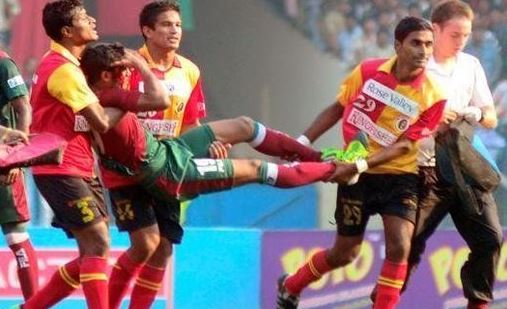
But recover it did, bigger and better than ever before. In 1996, the National Football League was created as the first ever national-scale soccer league for India. The following year saw the most memorable Kolkata Derby of all time: a 4-1 East Bengal win in front of 131,781 fans at Salt Lake Stadium. To this day, that game remains the highest-attended sporting event in Indian history. It also saw Bhaiching Bhutia score the first ever derby hat trick, putting three goals past Mohun Bagan. In 2007, the NFL gave way to the I-League, which became the first national and professional soccer league in India. The I-League would be the site of the next great Kolkata Derby controversy. A 2012 match between the two clubs saw everything go against Bagan, with three straight yellow cards followed by a Bengal goal, which was followed by a red card for Bagan just before halftime. The crowd got pissed, with one fan throwing a stone that hit Bagan midfielder Syed Rahim Nabi. Bleeding profusely, Nabi had to be carried off the field by Bengal players. Bagan refused to go back out for the second half and was fined and stripped of all of its points they had earned in the league thus far (they somehow staved off relegation).
One more controversial no-show took place in 2016, when Mohun Bagan refused to play a match where they claimed their supporters didn’t have enough seats allotted. But that was far from the biggest Indian soccer story of the 2010’s. In order to grow the game nationally, officials established the Indian Super League in 2013. Only one club per city was allowed and controversially neither Bagan or East Bengal (who were and are currently in a national title drought) were chosen to represent Kolkata. Instead, a new club — Atletico de Kolkata F.C. — was founded to play there instead. Both Bengal and Bagan were told to move outside of Kolkata if they wanted to join, but both clubs refused. Instead, Bagan (who had just won the I-League) and ATK (who had just won their third Super League) agreed in 2020 to merge, becoming ATK Mohun Bagan. Bagan’s history, colors, and badge were carried over to the new club, which moved to the Super League. Later that year, Bengal secured a new investor and rebranded itself as Sporting Club East Bengal. They then successfully bid to join the Super League, with Kolkata becoming the first city to be represented by two teams in the league. Bagan has swept the first three years of Super League competition with Bengal.
MAJOR ON-FIELD MOMENTS:
SHINING LIKE DIAMONDS
When Amal Dutta — former East Bengal manager — came over to Mohun Bagan, he brought with him a revolutionary idea. Playing a 4-2-4 formation (twice as many forwards as midfielders) certainly hadn’t been done before. But Bagan took Dutta’s “Diamond System” and ran with it, forming one of the best Indian sides ever during the 1960’s. The culmination of their efforts came in the 1969 IFA Shield Final against their hated rivals. The final score was 3-1 in favor of Bagan, with Pranab Ganguly scoring twice. But Bagan in the years that followed insisted that if they hadn’t missed several chances, they could’ve scored three times as much, so thoroughly were they dominating Bengal. The match still remains one of Bagan’s finest ever played.
HUMILIATION & TRAGEDY
The culmination of a record Kolkata Derby domination by East Bengal — 1932 days straight unbeaten against Mohun Bagan from 1970-75 — took place in the 1975 IFA Shield Final. Bengal got on the board within the first five minutes, then rookie Bagan goalkeeper Bhaskar Ganguly had a very bad day. A dropped cross led to a second Bengal goal, while another failure by Ganguly to collect a shot led to Bengal tapping in the rebound. Ranjit Mukherjee hit a rocket into the net and Subhankar Sanyal completed the 5-0 rout with a goal in the 84th minute. Bagan players were so fearful of fans that they spent that night on a boat, hidden away. One Bagan fan committed suicide, vowing to be reincarnated as a Bagan player to get revenge on Bengal.
THE STADIUM DISASTER
The Kolkata Derby of August 1980 finished in a scoreless draw, with East Bengal and Mohun Bagan reduced to ten men. Not none of that matters — what makes this derby memorable is the tragedy that took place in the stands. Spurred on by the general animosity between the two clubs and compounded by the red cards that day, the two fan bases (who had for some reason been allowed to sit together) began to fight, leading to stampedes which left 16 people dead and more than a hundred others injured. All other matches were canceled as officials tried to figure out what happened. Both Bengal and Bagan were fined for what happened. As a whole, the tragedy created a huge dark cloud over the sport, which took decades to recover.
131K STRONG
Imagine the entire population of Santa Clara attending a sporting event. Combine the record attendance of Michigan Stadium (115,109) and throw in the Golden 1 Center capacity (17,000). That’s what it was like at Salt Lake Stadium in 1997, when 131,781 fans attended the Kolkata Derby. It wasn’t just a record for the derby — it was the highest-attended sporting event ever in India. Those fans who helped make history also saw history. Up 1-0 at halftime, East Bengal doubled its lead thanks to Bhaichung Bhutia in the 46th minute. Chima Okorie pulled one back for Mohun Bagan, but two more goals from Bhutia in the final five minutes of the game secured the 4-1 win. Those goals also secured the first ever hat trick in the many decades of the derby.
UNWELCOME RETURN
Going into this iconic 2007 clash, Mohun Bagan were facing a familiar opponent. Subrata Bhattacharya had spent 17 years patrolling the Bagan defense. Now, he was back — as manager for East Bengal. The Bagan faithful weren’t happy with their hero and their team let them know it, going on the offensive early and taking a 3-0 halftime lead. While Bagan wanted to keep going and get revenge for the 5-0 humiliation 32 years before, Bengal had other ideas. They fought back and actually manage to make it a close match. However, Bagan was able to secure one more goal and held on for the 4-3 win, getting revenge against their former club icon/now enemy manager and taking one of the most entertaining derbies ever in the process.
CHIDI CHIDI BANG BANG
In the 100-year history of the Kolkata Derby, only two players have recorded hat tricks. The first was Bhaichung Bhutia for East Bengal in 1997. In 2009, Mohun Bagan finally got one of their own, only because of the rivalry they took it one step further. Bengal scored first, only for Bagan to answer with three straight goals. The first and third of those goals came from Chidi Edeh, who added a summersault to his second goal. Bengal rallied to tie the match at 3-3, but another goal from Edeh gave Bagan the lead again and secured the rare hat trick. Later in the match, Edeh sealed the 5-3 win for Bagan with a header from a corner kick, adding an astounding fourth goal to his total. No one has since come close to matching Edeh’s offensive output.
ADDING INJURY TO INSULT
It was one of those days when everything goes wrong, when one bad moment snowballs into something massively horrible. In 2012, Mohun Bagan and East Bengal were deadlocked at zero and getting physical. In fact, three Bagan players in a row were given a yellow card. In the 43rd minute, a goal off a free kick gave Bengal a 1-0 lead. Bagan’s Okolie Odafa was then given a red card for dissent. All of this was too much for Bagan fans, who began to throw items into the field. Unfortunately, one of those items was a stone that hit one of their own players — Syed Rahim Nabi — in the face. Bleeding and in pain, Nabi had to be carried off the field and taken to the hospital. Bagan refused to come out of the locker room and the match was called off.
DO-ING IT RIGHT
While East Bengal hasn’t won a national championship since 2004, they’ve kept their run in the Kolkata League going strong. That title stretch includes eight straight city crowns from 2010-18. It was in 2015 — on their way to title number six in a row — that Bengal recorded a historic win over their rivals. Do Dong-hyun scored two goals from long free kicks (including one just two minutes into the match), while Rahul Bjeke and Mohammed Rafique added two strikes of their own to power Bengal to a 4-0 victory over Mohun Bagan, equaling the club’s all-time record margin of victory in a Calcutta League match against their rivals. The previous 4-0 score line dated back to 1936, with the 2015 version being the most lopsided in recent derby memory.
STATISTICS:
HEAD-TO-HEAD RECORD
Bengal: 138
Bagan: 128
Draw: 125
LEAGUE CHAMPIONSHIPS (CALCUTTA)
Bengal: 39 (record)
Bagan: 30
LEAGUE CHAMPIONSHIPS (NFL/I-LEAGUE)
Bengal: 3
Bagan: 5 (record)
IFA SHIELD
Bengal: 29 (record)
Bagan: 22
FEDERATION CUP
Bengal: 8
Bagan: 14 (record)
DURAND CUP
Bengal: 16 (record)
Bagan: 16 (record)
INDIAN SUPER CUP
Bengal: 3 (record)
Bagan: 2
ROVERS CUP
Bengal: 10
Bagan: 14 (record)
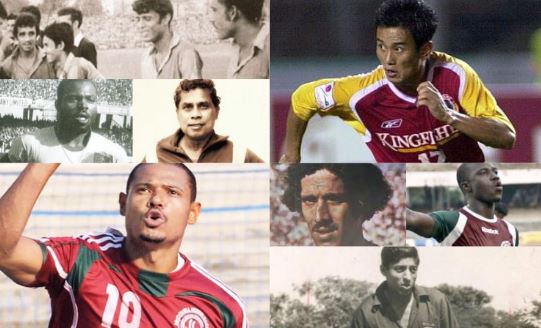
NOTABLE FIGURES:
K.P. DHANRAJ
One of the five core members of the Pancha Pandavas lineup from 1949-53, K.P. Dhanraj was the key cog in the legendary East Bengal offense. Leading all fellow Pandavas with 127 goals (third-most in club history), Dhanraj and his crew won a shit ton of trophies, along with the respect of many soccer players overseas. Dhanraj shone during Bengal’s tours into Eastern Europe during that era and played a big role in the club’s defeat of Chinese Olympic XI. They also participated in events in Romania and Soviet Union, with Dhanraj bringing in the fans.
CHUNI GOSWAMI
A man of many talents, Subimal “Chuni” Goswami was a first class cricketer and a former Sheriff of Kolkata. But his true talents lay in soccer, much to the joy of Mohun Bagan, where Goswami spent his legendary career. A key member of the great Bagan squad of the 1960’s, Goswami helped his club lay waste to the competition, particularly East Bengal. Goswami was also a tremendous asset for India’s national team, leading them to an appearance at the 1960 Summer Olympics and a gold medal at the 1962 Asian Games (and runner-up in 1964).
AMAL DUTTA
Arguably the most iconic coach in Indian soccer history, Amal Dutta was actually the first full-time soccer coach the country had ever seen, which was a major risk at the time. That risk paid off big time, as Dutta changed the Indian game with his creation of the 4-2-2 Diamond system, which revolutionized soccer in the country. Although Dutta began his managerial career with East Bengal and would run each club several times, it was during his first stint with Mohun Bagan that the Diamond system had its greatest ever moment — the 1969 IFA Shield Final.
SUBRATA BHATTACHARYA
One of the greatest defenders in Indian history, Subrata Bhattacharya became an icon with Mohun Bagan. During his incredible 17-year career with the club, Bhattacharya led Bagan to the triple crown in 1977 — his first as captain. That same year, Bagan held a famous match against Pele’s New York Cosmos. However, it was after retiring that Bhattacharya’s popularity took a major hit in Bagan fan circles. That will happen when you take over as East Bengal manager. Bhattacharya’s debut did not go well, with Bagan winning a memorable match 4-3.
CHIMA OKORIE
The former all-time goal scoring leader for East Bengal, Chima Okorie still ranks second with 131 goals to his name. Interestingly, Okorie had come to India from Nigeria in search of an education, enrolling at Vishakapatnam University and playing soccer as a hobby. That is until scouts spotted his talent. Okorie rose to prominence during his time with Bengal, with his duels with Subrata Bhattacharya becoming the main event of the Kolkata Derby. After several years, Okorie switched sides and became the first ever foreign player to suit up for Mohun Bagan.
BHAICHUNG BHUTIA
I.M. Vijayan — a three-time Indian Player of the Year — once called Bhaichung Bjutia “God’s gift to Indian football.” That’s pretty high praise, although Bhutia has a great argument to be made as the best Indian soccer player of all time. The first Indian player to sign a contract with a European club (Bury F.C.), Bhutia truly made his name in his home country. In 1997, Bhutia scored the first ever Kolkata Derby hat trick, contributing to his 19 total derby goals — the most by any single player. Bhutia also sits atop East Bengal’s all-time scoring list with 148 goals.
JOSE RAMIREZ BARRETO
One of the best foreign players in Indian soccer history, Jose Ramirez Barreto is one of the biggest icons Mohun Bagan has ever seen. In more than a decade across two different spans, Barreto set Bagan’s all-time record with 228 goals and is only behind Bhaiching Bhutia with 17 career Kolkata Derby goals. However, unlike most over derby legends (including Bhutia), Barreto never switched to the other side of Kolkata. Never putting on the East Bengal uniform has endeared Barreto to the Bagan faithful as the best non-Indian player ever for the club.
CHIDI EDEH
Although Chidi Edeh isn’t among the top all-time Kolkata Derby scorers, he’s done something no other player for Mohun Bagan or East Bengal has ever done — score four goals in one derby match. Edeh absolutely lit up the scoreboard for Bagan in 2009, scoring half of the combined eight goals in one of the most entertaining derbies ever. Maybe he felt bad for shitting all over Bengal, because just one year after leaving Bagan Edeh returned as part of the other club. Edeh once again got a hat trick in 2013, a 5-1 Bengal win in the 2013 AFC Cup Round of 16.
FAN INVOLVEMENT:
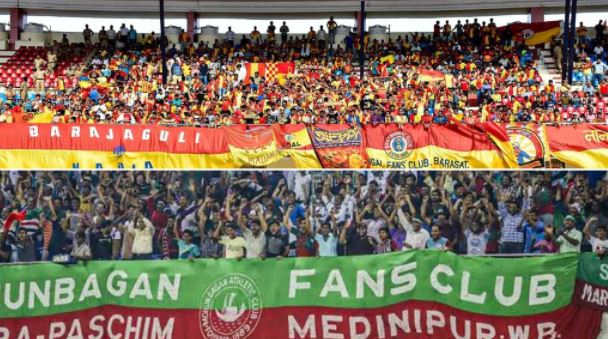
The hatred between East Bengal and Mohun Bagan ranks high with any other sporting rivalry in the world, with that animosity seeping not just into the stands on derby day, but all across Kolkata. Even though they have been slightly eroded in the decades that followed, the dividing lines between the native Indian Bagan fans (Ghotis) and the immigrant Bengal fans (Bangals) still remain off the field. Going back to the Old Firm comparison, the nationalistic Bagan fans are typically more right-leaning, while the Bengal fans are more left-leaning. The daily life struggle in one of India’s biggest cities contributes to the passion seen each derby day.
Of course, sometimes that passion has gone too far, as evident with the deadly stampede in 1980. This led to concerns over the future of the sport in the country as a whole. Something needed to change, although that change was unclear. Over the past several years, especially as professional soccer became a thing in India, groups of fans for each club began to do that thing. Ultras groups — Mariners’ Base Camp (Bagan) and the East Bengal Ultras — have tried to bring a more traditional style of support with tifos, chanting, and drums throughout the match. Although it’s taken a while, the effort has begun to stick and change fan culture in Indian soccer.
One other unique aspect of the Kolkata Derby is its relationship with fish. In the Bengal region, the only thing more popular than soccer (apart from cricket, obviously) is fish. Preferences differ across the region, with Bengal fans having a particular love of ilish and Bagan fans loving prawns. On derby days, it’s common for fish-related images in club colors to be seen across the city and stadium, as well as for the prices of those fish to skyrocket. Whichever club wins, that kind of fish will become astronomically expensive, although it will always be sold out fast.
SUMMARY:
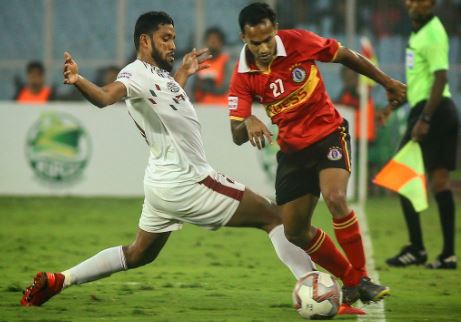
The Kolkata Derby has packed every aspect of a legendary rivalry — passion, controversy, tragedy, drama, intensity, success, and talent — into the past 100 years. A century of hate has passed between SC East Bengal and ATK Mohun Bagan, with plenty more to come in the next century and even further beyond.
From a country whose overall soccer history isn’t exactly legendary to one of the historically better Asian countries when it comes to soccer, our journey now heads to a place that actually bordered India when it was part of the British Empire. While it may not have the lengthy history of the Kolkata Derby, this rivalry has been able to fit plenty of hate into half that time.
Tehran Derby (Iran)
Esteghlal F.C. vs. Persepolis S.C.
“It means nothing to be champions if you’ve lost the derby. In Iranian football, to celebrate the championship, you have no choice but to win the derby.” — Mohsen Bengar, former Persepolis defender
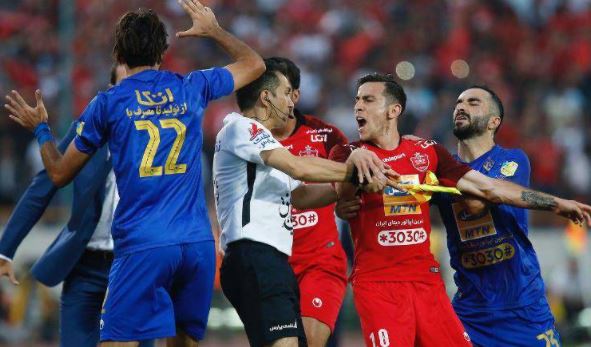
Deep in the Persian Gulf lies one of the biggest derbies in all of Asia and the world — the Tehran Derby. Clashes between Esteghlal and Persepolis literally shut down Iran’s capital, bring six figures of fans to stadiums, and are among some of the most dramatic, heated, and intense matches in all of soccer.
On the surface, this appears to be just another case of two rivals in the same capital city being pissed at each other with fans more interested in wrecking shit than watching the match. But take another look and you’ll see several interesting aspects about this unique rivalry. For instance, the Tehran Derby is basically the Casablanca Derby on steroids when it comes to draws, which account for nearly half of all match results. Second, it’s essentially the second, more powered-up version of an older rivalry that was literally stopped by Iran’s governing soccer body. Third, both sides weren’t originally founded as soccer clubs, rather clubs for very different sports. Finally, this derby has only been around since about the time of the first Super Bowl, yet has easily qualified for the World Cup of Hate and is talked about in the same breath as rivalries twice its age (like the Kolkata Derby). What the hell has happened over the past 50 years?
HISTORY:
In the early days of Iranian soccer, the game was largely played at the local level, with the capital city of Tehran holding the biggest and best teams. In 1945, one of the two eventual biggest clubs in the country was formed, although not for soccer. A group of young athletes and students, including a military officer and a member of the country’s national sports body, decided to establish Docharkhe Savaran. The name itself meant “The Cyclists” in Persian, as the club was originally established for cycling. However, their interests soon turned to soccer, forming their first team in 1946. In 1949, the club changed its name to Taj, which means “crown” and is much easier to type out. Taj Football Club played its first official match in 1950, winning 1-0. From there, Taj became an elite club in the city, winning several league and cup titles in Tehran. During their first couple of decades, they began to get a reputation as a club in favor of the elite and ruling party, a status which was helped by its rivalry with another Tehran club.
Taj’s first ever match (and win) came against Shahin F.C., with the two sides quickly becoming rivals. Where Taj was seen as the club of the upper class, Shahin was largely thought of as the people’s club, thus gaining a massive following. By massive, I mean monumental — their skill, success, and symbolism (many of their players were also part of Iran’s national team) made them the most popular soccer club in the history of the country. So great was their popularity that Shahin became at odds with both the Iran Football Federation and the Keihan Varzeshi (Iran’s most important sports publication at the time). The latter two thought Shahin was a threat, with political battles being fought behind closed doors throughout the 1960’s. The conflict reached its peak in 1967 when, after Shahin’s 3-0 win against Tehranjavan F.C., the federation declared Shahin officially dissolved. Despite protests and arguments, Iran’s most popular club was no more, with attendance suffering league-wide as a result.
While the club Shahin was gone, the Shahin players still needed a place to go. While some went elsewhere, most of the roster stayed in Tehran to play for a club that wasn’t even five years old. In 1963, businessman and former championship boxer Ali Abdo returned to Iran to found a club with a concentration on bowling. That club, called Persepolis (named after the historic landmark and former capital of the Achaemenid Empire), soon decided to add a soccer team, hiring Parviz Dehdari as manager and Masoud Boroumand as a member of the staff. Both were not only former Iran national team members, but also former Shahin players. At the start of the 1968 season, Dehdari and Boroumand used their connections with their old club to sign most of the former Shahin players, transforming one of the weaker sides in Tehran into one of the strongest. The signings also brought them part of the support that Shahin once had, although no club has ever been as popular. This also caused Persepolis to essentially take Shahin’s spot in their rivalry with Taj, whose upper class reputation was supported by the fact that their rival had been taken out by the establishment. The decision to remove Shahin from existence had unintentionally given birth to what would become Iran’s great sporting rivalry.
Right away, things got turned up to 11. Given the eventual pile of draws the two clubs would produce, it’s fitting that the first ever Tehran Derby would end in a 0-0 draw. Within two years, the derby had its first controversy — with Taj up 1-0 in the 82nd minute, Persepolis players left the field to protest the officials. Taj was given a 3-0 win in a scenario that was almost the exact same. This time the game was tied 1-1 in the 75th minute when Persepolis left the field in protest of more officiating. But the two forfeits only tell part of the history being made. In 1970, Taj took part in the third edition of what was then an upstart competition — the AFC Champions League. Taking advantage of Tehran being the host, Taj won their group and advanced to the final, where they faced Hapoel Tel Aviv, who had won the first tournament two years prior. But thanks to an extra time goal by Masoud Moeini, Taj won 2-1 and became the first Iranian club to be champions of Asia (as well as the first champion outside of Israel).
1970 was also a year of major change for Iranian soccer as a whole. For the first time, a national league was formed, with both Taj and Persepolis being allowed to compete. Taj took home the first league title, but the tides would soon turn in Persepolis’ favor. Persepolis won its first league crown in 1972, then became the first club to repeat as national champs in 1974 (they skipped a year). That time period also saw Perspolis’ first win in the derby in 1972, along with their largest ever derby win ever — a 6-0 ass whooping the following year. Two major domestic cups were established in the 1970’s — the Takht Jamshid Cup (which dissolved in 1979) and the Hazfi Cup (still in existence). Persepolis would claim the first Takht Jamshid Cup, while Taj won the inaugural Hazfi Cup. By the end of the decade, Taj and Persepolis (along with Pas Tehran) had established themselves as the biggest soccer clubs in Iran and earned a legion of fans. However, all of that was about to be brought to a screeching halt.
In 1978, all hell began to break loose in Iran, leading to the Iranian Revolution, one of the most significant Middle East conflicts of all time. While the initial revolution led to the overthrow of the long-ruling Pahlavi Dynasty and the implementation of an Islamic republic under the Ayatollah Ruhollah Khomeini, things didn’t end there. Iran’s new government was incredibly unstable for several years, while events like the Iran hostage crisis (which also played a big role in the political background of the Miracle on Ice) hampered relations with the west. Then Iraq decided to invade Iran, sparking the Iran-Iraq War that lasted until 1989. For the vast majority of that time, all national sports activity, including soccer, was stopped. The national league didn’t resume until 1989, with the Hazfi Cup only returning a few years earlier. However, clubs were able to stay active by playing in their local leagues. Tehran’s was inarguably the best at this time, with both Persepolis and Taj — which had changed its name to Esteghlal (meaning “independence”) — recording some memorable moments. Those include a 1983 Tehran Derby that saw a record attendance of 128,000 people.
When soccer did return to Iran on a national level, Esteghlal and Persepolis picked up right where they left off. Esteghlal took the first national crown in over a decade, while Persepolis was among the first few winners of the returned Hazfi Cup. But the two weren’t content with national victories — the continent was about to feel their wrath. In 1991, Esteghlal returned to the AFC Champions League and ran through everyone, finishing it off with a 2-1 victory over Liaoning FC in the final to record their second continental title. That same year, a new competition — the Asian Cup Winners’ Cup — was formed. Persepolis put together a run of their own and — after narrowly getting by Al Hilal in the semi-finals — scraped by Muharraq 1-0 in the final to win the inaugural competition. In 1991, the two best soccer teams in Asia called Tehran home. Perhaps that’s what made this decade of Tehran Derby play particularly spicy. Tempers boiled over in 1955, when a late Estaghlal comeback (aided by a penalty) caused a riot to break out in the stadium. That led to a decades-long rule to have non-Iranian referees used during the Tehran Derby. Silverware (and several league and cup titles) rounded out the decade for both sides. Esteghlal would reach two more AFC Champions League Finals and Persepolis would get to one more Cup Winners’ Cup Final (all losses). In 1999, the two sides met for the first time in the Hazfi Cup Final, with Persepolis emerging victorious 2-1.
One of the first Tehran Derbies of the 2000’s saw one of the more controversial moments, set up by Estaghlal’s Mehdi Hasheminasab facing his old club for the first time. The 2-2 draw saw two goals in the final five minutes (including one from Hasheminasab) as well as a massive brawl that was started by a punch. The ensuing post-game riot saw buses and buildings damaged and several players arrested. Esteghlal largely had the better numbers during this era, but things were about to get even. In 2010, a run of six straight derbies to finish 1-1 was broken by a late Persepolis goal. Esteghlal would get revenge with a huge win in the following yeart’s Hazfi Cup, but a memorable Persepolis win in 2012 set the tone for a future shift. Persepolis has been the better squad for the past several years, winning the past four Persian Gulf Pro League titles to go with a handful of Hazfi Cups. Persepolis also made its biggest runs in continental competition, losing the AFC Champions League Final in both 2018 and 2020. As of this writing, Esteghlal has yet to beat Persepolis in regulation in more than five years. But as always, you can never really count any result out in a match between these two rivals.
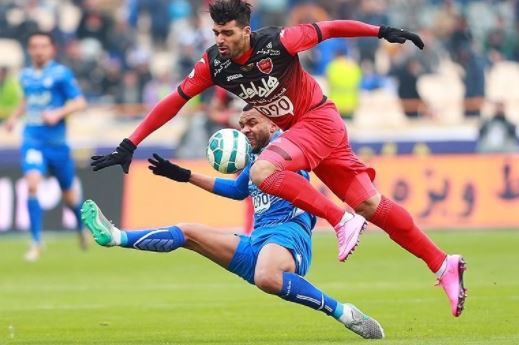
MAJOR ON-FIELD MOMENTS:
NOT HAPPY WITH THE OFFICIALS
Two of the first two ever Tehran Derbies provided the first two major controversies between the two sides. The first — in 1970 — saw Taj winning 1-0 with just eight minutes remaining when Persepolis’ frustration with the referees boiled over. The entire Persepolis squad left the field in protest and the match was called at that point. Taj was later declared the winner by a score of 3-0. 11 months later, the two clubs met again and feelings towards the officials hadn’t calmed down. This time, the score was tied at 1-1 in the 7th minute. However, once again Persepolis claimed a series of decisions had unfairly gone against them. So they left the field once more and never returned. For the second time in just under a year, Taj was given a 3-0 forfeit victory.
DESTROYING THE CROWN
It took four years for Persepolis to get their first ever win over Taj, coming out on top 4-2 in a 1972 showdown. It only took Persepolis one more year to record what remains to this day the most lopsided Tehran Derby ever. The first half hour was typically scoreless, before two goals gave Persepolis a 2-0 lead going into halftime. Homayoun Behzadi added to the lead five minutes into the second half while Iraj Soleimani’s second goal made it 4-0 just before the hour mark. Already this would be the largest margin of victory between the two sides. But Behzadi wasn’t done, adding another goal in the 86th minute and a third in stoppage time. The 6-0 scoreline remains a record between the rivals, with Behzadi recording the first derby hat trick.
A RECORD THAT WILL NEVER BE MATCHED
Iran (and the Middle East in general) wasn’t a great place to be during the 1980’s. A revolution and war had torn the country apart and shut down all national sports. But the local soccer scene was still in play, with the Tehran Derby being one of the few positive places for Iranians to channel their emotions. In 1983, TV broadcaster IRIB decided not to air the match, so fans flocked en masse to Azadi Stadium. The 100,000-capacity venue played host to an estimated 128,000 fans, with some fans being forced to climb the metal base of the stadium floodlights. The match result — a 1-0 Esteghlal win — was secondary to the massive crowd whose numbers (due to 2002 renovations that reduced capacity at the stadium) will never be matched again.
CALLING FOR FOREIGN REFEREES
Both Esteghlal and Persepolis were at the peak of their powers in the 1990’s, having both won continental titles. This raised the intensity of the Tehran Derby even higher, with things boiling over in 1995. Persepolis jumped out to a 2-0 lead early in the second half and appeared to be on the way to a victory. But then Estaghlal made a comeback, converting a penalty with just over ten minutes left and tying the game at 2-2 in the 87th minute. This angered the Persepolis fans who (despite one of their goals coming from a penalty) the referee was conspiring against them. Fans stormed the field and many fights broke out involving the players. Esteghlal was given a 3-0 win and it was decided that Iranian referees would no longer be used for the derby.
THE CUP FINAL
For as much as Persepolis and Esteghlal have dominated Iranian soccer, only once have the two rivals met in the final of the Hazfi Cup. That one showdown came at the end of the 20th century — the 1999 edition of the tournament. Mehdi Hasheminasab gave Persepolis an early lead thanks to a 12th minute penalty, while Estaghlal evened the score early in the second half thanks to Sohrab Bakhtiarizadeh. Things looked like they would be headed to extra time tied at 1-1 (remember that exact scoreline) before — in a rare instance in the Tehran Derby — one of the sides decided to not finish off the draw. That club was Persepolis, who stole the victory with an 86th minute goal from Mohammad Peyrovani and gained a major win over their arch rivals.
PLAYERS & FANS ARRESTED
Perhaps the craziest ever Tehran Derby was one of the first of the 21st century. In 2000, Mehdi Hasheminasab faced Persepolis for the first time as a member of Esteghlal, raising the stakes even more. Hasheminasab himself broke a 1-1 tie with a goal in the 86th minute, only for Ali Karimi to save a point for Persepolis, scoring in the 89th minute to secure a dramatic 2-2 draw. But this only tells part of the story. Esteghlal goalkeeper Parviz Broumand and Persepolis striker Payan Rafat got into it all match, with things culminating in Broumand punching Rafat in the face, sparking a huge brawl. All of this was too much for fans, who destroyed a reported 250 city buses in a riot. 60 fans — along with three players from each side — were later arrested.
BRAGGING RIGHTS ONLY
Here’s how you know a rivalry is truly great — it doesn’t matter if you only win two games all season, as long as those two come against your arch rival. In 2006, neither Esteghlal nor Persepolis were going to win the league or the Hazfi Cup. But getting a win in the Tehran Derby would increase their chances of finishing ahead of their rivals in the standings. Estaghlal went up 1-0 in the 16th minute, only for a mistake by goalkeeper Mehdi Rahmati to allow Persepolis to even the score just six minutes later. A wide-open second half somehow only led to one goal, courtesy of Mehrdad Oladi, who chipped Rahmati to give Persepolis a 2-1 win. Persepolis would end up finishing third place — one spot ahead of Esteghlal — by just a solitary point.
ENOUGH WITH THE DRAWS
That 2006 2-1 result was apparently too much to handle for the Tehran Derby, because the following six derbies didn’t just finish in a draw, but a 1-1 scoreline. Given the fact that both clubs somehow had the same owner, rumors floated of the matches being fixed to avoid one of them losing. Interestingly, the traditional pre-match dinner between the two sides (a way to try to lessen the tensions for the fans) didn’t take place before this game. But like the six that came before it, this match was tied at 1-1 late. Then Karim Bagheri said “fuck this” and sent a 35-yard screamer into the back of the net, giving Persepolis a 2-1 win. The very next derby, it was Estaghlal who broke a 0-0 tie in stoppage time, thanks to a counterattack goal by Farhan Majidi.
THREE IN EXTRA TIME
Esteghlal and Persepolis have met five times in the Hazfi Cup, going to penalties in three of them. One of the two decided before that was the classic final in 1999. The second came 12 years later, when the Tehran Derby took place in the quarter-finals. As usual, neither club could gain advantage or find the next in regulation, with the match heading to extra time scoreless. In the extra half hour, Esteghlal suddenly remembered how to score. Mojtaba Jabbari put them ahead 2-0 thanks to goals (one of them a penalty) four minutes apart before Esmaeil Sharifat made it a 3-0 Esteghlal lead, which would end up being the final score (and the largest against their rivals). Esteghlal would go on to win the Hazfi Cup, naturally, on penalties after a 0-0 draw.
10-10-3
With ten minutes left in the first Tehran Derby of 2012, Esteghlal was leading 2-0 and, with Persepolis reduced to ten men, looking like they would secure their fourth straight shutout win over their rivals. Persepolis fans had started leaving the stadium, which was a mistake given what Eamon Zayed was about to do. Zayed found the back of the net in the 82nd minute, cutting the deficit in half. That deficit was erased just a minute later, thanks to another goal by Zayed. The game was suddenly wide open and both clubs had several chances to win it. Persepolis finally converted thanks to Zayed, whose 92nd minute finish off a cross capped off the incredible 3-2 comeback win for Persepolis and just the second ever derby hat trick.
A RARE GOALFEST
Only twice has the Tehran Derby seen six goals scored in a single match. The first was the 6-0 Persepolis win back in 1973. The most recent happened 43 years later, in 2016, when Esteghlal and Persepolis were fighting for the title. Mehdi Taremi opened the scoring just five minutes into the match, adding another in the 35th minute to give Persepolis a 2-0 lead going into halftime. Ramin Rezaeian added another in the 54th minute and appeared to turn it into a rout, only for Jaber Ansari to make it 3-1 just a minute later. Both clubs had several chances before Mohsen Mosalman sealed the win for Persepolis in the 85th minute. Esteghlal still didn’t give up, but their converted penalty in the 89th minute only eased the pain of a wild 4-2 Persepolis win.
PARTING THE RED SEA
That 4-2 Persepolis win contributed to a streak of nearly six years without an Esteghlal victory in the Tehran Derby. Heading into the first clash of 2017, Persepolis had only conceded five goals in the previous 20 league matches. But all of that — the non-winning and sturdy defense — went out the window thanks to a huge surge by Esteghlal in the first half. While Soroush Rafiei put Persepolis ahead 1-0 just five minutes in, Farshid Esmaeili and Ali Ghorbani gave Esteghlal a 2-1 lead with goals just two minutes apart, while Kaveh Rezaei made it 3-1 just before halftime. Persepolis fought to catch Esteghlal, who had seen goalkeeper Mehdi Rahmati sent off, but their only second half goal came in stoppage time. Esteghlal held on for the cathartic 3-2 win.
DRAMA BEFORE PENALTIES
Esteghlal has only beaten Persepolis twice in the past three years, both on penalties in the Hazfi Cup. The most recent one was this past July, when both teams finished scoreless. But look one year before and you’ll find a surprisingly fantastic Tehran Derby. Mehdi Ghayedi put Esteghlal up 1-0 just four minutes into the game, which went into halftime with just one goal scored. But Persepolis struck back in the second half with a quick goal from Bashar Bonyan and seemingly won it with Ali Alipour’s 89th minute strike. However, Mohammad Daneshgar rescued Esteghlal with a tying goal deep into stoppage time, sending it to extra time. After neither club scored in added time, Esteghlal prevailed 4-3 in penalties to eliminate their rivals.
STATISTICS:
HEAD-TO-HEAD RECORD
Esteghlal: 26
Persepolis: 27
Draw: 48
LEAGUE CHAMPIONSHIPS
Esteghlal: 9
Persepolis: 15 (record)
IRANIAN HAZFI CUP
Esteghlal: 7 (tied for record)
Persepolis: 7 (tied for record)
IRANIAN SUPER CUP
Esteghlal: 1
Persepolis: 5 (record)
TEHRAN PROVINCE LEAGUE
Esteghlal: 13 (record)
Persepolis: 6
AFC CHAMPIONS LEAGUE
Esteghlal: 2
Persepolis: 0
ASIAN CUP WINNERS’ CUP
Esteghlal: 0
Persepolis: 1
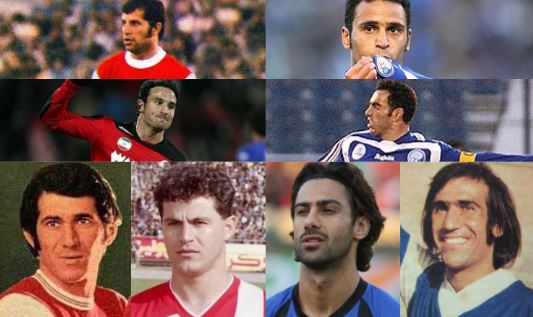
NOTABLE FIGURES:
ALI JABBARI
A key member of Esteghlal’s first great era, Ali Jabbari not only rocked the hell out of his long hair, but also rocked the back of opposing teams’ nets with thunderous goals. Jabbari is one of three players in Esteghlal history to score more than 90 goals, recording 92 goals in his decade of service. Five of those goals came against Persepolis, tied for the most in Tehran Derby history by an Esteghlal player. Jabbari also had a iconic game for Iran’s national team in 1972, scoring a hat trick in the last ten minutes against Thailand to turn a 0-2 hole into a 3-2 win.
GHOLAM HOSSEIN MAZLOUMI
One of the greatest strikers in Esteghlal history, Gholam Hossein Mazloumi ranks just ahead of Ali Jabbari with 94 goals and is even with him with five goals in the Tehran Derby. Nicknamed “Sar Talaei” (“Golden Head”), Mazloumi had a knack for getting his head to the ball, especially on corner kicks and free kicks. Upon his retirement, Mazloumi was the all-time leading goal scorer for Iran’s national team (he’s now eighth). After retirement, Mazloumi managed Esteghlal for a year and served as deputy chairman of his former club until his death from cancer in 2014.
SAFAR IRANPAK
Players making their debuts at ages 17-19 are considered incredibly young, and rightfully so. So what do you call someone who makes his debut at age 12? Safar Iranpak, for starters. Iranpak broke out with Shahin Avaz, played for them for nearly a decade, then was just in his mid-20’s when he made his move to Persepolis. Across the following decade, Iranpak scored 74 goals for Persepolis, fourth-most in club history. Iranpak also holds the record for most Tehran Derby goals with seven. Yeah, you read that right. Not a lot of people score on derby day.
HOMAYOUN BEHZADI
Homayoun Behzadi began his career at age 16 and was immediately taught to have Esteghlal — as a member of Shahin. Were his nearly 100 goals for them counted for Persepolis, Behzadi would easily be the top scorer in club history. Nevertheless, Behzadi played the vast majority of the remainder of his career after the dissolution of Shahin with Persepolis, making Tehran Derby history in that time. Behzadi scored half of Persepolis’ six goals during their record thrashing of Esteghlal, becoming the first player (and the only for nearly 40 years) to record a derby hat trick.
HOSSEIN KALANI
One of the first and most prominent members of the Persepolis Hall of Fame, Hossein Kalani ranks high on the club’s stat list in many categories. Despite playing for the club for notably less time than some of his contemporaries, Kalani is still one of only six Persepolis players to score more than 70 goals… as well as more than 60 goals. Kalani is also the second-highest scorer in the history of the Tehran Derby with six goals, just one behind Safar Iranpak. In addition, Kalani is among some of the players listed above to finish as the top scorer for the AFC Asian Cup.
ALI PARVIN
If there’s a contest for “Mr. Persepolis,” Ali Parvin would have a hell of an argument in his favor. One of the greatest players in club history, Parvin played 18 years for Persepolis, making a club-record 341 appearances (nearly 80 more than second place). During that time, Parvin also racked up 95 goals, the second-most in club history. After retiring from playing, Parvin took to managing, taking charge of Persepolis for a total of 17 years across three different spells. Most importantly, Parvin played a vital role in keeping Persepolis alive during the Iran-Iraq War.
FARSHAD PIOUS
For the entirety of his tenure with Persepolis, Farshad Pious did something that no one else who played for the club accomplished: score more than 100 goals. In fact, Pious did much better than that, putting 153 balls in the back of the net (nearly 60 more than Ali Parvin in second place). One of the best players and most prolific strikers in Iranian history, Pious was a key factor in Persepolis’ lone great continental triumph — the 1991 Asian Cup Winners’ Cup. Pious also went into managing after playing, getting his start as an assistant with Persepolis.
MAHMOUD FEKRI
Brought in to bolster the roster after Esteghlal’s AFC Champions League triumph in 1991, Mahmoud Fekri spent the better part of the next decade and a half patrolling the club’s back line. During that stretch, Fekri appeared in 345 games — more than anyone else in Esteghlal history (and is one of six players to cross the 300-game mark). After retirement, Fekri began a lengthy career as a manager, spending part of this year as caretaker for his old club. While his tenure lasted shorter than most would like, Fekri is still (rightfully) regarded as a club legend.
MEHDI HASHEMINASAB
One of only five players to score five or more goals in the Tehran Derby, Mehdi Hasheminasab is the only one of those men to score for both clubs. Hasheminasab made a name for himself during his tenure with Persepolis, becoming one of the up-and-coming strikers in the league. But in 2000 he left for Esteghlal, causing his long name to become a slur for Persepolis fans. His first derby with his new club was memorable, as he scored what would’ve been the late winner had it not been for Ali Karimi’s later tying goal (it was also memorable for the fight/riot).
FARHAD MAJIDI
One of Esteghlal’s iconic players of the 21st century, Farhad Majidi ranks among the Top 10 in club history when it comes to appearances (256) and the Top 10 of all-time Tehran Derby goal scorers (four). Majidi is also the second-highest goal scorer ever to lace up cleats for Esteghlal. Majidi’s talents also made him a natural selection for Iran’s national team, although injuries prevented him from reaching his full potential. Majidi has since become a manager and is currently in charge of Esteghlal, although the man ahead of him in the scoring list could be next.
ARASH BORHANI
All Arash Borhani does is score goals, as evident by his impressive resume. Borhani is the only player to score over 100 goals for Esteghlal, putting 107 balls in the back of the net during his tenure with the club. Across those nine years, Borhani made 292 appearances (sixth in club history) and scored the second-most goals of anyone in the Persian Gulf Premier League. The club’s greatest striker ever could also be in position to take the manager’s job should Farhad Majidi fuck up — Borhani is currently serving as manager of the reserve team, Esteghlal B.
EAMON ZAYED
Libyan by heritage and Irish by birthplace, Eamon Zayed has had quite the soccer journey, which has taken him from England and Norway to Malaysia and even the U.S.. But he earned international fame by what he did in Iran’s biggest match. In 2012, Persepolis was behind 0-2 to Esteghlal and reduced to ten men. His side seemingly beaten, Zayed came alive and scored a hat trick in the final ten minutes to give Persepolis a shocking 3-2 win. It was just the second hat trick ever in the Tehran Derby and it made Zayed the highest-scoring foreigner in the derby.
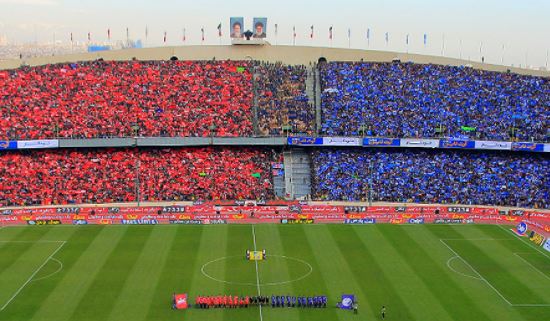
FAN INVOLVEMENT:
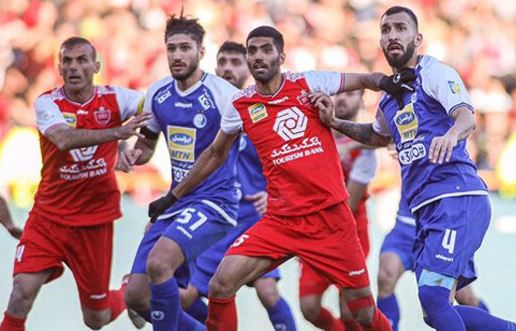
Although the instances of fan violence (like the riot of 1995) have notably decreased over the past several years, the Tehran Derby has lost none of its importance and intensity for supporters of Esteghlal and Persepolis. Whenever you visit Tehran, one of the first questions you’re asked is “Red or blue?” with your answer directly impacting how the person asking the question treats you. Businesses in the city literally shut down during the derby, both out of fear of vandalism and so they can watch the match. In fact, tensions rise so high that it’s a common practice for members of the two clubs to dine together the night before a match to try and promote peace. Nearly 100,000 people pack Azadi Stadium each time Persepolis and Esteghlal get together, with the stands perfectly divided in half — one blue, one red. Every single person in that stadium is shouting and cheering, creating an incredible atmosphere that often outshines the quality of soccer being played. While wrestling is still largely Iran’s most popular sport, soccer has a notable foothold in society, thanks in large part to the Tehran Derby.
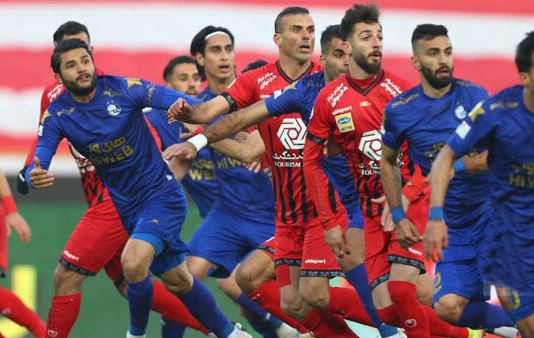
SUMMARY:
The Tehran Derby ensnares, dominates, and in some ways defines one of the biggest cities and bustling metropolises of Asia. When Esteghlal and Persepolis take the field against each other, they’re joined by the decades of history, animosity, drama, accomplishment, passion, and intensity that defines one of the best rivalries in the world.
When I began thinking about which rivalries would represent Asia in the World Cup of Hate, two immediately came to mind — the Kolkata Derby and the Tehran Derby. Most of the time fans are asked which is the best rivalry in the continent, one of those two are given as the answer. But what about the last two spots for Asia? Just because they aren’t the common response doesn’t mean they aren’t worthy of a place in the final tournament — or at least worth talking about.
Old Indonesia Derby (Indonesia)
Persija Jakarta vs. Persib Bandung
“Biarkan Permusuhan Ini Tetap Abadi.” (Let This Feud Remain Eternal) — unnamed Persib supporter
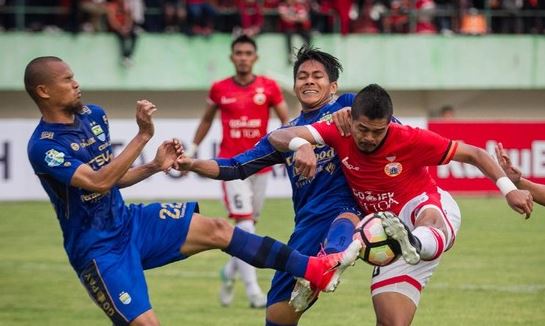
While Persatuan Sepakbola Indonesia Jakarta and Persatuan Sepakbola Indonesia Bandung have been facing off for nearly a century, it was only within the past few decades that the rivalry truly exploded, with the Old Indonesia Derby becoming one of the fiercest in the world due to close contests, class differences, and a heaping pile of hooliganism.
When you think of throngs of tens of thousands of fans screaming their lungs out while cheering on their teams in between brutal brawls with rival fans, you’d think of somewhere in Europe or South America (oh, we’ll get there). You probably wouldn’t think of Asia, let alone Indonesia. Of all the countries whose rivalries will qualify for the World Cup of Hate, I’d be willing to admit you know the least about Indonesia. The archipelago has been valuable to people throughout the Old World for centuries, consisting of thousands of ethnic groups and hundreds of linguistic groups. The Dutch colonized Indonesia and ruled until World War II, when Japan took over. Upon Japan’s defeat in the war, Indonesia fought off a bloody attempt by the Dutch to take back control, with independence being recognized in 1949. Like in other Southeast Asian countries, life has not been easy for Indonesia since then, with authoritarianism, an attempted coup, an anti-communist purge, concentration camps, mass corruption and suppression, and economic issues being felt over the ensuing decades. The country’s soccer scene has been dragged along and changed throughout these years, and despite Indonesia itself being relatively stable and growing, it now may be the most controversial part of the land
HISTORY:
In 1928, as the Dutch were spreading out towards the Indonesian borders, Voetbalbond Indonesische Jacatra (named after a fort on the coast of president-day Jakarta) was formed as a soccer club for Indonesian residents of what would become the country’s capital and largest city. Five years earlier in Bandung (the capital of Java, the second-most populous region in Indonesia), Bandoeng Inlandsche Voetbal Bond was created. It was succeeded by a few other teams, all of which merged together in 1933 to form the current club, known as Persib Bandung for short. Both Persib and VIJ took inspiration from their city’s seals in their crest designs. They were also among the founding clubs of the Football Association of Indonesia (PSSI) in 1931. Five years after Indonesian independence, VIJ would change its name to its current form, shortened to Persija Jakarta. The first meeting between the eventual Persija and Persib took place in 1933, which is pretty much all we know about the game. For the first and only time in this list, I have to include a tally of results that are “unknown” due to incomplete records. Two more exhibition games would follow that year, with the clubs splitting the results.
Because there was no official organized league or any kind of competition in the country, there was little reason for Persib and Persija to play each other — there were only a handful of games between the two until Indonesia gained independence. The Perserikatan had been the national amateur soccer tournament since 1931 (with the two clubs winning multiple titles), but once the 1950’s began things got a lot more official. This period saw some of the most notable results between the two future rivals. Persija got off to a better start, recording their most lopsided victories in Old Indonesia Derby history — 7-2 (1951), 6-1 (1957), and 7-1 (1957). However, the 1960’s saw fortune swing back in favor of Persib, which recorded a 6-0 win in 1963. In addition, a 2-0 Persib win was then transformed into a 7-0 victory for something Persija did. But despite much more frequent competition, the rivalry still didn’t truly take off, which wasn’t helped by the fact that Indonesian soccer was still an amateur competition.
That changed in 1994, when the PSSI decided to turn pro. In addition to the Perserikatan, Indonesia had another, separate semi-pro league called the Galatama. While the teams in the latter were much more professional, the clubs in the former had much more passionate fan bases. The two leagues merged to form the Liga Indonesia Premier Division, with organizers hoping to combine the two attributes and usher in a new era for soccer in the country. For the first few years, things went exactly as planned, with Persib even winning the inaugural league title. But then things began to get out of control in the stands, with fights in the stands and other hooliganism starting to form. Officials could’ve gotten a handle on the violence, but the league itself was in unsafe hands. The structure of the league itself changed nearly every year, with the number of teams and games growing rapidly. In 2008, the Top 8 teams were bumped up to another league, the Indonesia Super League (later Indonesian Premier League). The ISL would eventually come back as its own separate league in 2013, with Indonesia having two top flight divisions. Things got so crazy that FIFA suspended the PSSI due to meddling in the league, even recommending the top flight be shut down. Eventually, the top flight was reduced to just one league, which was renamed Liga 1 in 2017 and has remained that way ever since. But by the time league stability was reached, the games had become well known for the violence and general insanity in the crowds, which Persib and Persija may have sparked.
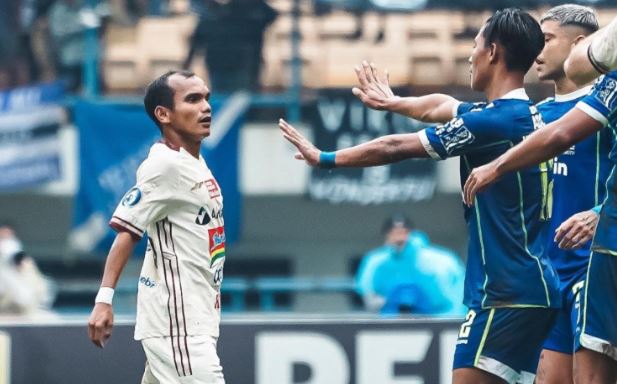
Persija and Persib had plenty of reasons to be rivals. First off, they were based in two of the biggest cities in Indonesia and the two largest regions. Those regions were also a contrast, with Persib representing a mostly Sudanese and Hindu group and Persija representing a mostly Javanese and Muslim group. Plus, they had a lengthy history both against each other and as part of the PSSI. However, the spark that blew up the rivalry didn’t come until the very end of the 20th century. By the time 1999 rolled around, Persib had been one of the better teams, while Persija wasn’t good at all. That changed when a former mayor of Jakarta transformed the club and made improvements, which caused some resentment among Persib fans. That year, Persija supporters flocked to Bandung for the away fixture. Persib fans began to yell and chant at the away supporters, which sparked a riot. It’s unclear who exactly was at fault, but Persija fans claim they were unfairly treated. Bad blood continued through 2001, when the supporters groups took part in an episode of the Kuis Siapa Berani? quiz show. The Persib fans won, mocking Persija and calling Jakarta a “flood city.” However, they forgot the studio was located in Jakarta, meaning the home fans could respond. That’s exactly what happened, with Persija fans blocking the Persib fans’ route home, sparking yet another riot.
Perhaps spurred on by their fans, Persija won their first top flight pro title in 2001. However, that success was one of the few trophies won by either club. The Old Indonesian Derby is unique in that neither team can be considered the most successful in the country, let alone among the top clubs in the region. Both Persija and Persib have won only one more league title since then, with neither holding the record for most league titles. None of them have won the country’s major tournament, with Persija alone even finishing runner-up. Naturally, both clubs have gone nowhere when it comes to continental competitions, with Persib being the only one to even make it to the knockout stage of the AFC Champions League. What’s more, several players have crossed the battle lines, playing for both clubs in several derby matches. No, this rivalry is carried by the fans. But don’t worry — they have plenty of strength to do so.
Between the excitement of finally getting professional soccer, the need for an outlet for years of frustration, the ability for fans who didn’t pay for a ticket to shockingly get inside stadiums, and the lack of proper oversight for the first two decades of the league, Indonesian soccer has become known for one thing: insane fan hooliganism. Over the past 30 years, there have been 76 soccer-related deaths across the country. Persija and Persib haven’t exactly helped bring down the numbers, with the Old Indonesia Derby contributing seven of those deaths. That includes a 2012 incident in which a Persib fan was beaten to death with a stadium bench by Persija fans for celebrating a goal, as well as a 2018 incident in which a Persija fan was killed by Persib fans before a match. The latter incident caused Persib to be fined $6,634 (which seems a little low) and play the rest of its matches behind closed doors that season. In fact, the PSSI has banned away fans from games between the two clubs. While there have been calls for fans of each club (as well as the greater Indonesian soccer community) to calm the fuck down and stop killing each other, it will be tough to move past this lengthy history of violence.
MAJOR ON-FIELD MOMENTS:
THE LAST AMATEUR CLASHES
As the amateur era Indonesian soccer was coming to an end, Persib was in the middle of one of its most dominant eras. That time period included winning the final Perserikatan, as well as claiming the 1994 Siliwangi Cup. In both of those tournaments, Persib had to get through Persija, which they did — just barely. In the Perserikatan, Persija made a great stand at home, with the 1-1 scoreline lasting all the way until penalty kicks, which went in favor of Persib 5-4. Exactly two months later, the two teams faced off in Bandung, with the even scoreline being 2-2 this time. Penalties were needed once again, with Persib coming out on top 4-2 this time. These two wins were part of a nine-year stretch where Persija recorded just one win over Persib.
SAFETY CONCERNS
Once Persija eventually broke that streak, they immediately began another one — this time in their favor. While Persija went on their own nine-year stretch without losing a match to Persib, the last win came at the seven-year mark, under… interesting circumstances. There were major security concerns going into the match, which was to take place in Jakarta. A massive crowd was expected, with officials moving the kick-off back three hours in an effort to calm things down. But, Persib claimed they received a threat of violence at the hotel they were staying at (whose location was supposed to be kept secret). So they went home to Bandung instead, with Persija taking the field alone and being awarded a 3-0 win. This happened in 2005, by the way.
EMPHATICALLY ENDING THE DROUGHT
By the time the winless streak entered year nine, Persib and Persija had drawn three straight times, giving Persib fans balls as blue as their team’s uniforms. The first matchup of the 2007-08 regular season would see that dam finally burst. In front of a ravenous Bandung crowd, Persib got on the board within the first 15 minutes thanks to a rocket from Eka Ramdani. Just two minutes later, Christian Bekamenga doubled the host’s lead. Things went back and forth for the rest of the half, until Bekamenga grabbed his second goal of the game just before the whistle. The 3-0 scoreline lasted until the end of the match, with Persib finally getting back in the win column against their rivals, while also clinching the mid-season Western Conference title.
WALKING OUT
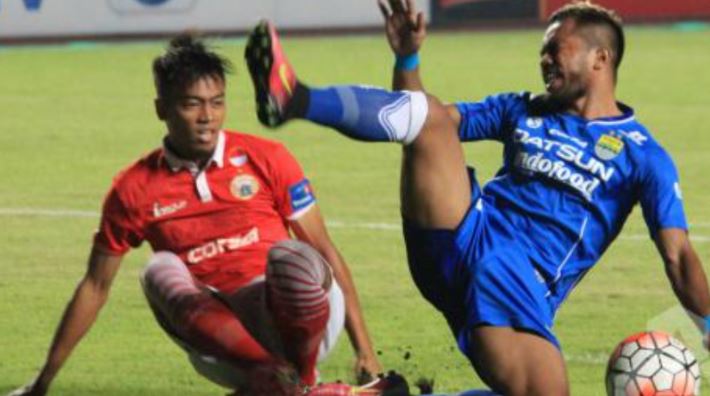
Things were already a shitshow even before Persib and Persija kicked off in the penultimate match of the 2017 season. That’s because Persija had to switch stadiums at the last minute due to failing to get a police permit for the original site. Then the match began and it was Persib who would get progressively pissed off. First, an apparent goal by Ezechiel N’Douassel was negated by the referee, despite the ball appearing to go in. Then in the 76th minute, Persija converted a penalty kick after a foul that Persib didn’t agree with. A few minutes later. Vladimir Vujovic was given two straight yellow cards, reducing Persib to ten men. That was enough for Persib, who left the field. The referee called the match in the 83rd minute, awarding Persija a 3-0 win.
NOT WITHOUT A FIGHT
In 2018, Persija finally ended their lengthy title drought, topping Liga 1 in a season that wasn’t without controversy (particularly the final game). Though Persija managed to claim the top spot on the table by just a point, it would’ve been easier had it not been for a wild battle with their rivals a few months earlier. Ezechiel N’Douassel gave Persib a lead near the half hour mark, only for Jamie Xavier to equalize deep into stoppage time of the first half. A successful penalty from Jonathan Bauman was negated by Rohit Chand just a few minutes later, with the match seemingly headed for a 2-2 draw. However, center back Bojan Malisic scored an unlikely goal four minutes into stoppage time to stun the eventual champs and give Persib the 3-2 victory.
BACK TO BUSINESS
After just a few matches, the 2020 Liga 1 season was suspended (and later outright canceled) due to the COVID-19 pandemic. A year later, teams were finally set to retake the field, with the PSSI bringing back the Menpora Cup — a preseason tournament — to allow them to shake off the cobwebs. Naturally, Persib and Persija were the last two teams standing, facing off in a two-legged final. In the first ever Old Indonesia Derby to take place in front of zero fans, Braif Fatari scored the earliest goal in the history of the rivalry, finding the back of the net in the first minute. Taufik Hidayat doubled Persija’s lead in the seventh minute, which solidified a 2-0 win for the Jakarta club. A 2-1 win in the second leg would give Persija the title in a 4-1 aggregate triumph.
STATISTICS:
HEAD-TO-HEAD RECORD
Persija: 52
Persib: 61
Draw: 51
Unknown: 12
LEAGUE CHAMPIONSHIPS
Persija: 11 (record)
Persib: 7
PERSERIKATAN
Persija: 5 (tied for record)
Persib: 4
INDONESIA PRESIDENT’S CUP
Persija: 1
Persib: 1
SOUTH INDONESIA INDEPENDENCE CUP
Persija: 1
Persib: 0
BRUNEI PESTA SUKAN CUP
Persija: 0
Persib: 1
NOTABLE FIGURES:
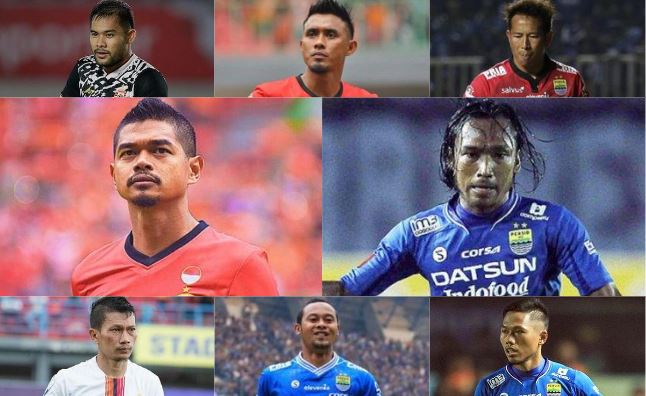
BAMBANG PAMUNGKAS
Considered one of the greatest Indonesian soccer players of all time, Bambang Pamungkas was an incredible striker during his playing days, one known for his outstanding header. His impact on the Old Indonesia Derby cannot be overstated — he’s the all-time leading goal scorer for any player (with nine goals total) by a long shot (the next closest player has just three goals). A longtime player and former two-time manager for Persija, Pamungkas is an incredibly popular figure across Indonesia — he was chosen as the torch bearer for the 2012 Summer Olympics.
ISMED SOFYAN
In 2002, then 22-year-old Ismed Sofyan moved to Persija. He would remain with the club for another two decades, making 370 appearances for the Jakarta club — an all-time record. Sofyan was a reliable anchor of the defense, with a rare speciality in free kick taking. Along with Bambang Pamungkas, Sofyan is one of just two players whose numbers have been retired by Persija in its history. In fact, the duo were a frequent pair on the field, with Sofyan feeding long balls to Pamungkas from the back. He also briefly served as an interim assistant coach in 2019.
ATEP RIZAL
Atep Rizal is (as of this writing) the second-most capped player in Old Indonesia Derby history and a Persib icon. But he actually made his debut with Persija in 2004. However, his play would attract suitors, including Persib, who managed to finally sign him in 2008. After a bit of a rocky start to his campaign, Atep would finally get things going in 2009. He became a hero in 2014, when he scored a spectacular goal that sent Persib to the league final. Known as “Lord Atep,” he ended up staying at Persib for a full decade, making 227 appearances for the Bandung club.
HARIONO
In 2008, Jaya Hartono left Deltras FC to become the coach at Persib, bringing along with him a promising defensive midfielder named Hariono. While Hartono lasted just two seasons, Hariono stuck around for a bit longer, making 239 appearances across an 11-year span. Hariono grew into a club legend during this time, famously never receiving a straight red card and only being sent off twice. He left the club in 2019 — a part of what Persib described as a rebuild — and his number was retired. However, that number would be brought back — if he returned to the club.
MAMAN ABDURRAHMAN
At age 41, Maman Abdurrahman is still kicking in the back line, the definitive veteran of the Old Indonesian Derby. He was brought into the rivalry by Persib, where he made 121 appearances over five seasons. But while he would leave in 2013, he would be back in just three years — as a member of Persija. Since then, he’s made 143 appearances and will likely retire in Jakarta. Along with Abanda Herman, Abdurrahman is one of only two players to make five or more appearances for both Persib and Persija in the rivalry and one of three to have 15 or more caps.
ABANDA HERMAN
Arguably the greatest (or at least the most productive) non-Indonesian player in the history of the Old Indonesia Derby, Abanda Herman is one of the few players to sit in the Top 10 lists in both caps and goals scored. The Cameroonian had played in 11 derbies and is one of just four players to score multiple goals in the rivalry’s history. In fact, he’s the only player to do so while scoring for both clubs. Abanda also did this in just six seasons, four with Persija and two with Persib (though Persib was the club he was playing for when he converted to Islam in 2013).
TONY SUCIPTO
Along with Atep Rizal, Tony Sucipto is one of only two players to make double digit appearances for Persib against Persija. However, before he put on the blue, he got a dash of red. Sucipto debuted in 2010 for Persija, though he left the following year for Persib. He spent the next seven years (and 173 appearances) shoring up Persib’s defense. Then, just as he appeared to be entering the decline of his career, Sucipto returned to Persija, where he has been ever since. Overall, he has the third-most appearances out of players who have been with both clubs.
ANDRITANY ARDHIYASA
Check back in another decade and Andritany Ardhiyasa may be considered the greatest player in Persija history. Ardhiyasa is just 31 years old and has already been with Persija for 13 years, making 214 appearances. He’s already set the record of most clean sheets in rivalry history with seven — more than double second best. Incredibly, he might not have gotten a shot had fate not intervened in 2010, when he was with Sriwijaya FC. All three of their goalkeepers got injured, so Ardhiyasa joined as an emergency player. He played well and Persija signed him months later.
MICHAEL ESSIEN
At one point, Michael Essien was considered one of the best midfielders in the world. A part of Ghana’s golden generation, Essien played for nearly a decade at Chelsea (where he won the Premier League) and also made stops at AC Milan and Real Madrid. Then, in 2017, Essien unexpectedly signed with Persib, saying he hoped he was the “prelude to other world players moving to Indonesia.” He scored five goals and the team cut him at the end of the season to open up more foreign player spots. I just think it’s weird that Essien played in this rivalry.
I MADE WIRAWAN
I Made Wirawan is kind of a Persib legend — he played with the Bandung club for 11 seasons, making 132 appearances (which included three clean sheets against Persija) and retiring this past season to become the goalkeeper coach. But he earns a spot on this list for one reason only: he has maybe the best name of any player I’ve come across while putting this list together. His name is a complete sentence — a declaration, at that. I don’t even know where the “I” came from or what it means, given that many of his online references are just “Made Wirawan.”
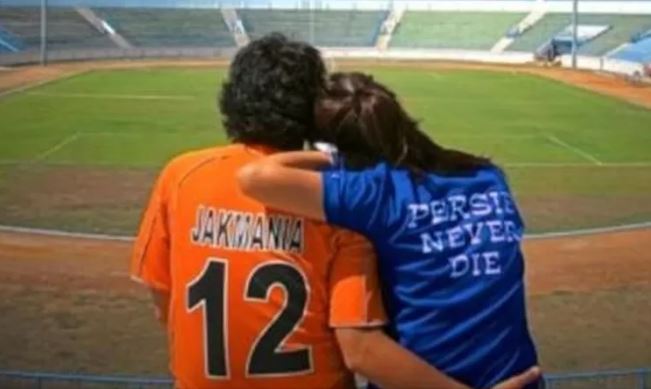
FAN INVOLVEMENT:
In general, the fan support for soccer in Indonesia is as ravenous as most Eastern European countries. This has led to a multitude of problems, including several deadly incidents. The Old Indonesia Derby is certainly not unfamiliar with this kind of violence (at least seven deaths since 1993), with instances between Persija supporters (Jakmania) and Persib supporters (Bobotoh) as recently as 2012 and 2018. In recent years, there has been a growing call for an overall reduction in hooliganism and overall violence at soccer matches, especially in the wake of last year’s Kanjuruhan Stadium disaster — 135 people were killed and 583 injured after a match between Arema and Persebaya Surabaya (the second-deadliest disaster in the history of soccer [not counting the Football War]). In the aftermath of that tragedy, fans of both Persib and Persija participated in prayer ceremonies in both Jakarta and Bandung. Although several subgroups from both sides had declared their intentions to reduce fanaticism and produce a safe atmosphere, at least one main figure in the fandom continues to front the slogan, “Biarkan Permusuhan Ini Tetap Abadi” (“Let This Feud Remain Eternal”).
If you need further evidence of Persija-Persib being the definitive derby in Indonesia, look towards the 2009 film Romeo and Juliet. While it doesn’t have the pair of breasts from the 1968 version we all saw in high school or the batshit craziness of Baz Luhrmann’s 1996 Romeo + Juliet, this century’s Indonesian adaptation of Shakespeare’s classic tale does involve soccer. Ranagga is a loyal supporter of Persija, while Desi is a Persib fan. The two try to make their blossoming love work despite their families being on opposite sides of the rivalry, eventually eloping. It has a 7.4/10 rating on IMDb. You can watch it here.
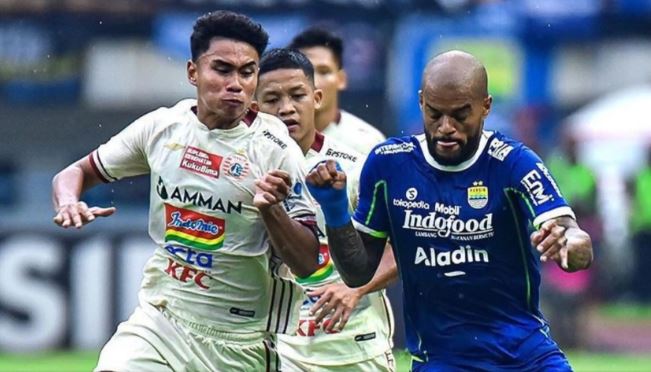
SUMMARY:
The Old Indonesia Derby relies on a lot of newer elements — the professionalism and insane crowd violence — to stand out among the crowd. However, stand out it does, with the atmosphere surrounding these two rivals being comparable to them most feisty venues in the entire world.
One more down, one more to go for Asia in the World Cup of Hate. For that last spot, we have to go to one part of Asia we haven’t been to — the far East, which is where people would usually think to name a random country from Asia. There’s no question which rivalry deserves this spot — despite being one of the youngest in the continent, it’s also one of the fiercest.
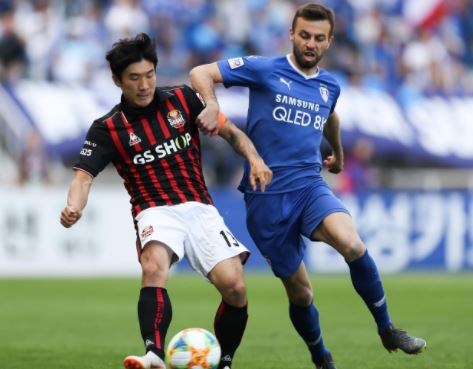
Super Match (South Korea)
FC Seoul vs. Suwon Samsung Bluewings
“The Jijidae derby between the old enemies is regarded as one of the high points of the K-League season, both for fans of the two clubs and for football-loving neutrals.” — Iain Pearce, The Outside View
The Super Match is always the highlight of South Korean soccer — matches between FC Seoul and the Suwon Samsung Bluewings bring a surprising amount of animosity for a relatively young league in a country without a lot of professional soccer history.
While soccer has been around in South Korea in some form since the early 1900’s, for various reasons (the occupation by Japan, the Korean War, etc.) professional soccer never really took off. Until the late 1970’s, only amateur soccer teams and competitions existed. Then — after a year of planning — Korean Football Association president Choi Soon-young created the country’s first professional soccer team, Hallelujah FC, in 1980. Two years later, the country’s other most popular sport, baseball, was made professional with the creation of the KBO League (shoutout to the 2020 championNC Dinos!) in 1982. After seeing how well the KBO did, the FA hastily created a professional soccer league in 1983, with the first season being a haphazard mix of a few pro and amateur clubs. The following year, the FA was able to gather some major companies and fully professionalize the league. That year, 1984, is where we begin.
HISTORY:
As the K League expanded to eight teams, several clubs were promoted to professional while several others were created. One of those teams was Lucky-Goldstar FC, funded by the Lucky-Goldstar Group (get used to corporations being part of team names). After a dismal opening season (second-to-last), Lucky-Goldstar rebounded to win its first league title in 1985. But unlike pretty much everywhere else, South Korean teams in this era didn’t have their own stadium. For the early part of its existence, Lucky-Goldstar had pleaded to play in the capital city of Seoul. Finally, after realizing that their formula was fucking stupid and people get more attached to clubs from their city, the Korean FA decided to make each club city specific. Lucky-Goldstar was one of the clubs sent to Seoul and responded to getting their wish by winning the 1990 league title. But the moves weren’t done — in 1995, South Korea was bidding to host the 2002 FIFA World Cup (along with Japan). In order to spread soccer popularity to other provinces, the Korean KA forcibly relocated several clubs — including Lucky-Goldstar (now the LG Cheetahs) — to other cities. The Cheetahs were sent to the Gyeonggi city of Anyang, which proved to be a fortuitous decision given what was happening nearby.
The K League wasn’t just relocating clubs — they were forming new ones in previously untapped markets. The same year the Cheetahs were sent to Anyang, the city of Suwon (less than ten miles away) was given the first ever professional Korean club to be founded in one specific city. The team — the Suwon Samsung Bluewings — were quickly embraced by their city and proved to be a perfect example of the Korean FA’s reasoning behind their plan. The Bluewings were also given a rival in the Anyang LG Cheetahs, and not just because the two clubs were located less than ten miles apart. The owners of the two clubs — LG and Samsung — were considered rivals in the business world, particularly in electronics. Thus, the Super Match is one of the few rivalries that can claim business as a major factor in their hatred. With Anyang several years removed from championship glory, Suwon was able to win the first ever Super Match 2-0 and the first season series 3-0-1. Suwon also won the second stage of competition to advance to the 1996 championship tie, where they would stumble in the second leg and fall to Ulsan Hyundai Horang-i. But the Bluewings wouldn’t have to wait long for silverware.
After an off year in 1997, Suwon captured their first ever trophy by claiming the K League title in 1998. The Bluewings then became the second ever Korean club to repeat as league champs, bringing home the 1999 title as well (despite finally losing to the Cheetahs for the first time). That year also saw Suwon claim the Korean League Cup, defeating Anyang in the final. But the Cheetahs — who had won their first Korean FA Cup the year before — were back in form and out for revenge. It was Anyang who stopped Suwon’s quest for a three-peat, winning all three league matches in 2000 and claiming the K League title. Throw in two more League Cups for Suwon and the fight for silverware was fully on. But the competition wouldn’t stay limited to South Korea. Suwon had gotten a taste of continental competition by reaching the 1998 Asian Cup Winners’ Cup Final (narrowly losing to Al-Nassr). That hunger would be satisfied in 2001, when the Bluewings avenged an early loss to Jubilo Iwata in the 2001 AFC Champions League to defeat Iwata 1-0 in the final, becoming the third Korean soccer club to be champions of Asia.
The following season saw the peak of the rivalry that firmly established Anyang and Suwon as true rivals. Both clubs had qualified for the 2001-02 AFC Champions League and met in the quarter-finals (a group stage). A 0-0 draw was both Suwon’s lone blemish and one of three stalemates for Anyang. But it was enough for both clubs to advance to the finals, where the Cheetahs took care of Esteghlal and the Bluewings flew by Nasaf Qarshi. That set up the second ever all-Korean Champions League Final and the first between these two rivals. Although the prospect of a major derby being played in the Champions League Final sounds exciting, the match itself ended in another scoreless draw. But that meant penalties, which saw Suwon prevail 4-2 and claim its second straight continental crown. With Suwon also winning the Korean FA Cup, the Bluewings achieved a historic double despite not winning the league (not to mention their second-straight Asian Super Cup). Even after this historic match, the rivalry was about to get another level of spice in 2004, this time due to actions off the field.
The forced relocation of the old Seoul clubs in 1995 was successful not only in spreading the love of the game across the country, but also in securing the 2002 World Cup for South Korea (who astoundingly finished fourth place) and Japan. The tournament saw ten brand new stadiums built, with regional clubs moving into the new digs. The exception was Seoul, whose stadium sat vacant. Thus began the battle to bring a club to Seoul, which was complicated both by expansion fees and the added bill a club would take for the cost of constructing the stadium. The Cheetahs — one of the clubs moved from Seoul several years earlier — wanted to be that club and was eventually granted permission (thanks to taking on a $15M bill). As a result, the Cheetahs renamed themselves FC Seoul. The move was controversial for several reasons, one of them being the fact that fans in Anyang were pissed about losing their club to the capital city (FC Seoul is one of the most universally hated clubs in all of South Korea). But it also changed a huge part of the rivalry with Suwon, increasing the distance between the two clubs. It also forced a change in the name of the rivalry — what was originally called the Jijidae Derby after a hill on the National Route 1 connecting Anyang and Suwon later became the Super Match.
The name of the match wasn’t the only thing to change after the move to Seoul. Suwon had largely held the advantage in the rivalry, both in terms of wins and accomplishments (the Bluewings added a third league title in 2004). But with the financial boost from their relocation to the capital, Seoul gradually became one of the more dominant clubs in the past 15 years in South Korea. Suwon last won a K League title in 2008, with Seoul winning three championships in that span (a mark only eclipsed by the dynasty that is Jeonbuk Hyundai Motors. Seoul also claimed its first Korean League Cup in 2010, two years before the tournament’s abolition. The one place Suwon can claim superiority in recent years is in the FA Cup (especially a dramatic win over Seoul in the 2016 Final). But the Bluewings have yet to get back to the Champions League Final, which Seoul reached in 2013 (losing to Guangzhou Evergrande). What’s more, Seoul reversed Suwon’s originally large lead in the rivalry win column.
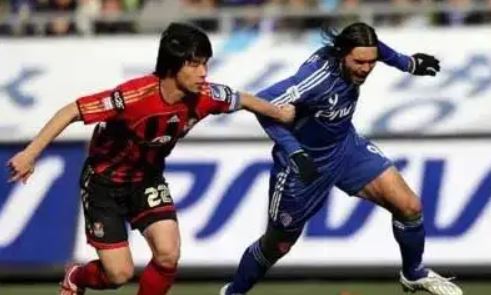
MAJOR ON-FIELD MOMENTS:
THE FIRST FINAL
The first few matches between these two rivals in the Korean League Cup were insane. A 2-2 draw in 1996 was followed by a 4-4 draw in 1997. The following year, Suwon edged out Anyang 1-0 in the first match, while the Cheetahs beat the Bluewings by the same scoreline in the second match. So what would 1999 bring? How about the first ever final between the Super March clubs? Anyang survived a penalty shootout in the first round to reach the final, while Suwon had come out on top in a back-and-forth match with the Pohang Steelers. Anyang’s 27th minute goal in the final was answered less than a minute later by Suwon, with both clubs at 2-2 entering halftime. A tense second half eventually developed into a 4-2 win for the Bluewings.
FIGHT FOR CONTINENTAL GLORY
Just over five years after their founding, Suwon had become continental champions. But it was their second straight title that they remember most fondly. That’s because it came against Anyang in the most high-stakes Super Match to date. It’s rare that a rivalry reaches the peak of a battle for continental supremacy (Al Ahly and Zamalek did it in 2020, while another rivalry we’ll get to soon did so in 2018). Although the match ended in a scoreless draw, penalties were (as usual) enough to provide the drama. The Bluewings prevailed, earning their place as one of the only clubs to repeat as AFC Champions League winners. The victory also served as the high mark for Suwon’s iconic dominant early teams, who won pretty much everything they played for.
BACK-AND-FORTH QUARTER-FINAL
The first time the Super Match played out in the Korean FA Cup was in 1997, when Anyang prevailed in penalties after a 2-2 draw. Nine years later, it was deja vu all over again, but somehow even more dramatic. The quarter-final clash was seemingly going to be a snoozer, with both teams scoreless at the half. But Silva gave Suwon the lead shortly after the whistle, only for Seoul to jump ahead with two goals ten minutes apart. Seoul looked like they would hold on for the win, but Mato Neretljak equalized with three minutes left in regulation. Penalties would once again be needed after a scoreless extra time. It took 14 kicks to decide the winner, with Suwon prevailing 6-5, although the Bluewings would go on to lose the FA Cup Final.
CLASH FOR THE LEAGUE CROWN
In 2008, there was barely anything separating Suwon and Seoul. Both clubs split their regular season matchups and finished on top of the standings with 54 points (Suwon was only three goals ahead on goal differential). Thus Seoul had to survive an extra time encounter with Ulsan Hyundai to face Suwon in the final. Seoul went ahead early in the first leg thanks to Adi, only for Suwon to salvage a 1-1 draw thanks to Kwak Hee-ju’s goal with just over ten minutes left. The second leg saw Suwon go ahead early this time — Edu scoring in the 11th minute — and Seoul equalize in the 25th minute thanks to a penalty. Song Chong-gug put the Bluewings ahead again shortly before halftime, with that goal being the winner as Suwon won the league 2-1.
A BATTLE BECOMES A ROUT
As can be expected from a rivalry with just 25 years of history, there haven’t been too many huge ass-whoopings in the Super Match. Two of the three times a match between these two rivals was decided by four or more goals came in 1999 (Suwon won 5-1 and 4-0). But that third and final match was the most unexpected. With both Seoul and Suwon fighting for league contention, South Korea’s capital hosted what would be a record rout. It didn’t seem like an extraordinary match, with the halftime score being 1-1. But then Yeom Ki-hun and Lee Sang-ho scored twice within five minutes of each other to make it 3-1. Jong Tae-se added a fourth in the 67th minute before tacking on another goal with two minutes left, cementing the score at 5-1.
TWO LEGS OF TERRIFIC PLAY
Perhaps the best ever Super Match took place in 2016, when Seoul and Suwon met in the Korean FA Cup Final. The first leg was won 2-1 by Suwon, but the second leg is where things truly went insane. Johnathan gave Suwon a 1-0 lead in the 55th minute, while Adriano tied the score at 1-1 to give Seoul a lifeline with 15 minutes remaining. Incredibly, Yoon Seung-won’s last gasp three minutes into stoppage time gave Seoul its second goal, with the two 2-1 scores meaning extra time was needed. Penalties were eventually needed as well, with the first 19 — nineteen! — kickers all converting from the spot. Unfortunately for Yu Sang-hun, he was number 20, with his miss giving Suwon the FA Cup title in one of the most dramatic ways possible.
STATISTICS:
HEAD-TO-HEAD RECORD
Seoul: 43
Suwon: 38
Draw: 30
LEAGUE CHAMPIONSHIPS
Seoul: 6
Suwon: 4
KOREAN LEAGUE CUP
Seoul: 2
Suwon: 6 (record)
KOREAN FA CUP
Seoul: 2
Suwon: 5 (record)
KOREAN SUPER CUP
Seoul: 1
Suwon: 3 (record)
AFC CHAMPIONS LEAGUE
Seoul: 0
Suwon: 2
ASIAN SUPER CUP
Seoul: 0
Suwon: 2 (record)
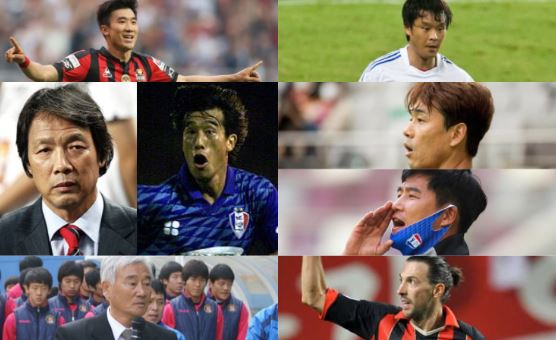
NOTABLE FIGURES:
KIM HO
A former star player himself, Kim Ho led the South Korean national team to the 1994 FIFA World Cup. He then got an offer to manage the expansion Suwon Bluewings and decided to take it. Eight years later, Ho left the club as one of the legendary managers in Korean soccer history. It was Ho who presided over Suwon’s golden age, with all of the K League titles, domestic cup wins, and back-to-back AFC Champions League/Asian Super Cup crowns. He also developed plenty of Korea’s best players of that era, who would become known as “Kim Ho’s children.”
CHO KWANG-RAE
One of South Korea’s greatest midfielders of all time, Cho Kwang-rae was nicknamed the “Computer Linker” due to his passing, vision, and decison-making. So it’s no surprise that Cho eventually became a manager, settling in as an assistant for Kim Ho at Suwon. What was a surprise was that — after taking a year off — Cho returned to coaching as manager of the Anyang Cheetahs. Cho would lead the club to several titles, but became one of the Bluewings’ biggest enemies and one part of an era of controversial moves at the Super Match’s height.
SEO JUNG-WON
The other half of that was Seo Jung-won, who began his career as a young prospect with Anyang. Nicknamed “Nalssaendori” (“An Agile Man”), Seo attracted the attention of French club Strasbourg. But after a year overseas, Seo returned to Gyeonggi in 1999 — only this time for Suwon. This — combined with Cho Kwang-Rae’s move to the Cheetahs — sparked a new level of hatred between the two clubs at what many consider the peak of their rivalry. Seo went on to have a stellar career with the Bluewings, being named to the club’s greatest ever team in 2015.
YOON SANG-CHUL
A incredibly prolific goal scorer, Yoon Sang-chul is one of only four players to appear in more than 300 matches for Seoul, as well as one of only two men to score more than 100 goals. Yoon also made domestic history as the first player to ever score 100 goals in the K league. With the exception of a couple of stints in New Zealand and Australia, Yoon spent the entirety of his playing career with the club, being a part of the Lucky-Goldstar Hwanso, LG Cheetahs, and Anyang LG Cheetahs eras. Yoon retired with a plethora of individual honors by the K League.
PARK KUN-HA
While being a specialist at a single position is important for being a good player, sometimes it’s just as important to be able to play any position on the field. Take for example Park Kun-ha. Park began his career with Suwon in 1996 as a forward, scoring many goals to help lead the Bluewings to their first K League titles and back-to-back Champions League wins. Later on he switched to defense, keeping the Suwon goal safe during their third league championship. Not content with resting on his playing record, Park returned to Suwon in 2020 as club manager.
GO YO-HAN
What do you do after failing math class in middle school? If you’re Go Yo-han, you drop out of school altogether and become a Korean soccer legend. Go joined Seoul right after their move back to the capital city and is still kicking it for the club. The club’s all-time leader with a 370 appearances, Go is part of the squad that brought Seoul back to their title-winning form, having been part of the club’s three most recent K League titles. Interestingly, Go doesn’t have a Hanja name (like most Koreans) — Yo-han is a Korean translation of John, an apostle of Jesus.
KWAK HEE-JU
The all-time leader in Super Match appearances with 34, Kwak Hee-ju got a relatively late start with the senior team for Suwon. After a rough beginning, Kwak managed to stabilize his spot in the Bluewings lineup, where he stayed for ten straight years. During that time, Kwak helped Suwon claim two K League titles in 2004 and 2008 — the last time the club won the league. After brief stints overseas in Japan (FC Tokyo) and Qatar (Al-Wakrah), Kwak returned to Korea for one more year with Suwon. Kwak was also named to Suwon’s greatest ever team in 2015.
PARK CHU-YOUNG
If you’ve ever heard of Park Chu-young, it’s probably because you’ve seen him on a “Biggest Transfer Flops Ever” list. In 2001, Park moved from Monaco to Arsenal on a strange transfer, but had a stretch where he didn’t play for 14 months. Park eventually moved back to Korea, specifically to Seoul, where he began his careeer. Back at home, Park was able to excell — he is currently eighth in appearances and fourth in goals for Seoul. Park also holds another record in terms of Korea’s biggest soccer rivalry — his ten goals are the most in Super Match history.
YEOM KI-HUN
Yeom Ki-hun has been through a lot in his career. He began with Jeonbuk Hyundai Motors, getting injured in a car accident. Yeom managed to recover in time to play a key role in the club’s AFC Champions League win. But a transfer to Ulsan Hyundai led to years of injuries. Yeom even moved to West Bromwich Albion, although because he did so without the club’s permission the transfer was blocked. Yeom did end up leaving in 2010, moving to Suwon, where his career was revitalized. Yeom is still in Suwon, having made over 250 appearances.
DEJAN DAMJANOVIC
It took a while for Dejan Damjanovic to arrive in Seoul (ten years into his playing career), but his scoring prowess quickly made him a legend. One of the best foreigners ever to play in the K League and (even considering Adilson dos Santos) the best in Seoul history, the Montenegro native has made 330 appearances (second-most ever) and scored 143 goals (by far the most in club history). Damjanovic is also the second-most prolific goal scorer in K League history with 198 career goals. Damjanovic also scored twice in a 2012 friendly against Manchester United.
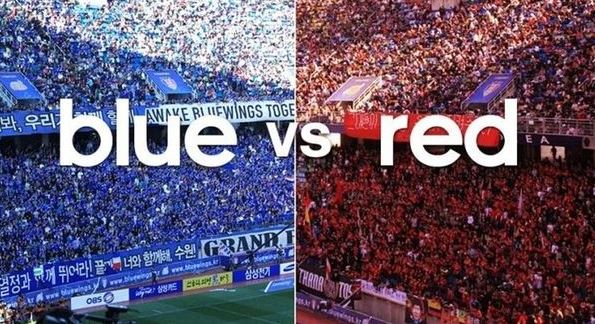
FAN INVOLVEMENT:
Although it took a while for soccer to truly take off in South Korea, the passion for the sport is definitely there throughout the country. Ultras groups, flares, tifos, chants/songs, and overall chaos have become a crucial part of the fan culture there. For heated matches, scenes similar to those for European derbies play out, with violence not entirely uncommon. There was an instance pointed out in the book Who Are all the Squid?: Football Adventures in South Korea (which partially led to me putting this list together) where Seoul supporters produced a tifo showing their cheetah mascot… um… fornicating with Suwon’s bluebird mascot — Suwon supporters responded by ripping seats from the stadium and swearing for 90 minutes. To put it simply, the Super Match is a classic case of two sides simply hating each other. One interesting note about Suwon — the city proudly refers to itself as the toilet capital of the world. The city is literally on the cutting edge of shitting technology, which includes Mr. Toilet House, a famous toilet museum. This might be the one public place I trust to have clean bathrooms.
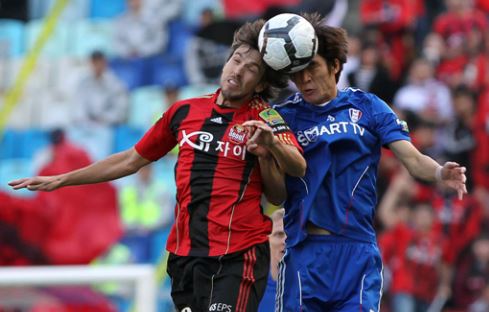
SUMMARY:
Although it doesn’t boast the lengthy history of many of its competitors, the Super Match displays enough passion, hatred, drama, success, and fandom to rival any other derby. With twists and turns and multiple betrayals and relocaitons between them, FC Seoul and the Suwon Samsung Bluewings have many reasons to hate each other.
With that, we have reached the end of Asia’s candidates for the World Cup of Hate — for now. I’m not going to go through the rivalries that just missed the cut because Asia is one of two regions (along with North America) contending for a wild card spot. Once we fill out the final non-wild card spots, we’ll have out first showdown — with Asia being represented.
But as far as filling out the lineup, we now have more than 75% of the World Cup of Hate participants identified. There aren’t too many spots left, but these might just be the most exciting and insane spots left. That’s because we’re heading to South America, home of nine World Cup champions and some of the best players/clubs to ever take on the sport. Most importantly, it’s home of arguably the favorite to win this entire competition.
COMING UP IN PART 10: The chaos of Buenos Aires, 120 years of fighting, a halftime escape, and the most insane series of derbies ever.
 Ruben's Writings
Leave a comment