20 years ago this year, my father took me to my first Major League Baseball game, where everything that could possibly go wrong did in fact go wrong.
I may have started playing nearly every sport as a young kid, but it took me a while to realize that grownups actually play these games for a living. That started when I, like many kids growing up in the 90’s, wanted to be like Michael Jordan. Then, when he retired, I didn’t really care for the Chicago Bulls, so I asked my dad which team I should root for. As it turned out, my hometown of Sacramento just happened to have a team of its own called the Kings. Since that was the local team, I should root for them. That was sound logic to a then-six-year-old Ruben, not knowing that decision, while correct, would cause me pain and suffering for nearly three decades and counting. But starting with the Kings, I adopted the (correct) mindset of rooting for the local team or closest team to you, no matter how bad they are. The then-Oakland Raiders and San Jose Sharks would be added to my list of favorite teams in due time, while the San Jose Earthquakes and Sacramento Republic FC would follow for soccer, solidifying my all-Northern California favorite team lineup. However, there is a major exception to that rule when it comes to the sport of baseball.
When my dad was growing up in the Delta, his favorite baseball team was the Los Angeles Dodgers, thanks in large part to the rooting interests of my grandfather, who basically raised him alongside my grandmother. From my dad’s childhood to his college years, the Dodgers were locked in a rivalry with the Cincinnati Reds, as part of the newly-formed National League West division. Both teams were at their peak in the 70’s, with the Dodgers — led by the infield of Steve Garvey, Davey Lopes, Bill Russell, and Ron Cey — clashing with the Big Red Machine — made up of Pete Rose, Johnny Bench, Joe Morgan, Tony Perez, and more. Both teams combined to win all but one NL West title in the 70’s, which was important. At the time in MLB, only division winners made the playoffs, meaning the Dodgers and Reds had to essentially play a mini World Series against each other to have a shot at winning the actual World Series. Such was the case in 1975, when the Reds won a franchise record 108 games, took the NL West over the Dodgers by 20 games, and swept the Pittsburgh Pirates in the NLCS to reach the World Series. Being a Reds hater, my dad decided to root for their opponent, the American League champion. That decision is the proverbial “butterfly flapping its wings” of this story.
The 1975 AL champion was the Boston Red Sox, who were hoping to win their first World Series in 57 years. They featured a pair of rookie phenoms in Jim Rice and Fred Lynn, the latter being the first ever to win ROY and MVP in the same season (a feat matched only by Ichiro Suzuki in 2001). Boston’s roster also included HOFers Carl Yastrzemski and Carlton Fisk, as well as the likes of Luis Tiant, Dwight Evans, Bill Lee, Bernie Carbo, and Cecil Cooper. They were a loveable, colorful bunch and were good as well, breaking the Baltimore Orioles’ hold on the AL East and sweeping the Oakland Athletics to reach the Fall Classic. The 1975 World Series was an absolute classic, with both teams going back-and-forth and producing several memorable moments (most notably Fisk’s famous walk-off home run in the 12th inning of Game 6). However, much to my dad’s chagrin, the Reds would outlast the Red Sox in seven games and claim the Big Red Machine’s first championship.
But a funny thing happened during the 1975 World Series. As my dad cheered harder and harder for the Red Sox, the reason for that rooting interest changed. What initially began as pure dislike towards Cincinnati gradually transformed into a genuine love of Boston. As the aftermath of the World Series faded and most had moved on, my dad didn’t. That love of the Red Sox stayed, and had grown to be larger than whatever admiration he had for the Dodgers. So, as the 1976 MLB season began, my dad did the unthinkable: he switched allegiances, becoming a West Coast Red Sox fan. Given that this was in the middle of one of the Dodgers’ greatest ever eras, the love was serious. It also appeared to be slightly misguided, as the Red Sox would only reach one more World Series in the 20th century. Meanwhile, the Dodgers won two World Series in the 80’s and the New York Yankees — my dad’s new most hated team — won six titles in the 25-year span following his switch.
Fortunately, I started following professional baseball just two years into the 21st century. Unlike with the other sports, my dad didn’t tell me to root local, for either the A’s or San Francisco Giants. He had me follow him in rooting for a team across the country, his team: the Red Sox. I joined up just in time to watch Aaron Boone make the only meaningful contribution to baseball of his entire playing or managerial career in Game 7 of the 2003 ALCS. I was also just in time to watch and appreciate one of the most incredible sports stories of all-time, as the Red Sox finally broke their now 86-year title drought, becoming the first (and as of this writing only) MLB team to win a seven-game series after losing the first three games, and doing so against the Yankees of all teams. Four wins against the St. Louis Cardinals later and for the first time in my life, I saw one of my favorite teams win a championship. Turns out, while my dad had to wait nearly 30 years to see Boston win a title, I had to wait two, and then three (2007), and then six (2013), and then five (2018). Unlike every other American-based major sports team I root for (unless Macklin Celebrini or Fernando Mendoza deliver), the Red Sox have given me not one but multiple championships to celebrate, as well as plenty of other happy memories.
August 28, 2006 would not be one of those happy memories. I was 14 and my family and I happened to be in Oakland after one of my soccer tournaments, which had actually ended the day earlier. Still, we were staying one more night away from home for some mysterious reason. As it turned out, that was because my dad had gotten two tickets to that night’s A’s game, and the Red Sox just happened to be in town for the start of a three-game series. I was ecstatic — I was finally going to an MLB game and even see my Red Sox play in person! I was also slightly confused, with us only having two tickets and there being four of us. Fortunately, while my mother wasn’t exactly thrilled about being left to watch my four-year-old sister in a hotel room in Oakland, she was cool with not being a fan of an away team in the crowd in Oakland.
So, as she and my sister ordered room service and settled in to watch a movie about princesses, my dad and I left for the ball game. After a slightly scary walk from our hotel to the McAfee Coliseum, we entered the venue and I immediately felt the energy shift, even though we were nearly an hour away from the first pitch. As we took our seats, I saw something I knew existed but didn’t believe could be real: other Red Sox fans. I got my first glimpse of Boston’s strong traveling fan base, happy to finally be among fellow like-minded fans. I was also starting to see several players I recognized, like Coco Crisp and Kevin Youlikis. Dustin Pedroia was just five games into his MLB career, which is fun to look back on now. As my dad and I settled into our seats and both teams took the field to start the game, I nervously but excitedly sat back and prepared to enjoy the spectacle of MLB before my eyes. Then, Murphy’s Law went into effect.
One player I didn’t get to see was my favorite, David Ortiz, who was scratched from the lineup due to (of all things) an irregular heartbeat. Other beloved members from the 2004 World Series champs — such as Manny Ramirez, Trot Nixon, and Jason Varitek — also didn’t play. If they had, Boston might’ve scored some runs. Instead, Esteban Loaiza went seven innings of shutout ball, Frank Thomas and Nick Swisher were among three A’s players to hit home runs, 2004 closer Keith Foulke got shelled for four runs, and Oakland won in a 9-0 rout (the fact that 9 is my favorite number was the cherry on top). As my dad and I left the ballpark, we were bad-mouthed by a Coliseum security guard just for being Red Sox fans. Then, we had to survive that same walk — this time much scarier due to it being dark — back to our hotel room, where my mom and sister looked like they had a wonderful time not doing anything. Indeed, my dad’s efforts to provide a nice memory for his son could not have gone worse. If anything, it had become more likely that I would never attend another MLB game for as long as I live.
Naturally, nearly 20 years later, I have now watched a game at every current MLB ballpark.
There were two people who changed how I looked at ballparks. The first was my friend Jimmy, who like me is a sports nut who wants to go to as many sporting events in as many different places as possible. But way at the top of his list are MLB ballparks, and it was he who invited me to go with him (and a mutual friend) to Seattle to watch his A’s face the Mariners at then-Safeco Field back in 2016. When I asked him why MLB home venues were his main priority, he pointed out to me how unique ballparks are compared to other venues in the four/five major American sports (baseball, football, basketball, hockey, soccer), and therefore worth seeing. This perspective was something that I had never considered, but the more I thought about it, the more sense it made.
When it comes to them as pure buildings, basketball and hockey arenas (largely shared between two teams in the same city) may have unique facades and aspects of their outer design. But as for the main part where the action actually takes place, they’re pretty much the same: a hardwood floor/sheet of ice surrounded by a bunch of seats. Only the logos and colors on them and the walls/banners are different, with many of the unique aspects of going to a game at each venue coming factors unrelated to building specifics. Football stadiums are a bit more unique, with more room to show off specific designs and (at least for non-domed stadiums) ability to be impacted by weather. However, that uniqueness is somewhat offset by the sheer size required of football stadiums, limiting what they can do. While the size of football stadiums (particularly at the collegiate level) gives them power, as a building most are pretty similar. Soccer venues come the closest, with some like Signal Iduna Park creating an intense atmosphere thanks to its “Yellow Wall” and Tottenham Hotspur Stadium being arguably the most impressive sporting venue in the world. But by and large, what makes them special isn’t to do with the venue itself.
Then we have baseball. While there are certain restrictions on minimum distances between each base and outfield dimensions, there is enough wiggle room for each field to be different, especially given the unique shape of a baseball field. In fact, there are no two MLB ballparks who have the exact same field dimensions, and that’s before we get into the types of grass and dirt. Each of these differences change exactly how the game is played, providing certain advantages/disadvantages for teams (let’s not forget that the then-Enron Field/Minute Maid Park had a hill and flag pole in play in center field for years). These quirks also allow for certain parts of the facade of the ballpark to be spread inside as well, helping them better reflect the unique aspects of the city they’re in or team they host. Ballparks are also unique in that you can see the on-field action even if you’re not in your seat. At other venues, if you want to use the restroom or get a snack, you have to wander the concourse, blocked off from the actual field. But most ballparks have open concourses and points of view to enjoy the game. You don’t even have to strictly enjoy the game, as there are other forms of entertainment (particularly for kids) located throughout — another unique ballpark feature. Even the name “ballpark” is unique to baseball. If you say “arena,” “stadium,” or “field,” it’s not entirely certain what sport is being played there. But only baseball is played in a ballpark.
There are other, smarter people whose expertise can better describe what else makes ballparks unique. That includes Paul Goldberger, an award-winning architecture critic and the second person who helped me see ballparks in a different light. His book, Ballpark: Baseball in the American City, is a look back at the history of ballparks in the U.S. (and technically Canada) and a must-read for any baseball fan. It highlights how baseball and its ballparks became engrained in American society, their design adapting to the growth of their cities and the changing of culture. It goes through three main eras of ballpark construction, from the golden age still thriving in Boston and Chicago to the “concrete donut” multipurpose stadiums built to host baseball and football (like the A’s now-former home in Oakland) to the “retro-classic/modern” ballparks that began in Baltimore to even a possible fourth era starting now. It also shows how the best ballparks regardless of era strike a balance between architecture, sport, and urbanism, respecting their heritage, surroundings, and the game of baseball itself.
Throughout his book, Goldberger uses the term “rus in urbe” — a concept meaning “countryside in the city.” When baseball was first being played or when you and your friends played in the park as kids, there was no ballpark — the outfield stretched out forever. When baseball turned professional and these ballparks popped, with necessary outfield walls, the view over the fence reflected a bit of countryside within the city, allowing spectators an escape from the hustle and bustle of life. The current practice keeps baseball within its urban roots, with the very nature of the field — straight and orderly near home while vast and wild outside of it — reflecting the very idea of a city. It’s a concept that puts into words what makes ballparks magical. As Goldberger writes in the book’s prologue…
“In the ballpark, two sides of the American character — the Jeffersonian impulse toward open space and rural expanse, and the Hamiltonian belief in the city and in industrial infrastructure — are joined, and cannot be torn apart. They no longer represent two alternative versions of the world, as they so often do. In the baseball park, they each need the other. They must coexist. The exquisite garden of the baseball field without the structure around it would just be a rural meadow, bereft not only of the spectators themselves but of the transformative energy they bring. And the stands without the diamond and the outfield would be a pointless construction.”
How can you not be romantic about baseball, indeed?
All of that setup was to explain my background and overall thought process when it comes to ballparks. Thus, you can get a sense of my mindset and potential biases (as much as I try to be objective, there will be some) while evaluating all 30 current ballparks. I’m not a perfect reviewer, and few if any of these ballparks were reviewed in similar circumstances to each other. I visited some ballparks several times; others, just once as I passed through town. Most of these visits took place over the span of a decade, meaning I haven’t been able some upgrades that have taken place since I stopped by. But I’ve made it out to see every team play at least one home game.
You might be wondering: apart from seeing a game at all 30 MLB ballparks, how qualified am I to judge these venues? Well, I played a bit of baseball growing up, but nothing above little league. I’d like to think I know more about baseball than the average person, but I’m not calling myself an expert by any means. I like Goldberger’s book, but I disagree with his overall opinion of certain ballparks. I didn’t get paid to do any of this, but I still did so for the love of the game. How else would you explain sacrificing a day off a European vacation to watch the Los Angeles Angels vs. the Texas Rangers in September, or braving literal snowfall to watch the Minnesota Twins vs. the Tampa Bay Rays, or tacking on an extra vacation day so I can watch the Miami Marlins vs. the New York Mets?
Alright, enough stalling. Let’s get to why you’re here: to find out how I — someone who has seen a game at every current MLB ballpark — rank them.
Even though I’m trying to be as objective as I can with these rankings, I’m going to go away from any kind of numeric or formulaic process here. For one, there are a lot of awesome ballparks deserving of perfect scores. But above all, I don’t think that numeric/formulaic scoring is appropriate for this kind of topic. I’ll be going based on vibes and my own personal experience, considering areas like location, surrounding area, aesthetics, food/drink, panorama, overall quality, organization, navigability, ease of access, other entertainment/amenities, and how it best represents its team/city. Also, I refuse to consider weather as a positive or negative for a ballpark. You can adjust the ballpark to weather, but I will not give a ballpark credit for happening to be in a nice area of the country. You can control many aspects of a ballpark, but you can’t control the weather surrounding it. There will be some similarities to other rankings, but there will also be some differences. But I can only go off my opinion here, fair or not.
Before we get into the current 30, there is one review I need to make first. I plan on coming back to this list and updating it whenever a new ballpark is built (and I go see a game at it). That means another ballpark will be replaced and my review of it will be relegated to the past. But just because I had to remove it from the list doesn’t mean I’m not going to talk about it. As of 2026, the list of former ballparks that I’ve visited has just one name. Still, it’s a big one for me.
Before we can begin with the current MLB ballpark rankings, we have to go back to where it all began.
FORMER MLB BALLPARKS
OAKLAND-ALAMEDA COUNTY COLISEUM
HOME TEAM: OAKLAND ATHLETICS
LOCATION: OAKLAND, CALIFORNIA
OPEN SINCE: 1966 (USED FOR MLB FROM 1968-2024)
ORDER VISITED: 1 (08/28/06)
GAMES I SAW THERE: 4 (4-0 HOME TEAM RECORD)
RANKING BEFORE REMOVAL: 20 (OUT OF 21)
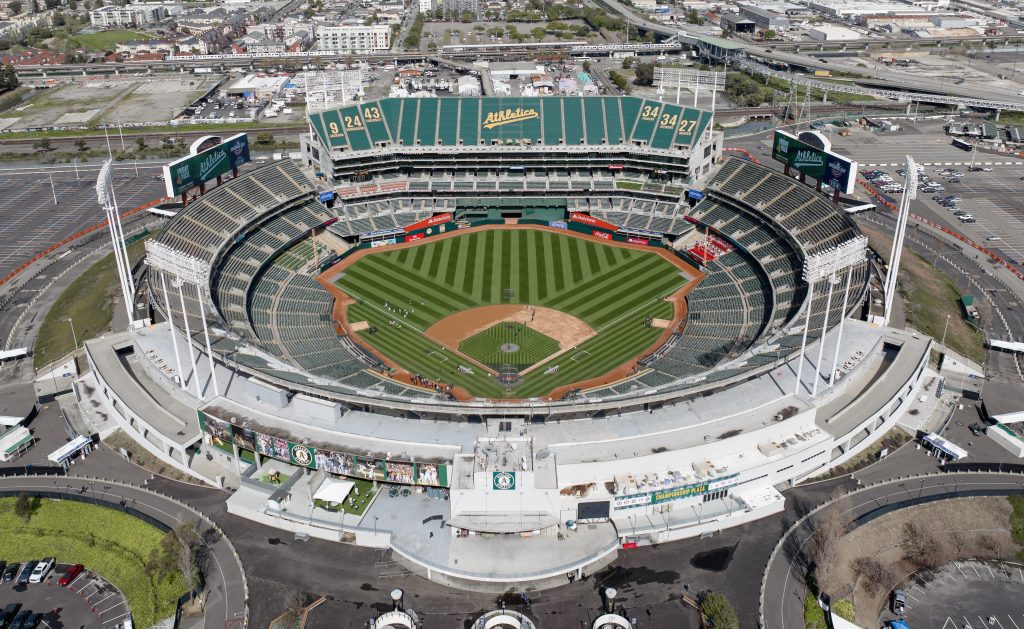
In the film Moneyball, Oakland Athletics general manager Billy Beane (played by Brad Pitt) utters the now-famous quote I mentioned just a few paragraphs ago: “how can you not be romantic about baseball?”. He does so while sitting in the film room inside the Oakland-Alameda County Coliseum (at the time the film takes place, 2002, it would’ve been the Network Associates Coliseum). It’s a fitting location for a line alluding to the poetic undertones of the game. After all, perhaps no other fandom loved their team and ballpark like Oakland loved the A’s and the Coliseum. True love isn’t loving someone because they’re perfect — it’s loving someone despite their faults. If there was ever a ballpark that was loved despite its many faults, it was the Coliseum.
Opened in 1966, the Coliseum welcomed the A’s from their move from Kansas City two years later. When the team moved to West Sacramento after the 2024 season, the Coliseum was tied for the fourth-oldest ballpark in MLB and the only multi-purpose stadium for well over a decade. During those 50+ years, the Coliseum went from a quaint ballpark for a bygone era (and that era couldn’t go quickly enough) to a broken-down Frankenstein’s monster of a venue that somehow had both the lowest and highest seating capacity out of every MLB ballpark. Of course, those distinctions were based on whether or not 20,000-seat upper deck known as “Mount Davis” — after late Oakland Raiders owner Al Davis — was covered with tarps or opened up to the public (the latter became more of a rarity as time went on). Without Mount Davis, the Coliseum might’ve had a better reputation as a nondescript but intimate ballpark from a simpler time. While Mount Davis may have been one of the greatest upgrades turned downgrades in ballpark history, there were plenty of problems with the original parts of the venue.
The “concrete” part of “concrete donut” was the ballpark’s biggest distinction, with the age and deterioration getting harder to hide each year. Walking through the concourse was like traveling through a sweaty concrete tunnel, illuminated by the light coming from the top of the steps leading to the seats in the upper levels, as well as the fluorescent glow from the concession stands. Those stands would be selling only the most generic sporting event food, and even then due to the presumed quality you’d be afraid to sample anything not deep fried. Over the final several years of the A’s era, upgrades to bars and restaurants were notable and appreciated. But apart from sampling some local breweries and wineries (the latter of which seemed to be from Napa Valley, not the Bay Area), there were no distinct offerings. Other amenities looked like they had been there since the A’s moved in in 1967, and the bathrooms (or rather, troughs) looked even older and nastier than that. To get from your seat to any of these, navigating the concourse would often turn into a game of not getting trapped in lines that would clog up foot traffic. The cramped nature of these situations would often force you to look around at the grey concrete walls, only partially covered by green and yellow paint.
Another sign of the Coliseum being a product of a long gone era is its location, as well as the surrounding area. The ballpark is located just east of Interstate 880, surrounded by a sea of parking lots. While that layout definitely helped with the eightish days per year the Raiders would have a home game (tailgating is huge in football culture), for the 81ish days the A’s had a home game it was only good for adding to the notoriously terrible Bay Area traffic. The layout also includes Oakland Arena — the former Oracle Arena and old home of the Golden State Warriors. Oakland wasn’t the only city to put all of its major sports venues together in a big parking lot — Kansas City and Philadelphia (more on them in a bit) are structured similarly. I would even venture to say that Oakland’s setup is better than Kansas City’s — at least there are some public transportation options, with the Amtrak and BART Coliseum station being a short walk across a pedestrian bridge away from the ballpark. But the surrounding area is not what you’d call a good part of town, and what businesses exist there — mostly either industrial or generic fast food restaurants — didn’t exactly invite a continuation of ballpark festivities.
The expanse of pavement surrounding the Coliseum was perhaps the only wider open space than the foul territory. That part of the playing surface was naturally larger due to needing to fit a football field on it. But that made for a lot of pop outs and fewer home runs, and it was tough to tell which was which on the broadcast sometimes. The latter problem didn’t really exist until the addition of Mount Davis, which replaced a natural panorama of the East Bay with more concrete and glass windows of suites, not to mention the giant dark green space dead center. While they were removed more often towards the end of the A’s era, the tarps on top of Mount Davis only served to make the ballpark — which was meant to feel more intimate — much emptier, especially during the final few years. Some spots felt far away from the action, with some seats being cut off from certain plays. I remember being in attendance for Game 3 of the 2012 ALCS against the Detroit Tigers, when Coco Crisp made an incredible catch in center field to rob Miguel Cabrera of a home run. Actually, I didn’t see it — the configuration of the outfield cut off my view of the play just as Crisp leapt into the air. I had to wait to see the crowd’s reaction to know whether or not to celebrate.
All of these problems would’ve remained even had the Coliseum been properly maintained. Of course, it wasn’t. While maintenance problems had been an issue since the 1970’s, they really ramped up towards the end of the 2000’s and early 2010’s. The ballpark’s antiquated plumbing system resulted in multiple sewage issues, most notably in 2013, when leaky pipes spilled puddles of sewage in various places, forcing the A’s and visiting Seattle Mariners to share the Raiders’ locker room. It was also around this time that a family of possums was discovered to be living at the Coliseum, with the marsupials living there for several more years (they actually may still be there). The Coliseum spent its final decade battling with Northwest Stadium (formerly FedEx Field) as the most disgusting, broken down venue in the four major North American pro sports leagues. Any renovations made near the end of the A’s era — from the new scoreboards to Championship Plaza — were seen simply as putting lipstick on a pig.
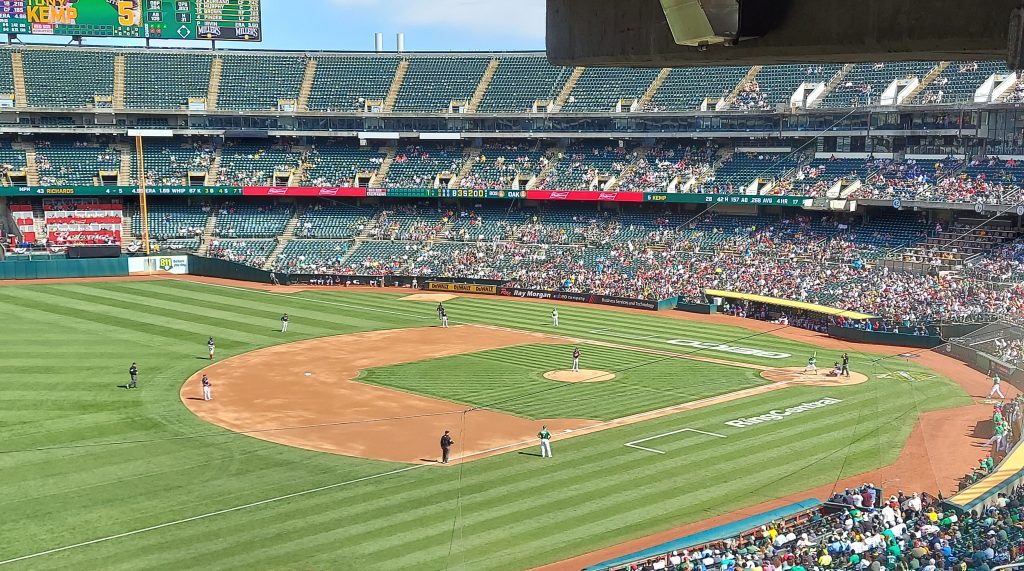
To recap: the Coliseum is bland to the point of being unique for its lack of distinction, generally unattractive and seemingly falling apart, not near anything remotely fun, and a relic of a bygone non-celebrated era whose most notable feature is an expensive eyesore that put the city and county into debt and took away any source of relief from the sea of concrete it had become. Surely, it must’ve been universally hated, right? The answer is yes, except for those wearing green and yellow. They thought it was the greatest venue in the world.
Some skeptics may call it Stockholm syndrome. Others call it regional pride. But year after year, A’s fans saw the Coliseum’s name get dragged through the mud, only to pick it up and put it on their shirt like a badge of honor. Where others saw the expansive parking lots as a nuisance, they made tailgating an art form. While fans of other teams might’ve been either scared or disgusted to go inside the Coliseum, A’s fans packed the bleachers and turned it into a cauldron for any visitor who dared enter. What some saw as old, dilapidated, rough around the edges, and embarrassing, they treated as tough, gritty, blue-collar (or, rather, green-collar), and character-building. They saw other teams and cities (most notably their Bay Area neighbors in San Francisco) get shiny new venues and said we’re happy with what we have. They consider parking at the nearby Denny’s, climbing through a hole in the fence surrounding the Coliseum parking lot, and walking across the pavement to the ballpark a right of passage. They didn’t care how nice their ballpark was, as long as it was covered in green and yellow. To paraphrase an A’s fan friend of mine: “it’s a shithole, but it’s our shithole.”
The next two times I went to an A’s game at the Coliseum, the Boston Red Sox weren’t the visiting team, so I could actually bandwagon the home squad and not be afraid. I was also a lot older, (somewhat) wiser, and more experienced, able to let my guard down and actually enjoy the game. I had a lot of fun, none more so than the second game — that 2012 ALCS game I mentioned earlier. Sat up above right field with the bleacher creatures, we roared and cheered throughout the night in one of the best sporting environments I have ever had the pleasure of enjoying. Due to their low payroll (read: cheap owner) and overall unattractive environment, the A’s were seemingly always the underdog, and A’s fans embraced that role wholeheartedly. That energy always seemed to find a way to seep through, and I understood how people could look at even the worst ballpark in MLB with rose-tinted glasses (or, rather, green-tinted glasses).
Another reason I could emphasize with the plight of A’s fans is that the Coliseum was also my favorite team’s home venue. Like many other cursed individuals, I am a Raiders fan. While the Raiders being the closest team to Sacramento didn’t hurt in my decision, proximity alone was not the reason I fell in love with the Silver & Black, meaning I (stupidly) have remained a fan since they moved to Las Vegas and built the absolutely phenomenal Allegiant Stadium. But the Raiders seemingly forgot their soul when they packed up for Sin City. Allegiant sits as a shiny beacon for visiting fans to cheer on their team and take over the stadium — an unthinkable situation back in Oakland. Think about every negative/frightening aspect of the Coliseum I’ve mentioned, then add having to deal with drunk and enraged Raiders fans on top of it all. There’s a reason the Black Hole was the most intimidating place to visit in the NFL. Raiders fans (most of them also A’s fans) turned their venue disadvantages into a weapon, which the team itself fed off of to give opponents a hard time (even when they were worse than dog water). While I was never a fan of having my favorite NFL team be the only one with dirt on its field for a quarter of the season, it fed into that character as well. It’s a shame the Raiders left for Vegas.
Unfortunately, the A’s are all but set to follow in their footsteps. The issues at the Coliseum ended up mounting to the point where there needed to be a replacement. Potential sites in Fremont, San Jose (due to the San Francisco Giants’ refusal to give up territorial rights in a back-stabbing move after the A’s had helped them years earlier), and finally the Howard Terminal area in Oakland fell through. Enticed by the glitz, glamour, and gold in Sin City, MLB was hell-bent on getting a team in Las Vegas and used the situation in Oakland to their advantage. Rob Manfred, John Fisher, Dave Kaval, and more are responsible for spurning a feasible push to keep the A’s in their home of nearly 60 years to be, at best, the third-most popular sports team in Vegas. The A’s closed out their 57-year tenure in Oakland in 2024, taking the tarps off and saying goodbye to the 46,889 fans in attendance on a high note with a 3-2 win over the Texas Rangers.
In the end, was the Oakland Coliseum a good ballpark? It was in its heyday — it even hosted the 1987 MLB All-Star game! Unfortunately, that heyday is long gone. The Coliseum of 2024 was a decrepit shell of what it once was, worn down and broken beyond repair. Perhaps, being the last multi-purpose concrete donut remaining, it had a finite shelf life and limited nostalgia. But while it lived longer than the rest, poor management prevented it from having the best life it could’ve had. In the end, anything special about the ballpark came from its fans, who turned its terrible traits into triumphs. While, ultimately, the Coliseum needed to be relegated to history when it comes to MLB (it’s still active for soccer and cricket matches), the way it went was unbecoming of a ballpark that old and beloved by its fans. The rotten cherry on top of this sordid sundae is that the next home of the A’s (at least temporarily) is an even worse MLB ballpark.
With that out of the way, it’s finally time to review all 30 MLB ballparks, going from bottom to top. In addition to ranking them 1-30 (1 being best and 30 worst), I’ll also be sorting each ballpark into one of nine tiers, ascending in order in terms of quality. The first of these tiers starts below.
F TIER
This tier is reserved for the ballparks that aren’t just bad, they actively fail at some if not all basics of being a MLB ballpark. There are only two ballparks in this tier, and based on this being the lowest part you can probably guess which two ballparks these are. While a tier for just two ballparks may seem unnecessary, these two are bad enough MLB ballparks on every level that they deserve to have this dubious distinction. The good news: if all goes according to plan, one of these ballparks will be relegated to the “former” list in two years (with its replacement surely placing higher on the list), while the other is the focus of perhaps more replacement/relocation rumors than any other. Thus, it’s feasible that in like five years or so, this tier will be eliminated altogether. However, that hasn’t happened yet, so we have to start here. When it comes to which ballpark and team gets the “honor” of being dead last, we don’t have to wander far from the former MLB ballpark I was just writing about.
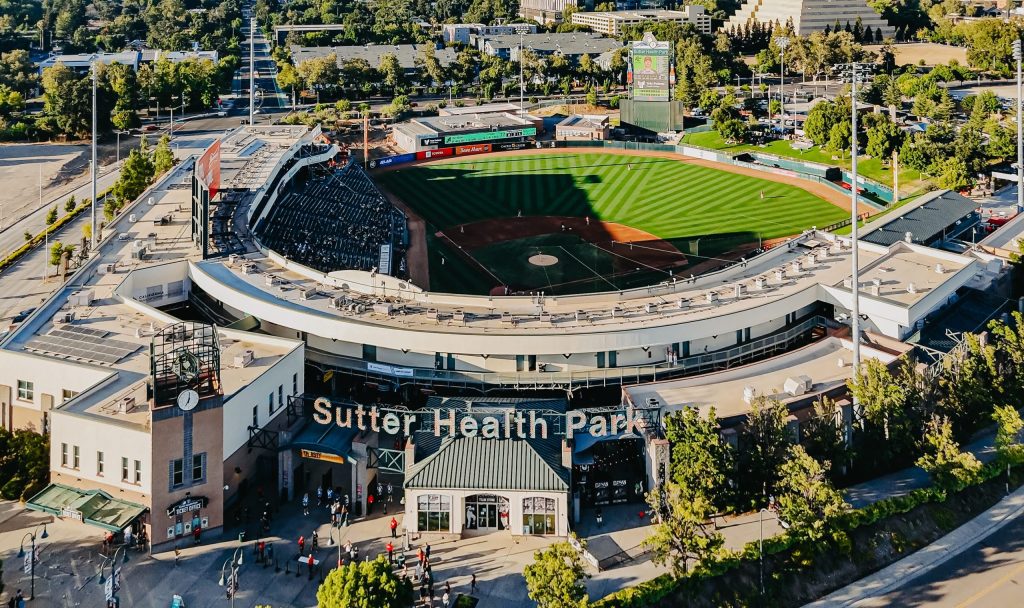
30. SUTTER HEALTH PARK
HOME TEAM: ATHLETICS
LOCATION: WEST SACRAMENTO, CALIFORNIA
OPEN SINCE: 2000 (IN USE FOR MLB SINCE 2025)
ORDER VISITED: 23 (05/24/25)
GAMES I HAVE SEEN THERE: 2 (1-1 HOME TEAM RECORD)
It may not look like it from the outside, with the Kings clearly the top dog as the region’s only major league sports team (until 2025, anyway) and Republic FC continuing its push for Major League Soccer, but Sacramento has a long and storied baseball history. All of it is minor league, with the Sacramento Solons being the most notable from 1883-1976. Then, in 1999, the Vancouver Canadians of the Triple-A Pacific Coast League moved to Sacramento and became the River Cats. Since then, the team has been a mainstay of summers in Sacramento, with Sutter Health Park (formerly Raley Field) being one of the top-rated Triple-A ballparks, welcoming fans with cheap tickets, lawn seats, and delicious tri-tip sandwiches. The River Cats have also been successful, winning Triple-A championships as affiliates of both of the Oakland Athletics and (currently) San Francisco Giants. Though the only major league action fans in Sacramento saw were occasional big league stars making injury rehab starts and preseason scrimmages between the River Cats and their affiliate, it was still a good time well worth your money. You definitely tried to make at least one River Cats game each year.
Then, last year, the River Cats’ former MLB affiliate thrust their city and ballpark into the middle of arguably the most fustercluck of a relocation saga in the history of U.S. major league sports, made them part of a black eye on the sport of baseball, and made them the subject of countless, memes, jokes, and ridicule, all while refusing to even share the name of the city that gave them a massive bailout. In doing so, they have put a well-liked ballpark in prime position to be mocked by the greater baseball world because it’s being forced to do something it was never built to do.
Sutter Health Park is not a MLB ballpark. It was never meant to be, and that’s obvious just looking at it. It has a seating capacity of just over 14,000 — more than 10,000 fewer than the second-smallest MLB ballpark and more than 20,000 fewer than the third-smallest. It has just one level of seating, with a line of club seats and boxes stacked on top of it. There are few bleacher seats and the vast majority of outfield spots are first-come, first-serve on a grassy hill. There is an argument to be made about intimacy and smaller ballpark settings creating a better atmosphere (I’ll touch on that some more in a bit). But there’s simply a cap on what kind of atmosphere can be created in this kind of environment, at least compared to the average MLB ballpark.
Sadly, a rowdy environment is one of the reasons that the River Cats — now owned by Sacramento Kings majority owner Vivek Ranadive, a friend of A’s owner John Fisher — allowed the A’s to use their ballpark for (at least) three years while their future ballpark in Las Vegas is being built. Sacramento has been striving for a second major league sports franchise for a long time, and the logic of having the A’s play at Sutter Health Park was two-fold. If the Vegas deal/ballpark construction fell through, the A’s would simply keep playing in West Sacramento indefinitely. If the A’s did end up in Vegas, MLB would look at Sacramento favorably as a potential expansion site. The first situation doesn’t appear to be playing out, so they have to be banking on the second. Unfortunately for MLB in Sacramento, the second one isn’t working out either, and it’s largely their doing.
Sacramento sports fans are loyal and value loyalty. They show up in strong numbers, as proven by Sacramento Republic FC and whenever the Kings aren’t absolute dog water. But you can’t take that loyalty for granted or assume it will be blindly given. For example, if those fans know you’re only in town for three years — during which time you rebrand yourself as just “The Athletics” with no affiliation to Sacramento, only make reference to Sacramento with a jersey patch (one the same size or smaller than another advertising your future home), and fill the space with “Visit Las Vegas” ads — they’re going to think you’re just using them to kill some time. It also doesn’t help that tickets to A’s game were astronomically high during their first season at Sutter Health Park in 2025, with many fans who had bought season tickets at those prices and had hopes of selling them to visiting fans instead being stuck to foot the bill as those away fans found them for much cheaper on different resale markets. Those away fans also grew to largely outnumber the home supporters, effectively turning that intimate atmosphere into a road game for the home team.
Beyond being too small to the a proper MLB ballpark, Sutter Health Park is lacking in other crucial areas. The dugouts are not connected to the clubhouse, meaning players and coaches have to walk across part of the field to reach it. That issue has been partially solved with a makeshift room for pitchers inside the dugout, after the A’s ace pitcher, Luis Severino, complained. The field layout is also challenging in that managers cannot see certain parts of the fair/foul territory from the dugouts, making the process of challenges/replays more difficult. The main media room areas have largely been in what can best be described as sheds available for purchase at hardware stores, which aren’t exactly comfortable during the 100+ degree summer days in West Sacramento. When I say Sutter Health Park fails at being a MLB ballpark, this is what I mean. Some of these problems are even worse than what they were at the Oakland-Alameda County Coliseum.
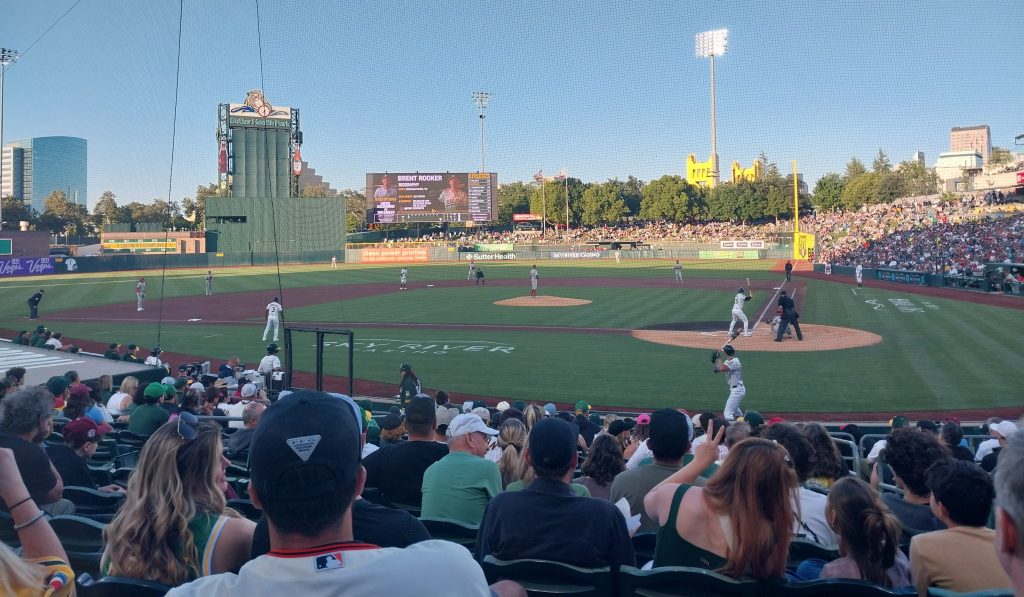
Does all of this take away from the ballpark experience? It depends on what kind of experience you’re looking for. If you’re used to the size and scale of ballparks in New York or Boston or Chicago or Los Angeles, you may find the whole scenario a bit, well, minor league. But as I mentioned above, River Cats games are a good time. A’s games are essentially the same experience except with higher ticket prices. Oh, and instead of players hoping to reach the majors or one or two major leaguers going at half speed, you’re watching actual genuine major league baseball. The novelty of seeing MLB played in a venue like this alone is enough to warrant a visit for a game or two. For like $25, you can lie down on a blanket with a beer in your hand and watch from the comfort of a grassy hill as Shohei Ohtani or Aaron Judge try to hit a home run off Severino or Nick Kurtz continues to evolve into MLB’s next great infielder. While I hate how it happened and know that whatever this situation is will be over in two years maximum, it’s still surreal that major league baseball is being played in my hometown.
The layout of the field is also playing a factor into that entertainment value as well. Sutter Health Park is one of the more hitter-friendly ballparks in Triple-A and that trend has continued in the majors. Lots of high scores have piled up over the past season-plus, and while part of that is due to the A’s being not good at defense besides Denzel Clarke being an outfield god (the Chicago Cubs scored 35 combined runs in the first three-game MLB series at Sutter Health Park), the home team has seemingly settled and adjusted into their temporary digs. As a result, the offense (particularly the long bomb) has started to pick up on their side as well. One other aspect hurting the ballpark is the scorching summer months, which can often leave fans baking in their seats. But once night falls it’s a fun summer night, with the ballpark’s location right next to the Sacramento River providing a lovely panorama that includes the Tower Bridge and Ziggurat. In a way, it’s kind of a minor league version of the panorama on display at a different ballpark on the other end of this list.
The ballpark’s location — to the northwest of the connector between Interstate 5 and Highway 50 in Downtown Sacramento — doesn’t do any favors when it comes to transportation. That particular area is notoriously awful when it comes to traffic, and the transition from freeway to ballpark can turn into a parking lot. Speaking of, that’s what a lot of the area south of the ballpark is dedicated to, while the area turns business and residential immediately north. There is also a lot near the Ziggurat and a rideshare pickup area just to the west. When it comes to public transport, both SacRT and Yolobus work to get from Downtown to the ballpark, with out-of-towners able to use the Capitol Corridor Amtrak train to get there (a reverse of the Oakland days). Still, there’s a lot of pre- and post-game traffic, which can be alleviated by just parking somewhere close to the Tower Bridge Downtown, then walking or riding an e-bike or e-scooter over the bridge. Doing the reverse is also the best way to get to post-game entertainment in the Old Sacramento area, though they are working more to beef up pre-game activities. It’s also the route you’d take to get to the Downtown Commons/K Street area — the best shot at nightlife in the city and where most of the closest hotels are. Besides all of that, the only main post-game spot near the ballpark is Drake’s: The Barn, located a short walk to the south of the ballpark. Birdies Social Club, located just across the street of the ballpark to the east, is also growing as a pre-game spot for A’s games.
When it comes to eating and drinking inside the ballpark, Sutter Health Park does have options. Granted, being a minor league ballpark, the vast majority of offerings are your generic sports food you could find at any ballpark (and are of similar quality). Still, there are some unique and tasty options, such as the aforementioned tri-tip sandwich (a staple at River Cats games for as long as I can remember). There is also a beer garden to fit the region’s general affinity for craft brewing and some decent Mexican food choices. For dessert, Sutter Health Park boasts a stand selling Merlino’s freezes, which are up for the best sweet sold at any MLB ballpark. Both the Solon and Legacy clubs are nice places to enjoy the game, though the Legacy Club is better if you like indoor viewing (it’s basically a cafeteria with a bar in it) while the Solon Club is better for outdoor activities (it’s basically an outdoor bar). The Gilt-Edge Club is kind of like a mini, less good version of the latter.
Like I said before, River Cats games are a good time. In fact, you can experience them for yourself — the River Cats never stopped being a thing and still play at Sutter Health Park when the A’s are on the road. All of the little enhancements that have come to the ballpark because of the arrival of the A’s have made that experience all the better. As for the A’s experience, there are definitely good reasons to go. After all, it’s still MLB. But while the novelty of seeing MLB at a minor league ballpark (albeit a good one) is worth seeing, at the end of the day it’s just that: a novelty. It’s also an indictment on MLB that one of its oldest, most historic and successful clubs is even playing at a minor league ballpark, let alone due to an absolute mess of a forced relocation and a saga that’s left a black eye on the game. A’s fans don’t deserve this — going from an old dilapidated ballpark to one that isn’t even MLB level. That’s what it all comes down to the end of the day. No matter how good of a minor league park Sutter Health may be, it’s still a minor league park competing against MLB ones. Therefore, I have no choice but to put it at the very bottom of this list.
Sometimes, timing really is everything. If this were two years ago, the Coliseum would’ve still qualified for the list and — while ranked low — would not have been dead last. If this were two years from now, the future Las Vegas A’s ballpark would be finished and on pure “it can’t possibly be as bad” vibes not be last — in fact ranked much higher. Even if this list would’ve been made last year, Sutter Health Park would’ve ranked 29th instead of last. That’s because it wasn’t the only minor league ballpark in use by MLB in 2025. After all, the Tampa Bay Rays were forced to play all of last season at George M. Steinbrenner Field due to damage sustained by their normal home ballpark during Hurricane Milton. But repairs have been completed and that ballpark, by pure virtue of being an actual MLB ballpark, ranks above Sutter Health Park on this list. That being said, it’s not by much.
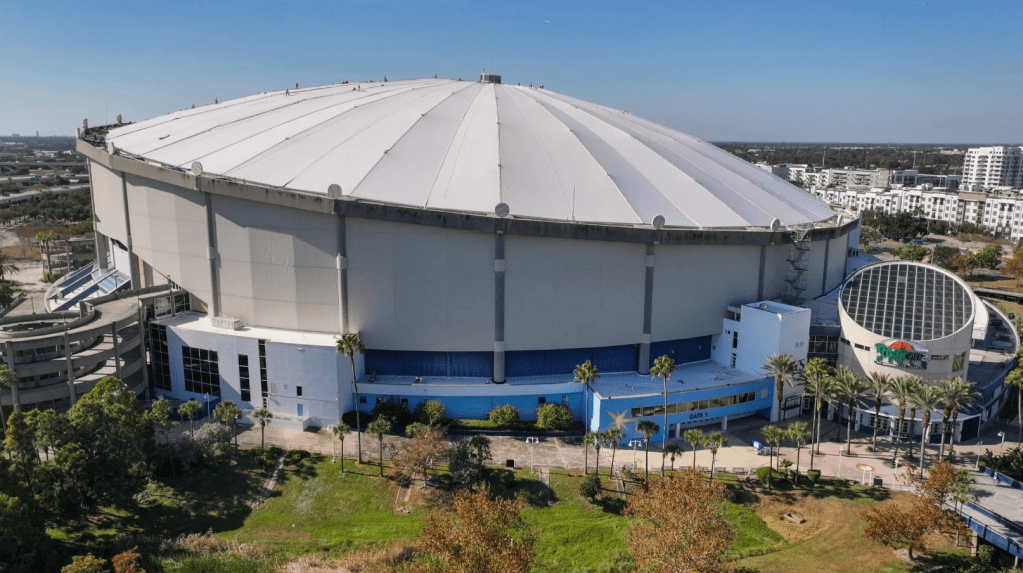
29. TROPICANA FIELD
HOME TEAM: TAMPA BAY RAYS
LOCATION: ST. PETERSBURG, FLORIDA
OPEN SINCE: 1990 (IN USE FOR MLB SINCE 1998)
ORDER VISITED: 17 (09/06/22)
GAMES I HAVE SEEN THERE: 1 (1-0 HOME TEAM RECORD)
This year marks 40 years since construction on Tropicana Field began. The venue opened four years later (with a groundbreaking ceremony that included Chuck Berry of all people), but did not have a tenant to start. After hosting the 1990 Davis Cup Finals, the Arena Football League’s Tampa Bay Storm and National Hockey League’s Tampa Bay Lightning both called “The Trop” home. But the main goal for Tropicana Field was to bring a MLB team to the area, and after previous expansion and relocation efforts failed in the early 1990’s, the effort was finally rewarded with a franchise in 1995. The Storm and Lightning relocated to the now-Benchmark International Arena in Tampa as Tropicana Field was fully converted into a baseball venue, and that expansion team — the Tampa Bay Devil Rays — began play in 1998. It’s ironic that since its introduction to MLB, the very venue deemed key to even getting a team to the greater Tampa Bay area has been arguably the most maligned ballpark in the entire league.
There are plenty of reasons why Tropicana Field has garnered the reputation — rather, the notoriety — is has over the years. Perhaps the biggest one is due to a problem found in states like Florida, and inspired the names of the Trop’s previous tenants. Florida is by far the state that sees the most hurricanes each year, with the Tampa Bay area in particular being pelted by major storms. So, any kind of major sporting venue needs to take that into account. That — and hot, humid summers — was why officials opted for a roof on the ballpark when it was being built. It’s also the reason why the roof is slanted, as to reduce cooling costs and better protect the building from hurricanes (it’s probably why only the roof was heavily damaged during Hurricane Milton). However, the decision to make Tropicana Field’s roof permanent was a terrible one in hindsight. After the baseball configuration, Tropicana Field was stuck between two eras — mixed-use ballparks with permanent roofs (like the Hubert H. Humphrey Metrodome) and ballparks with retractable roofs. The latter was brought on by expansion into areas with extreme weather (like Toronto, Phoenix, and Miami) or upgrades for teams in similar conditions (Seattle and Houston). But the Trop was the only one with a permanent roof, and it remains that way to this day.
The roof and its permanent status heavily impacts Tropicana Field in three main ways. First, looks. The roof is flat out ugly. It tries to evoke the inside of a circus tent, but misses the mark entirely. It also makes the baseball being played underneath it seem a bit out of place under a roof and all. Second, adaptability (or, rather, the lack of it). Any additions that could be brought on to expand or alter the outside of the ballpark are basically impossible to implement, given the fact that the roof is permanently latched on. Trying to remove one part of it would defeat the purpose and threaten structural integrity. Thus, the ballpark is sort of stuck as it is. Third, the game itself. The roof also includes four catwalks arranged in rings, which are not only technically in the field of play, but close enough to be hit on a semi-regular basis. Each ring has a different designation if hit, meaning a high pop up can result in a hit or out or foul ball or even home run. In certain situations, balls hitting these rings can impact the outcome of games. This contributes to Tropicana Field being among the worst-rated ballparks for hitters. Given that other ballparks with roofs don’t have them that close to the field, Tropicana Field is the only one in MLB with this kind of problem.
Another way that Tropicana Field is a relic of the past (in a bad way) is the bullpen situation. Instead of dedicated bullpen sections behind the outfield walls (which even Sutter Health Park has), bullpens at the Trop are lined up in foul territory right below each foul pole. They are technically in play, both in terms of foul pop-ups and balls fair balls drifting over there. This used to be a common site at many MLB ballparks. But as time went on, this practice went away and the enclosed bullpen-specific areas out of the field of play became the standard. Following the departure of the A’s from the Oakland Coliseum, Tropicana Field is now the only MLB ballpark where the bullpens are still in the field of play. It’s also one of only five MLB ballparks to have artificial turf instead of natural grass. All five are ballparks with roofs located in cities where it’s probably safer and easier to be used then try to maintain natural grass. Still, combined with everything else, the Trop’s turf usage adds to the overall unnatural feel of baseball in the venue.
You don’t really get a sense of just how weird it feels until you step inside. Watching a game at Tropicana Field feels like watching baseball in a basketball or hockey venue. Maybe it’s because I started watching baseball as the permanent indoor ballparks were going away, and therefore the all-outdoor ballparks feel more normal. But it just looks wrong. All you can focus on is the roof, even when you’re just trying to watch the game. It’s like a baseball diamond was placed next to the wall of a warehouse. The Trop is also surprisingly confusing to navigate. You’d think this wouldn’t be a problem, given that ballparks and sporting venues in general are easy to understand layout-wise. However, there are certain paths in the concourse (which pretty much doesn’t offer any views of the field) that apparently don’t lead to seats and the main food area is sort of off to the side, detached from the rest of the ballpark. I genuinely got lost once while trying to sightsee and had trouble getting back to my specific seating area. To be fair, that also could’ve been due to alcohol consumption.
Speaking of seating, Tropicana Field is one of the few ballparks I’ve seen that has actively shrunk its capacity over the years instead of increased it. That decrease isn’t minimal, either. When MLB debuted at the Trop, capacity sat at more than 45,000, which would put it in the Top 10 today. However, after an initial surge of supporters in the inaugural season of 1998, that capacity was slightly decreased as average attendance went down. Going into the 2008 season, the Devil Rays decided to remove the first part of their name and cover the upper deck with tarps, reducing capacity to about 36,000. That year would see the Rays actually be a good team for the first time ever, resulting in an attendance bump which led to some tarp removals. In 2019, the upper deck would be closed off, further reducing the capacity to just 25,000 — the lowest in MLB until Sutter Health Park came along. The Rays said it was done to increase a feeling of intimacy. But even with a lower bar to reach, the Rays are consistently among worst MLB teams in terms of average attendance per game.
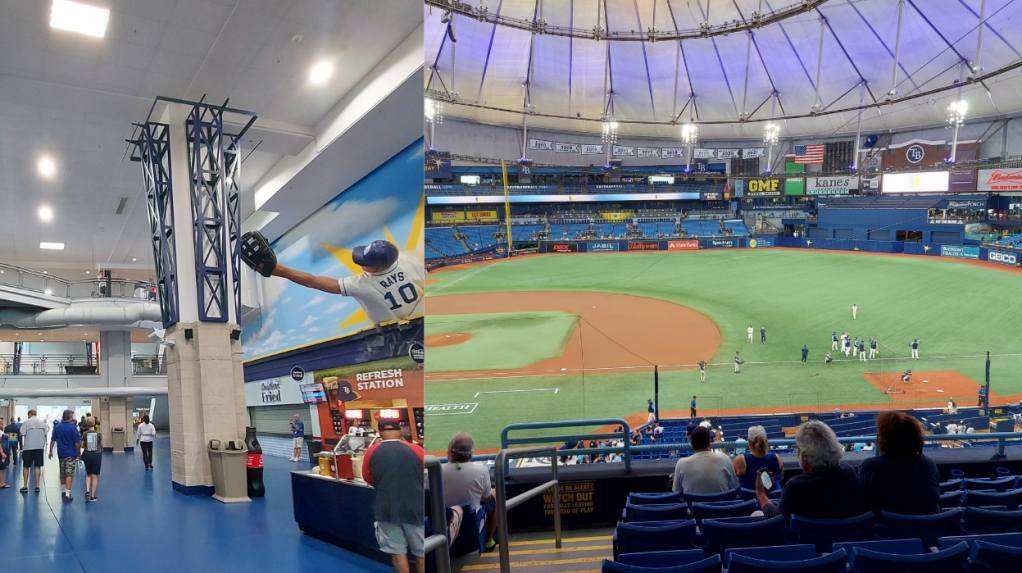
Going back to the warehouse remark, it’s a fitting comparison for other reasons, namely looks. Like the roof, the rest of Tropicana Field is not pretty. But while the roof is garish and unsightly, the rest of the ballpark offends with sheer blandness. The spiral entrance ramps are the only exterior indicators that this is a sporting venue. Without them, it looks like a giant storage facility — the kind used for boats or RVs. That’s also because there’s little to no branding for either the title sponsor (usually with a big logo plastered in multiple places) or for the Tampa Bay Rays themselves. Instead, there’s just so much blank concrete. That extends inside the ballpark, with plenty of grey stretching from the upper deck to the roof. At least the Coliseum had the decency to paint some of their concrete in the team colors, to give it some kind of personality besides just “building.” All told, not exactly a top tier panorama. There is some variety in the concourse, which is surprisingly vibrant and includes a rotunda meant to evoke the iconic Ebbets Field. However, Ebbets Field in its current form (an apartment complex) is better suited for baseball than the Trop.
To be fair, the Rays have taken steps to make the ballpark experience less drab and, like some critics said about the later Coliseum upgrades, put lipstick on a pig. Part of that is the aforementioned concourse, which is the prettiest part of the ballpark. The team store is also one of the more memorable in MLB and one of the few that includes a second floor. Other upgrades include a walk that actually goes around the whole ballpark (can’t imagine why that would be needed) and improved video boards. Then there’s the Trop’s unique drawing point: a 10,000-gallon tank filled with actual cownose stingrays. Run in partnership with the Florida Aquarium, the tank is a popular experience where fans are invited to dip their hands in the water and actually touch the rays. Having done it myself, I can say it’s a pretty cool experience on its own, let alone being paired with live baseball. Those upgrades have also applied to Tropicana Field’s food and drink offerings. The outfield areas include a gathering/eating/drinking area (albeit a small one), adding onto the concession pool that — while lacking a standout offering — is nonetheless one of the more solid and diverse altogether, featuring plenty of craft beers and Florida staples, like the Cuban sandwich.
Much like the feelings surrounding the Coliseum, I can imagine the sentiment among Rays fans towards the Trop. They must know how objectively bad it is as a MLB ballpark. However, it’s their ballpark, and they embrace it and wear its faults/quirks proudly. The vibe I get can be best felt at Ferg’s Sports Bar and Grill — a watering hole just to the north of Tropicana Field, right across the street. Looking like a marina restaurant despite being over a mile from shore, Ferg’s (one of the few spots like it in an otherwise urban and business-centric area of St. Petersburg) is the definition of a Florida dive bar, filled with more Tampa Bay sports memorabilia than restaurant essentials like seats and cups. It’s extremely bare bones and somewhat open to the elements. But go inside and you’ll find that there’s no better place to wet your whistle before a game, drown your sorrows after a defeat, or further celebrate victory. It’s a reflection of both the Rays — managing to find success and reach two World Series despite being run on a budget that John Fisher would call slim — and the Rays fandom itself. But while such a perfect representation sits right by Tropicana Field, its overall location has presented another major problem.
Tropicana Field was built on what was known as the Gas Plant district — a predominantly black neighborhood with plenty of black-owned businesses and churches. Despite a vote to refurbish the neighborhood, no concrete proposals to do so came about, and officials shifted focus to approving a baseball stadium. The change — which altered economic and reparation plans — effectively crippled the black business community in the region. All of that — not to mention finding hazardous chemicals in the soil during construction — was to build a ballpark serving as the only home for a major Tampa Bay sports team not in Tampa Bay proper (it’s about 20 miles from the central part of the city). Both Benchmark International Arena and Raymond James Stadium (home of the Tampa Bay Buccaneers) are within the city of Tampa Bay (about one and four miles away from the center, respectively), the more populous part of the region. Therefore, the majority of Rays fans have to travel much further to see their baseball team than they do to watch their football or ice hockey teams. They do that either by car (a lot of parking lots around the venue) or by some combination of public transport (usually the SunRunner bus and/or the trolley). I would say the former creates a lot of congestion, but, you know, low attendance. Ironically, the Rays’ temporary 2025 home of George M. Steinbrenner Field is right next to Raymond James Stadium, right in Tampa Bay proper.
Between all of the above and much more, it’s no wonder that the Rays have sought a new home for several years. To the best I can count, no fewer than three serious proposals have been made to build a new Rays ballpark, ranging from elsewhere in the St. Petersburg area to the Tampa Bay area proper. So far, all of them have fallen through, with the latest being a $2.3B proposed ballpark and mixed-use district in the Hillsborough Community College Dale Mabry campus — right by Raymond James Stadium. Given the roadblocks other proposals have run into, the general vibe is “wait and see.” There’s also the potential of the Rays being outright relocated to a different city, either an expansion candidate like Nashville, Charlotte, Portland, or Salt Lake City or a former MLB city like Montreal. In 2022, MLB rejected a proposal to have the Rays split their home games between Tampa Bay and Montreal, a move which had it gone through would’ve seemingly led to a revival of the Montreal Expos.
Ultimately, we will just have to wait and see what happens. The Rays’ lease agreement with Tropicana Field expires after the 2027 season. We could see the A’s make their move to Las Vegas and the Rays end up deciding their future, whether it be in Tampa Bay or not. While the A’s are one of the most historic MLB teams and the Rays are one of the newest, both of them are linked to each other. Not only are they each run by cheap owners who force them to rely on their farm systems and young players on inexpensive contracts, but they happen to play at the two worst ballparks in MLB. While each of those ballparks have quite different histories, perhaps the current state of both of them is not a coincidence. Each of them fail to meet some of the basic needs of being a MLB ballpark in their own different ways. Each of these teams need a proper home. The A’s seem likely to get something close to it at least soon. The Rays are more of a question mark. Still, their current ballpark is at least a MLB ballpark, though it’d be more fitting as a so-called “Quadruple-A” ballpark. While that doesn’t exist, Tropicana Field will, once the calendar turns to 2028, take its rightful spot at the bottom of this list.
With the undoubtedly two worst ballparks out of the way, we now move up a tier, though not up too much in overall quality.
D TIER
This tier is for the venues that don’t actively take away from the overall experience of watching major league baseball, unlike the prior two. In fact, there are several actual, genuinely good aspects about these ballparks. There’s a sizeable gap between this tier and the previous one — after all, there’s a reason I didn’t make an “E Tier.” However, if you sit in these ballparks long enough, you’ll start to notice that they have more problems than most of the other MLB venues. These ballparks are not bad, and with some work/success these ballparks can actually become much better. Still, they’re not what I would call “good” and in a lower class than the rest, especially the most elite ballparks. We begin in a city that boasts one of the most elite and beloved ballparks in all of baseball. This is the other one.
28. RATE FIELD
HOME TEAM: CHICAGO WHITE SOX
LOCATION: CHICAGO, ILLINOIS
OPEN SINCE: 1991
ORDER VISITED: 27 (07/26/25)
GAMES I HAVE SEEN THERE: 1 (0-1 HOME TEAM RECORD)
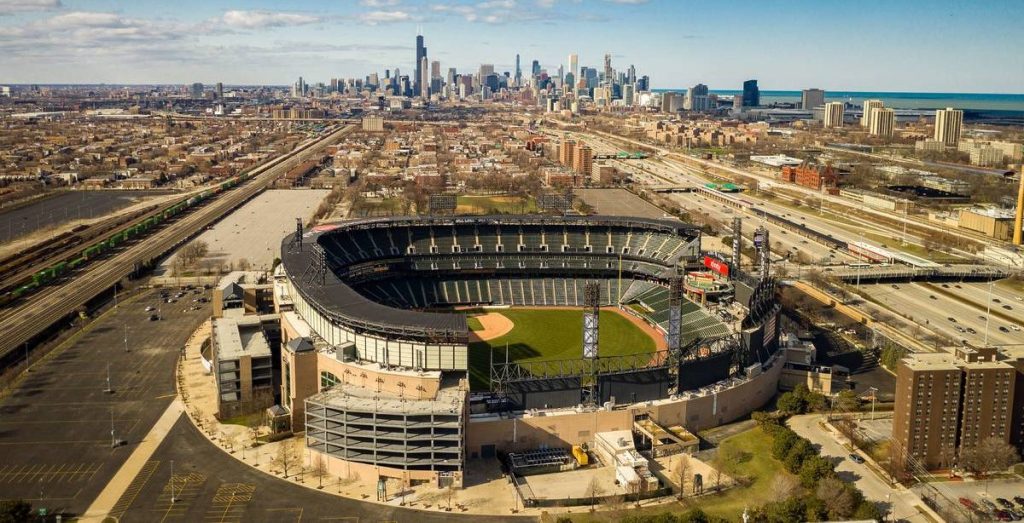
When Rate Field — first built as Comiskey Park II — was first opened in 1991, it had a lot of expectations. First of all, there’s the name: Comiskey Park. That’s where the Chicago White Sox had played for the past 80 years, and while it played host to several memorable moments both in baseball and general sports history, the old Comiskey Park was far from a modern facility. Jerry Reinsdorf, who had recently bought both the White Sox and Chicago Bulls, wanted that modern stadium and threatened to move his baseball team to Tampa Bay if he didn’t get one. Thus, the demolition of the old Comiskey Park (a decade after hosting Disco Demolition Night) and the construction of its successor. With the old Comiskey Park still in the minds of many, the new ballpark had to compete with another old, beloved ballpark in the North Side of the city. It would also be the first new major sporting venue built in Chicago since 1929, bringing the city into the modern era. It was a lot of pressure and perhaps it’s not a surprise that it failed to live up to that, especially given what came immediately after (more on that later).
That’s not to say it didn’t try. Rate Field has several features that echo Comiskey Park, not to mention a marble plaque where home plate used to be and painted lines marking the old foul pole locations. The front facade is of a similar design to its predecessor, and the multi-colored pinwheels atop the “exploding scoreboard” pay homage to what it was like at the old ballpark. The statue in front of the main entrance to Rate Field — not to mention the rest of the plaza and the other statues behind some of the sections in the lower bowl — also nicely pay tribute to old and recent White Sox history. One little oddity that remains from the Comiskey Park days is a single-stall shower located on the first level. A similar shower (minus the stall) was put in the old ballpark in 1975 to help fans cool off on hot days. A similar shower was included in the Rate Field design. Overall, as far as looks go, the ballpark is solid if not spectacular.
There is also a unique feature I didn’t even realize was there until I actually started walking around Rate Field. Directly north of the ballpark — in between it and the central parking lot where Comiskey Park used to sit — is a multi-story building connected to Rate Field by a pair of skyways that stretch over the street below. That building not only contains the main White Sox team score (which fans can visit both before and during games), but also a multi-floor restaurant, ChiSox Bar & Grill. It’s a decent albeit cramped place to go for pre-game grub and drinks, and provides a solid environment for home fans to gather. That — combined with the aforementioned plaza — actually makes for a solid foundation for a good environment. However, due to various factors that have put the White Sox towards the bottom of MLB when it comes to average attendance, this is rarely taken advantage of by the home crowd. That’s also because the vast majority of the pre-game festivities take place in the parking lots, where tailgating is still in full force.
They say ballparks often reflect the surrounding area, and unfortunately for Rate Field the surrounding area is located in Chicago’s South Side area. The South Side doesn’t particularly have the best reputation when it comes to crime, safety, and overall economic status. The areas to the north, south, and west of the ballpark are almost entirely residential, with more industrial businesses and bars/restaurants known more for their age than their quality sprinkled throughout. The area to the east — near the Illinois Institute of Technology — is a bit nicer, but it’s also on the other side of Interstate 90 East. In other words, Rate Field and the surrounding area give me serious Oakland Coliseum vibes, which isn’t exactly a good thing. White Sox fans, like A’s fans with their old venue, may find comfort in familiarity and turn rough and tumble into gritty and experienced. But I am not a White Sox fan (wrong color), and definitely felt I had to watch where I was going.
Also like the Coliseum, there are plenty of parking lots surrounding Rate Field (namely north and south) — hence all of the tailgating. Naturally, this makes gameday traffic pretty crazy, even before you get off the freeway. There are also a few bus stops right by the ballpark, if you don’t feel like driving or dealing with ridesharing. However, Chicago offers something few American cities get right: a good, actually working rapid transit system. The CTA “L” trains are extensive and super convenient, and the system isn’t difficult to figure out. The Red Line is your best bet, although the Green Line is good as well. Both will take you up into the Loop (Downtown Chicago), with the Red Line going further north and the Green Line going west afterwards. Either i great for getting to and from Rate Field, though they can get crowded quickly.
The location of Rate Field in relation to the Loop gave it a chance to have a legendary panorama. It’s far enough to where you can have an excellent view of the Chicago Skyline, which is one of the most diverse and impressive (both on an technically architectural and purely visual standpoint) in the country. However, in a move that has seemed bizarre in hindsight, Rate Field was built facing southeast — towards the bottom of Lake Michigan (which you can’t see) — instead of north directly towards the city. There might have been some concerns due to the position of the sun, but ultimately that issue would be negligible for most games. You can still see the Chicago skyline — just from the back of the ballpark instead. While Rate Field’s panorama isn’t exactly awful by any means, not having it face north meant throwing away the chance to have a potential top tier skyline in all of baseball, one that could’ve helped it compete with its North Side counterpart.
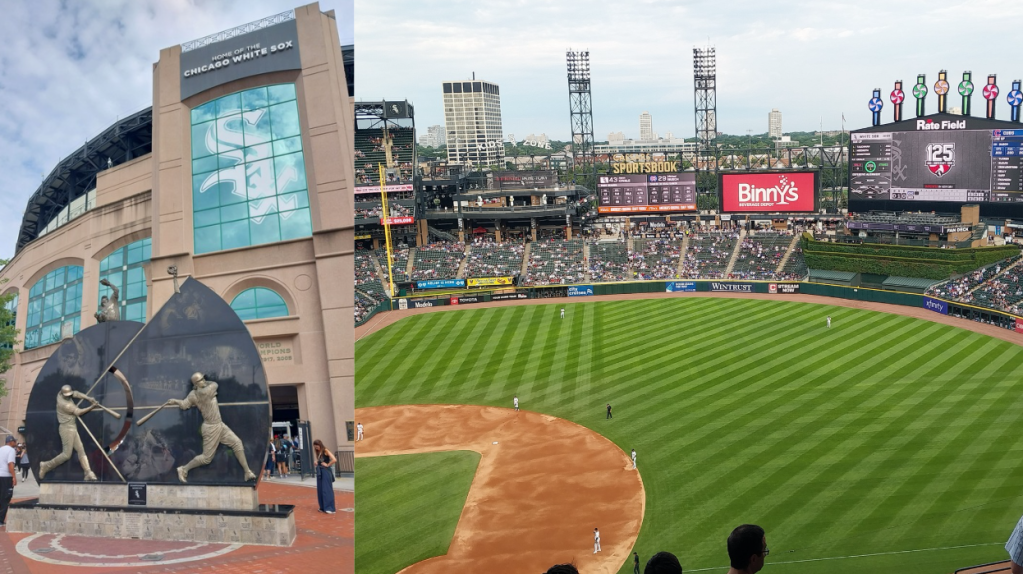
There are other aspects of Rate Field that don’t quite make sense. Going from the top down, the upper decks were the subject of scorn immediately upon the ballpark’s opening. These seats were structured in a way to give unobstructed views, but as a result they also pushed fans higher and therefore further away from the action. Even after chopping off the top eight rows (eliminating over 6,000 seats in the process), the problem persists, with the climb to seats higher up in the top deck (the 500 level) being somewhat exhausting. The food and drink options at the highest level are also extremely barebones. Now, this is a thing at pretty much every MLB ballpark, with the lower levels having better and more diverse concession options and the upper levels being your generic sports fare. But even in comparison to that, concessions in the 500 level at Rate Field have a lot to be desired, which makes this next point all the more impactful.
While in my research I couldn’t get an accurate result for when or how long this was in place, I can say that for at least a majority of the time Rate Field has been opened, there has been a policy where people sitting in the 500 level area could not even access the lower 100 level area. Some sources I saw had this as a blanket policy, others for games with more than 25,000 fans in attendance (Rate Field has a capacity of just over 40,000). But unless you shelled out money to sit in the good seats, you couldn’t even go down to the 100 level just to get some food and return to your 500 level seat. Ushers would check your tickets and literally restrict you to the 500 level. As far as I can tell, the White Sox are the only ones with this kind of policy, which is, to put it mildly, [insert your favorite swear word] insane. I could not verify if this policy was still in place. When I went to Rate Field, I has a 500 level ticket for a game against the Chicago Cubs (guaranteed to have over 25,000 fans). I had to enter the ballpark via a specific way that had me take an escalator up to the 500 level, but I was able to go to either end of that section and walk down switchback pedestrian ramps (which I kind of despise) to get to the 100 level and back without my ticket being checked. While it seems to me that the policy is no longer in place, I haven’t been able to confirm it and, again, the very idea of this policy makes the White Sox look incredibly cheap.
When it comes to the 100 level, in the time I did have to explore, I saw both good and bad. The good: almost everything in the outfield area. That includes the Fan Deck and its concessions in center field, the Millet Lite Landing in right field, and the Craft Kave in right field (which features a beer stall modeled after an L train car. There are also some pretty good food stands in the main concourse area, sampling from local restaurants and items. Given that Chicago has some phenomenal food (deep dish pizza, Italian beef, hot dogs, etc.), this is a good thing. The bad: some of that food isn’t as good as you’d think, and a lot of the White Sox’s newer signature, eye-catching items tend to fall in the “looks pretty on social media, but is awkward to eat and not that good” camp. Such was the case with an extra long and topping-filled hot dog I tried that, while it should’ve worked on paper, ultimately fell flat. In addition, the concourse felt a bit cramped, with less space between the floor and ceiling than you’d think. I noticed the temperature rise noticeably when I walked from the open-air outfield area and into the closed off infield section.
To be fair, that last cramped problem is also felt in the North Side ballpark, which I will get into in much more depth eventually. However (spoiler alert), it’s on the opposite side of the list as Rate Field, which in a way seems to be the bizarro version of its North Side counterpart. Instead of integrating itself into the surrounding neighborhood and naturally building up the area, Rate Field stands out — not quite an eyesore but still out of place. While it has several features of and nods to the past, it makes many modern mistakes and fails to write its own legacy. It could have been a worthy successor to a historic ballpark looked back on with rose-tinted glasses. Comiskey Park was the oldest ballpark in Chicago, and its replacement was meant to be the king of the new era of ballparks. But not only has Rate Field failed to even come close to that mark, but little did the White Sox know that it would just miss out on the real new era of ballpark renaissance.
I alluded to this in the beginning of this entry, but Rate Field’s reputation has not been helped by what came after it. After the White Sox moved into their new digs, the very next team to get a new ballpark was the Baltimore Orioles. I will go more in-depth on that ballpark later, but suffice it to say that it’s near the North Side ballpark on this list. Baltimore’s ballpark was so revolutionary, so well-received, and so influential that it kicked off a brand new era of ballparks and sporting venue construction that’s still being felt to this day. To rub salt in the wound, both Rate Field and Baltimore’s ballpark were built by the same architect: HOK Sport (now know as Populus). Compared to many of the ballparks that have come since its construction, Rate Field seems a bit soulless and hollow, and the White Sox foolish for not coming up with what the Orioles did.
In their defense, the White Sox have made changes to Rate Field over the years to try to close the gap. Some of those changes have actually worked and brought improvements to the ballpark. However, altogether it has arrived later than it should have and hasn’t been enough to shed the label and reputation garnered over the years. When it replaced Comiskey Park, Rate Field had to be good to compete with its North Side counterpart. 35 years later, the other ballpark remains one of the most beloved in the sport and a must-visit for tourists visiting Chicago. On the other hand, Rate Field is the forgettable second ballpark that many forget even exists and most skip out on when they come to the Windy City. It’s no wonder why the White Sox are already looking for a potential replacement. But given the combination of Chicago city officials and the politics of sports venue construction (see what’s happening with the Chicago Bears), as well as the overall cheapness of White Sox ownership, I’m not holding my breath.
27. LOANDEPOT PARK
HOME TEAM: MIAMI MARLINS
LOCATION: MIAMI, FLORIDA
OPEN SINCE: 2012
ORDER VISITED: 18 (09/09/22)
GAMES I HAVE SEEN THERE: 1 (1-0 HOME TEAM RECORD)
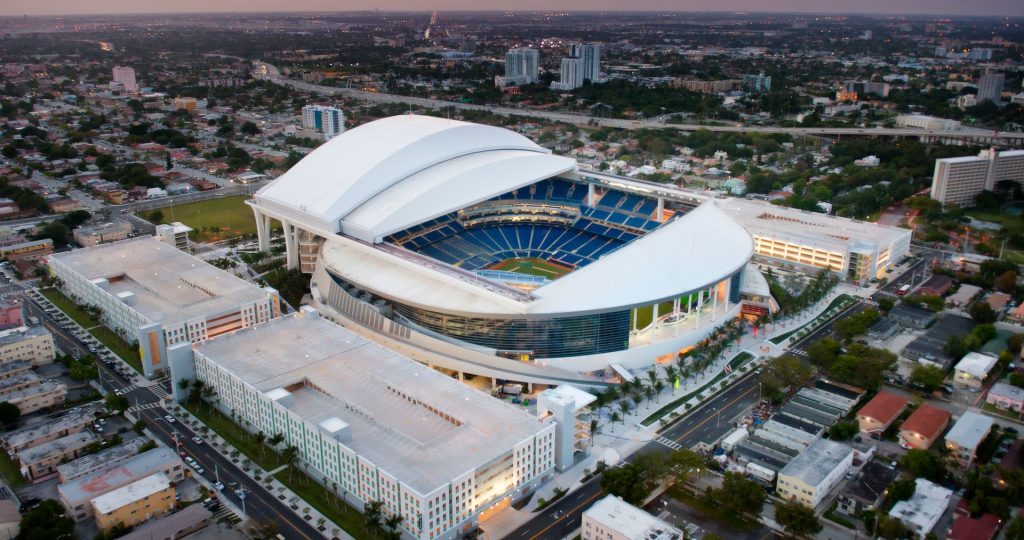
If Sutter Health is the most underqualified ballpark in MLB, Tropicana Field is the most maligned, and Rate Field is the most forgotten, then loanDepot Park is the most confusing. It starts with the ballpark’s name. I didn’t forget to capitalize the “l” in loanDepot Park, that’s how it’s stylized. It continues on throughout the ballpark itself, a big white blob towering over the residential area it sits in. It’s both objectively pretty and unsightly in its out-of-placeness. It’s undoubtedly the quirkiest MLB ballpark, full of a mishmash of art and other decor perfect for a Miami venue, as well as seemingly random inclusions that make visitors wonder what they’re doing in Miami of all places. Some of those inclusions have since been removed due to criticism, only for the remaining ballpark to be criticized for losing part of its identity. It offers so much for visitors to see yet is unnecessarily difficult to get to. It has proven to be capable of producing an incredible atmosphere yet is home to a team whose fanbase largely doesn’t show up and has been given few reasons to do so. It should be higher up on this list, but cannot be moved up due to reasons that, if changed, would make it an entirely different ballpark.
Perhaps it’s fitting for a team like the Miami Marlins, the most peculiar in MLB history. Throughout their relatively short history, the Marlins have seen a lot of losing and a lot of changeover, part of the reason why despite being in a major market they’ve struggled to field consistent crowds. The Marlins have made the playoffs just four times and have the second-worst winning percentage among active MLB teams. They have yet to win their division, but have also won two World Series. They accomplished those feats while called the Florida Marlins and while playing in a football stadium — specifically, Joe Robbie Stadium (now Hard Rock Stadium), where they sometimes struggled to attract crowds above 5,000. Between this and various lease issues with the stadium and the Miami Dolphins (the main tenants), the Marlins were the subject of several relocation rumors. But eventually, they reached an agreement with the city of Miami and Miami-Date County to build a new baseball-specific venue (with changing their name to Miami Marlins a key part of the deal). In 2012, loanDepot Park opened its doors, and the larger MLB world could not have predicted what kind of ballpark this would be, or that the Marlins of all teams play there. Then again, the Marlins have always defied convention.
Jeffrey Loria — then-owner of the Marlins — made his fortune as an art dealer, and that artistic thought process was upfront as he directed the design of loanDepot Park. It was the first MLB ballpark to be designed in a “contemporary” style (and will be until the Las Vegas ballpark is finished), designed to reject the wave of nostalgia that began with the Baltimore Orioles’ new ballpark. Instead, Loria wanted his team’s ballpark to be “different and experimental,” while making a statement about Miami’s culture. Effectively, Loria wanted his ballpark to be a piece of art in itself, not as an aesthetically pleasing ballpark. The end result was certainly a statement, with the ballpark being a large, sweeping white structure with a glass facade, looking more like a basketball or hockey arena (a modern one) than a ballpark. Part of the structure was a large retractable roof, built to help deal with the humidity and rain/storms in Miami. That roof slides over onto a set of large white columns, which are rooted into the ground in a plaza that surrounds the outside of the ballpark, behind a fence.
The ballpark itself was just the start. The plaza was lined with colorful tiled walkways designed by Venezuelan artist Carlos Cruz-Diez. Pastel, Miami-Deco influenced patterns line the parking garages next to the ballpark. Various pieces of Latin art are scattered on the walls and ceilings across the ballpark. Glass windows stretched across the outfield panorama, able to be retracted along with the roof on good days. The outfield walls and backdrop were painted bright green. There was a “bobblehead museum” jiggling to show off its display. There were aquariums tank that spanned the length of the backstop and a swimming pool and bar styled after the Clevelander nightclub in the outfield. Most notable of all was a massive 75-foot, $2.5M sculpture that included a bunch of wildlife (including marlins) that came to life and moved around whenever a Marlins player hit a home run. It was a colorful, striking ballpark filled with plenty of non-traditional features, a ballpark that definitely stood out from the rest.
The immediate reaction to everything was mixed to say the least. While some thought the overall design and collective aspects were neat and unique, others were quick to mock the bright green colors and bombastic nature of everything. The word “tacky” was thrown around a lot, in particular towards the home run sculpture. Some called the scene an eyesore, but it did at least get more people talking about the Marlins than they ever would have. Over time, there have been some renovations and changes made. The outfield walls and backstop were painted a more eye-soothing deep blue. The aquariums and pool were removed. Finally, the home run structure was relocated from its position behind the outfield wall to a spot just outside the ballpark, where fans can take pictures with it. I think time has been kind to some of these features — the sculpture in particular — with more people praising the attempt at creating something unique and not going with the flow. I think that’s largely the nostalgia talking (the use of “tacky” was accurate looking back on it), though I do believe the home run sculpture was over-hated from the beginning.
Still, the more I think about it, the more I think Loria helped create an art gallery that also hosts baseball games. By that I mean he prioritized making loanDepot Park a statement and flashy media bait than making an actually good ballpark, throwing more and more features into his ballpark purely on uniqueness, hoping something stuck. Maybe it was an attempt to draw in fans in the Miami area. But in the end, especially with a lot of the main original attractions either gone, altered, or relocated, the collection that remains seems like a mishmash of random items. I mean, why is there a bobblehead museum in the Marlins’ ballpark of all places? After all, the actual National Bobblehead Museum is in Milwaukee. Also, why does the bobblehead feature items from all teams, not just the Marlins? As for the ballpark itself, I’d like to amend my previous statement and instead say that from the outside, it looks like an art gallery, rather than a sporting venue. That’s actually kinder than what others have said about it, with some comparing the bright white building to the porcelain bowl of a toilet.
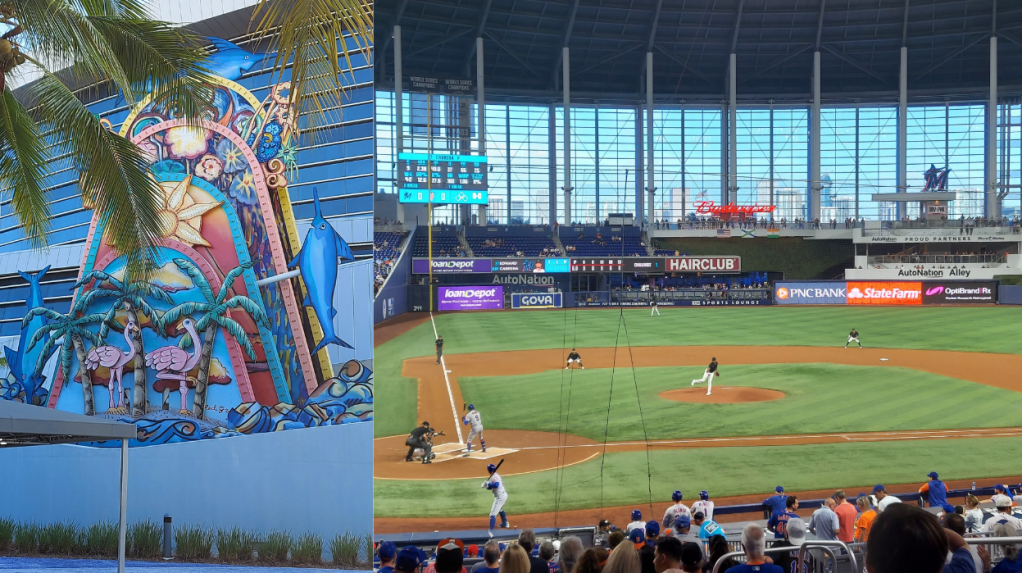
That all being said, I actually quite like the ballpark interior. Granted, it’s a bit confusing to get into, with entrances to even the lower level seats being up ramps (or the main helix ramp) and the exits being downward at street level (I’m not sure if that’s an intentional design or me failing to figure out where exactly to go). Still, the panorama is incredibly underrated, the amenities are still nice and enjoyable, and the overall post-green look is somehow vibrant yet understated at the same time. The murals and other pieces of art still on display throughout the interior are nice to look at and the concourse itself is spacious and easily within eyesight of the field. As for the field, loanDepot Park is one of the five MLB ballparks which uses artificial turf. It looks nice and the field of play has never really been an issue when it comes to the actual baseball being played (at least as far as I’m aware).
When it comes to food and drink, loanDepot Park is also underrated in the grand scheme of MLB. The offerings are surprisingly diverse and reflect the culture of Miami well. There’s the classic sports fare like hot dogs (build-your-own style), chicken, and burgers. Then there are the options like barbeque and Tex-Mex, as well as other unique dishes from Latin cultures — Cuban, Peruvian, etc. — and even Japanese-inspired items. Looking back on my journey, I’m hard pressed to come up with a ballpark menu that had more unique items than loanDepot Park. As for drinks, the ballpark offers a variety of options, particularly when it comes to alcohol. That being said, it is Miami, so while I might’ve sampled their decent sample of beers, the atmosphere felt more fitting to enjoy a cocktail. Considering all of what’s been said in this and the previous paragraph, it might seem weird that the ballpark keeps failing to draw consistent crowds. Well besides failing to field a consistently good baseball team, there are three reasons why: location, location, location.
Miami/Miami-Dade County’s politics are complex and infuriating, and getting approval for something like a new sporting venue is extremely difficult (see Inter Miami’s entire history). Fortunately for the Marlins, they were able to use land that already had a sporting venue on it. The old Miami Orange Bowl was torn down in 2008, with loan Depot Park coming four years later. But while getting some kind of land was perhaps the biggest hurdle, clearing it inadvertently created another one. The area is surrounded by nothing but homes, apartments, and the occasional restaurant. There is absolutely nothing else to do in the general area around loanDepot Park, making the ballpark stick out like a sore thumb more than any other ballpark in MLB. While a lack of other places of entertainment is more acceptable for football stadiums (used a lot less than ballparks), the frequency of baseball games means this problem keeps creeping up. There’s nothing to do before or after the game besides arrive and leave, leading to another problem.
There are some public transportation options to get to and from loanDepot Park. There is a trolley service and a special Marlins shuttle from multiple Metrorail stations nearby. However, by far the main way to get to and from the ballpark is via car, as evident by the several parking garages right next to loanDepot Park. In fact, there are more garages than there are streets with more than one lane in each direction surrounding the ballpark. All of this creates quite the cocktail of traffic, which is backed up far for even the most average Marlins game. All of this means rideshare service takes a literal eternity, as I found out while waiting for my ride in the sweltering Miami humidity. You’ll need a ride to get anywhere else in the city, with the ballpark’s location — far west of Interstate 95 below where Dolphin Expressway gets ready to turn into Interstate 395 — far from Downtown Miami and other tourist-popular areas like South Beach. The area where loanDepot Park sits is awful for auto traffic, yet its very design favors the driving of cars and it’s too far from everything else to consider using other forms of transportation. It’s a self-fulfilling traffic nightmare.
So, why does a ballpark that, despite garnering kind of a bad reputation at its inception, is actually pretty good and good-looking on the inside continuously fail to draw in a crowd? Well, consider all that Miami has to offer and ask whether or not the casual resident or tourist would want to put themselves through all of that travel headache when they could instead of something much closer and convenient instead? The situation would be helped if the Marlins were consistently good (though to be fair they have made the playoffs in two of the past six seasons). But those instances of success are often few and far between, especially compared to instances of the Marlins being bad or mediocre, or straight up getting rid of their best players who would draw in fans. Sporting venues are elevated by the atmosphere fans create, and right now loanDepot Park has little to speak of.
However, we know now more than ever what this ballpark is capable of. Once again, loanDepot Park was selected as a host site for the World Baseball Classic, serving as the site for Pool D play as well as two quarterfinals, both semifinals and the final. Along the way, fans of some of the best and most vocal countries in Latin America — namely the Dominican Republic and eventual champion Venezuela — packed loanDepot Park and turned it into a madhouse. It was easily the most incredible atmosphere of the entire tournament and served as an example of loanDepot Park’s potential if the Marlins ever became consistent and good. However, even if that does happen, the logistical issues surrounding the ballpark will not only remain, but get even worse. In the end, in Loria and the Marlins’ attempt to stand out and go against the grain, they found why so many others go with the grain instead. What has stuck around more than a decade later is more bad than good, and that’s unlikely to change anytime soon.
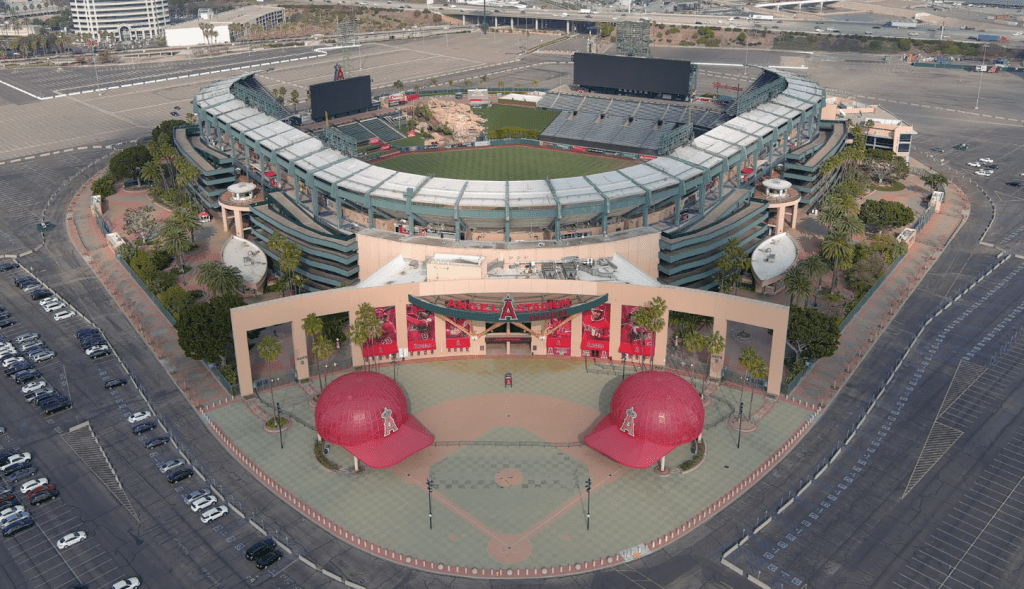
26. ANGEL STADIUM
HOME TEAM: LOS ANGELES ANGELS
LOCATION: ANAHEIM, CALIFORNIA
OPEN SINCE: 1966
ORDER VISITED: 4 (09/16/17)
GAMES I HAVE SEEN THERE: 1 (1-0 HOME TEAM RECORD)
On paper, Angel Stadium should be one of the most beloved ballparks in MLB. It has many of the ingredients needed to do so. It sits in the middle of one of the largest metropolitan areas/media markets in the country. It’s the fourth-oldest ballpark in the league (opened in 1966). It went through a major renovation within the past 30 years and has both classic and new(ish) unique aspects. It’s near public transportation. It houses a team that not only won a World Series but was also consistently successful in the early 2000’s. That team has also not only owned by a major local corporation but currently has one of the richest owners in MLB, with the cash to make key changes. However, instead of being up with another Los Angeles-based ballpark in terms of prestige, Angel Stadium is one of MLB’s most forgettable ballparks, with more fans thinking of it as bad rather than good and even more barely thinking about it at all.
For such a largely unremarkable ballpark — and franchise — there’s actually some interesting (albeit slightly stupid) history here. Upon entering MLB, the Los Angeles Angels played at Wrigley Field (no not that one) and then shared space with the Los Angeles Dodgers at their home in Chavez Ravine before moving into Angel Stadium (then-Anaheim Stadium), where they have been since. However, the Angels (renamed the California Angels, then Anaheim Angels, then Los Angeles Angels of Anaheim, and then back to the Los Angeles Angels) haven’t been the only tenants during that time. The Los Angeles Rams moved there in 1980 after struggling to fill their old home of Memorial Coliseum. Thus, the ballpark had to be reconfigured for football, with the upper decks and mezzanine extended to completely enclose the field and extra bleachers added in a way they definitely did not look natural. In addition, the Angels’ iconic “Big A” scoreboard — a giant white structure resembling an uppercase “A” with a halo on top — was moved from its original position in left field to the parking lot. It was one of the rare times a baseball-only venue was transformed into a multipurpose one. The Rams remained there until their move to St. Louis after the 1994 season. By then, a new owner was taking over and about to transform the ballpark.
That owner would be the other big thing (or, rather, THE big thing) in Anaheim. The Walt Disney Company had been a minority owner of the Angels for a few years — in fact in 1994 they released Angels in the Outfield, with the Angels (instead of the Pittsburgh Pirates in the original 1951 film) taking center stage. In 1996, Disney gained full control of the team and — after negotiating a new lease with the city — began a major renovation project the following year. In 1998, the ballpark — renamed Edison International Field of Anaheim — was finished, with many features fans know today installed. Those include the “California Spectacular” — a rockpile in center field modeled after Pride Rock from The Lion King — and a new plaza around the outside, complete with two enormous Angels hats at the main entrance. It was in these new conditions that the Angels won their (as of this writing) only World Series in 2002. A year later, Disney sold the team. The ballpark, now Angel Stadium, has largely remained the same since, with two new huge scoreboards (especially the one in right field) added in 2018 being the only main changes in the past 20-plus years.
So, why exactly is Angel Stadium this low? After all, those additions were pretty much all well-received. The plaza is inviting and the main entrance is one of the more unique in MLB. The concourse is relatively clean and more spacious than you’d think. The rockpile may be kind of dumb, a blockade for some spots behind it in center field, and not a true representation of the Angels — it’s a far cry from the now-painted red Big A, which remains in the parking lot — but it at least gives the ballpark some character. Plus, it has a decent panorama, complete with an Amtrak station that looks like a NASA hangar. The problem is that, apart from the aforementioned scoreboards (which aren’t that impressive, honestly), the Angels have rested on their laurels and largely failed to do anything besides sit on their ballpark. Little renovation or adaptation has taken place. Even the best ballparks need to be maintained and adapt to changing times. Angel Stadium seems to be one of the few ballparks seemingly incapable of doing so.
Pretty much every aspect of Angel Stadium can be described as follows: “it’s nice/good/decent/alright/okay I guess, but…” — followed by some negative remark. How was your experience? It was alright — the weather was nice but that was pretty much it. How was the condition of the field and ballpark? It’s decent I guess, but could be better. How’s the panorama? It’s okay but could be better. How does the actual field play for hitters and pitchers? Decent, but nothing too one way or the other. How’s the food? It’s solid, but nothing really stands out. Actually on that last part I was stunned to find Angel Stadium had, of all things, a Jucy/Juicy Lucy burger, a Minneapolis/St. Paul staple. I didn’t want to eat it because I wanted to wait for my eventual trip to watch the Minnesota Twins to do so (a decision that ended up paying off). Also, the Lexus Diamond Club Patio, which includes dining tables situated right next to regular ballpark seats, is one of the more bizarre contrasts in any ballpark I’ve ever seen.
Anyway, my point with all of this is that Angel Stadium could and should be much more. It’s in a prime location, has longevity and expense going in its favor, and has been home to two of the greatest players of their generation in recent years. But all you will hear anyone say about the ballpark is that it’s “good” at best and “forgettable” at worst. When someone mentions a ballpark in Los Angeles area, they’re rarely talking about Angel Stadium. It and the Angels have become the little brother in their own metropolitan area. They’ve become the Los Angeles Clippers of MLB, if the Clippers had ever had a lucky year and had their championship opponent choke a huge lead in Game 6. Even then, the Clippers’ new Intuit Dome is one of the best and most technologically advanced in the NBA. Meanwhile, Angel Stadium seems frustratingly stuck in the past.
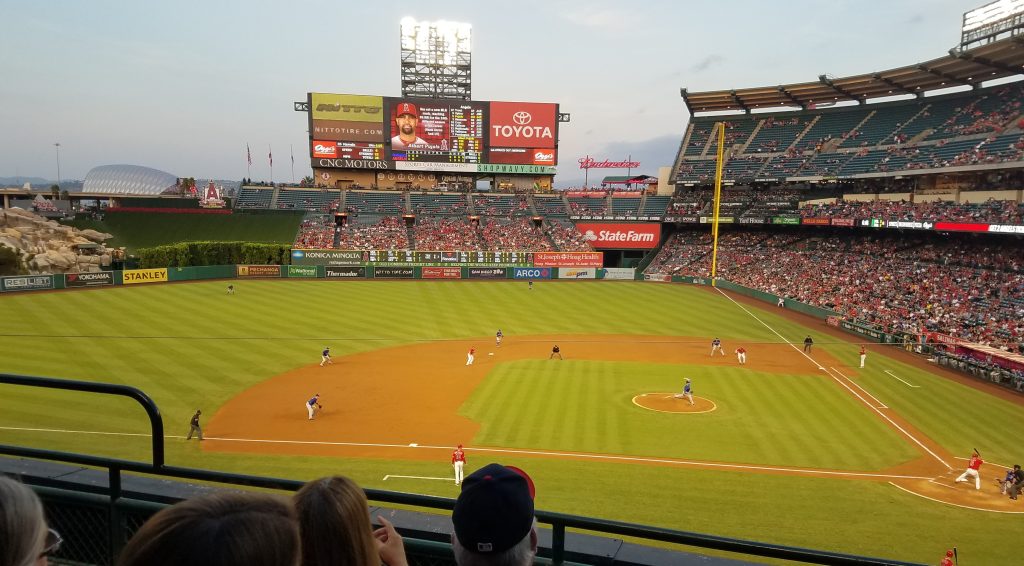
Unlike in the case with most ballparks, we can identify the exact reason for this stagnation: the very person heading the group who bought the Angels from Disney in 2003. In his 20-plus year tenure in charge of the Angels, Arte Moreno has arguably been the worst owner in MLB, even compared to the likes of John Fisher, Jerry Reinsdorf, Bob Nutting, and the Monfort brothers. Moreno inherited the defending World Series champions and has handed out massive contract after massive contract, most of which resulting in some of the worst deals in baseball history. This an an utter abandonment of the farm system and pitching department (doing so with cost-cutting measures extreme for any MLB team) has led to the (so far) utter waste of Mike Trout’s career and the departure of Shohei Ohtani, who combined to win zero playoff games in one appearance with the Angels. He also ignited backlash by seemingly distancing the team from its home city, inserting “Los Angeles” back into the Angels’ name despite the team remaining in Anaheim.
When it comes to Angel Stadium, Moreno has gotten plenty of criticism as well. In addition to not prioritizing the little things that come with running a MLB team, the little things that make a ballpark great have been allowed to stagnate under his watch. Still, the presence of Ohtani at least led to jumps in attendance due to an influx of Japanese fans. But when Ohtani left for the other team in the greater Los Angeles area, so did they. However, Moreno seemed unbothered by this, saying fans prioritize safety and a “good experience” at the ballpark and that winning isn’t in their Top 5 priorities. The point about fans not caring if they win was so infuriating to Angels supporters that they didn’t care that Moreno prioritized affordability most of all (a broken clock is right twice a day). Seeing their team’s lack of success (the Angels have the longest active playoff drought in MLB) and apparent lack of desire to be successful, fans have shown their displeasure by not going, reducing the atmosphere in the ballpark. But even with Moreno trying to prioritize an affordable “good experience” at the ballpark, many have seen that they’re getting what they’re paying for in terms of ballpark quality.
Like with his free agent signings, Moreno goes for the big plays when it comes to ballpark improvement (including the scoreboards). For Moreno, this means parking lots, or, rather, the land they sit on. Angel Stadium is surrounded by a sea of parking lots, visible even in the ballpark’s panorama. This, of course, makes driving the most prioritize method of transport, with the potential for huge traffic given its location sandwiched between Interstate 5 (no, not “The Five,” you SoCal people) and the Orange Freeway. Sure, the aforementioned Amtrak stop at the Anaheim Regional Transportation Intermodal Center is quite convenient. But it’s still a decent walk from the ballpark, as are most other entertainment options in the area. While there are a few bars/breweries/restaurants nearby, it’s not exactly a hub or pre- or post-game activity. But if Moreno had his way, that would change. Or not, given how the plan fell through.
In 2018, despite having no plan for an alternate home, the Angels opted out of their lease at Angel stadium, in part to prevent them being forced to remain their until 2029. The following year, the city agreed to sell the ballpark and surrounding land to a management company affiliated with Moreno for $325M. The deal would have locked the Angels in place until at least 2050 (with an option for 2065) while essentially allowing Moreno to both refurbish the ballpark and turn the lots and land into apartments, condos, and office/retail space. While that may seem like a much-needed turn of events, the deal (made behind closed doors) seemed fishy, and not just because of Trout. Allegations of corruption and violation of California’s Surplus Land Act led to an FBI investigation, which found that then-Anaheim Mayor Harry Sidhu agreed to the deal with an Angels representative in exchange for a $1M contribution to Sidhu’s reelection campaign. In 2022, Sidhu resigned as mayor and the Anaheim City Council voted to cancel the sale of the Angel Stadium land.
So, where does Angel Stadium go from here? It’s unclear, although the Angels are locked down for the foreseeable future — last year, the Angels agreed to extend their lease at Angel Stadium until 2032. But in the end, it all depends on the man running the show. In the months that followed the corruption scandal, Moreno announced that he would explore a potential sale of the Angels, who had incredibly been estimated by Forbes to be worth $2.2B. While Angels fans rejoiced at the chance to see their team finally in the hands of someone competent, Moreno would eventually retract that announcement, saying that he would not be selling the team due to “unfinished business.” It remains unclear what exactly that business entails, and it’s also unclear what exactly it means for the future of the team and ballpark. When it comes to the latter, a section of the 400-level was closed off this season due to a reported rodent infestation. So, Angel Stadium is slowly becoming Oakland Coliseum 2.0.
Angels fans can see an alternate reality play out in their own ballpark’s panorama, on the other side of the Orange Freeway. The view from behind home plate includes the Honda Center, home to the Anaheim Ducks. Team owner Henry Samueli is the driving force behind OCVibe, a $4B, 100-acre entertainment district aimed at revitalizing the area surrounding the Honda Center. The final product will include extensive commercial and residential development, including a massive food hall, concert venue, and public park. It’s expected to be finished in 2033, one year after the expiration of the Angel Stadium lease. The future of entertainment and sports-related real estate in Anaheim is near, but it’s not the Angels who are controlling it. For now, all Angels fans can do is watch that future come to pass from the other side of Katella Avenue, trapped in their sea of parking lots with their rich yet cheap owner and their old ballpark, a historic venue that doesn’t deserve the stagnation and degradation it’s been receiving.
With that, we conclude the first five on the list, AKA the Bottom 5 current MLB ballparks. I did consider adding one or two more down below, but ultimately decided to give them a break. For more, we head to a new tier.
C TIER
At this point, we are completely done with the ballparks I consider “bad.” Some might disagree, especially with the first couple of entries in this tier. But again, my list my rules. I personally call all of these ballparks “good,” — not “excellent” or “amazing” or “well done” or even “nice,” per se. These ballparks effectively just made the cut to get a passing grade from me, though there are certainly problems with all of them, some of which can’t quite be solved. Some if it deals with the hand these ballparks were dealt, some of it deals with decisions made at their creation, and some of it is due to what came before. The first ballpark up on this list concerns the first two.
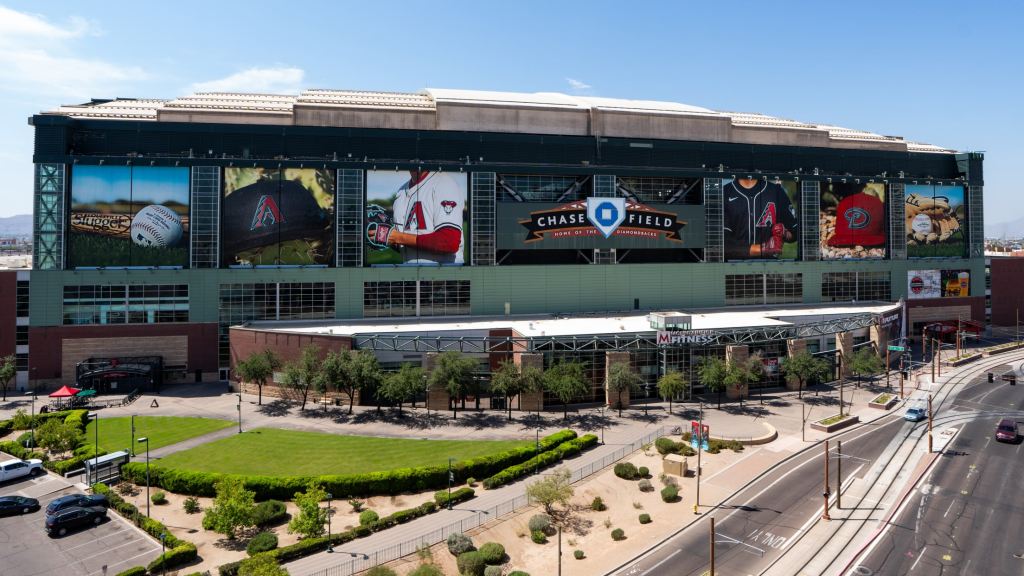
25. CHASE FIELD
HOME TEAM: ARIZONA DIAMONDBACKS
LOCATION: PHOENIX, ARIZONA
OPEN SINCE: 1998
ORDER VISITED: 19 (05/27/23)
GAMES I HAVE SEEN THERE: 2 (1-1 HOME TEAM RECORD)
As noted philosopher Margaret J. “Peggy” Hill once proclaimed about Phoenix, “this city should not exist — it is a monument to man’s arrogance.” The fifth-largest city in the country, Phoenix is also by far the hottest major U.S. city, with the average temperature during MLB’s regular season being over 99 degrees Fahrenheit. It’s why Phoenix wasn’t considered a choice for MLB expansion until well after the post-World War II population explosion, largely made possible by the invention, perfection, and proliferation of air conditioning. After years of the Phoenix Suns being the only team in town, the late 1980’s to 1990’s saw a major sports boom for the city, with both the St. Louis Cardinals (NFL) and Winnipeg Jets relocating to Phoenix (the latter rebranding to the Coyotes). This growth was capped by the arrival of the Arizona Diamondbacks, who along with the Tampa Bay Devil Rays were awarded MLB expansion bids in 1995. With the Marlins already in Florida, the Diamondbacks’ introduction made Arizona the most recent state to get a MLB team for the first time (Nevada will claim that distinction upon the Athletics’ move in 2028). The new franchise also had a new challenge in front of it: consistently play an outdoor sport in the middle of the desert. Their answer was Bank One Ballpark (now Chase Field), and since its introduction (as well as the team’s) in 1998, these conditions have shaped its reputation in the greater baseball world.
Like their fellow 1998 debutantes, the Diamondbacks would be playing under a roof. However, unlike Tampa Bay’s ballpark, Arizona’s roof would not be fixed. In fact, Chase Field holds the distinction of being the first ever retractable roof venue for a U.S.-based MLB team. The roof opens from the center outwards, and is actually quite pretty while agape — while that was much more necessary when the field had natural grass, it remains a rarity on game days due to Phoenix’s heat. It’s also probably why a lot of the glass in the wall behind center field is blocked off with square billboards. The view would be better either without them or if they were more transparent. That has been a growing complaint ever since the Diamondbacks switched from natural grass to artificial turf (becoming one of five MLB teams to do so) in 2019, meaning a reduction in roof openings in general. Interestingly, the change to turf also resulted in the dirt strip leading from the pitcher’s mound to home plate being removed. At the time, Chase Field was one of just two ballparks in MLB to have this feature (known as a “keyhole”), which was a lot more common in older ballparks.
Also unlike Tropicana Field’s roof, which is so low that it regularly interferes with balls in play, Chase Field’s roof stretches way above the field. While this means that balls rarely if ever manage to reach the heights needed to hit the roof, being on the opposite end of the spectrum has its drawbacks. Many have compared the roof and the space it between it and the field to an airplane hangar, and there is definitely a likeness. It’s one of the few ballparks where you really get a sense of scale upon seeing that space in person. It’s not even a sense you get upon entering a roofless ballpark, which in theory has infinite space between the field and the sky. Roofed ballparks take that feeling away, providing a faint to obvious (the latter in the case of Tropicana Field) sense of being crammed into a space. Chase Field doesn’t have that, which is good for not feeling cramped up but bad for not feeling as intimate. Noise travels further in bigger spaces, making it softer, making it a bit tougher for home fans to use their advantage. Overall, the vastness is not off-putting, just a bit odd compared to other ballparks.
The spaciousness is also apparent because Chase Field is also straight up large. With over 48,000 seats, Chase Field has the second-highest capacity in all of MLB. The 407 feet from home plate to the center field wall isn’t the longest (though it definitely isn’t the shortest), but combined with the 413-foot marks at the border between center and left/right fields, going dead straight is no easy feat for home run hitters. Also, the home run marker in dead center is just a yellow line on a green wall 25 feet above the ground (kind of disappointing in my opinion). Chase Field also has a larger foul territory than most, while about 80% of its seats are in foul play. The upper deck is one of the highest in the majors, though the positioning of the luxury boxes brings the top level closer to the field than you’d think (still pretty far though). Speaking of the upper deck, Chase Field has an odd seating configuration I haven’t noticed at any other ballpark. The very last sections on the upper deck (300 to the left and 332 to the right) have rows made up of just five seats. Why did they map out the seating this way? They look like slivers of a normal section (which has more than 20 seats). Why not just extend the sections next to them to make them larger instead of having these bizarre mini-sections? I couldn’t find an answer, but these sections remain a quirky feature of Chase Field as of this writing.
Anyway, getting back to Chase Field’s largeness, there’s a reason behind it all. While a certain ballpark in Denver gets most of the attention for being a hitter’s paradise, Phoenix’s heat can also add plenty of offense by making baseballs bouncier and more difficult to grip. As such, for the majority of its existence, Chase Field has been seen as a bit of a launchpad, consistently ranking towards the top of all MLB ballparks when it comes to hitting and scoring statistics. Despite the sheer size and space of the ballpark, the offense has regularly been free-flowing. That is, until 2018, when the Diamondbacks introduced a humidor in Chase Field. The humidor keeps moisture in baseballs, resulting in a significantly reduced home run rate and aiding pitchers greatly. However, this has seemingly changed lately, with statistics and guides used by Baseball Savant putting Chase Field in the Top 3 when it comes to hitter-friendly ballparks over the past three seasons. It seems like despite the best efforts of the Diamondbacks and Chase Field, heat definitely plays a factor, despite the ballpark’s designs.
Even with the roof, by far the most unique feature of Chase Field is the pool just behind right field. The Presidential Pools Suite is perhaps the most Arizona thing about Chase Field — and that includes a beautiful mural and rotunda area celebrating the sporting history of the Grand Canyon State. It features a pool, as well as a hot tub and several seats by it (and right behind the right field fence). It fits about 35 people and costs several thousand dollars to rent per game, though opposing teams who defeated the Diamondbacks in the playoffs have managed to crash the area by taking celebratory dives into the pool. Other unique aspects about Chase Field include Cold Beer & Cheeseburgers — no, not the food items (though they are served at the ballpark). Rather, it’s a sports bar/restaurant chain that has a location inside Chase Field. It’s complete with seating for games and open even on non-game days. If you want to work off whatever you put down there, you can visit Mountainside Fitness, a public gym and fitness club located inside Chase Field itself (also open on non-game days).
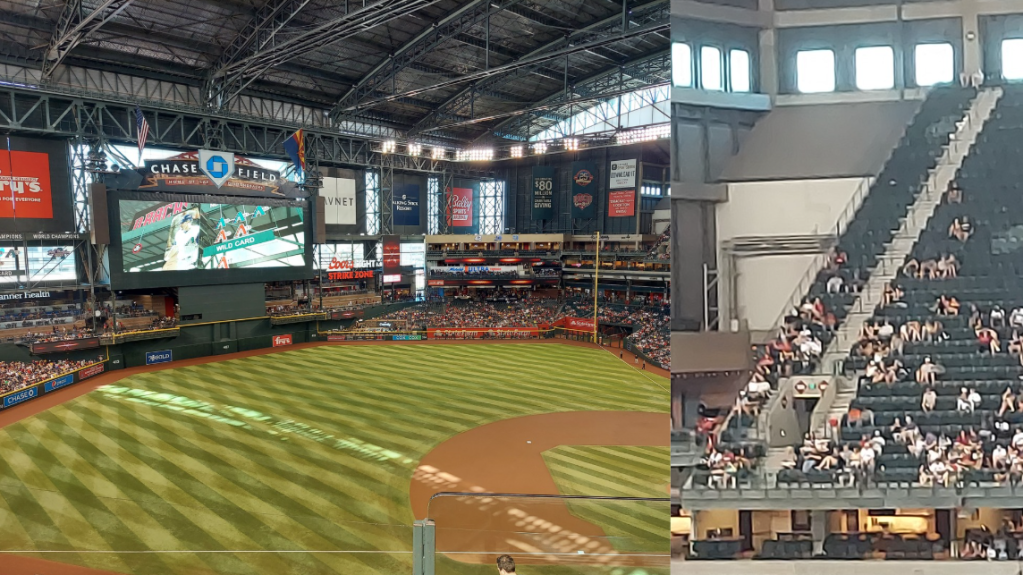
When it comes to ballpark food, Chase Field has a lot to offer besides, well, cold beer and cheeseburgers. Taking advantage of the cuisine of Arizona — most closely resembling Tex-Mex with some unique cactus-based options — Chase Field’s menu includes plenty of tacos, quesadillas, burritos, and more. The barbacoa nachos have also been well-received. Plus, Chase Field is the only MLB ballpark (as far as I’ve seen) that sells tamales, which means it gets an automatic passing grade in my book. The rest of the food selection ranges from solid to good (for the most part), while the beer selection ranges from good to pretty good. Interestingly, Chase Field has sort of leaned into desserts over the past few years. From milkshakes to cookies and more, desserts are eye-catching if not a bit average. It’s also the only ballpark I’ve seen with two different kinds of dessert hot dogs — one with ice cream for meat (which I had and thought was decent) and one with a churro (which, given the mediocre nature of most sporting venue churros, probably isn’t much to write home about).
When it comes to getting to the ballpark, Chase Field’s central location in Downtown Phoenix lends well to transportation. Phoenix is a surprisingly walkable city (at least by major American city standards), with more traffic coming by foot than you’d think. Still, the main method of transportation remains the car, with plenty of parking lots right by the ballpark. Of course, this leads to some traffic that makes it much more preferable to just walk to the game. Fans can also use the A Line of the Valley Metro Rail System, with both the 3rd Street/Jefferson and 3rd Street/Washington stations being easily within walking distance of the ballpark. If you’re using rideshare apps to get to and from Chase Field, you’ll have to walk a decent but not too far distance to make the final small leg of the trip. Again, while the area where Chase Field is constructed makes it easier for fans to get to and from the ballpark, it also speaks towards another aspect of Phoenix that ends up impacting the home of the Diamondbacks.
Phoenix is the first city we’ve come across so far where multiple major sporting venues are next to each other (Anaheim doesn’t count — Angel Stadium and the Honda Center are separated by the Orange Freeway). Mortgage Matchup Center (home of the Suns and former home of the Coyotes, now the Utah Mammoth) stood by itself Downtown for several years before Chase Field came around. Together, they make Phoenix’s sports scene pretty reachable and have led to a bit of transformation for the once downtrodden area. But it’s not like the area is a hub for fans before or after games. While there are some bars and restaurants right by Chase Field, the immediate surrounding area is filled with more industrial businesses than not. In fact, many fans end up going west — closer to the arena than to the ballpark — to a more nightlife-friendly area. Maybe it’s because it’s straight up too hot to do much outdoors, but I found Downtown Phoenix surprisingly empty at night. Maybe I just had an unusual experience. Either way, it seems Chase Field has made an impact, but not as big as some thought it would.
Chase Field is also in its late 20’s, and as it gets ready to turn 30, it’s starting to show its age. But instead of the sore knees/back and hair loss/graying of the fans who pack its seats, Chase Field is aging via certain systems not working properly and other features not being updated properly. When it comes to the former, complaints have risen that the air conditioning has not been as effective as usual. To be totally fair, this could also be due to rising temperatures, especially in the summer (while I was there — not in the summer — the A/C was fine). When it comes to the latter issue, that’s more of a personal preference, though it’s still distinct. It’s the little things — like seeing blank spaces in the open or haphazardly covered up or areas clearly constructed in the 90’s not getting that modern touch. Can you see the field as easily as you can see the piping/ducts that help keep the ballpark cool in some areas? Certainly not. Are the out-of-town scoreboards in a really odd place (high up behind both foul poles)? Yes. Still, it’s not like Chase Field is falling apart of the product of a bygone era. It still cleans up well and has plenty to offer the average fan on game days.
Still, talks of modernizing and refurbishing the ballpark have been on the minds of people in Phoenix for at least a decade, though due to the team’s original lease they couldn’t even think about possibly replacing Chase Field until 2024. Leading up to then, that, the lease itself (which expired in 2027), and the feasibility of such major moves were a huge topic of discussion. Ultimately, before that lease could expire, a new deal was struck to keep and renovate Chase Field, with this lease not expiring until 2055. As part of the agreement, Maricopa County will contribute $500M to renovating Chase Field, with the Diamondbacks putting in $250M of their own. Given that the deal is less than a year old, we have yet to see the fruits of that labor, or even that labor really even begin. Still, all we have to do is wait to see what comes from all of that money and work, and how it could change (and potentially ellavate) the ballpark.
When that work is eventually done, it’ll be likely that Chase Field continues its reputation as a mishmash of nostalgia and modernity, giving off some old school vibes despite being relatively young. Phoenix is not like most major U.S. cities, and it makes sense that its MLB ballpark is not like most others. It’ll still be the one building capable of making MLB in the Arizona desert a possibility. It’ll still have a pool (fans might riot if that ever gets removed) and A/C and some delicious Southwest cooking. It’ll also still be large, though that’s to be expected. I wouldn’t mind, though maybe it’s because I like old school airplane hangars. As for the current Chase Field, it’s well worth a visit for those seeking a spring break trip or last-gasp attempt at holding onto the warmth as fall approaches. Just don’t go during the summer, unless you have a death wish. After all, the stove will be far from the only scorching hot thing there.
24. GLOBE LIFE FIELD
HOME TEAM: TEXAS RANGERS
LOCATION: ARLINGTON, TEXAS
OPEN SINCE: 2020
ORDER VISITED: 13 (08/28/21)
GAMES I HAVE SEEN THERE: 1 (0-1 HOME TEAM RECORD)
Until the Athletics’ new Las Vegas ballpark is completed and in use, Globe Life Field remains the newest ballpark (in terms of opening date) in MLB. For a ballpark so young, it has already had quite a unique history, for better or worse. It made its MLB debut in 2020, but because of the COVID-19 Pandemic it did so in July — not March as originally planned. Also because of the pandemic, the first few dozen games it hosted were without fanfare, literally. When fans were allowed to show up to games, few (if any) of them supported the Texas Rangers, Globe Life Field’s home team. That’s because the ballpark was selected to host the latter portions of the 2020 MLB playoffs, due to its central location and overall newness (or, rather, lack of germs). This also makes Globe Life Field the only ballpark in MLB history to host World Series games despite its tenant not playing in the Fall Classic. While that did happen a few years later (when the Rangers won the 2023 World Series), another unique aspect about the ballpark involves its past. Globe Life Field is the only ballpark in MLB whose predecessor is not only still around, but also (as of this writing) still in operation right next to it. In fact, in order to properly talk about Globe Life Field, we have to first discuss what came before and is still there now.
Opened in 1994 as the Ballpark in Arlington (later renamed a few times, most notably as Globe Life Park), drew plenty of praise upon its debut. It’s quite pretty, with many homages to “jewel box” ballparks of old — such as the roofed home run porch (Tiger Stadium), white steel frieze on the upper deck (Yankee Stadium), arched windows (Comiskey Park), outfield fence (Ebbets Field), and left field wall out of town scoreboard (a ballpark in Boston we’ll get to later). Granted, some of those outfield features came at the expense of a nice panorama. It also has a lovely brick and Texas Sunset Red granite facade and a batter’s eye consisting of Greene’s Hill, a lawn behind the center field fence. However, it soon developed problems, specifically when it came to the extreme weather in the Dallas-Fort Worth-Arlington area. The intense summer heat was of particular concern, with fans roasting in the stands due to the ballpark’s lack of a roof (except for that portion in right field. This, combined with wear from sun and rain, led to the Rangers claiming it was deteriorating faster than other ballparks, and a new one was needed. So, after the 2019 season — just 26 seasons after Globe Life Park’s debut — the Rangers moved to their new digs next door. Incredibly, that was actually a longer MLB lifespan than the previous ballpark, Arlington Stadium, which served as the Rangers’ home from 1972-93. But unlike Arlington Stadium, which was demolished, Globe Life Park was given a new name (Choctaw Stadium) and reconfigured to host everything from football and soccer to even lacrosse. It is still in use today, most notably as a host for North Texas SC matches.
So, the goal was pretty much to be “Globe Life Park with a roof.” How did it do? Like every non-Tropicana Field closed ballpark, Globe Life Field features a retractable roof, which slides westward in one big piece to open. In fact, at 240,000 square feet, it’s the largest single-panel operable roof in the world. It sits about 278 feet above the field (for comparison, Chase Field’s roof is 255 above the field). Much of the northern, southern, and eastern walls are covered in glass panels that let in a bit of light. As a whole, the inside provides a better panorama than Chase field (helped by those long arches stretching from left to center field), though it’s far from the best in the league. It’s also somehow one of the few ballparks with roofs that look better with it closed. Given the infrequency of the roof opening (and during that time certain seats are guaranteed to get baked by the sun), the Rangers opted for synthetic turf for Globe Life field, which is one of five ballparks in MLB to not have natural grass. Again, like with Chase Field, you truly feel the spaciousness of the inside of the ballpark, though Globe Life Field somehow feels more natural. Man, the 2023 World Series must’ve felt like two different versions of the same idea, one much newer than the other.
All of that said, Globe Life Field doesn’t so much feel like its predecessor with a roof, but rather like the exact opposite of Globe Life Park. This goes much further than just having a roof, both good and bad. Fans at the newer ballpark will definitely not be sweating it out in the sun, being cooled off quite well by the air conditioning. The panorama also actually shows a bit of the outside. However, Globe Life Park’s good traits are also missing. The older ballpark had plenty of character, while Globe Life Field still feels a bit soulless. Although that could be remedied simply through time, that effort will be hampered by its design. Globe Life Park tried to emulate some of the prettiest and most celebrated aspects of other ballparks, while also having its own unique features. Globe Life Field looks like a stainless steel outdoor grill with the hood down. For all of the baseball aspects on the inside (we’ll get to those in a minute), on the outside it doesn’t even look good, let alone like a ballpark. It looks like a big metal barn, and not in a good way that some other sporting venues do. Also, the doesn’t exactly combat the whole comparison of playing baseball in something that looks like a warehouse — a shiny new fancy warehouse, but a warehouse nonetheless.
Another way Globe Life Field is the exact opposite of its predecessor is in some of the more understated features. Whereas Globe Life Park took inspiration and made imitation of classic ballparks like Ebbets Field, Tiger Stadium, and Comiskey Park, its successor is distinctly all-Rangers. The aforementioned arches pay homage to the inner concourse of Globe Life Park. The measurements for the very dimensions of the field pay homage to key seasons in team history and retired numbers of former great players (such as Nolan Ryan, Adrian Beltre, Ivan Rodriguez, and Michael Young). The size of the ballpark and field, combined with the effectiveness of controlling the indoor temperature, also mean the new home of the Rangers plays the exact opposite of their old home. While Globe Life Park was among the most hitter-friendly ballparks in MLB, Globe Life Field ranks at the other end of Baseball Savant’s spectrum, and has been the most pitcher-friendly ballpark over the past few seasons.
In a way, Globe Life Field reflects a reversal in terms of ballpark design. While at the start it was seemingly a race to see how ornate ballparks could be with little regard to functionality, the era of multipurpose stadiums was the ultimate support of functionality over ornateness. The third era was much more in the middle, a happy balance of old school design and modern functionality. But Globe Life Field seems to be part of a growing list that is rejecting that trend for larger usefulness. As far as the Rangers were concerned, as long is it had a roof and A/C and didn’t look awful on the inside, it didn’t matter if it looked like a Soviet airport or half of a Transformer on the outside. Don’t get me wrong, the modernity on its own is a huge advantage over other ballparks, and the roof did ultimately address the biggest need for a new home. But it lacks heart and passion, which isn’t helped by the overall vibes from the Rangers themselves. After all, the newest addition to the venue is the One Riot, One Ranger statue. The statue — once at Dallas Love Field airport — was modeled after a former Texas Ranger who enforced school segregation in the 1950’s. This past offseason, the Rangers agreed to display it outside the ballpark with no prior discussion and no response to backlash from fans after the decision.
Speaking of features on the outside of the ballpark, there is another major feature that makes Globe Life Field part of a possible fourth generation of ballparks (I’ll have a lot more on this in the next part). That would be Texas Live!, a huge entertainment center just to the north of the ballpark. The $250M mini “entertainment district” is a collection of restaurants, bars, and other businesses centered around a large space for fans to watch games on a giant 90-foot screen TV (often partially broken up into multiple smaller screens). It’s basically a massive corporate watch party designed to feel like a natural place for people to gather before and after games. By the way, Texas Live! is not to be confused with PBR Texas: A Coors Banquet Bar — a separate bar/entertainment place stationed just outside Globe Life Field’s north entrance. All of this action is meant to replicate other settings where ballparks are surrounded by tradition, longer-lasting watering holes. It’s a way to artificially create something natural, and it’s far from the only piece of the larger puzzle the area is transforming into.
Arlington is just a small part of the greater regional metropolitan area, sandwiched between the larger Dallas and Fort Worth. With somewhat limited space in Dallas and no one wanting to travel to Fort Worth, Arlington has been the site for expansion and new venues, none larger or more spectacular than Globe Life Field’s neighbor less than a thousand feet to the west. That would be AT&T Stadium, home of the Dallas Cowboys and the third-largest stadium in the NFL. It’s a venue that’s attracted major events — including the Super Bowl, College Football Playoff National Championship, Final Four, NBA All-Star Game, FIFA World Cup, and Wrestlemania. It’s clearly the main draw of Arlington and Globe Life Field shares its space. If that’s not all, to the northeast of Globe Life Field — just west of Highway 360 — sits the Six Flags Over Texas theme park. In addition, to the north — on the other side of the Tom Landry Freeway — sits Hurricane Harbor water park. The region as a whole has become dedicated to drawing in as many people as possible, with these venues surrounded by corporate offerings.
All of this means one thing: a metric crapload of traffic. The area in general isn’t exactly known for free-flowing car travel, and on game days (especially Cowboys games) traffic can be at a standstill. This can last for a while, as Globe Life Field is about 18 miles away from Dallas and 15 miles from Fort Worth. There are plenty of parking lots surrounding the general sporting area, not to mention both immediately around and in between Globe Life Field and AT&T Stadium. These lots can be just outside of the ballpark or a decent walk to the north — closer to the Tom Landry Freeway than to the ballpark itself. There is a rideshare lot fairly close to the ballpark, but given that drivers would have to fight their way through a sea of cars, you’d better hope that you don’t have to stand too long in the sweltering heat that led to Globe Life Field having a roof in the first place. Don’t have a car or want to ride in one? You’d better be staying at a hotel within walking distance. The Globe Life Field section on the official Texas Rangers website doesn’t have a “public transportation” section. My best research couldn’t find a public transport option from Dallas other than Greyhound, while the FlixBus route from Fort Worth still requires a nearly half hour walk from the closest stop.
When it comes to the offerings at the ballpark once you get there (not counting Texas Live! or PBR Texas), there are some notable options. In addition to the Tex-Mex options similar to those at Chase Field (like brisket nachos), Globe Life Field leans into a Texas staple: barbeque. There are several tasty BBQ options throughout the venue, with Hurtado Barbecue being a favorite among Rangers fans. This year, the Rangers introduced the 9th Inning Rally Sombrero — a massive nine-layer dip served inside a 26-inch fried tortilla shell that is designed to be worn like a sombrero. While you’d have to be rich, insane, drunk (there is a pretty good beer selection at Globe Life Field — particularly in the outfield concourse), or a combination of the three to try it, I would recommend caution for a different reason. When I visited Globe Life Field, the hot new item was the Rattler — a rattlesnake and rabbit sausage served on a hoagie roll with “venom sauce.” I tried it and was disappointed — not by the taste of the sausage, but by the awful sauce and the fact that the bun was twice the size of the sausage. Similarities between myself and one of my ex-girlfriends aside, be careful when trying a new food item that seems a bit too good to be true.
As a whole, what Globe Life Field offers is much of what Rangers fans have come to live in a sanitized, corporate environment. While Globe Life Park (as well as Arlington Stadium) had been the lone attraction in Arlington, Globe Life Field came along after the region had added pretty much all of those extra entertainment options. While Globe Life Park was unique in its design and stood out as the corporate jungle grew around it, Globe Life Field decided to blend in, while at the same time paling in comparison to the giant sliver blimp that is AT&T Stadium. While Globe Life Park certainly had its faults and certain design choices from the beginning sealed its fate as a ballpark with a relatively short lifespan (at least in terms of being a MLB venue), Globe Life Field’s faults, while maybe not as detrimental or even damaging, are nonetheless more depressing. Even its best attempts at creating something unique are — much like Prince Fielder with the Rangers — swings and misses. There are seats meant to emulate a dugout located closer to the foul poles, as well as below-field level suites behind home plate. The former has a hampered view and the latter hampers views.
Fortunately, Globe Life Field’s biggest reason for a hopeful future is the one thing it has the least of compared to other MLB ballparks: time. It’s newness and modern features are a benefit and many aspects of its design (at least on the inside) appear primed to age well, as opposed to the awful-looking exterior that, if ages well, is more of a knock on society than a compliment to it. There are other aspects of ballparks that can only be earned with time — aura, prestige, history. Globe Life Field has already hosted two World Series, with its home team winning one of them and providing memorable moments along the way. Keep that up and Globe Life Field might actually develop a personality some day. But I can’t judge a ballpark based on potential, only the present. While Globe Life Field is far from a bad ballpark, it’s average at best and bland at worst. Globe Life Field ranks this low not necessarily for its faults, but because of there being so many other good to great ballparks. Still, Globe Life Field isn’t doing itself any favors, and something needs to change for it to stop being an afterthought for the average MLB fan.
23. ROGERS CENTRE
HOME TEAM: TORONTO BLUE JAYS
LOCATION: TORONTO, ONTARIO, CANADA
OPEN SINCE: 1989
ORDER VISITED: 5 (04/17/18)
GAMES I HAVE SEEN THERE: 1 (1-0 HOME TEAM RECORD)
So, I know what some of you may be thinking at this point. The first patterns are starting to emerge in this list, and this is the third straight entry (and the fourth out of the past five) featuring a ballpark with a retractable roof. Given their relatively low ranking, I must have ballparks with roofs, right? Well, while I prefer non-roofed ballparks, as someone who has been baked in the Sacramento summer sun at outdoor sporting events, I get the need for them. In fact, whether or not a ballpark has a roof barely impacts my overall rating for them — the next retractable roof ballpark is (spoiler alert) nearly ten spots ahead on the list. But that’s for later. For now, we have to make our way up north and cross the border into Canada, for the first ever retractable roof venue in sports history. It’s also the sixth-oldest ballpark in MLB, the final venue ever built to accommodate both baseball and football, and the only MLB ballpark that has a hotel built into it (more on that later). It was also the first ballpark outside of the West Coast that I visited.
The year is 1982. The Toronto Blue Jays have just finished their sixth season in MLB at their home of Exhibition Stadium, which also serves as the home of the Toronto Argonauts of the Canadian Football League. This is significant because the Argonauts not only are in the Grey Cup for the first time in 11 years, but are hosting it. More than 54,000 fans back the Exhibition Stadium stands and get absolutely drenched in a driving rainstorm, which is so bad that the game is named the “Rain Bowl.” The exposed seats forced fans to watch the game from the concourse, with the water forcing the bathrooms to overflow as well. Plus, the Argonauts got destroyed. All of this happened in front of the largest TV audience in Canadian history at the time, as well as Bill Davis, the Premier of Ontario, who was in attendance. The following year, Davis begins the process of trying to put a dome over Exhibition Stadium. That process ends with the creation of a brand new venue at the base of the CN Tower in the Railway Lands, one with a roof (for snow and rain) that could be removed if needed. In 1989 — after a delay due to a construction worker strike — the Blue Jays moved into their new home: the SkyDome (since renamed Rogers Centre).
The Blue Jays were not the only ones to regularly use Rogers Centre. The Argonauts also moved in during their 1989 season and only left for BMO Field in 2015. The Toronto Raptors played their first four seasons there until the Scotiabank Arena opened in 1999, and the NCAA even hosted the International Bowl there from 2007-10. With such a differing lineup of tenants, Rogers Centre was built similar to the other so-called concrete donuts of the multipurpose stadium era. However, there were a few differences, one of which was the roof itself. Because the roof was the first of its kind, the designs for it and the ballpark as a whole were kept simple (well, as simple as a design like it could be). The roof is made up of four panels, with the two middle ones sliding laterally and the lower-most panel rotating around the venue and ending up inside the stack. This means that, unlike most other retractable roofs that have come since, Rogers Centre’s roof opens up in the direction of home plate, with the stack of panels hanging above the far edge of the outfield.
Part of the development of Rogers Centre included the addition of a cable-stayed bridge over Union Station Rail Corridor. This bridge has not only been used by pedestrians and hot dog salesmen alike, but it has also serves as a gateway to a prettier side of Rogers Centre, which is decked out with several pieces of public art — including a golden statue of screaming fans known as “The Audience.” But with most ballparks, the most beautiful part of it is the panorama. That’s not necessarily the case with the Rogers Centre, whose panorama consists of some bleachers, the scoreboard, some suites, and a bunch of glass windows. Those windows are actually part of the Toronto Marriott City Centre Hotel — the only hotel built into a MLB ballpark. The hotel has 55 rooms with floor-to-ceiling overlooking the playing field, essentially providing a free ticket to the game to go along with your room (there’s also a restaurant that overlooks the ballpark). It’s a unique item to check off a baseball diehard’s list, but it’s created some interesting problems. In the Rogers Centre’s early days, multiple people were caught indecently exposed in view of those in the ballpark. Guests staying in those rooms now have to sign a waiver saying they won’t perform any lewd acts in view of the ballpark. Still, the hotel’s presence does indicate that baseball is far from the only thing to do in the area.
There are three aspects where Rogers Centre arguably shines brighter at than any other MLB ballpark: location, location, location. Rogers Centre sits smack dab in Downtown Toronto, just north of the Gardiner Expressway near the shore of Lake Ontario. It’s surrounded by plenty of attractions popular with tourists, such as the Toronto Railway Museum, Ripley’s Aquarium of Canada, and the Metro Toronto Convention Center. Naturally, there are plenty of restaurants and bars nearby as well, perfect for pre- and post-game festivities. Because of all of this, there are plenty of ways to get there and back to wherever tourists are coming from. Fans can easily make their way to the ballpark in several different ways, including simply walking from nearby hotels. Of course, there are parking lots available for driving and ridesharing (including the main one underneath the ballpark itself), though because of typical downtown traffic there will be delays. There are also quite a few public transport options, including the Line 1 Yonge-University of the Toronto subway, GO Transit bus, and 509 Harbourfront and 510 Spadina streetcars. Union Station, the main railway and transportation hub, is also a short walk away.
Beyond anything else, the biggest (both literally and metaphorically) and most important part of Rogers Centre’s location is the building directly next to it on the east side. That could be the CN Tower — an observation tower and the tallest free-standing structure on land in the Western Hemisphere. The CN Tower is the defining symbol of Toronto and arguably the most iconic architectural structure in all of Canada. Rogers Centre being at its base makes it part of that imagery and helps draw in fans to games. Oddly, Rogers Centre’s proximity to the CN Tower would provide a rare detriment during my visit, which took place during the typically non-freezing cold month of April. However, a rare late snowstorm hit just as I arrived, piling snow atop the CN Tower. That snow froze into ice, and a large chunk of it ended up falling from the top of the tower, piercing the Rogers Centre roof. Fortunately, this was before that night’s game and no one was hurt. However, it resulted in that game being postponed to the following day, resulting in a double-header. I ended up going to the first game of that double-header, which, given the fact that it didn’t exist at that time 24 hours earlier, explains the paltry crowd in the photos I took below.
There’s another pattern you may have noticed. Rogers Center is one of five MLB ballparks to use synthetic turf. Given that this is the fifth time I’ve written “[insert ballpark] is one of five MLB ballparks to use artificial turf,” you may think I have something against turf fields. I must again stress that this is a coincidence. While I definitely prefer natural grass, it’s not a major factor in my rating at all and I get the need for them. Of all grass-based sports, baseball is the least impacted by the turf, anyway. Given the improvements in turf technology, the difference between turf and grass is becoming less apparent. That said, I don’t like AstroTurf, which makes it funny that Rogers Centre — the highest-ranking of the five MLB ballparks with artificial turf — is the only one that uses AstroTurf instead of Shaw Sports Turf. Proof that I’m not completely biased! In addition, Rogers Centre is the only MLB ballpark that does not have metal foul poles. Instead, it has a yellow mesh net the width of a foul pole that stretches from the roof to the outfield wall. While it doesn’t make a difference, I found it bizarre and have yet to find a definitive reason why. It’s likely due to easy removal and better fan views, but if so, then why doesn’t another ballpark — especially one with a retractable roof — have them? I like to think it’s because foul poles have been made illegal in Canada.
Being in Canada, Rogers Centre incorporates some of the country’s unique cuisine into its food offerings. Chief among them is poutine — French fries topped with cheese curds and covered in gravy. In a word, poutine is fantastic, and this year Rogers Centre began offering poutine topped with another Canadian item: Montreal-style smoked meat. The food diversity also includes offerings like calamari, hot dogs al pastor, jerk chicken nachos, Korean rice dogs, and shawarma. The beer is relatively okay, but expensive (even compared to other ballpark prices). It’s recommended that fans wet their whistle at nearby breweries, which brings up an interesting topic I found while doing research. As it turns out, 26 of the 30 MLB ballparks allow fans to bring in some food, as long as it’s small and in a clear bag. However, Rogers Centre apparently has the most relaxed policy when it comes to food, with some fans reportedly being able to bring in whole pizzas. I haven’t personally verified this, so try it at your own risk.
Apart from that, there’s not too much else to report. I mentioned earlier that they kept the design of the ballpark relatively simple. While that may have helped with the overall configuration, as a ballpark there was a lot to be desired. While it was vast — at one point having a seating capacity of over 50,000 (the second-highest in MLB) — it was also chasmic. The upper decks were far from the action, with metal bars in front of some seats to keep fans from falling (ironically, forcing them to lean forward to get a better view, risking the chance of falling even more). The overall concourse was pretty bland, but looked better compared to the concrete facade of the ballpark as a whole — unremarkable apart from the novelty of the retractable roof. It had all of the bad qualities of a multipurpose venue and, compared with straight-up ballparks, was always going to look worse by comparison. All told, I was disappointed with Rogers Centre and as I was assembling this list had it ranked much lower — well inside the Bottom 5. So why is it several spots above that now, and threatening to place even higher?
That’s because those who run Rogers Centre, unlike those in charge of other older ballparks, realized it was now in its 30’s and needed an upgrade. So, after the 2022 season (four years after my visit), the Blue Jays began a massive two-part, $400M renovation of Rogers Centre that was finished in time for the 2024 season. The many changes brought by these renovations include re-orienting seats in both the lower and upper decks to face home plate (instead of just straight forward), adding cupholders to some seats while widening others, reducing the size of foul territory, raising the bullpens, making the outfield dimensions asymmetrical, upgrading the dugouts, lengthening the LED backstop advertising to cover the entire area, and adding social spaces with bars in the upper-most sections. In addition, 2024 also saw the addition of 5G cellular service to be ready for, of all things, a Taylor Swift Eras Tour concert.
To say the fruits of all of this labor have been well-received would be an understatement. While Rogers Centre had always been beloved by Blue Jays fans, it had never really felt like a true ballpark. Now, with the team as the only tenant and these renovations in place, Rogers Centre truly feels like the home of Blue Jays baseball. At least, that’s what those who have been there before and after the renovations say. Alas, I have only been there beforehand. So, I supposed Rogers Centre’s current placement is a result of me both acknowledging the improvements and a way of not going too far against what I saw for myself. Of course, this just means I have to go back to Toronto for another visit (twist my arm, why don’t you?). That being said, even with these renovations, Rogers Centre is still closer to the bottom of the list than the top. While some of the criticisms I had were addressed, some still remain. Ultimately, for a venue that was built for multipurpose use and has a retractable roof, it, ironically, has a ceiling for how good it can be.
Still, that doesn’t have to mean this is the ceiling. Rogers Centre is one of the few ballparks I want to return to not just because I had fun the last time I was there, but to reevaluate it and give it a proper chance at a true ranking. Plus, there are other, non-tangible factors that can elevate a ballpark beyond what it may physically be capable of. Blue Jays fans not only have Rogers Centre close to their hearts, but their lungs are put to good use by ruining their ears anytime they visit. The playoff success of the Blue Jays over the past decade — from Jose Bautista’s ALDS home run to Toronto’s run to the 2025 World Series — has been done amid a soundtrack of utter delirium from a fanbase that has established itself among the loudest in baseball. At their best, these fans provide an incredible atmosphere that makes Rogers Centre an intimidating place to play, and that atmosphere has surely been enhanced by the work done to the ballpark in recent years. In the end, Blue Jays fans have given Rogers Centre a soul, something certain other ballparks can’t say they possess.
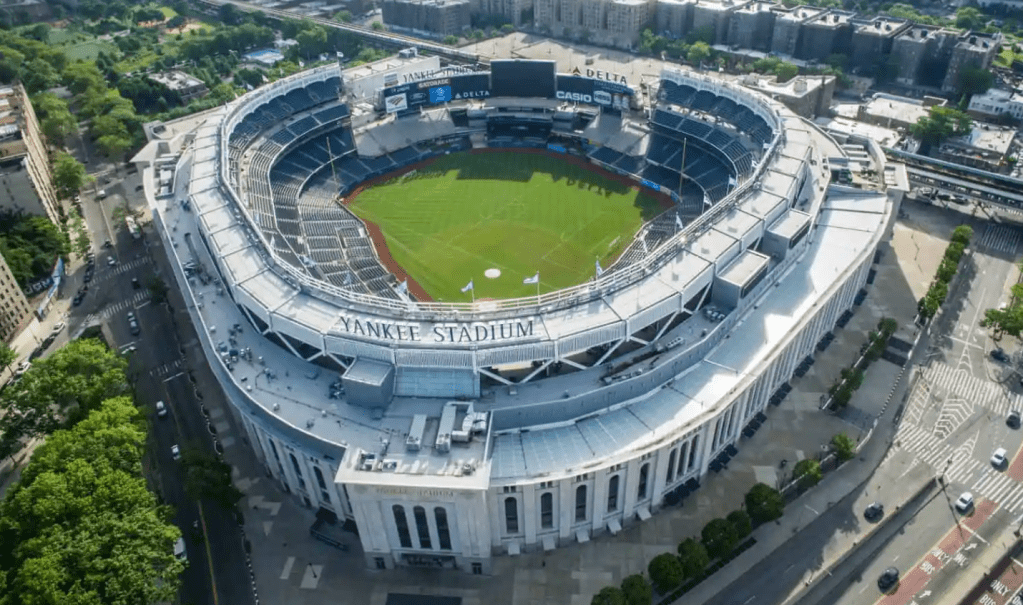
22. YANKEE STADIUM
HOME TEAM: NEW YORK YANKEES
LOCATION: THE BRONX, NEW YORK CITY, NEW YORK
OPEN SINCE: 2009
ORDER VISITED: 9 (06/17/19)
GAMES I HAVE SEEN THERE: 1 (1-0 HOME TEAM RECORD)
When I decided to visit every MLB ballpark, I knew at some point I would have to step foot inside Yankee Stadium. As a Boston Red Sox fan, I would rather be almost anywhere else in the world than the home of the New York Yankees. Indeed, when I eventually did attend a Yankees game in 2019, virtually everything in and around the stadium (to use a phrase that does what it says it does) gave me the ick. But that was simply because of all of the Yankees crap everywhere. Still, throughout all of these ballpark reviews, I have vowed to look at all of these venues as objectively as I can, rating them on pure merit with as little personal bias as possible. That doesn’t mean that reviewing the place where Brock Holt hit for the only cycle in MLB postseason history won’t be tricky, as I wondered if I would actually end up giving it a bit more credit by accidentally over-correcting any criticism born from my own bias. Yet I think that most Yankees fans would either agree with or at least understand where I’m coming from with most of my points. Or, maybe they won’t, and instead they’ll be angry that Yankee Stadium is ranked this low. To those fans, I offer a tune from the world’s smallest violin as consolation. Anyway, in order to talk about Yankee Stadium, I first have to detail the ballpark it replaced, both by name and occupation.
The original Yankee Stadium was built in 1923 and hailed as one of the most unique ballparks in the country. In the 85 years it hosted the Yankees, it became one of the most famous and storied sporting venues in the world. It was the first sports facility in North America with three tiers, with its facade — complete with its unique frieze — providing a look that became iconic. Its huge capacity and looming concrete exterior provided an intimidating presence and truly evoked the “stadium” part of its name. This, coupled with the prospect of playing a good, consistent, rich baseball team, made Yankee Stadium an incredibly tough place to play for visiting teams. In 1974, Yankee Stadium underwent a massive renovation project to repair significant structural issues that had emerged over the years. While the exterior was preserved, the interior underwent so many changes — both to the seating and field itself — that many referred to them as two different venues: Yankee Stadium I (1923-74) vs. Yankee Stadium II. A lot of complaints also surfaced that these changes took away a lot of what made Yankee Stadium unique. But most importantly, Yankee Stadium retained its reputation and aura as a tough place to play for non-Yankee teams, even as the overall quality of the ballpark went down again. Eventually, instead of another extensive renovation, the Yankees opted to build a brand new ballpark one block to the north. In 2008, the Yankees played for the final time in the ballpark where, four years earlier, they became the first MLB team to lose a seven-game postseason series despite winning the first three games. Demolition of Yankee Stadium was finished in 2010, with the Yankees now in their new home, for better or worse.
Located just east of Interstate 87 and the Harlem River on the southwest side of the Bronx borough in New York City, new Yankee Stadium (which will be referred to as simply Yankee Stadium for now on) is in many ways a new-age version of its predecessor (which will be referred to as old Yankee Stadium). Many traditions and features of old Yankee Stadium live on today, from that famous frieze to “the bat” — a giant exhaust pipe in the shape of a baseball bat that stands near the Metro North Station — to Monument Park, an open-air museum filled with plaques, retired numbers, and other monuments dedicated to Yankee legends. Yankee Stadium’s exterior — made with Indiana limestone from the same quarry that produced limestone for the Empire State Building — mirrors that used on its predecessor. Inside, the “Great Hall” concourse is the largest open air public entry way in any sports venue in the world, and is lined with banners of past and present Yankee greats. There’s also a museum displaying a wide range of memorabilia, from a “ball wall” and locker room replica to a tribute to Don Larsen’s perfect game in the 1956 World Series. The interior walls are adorned with hundreds of photographs capturing the history of the Yankees, most of which are from old Yankee Stadium and none of which are from Games 4-7 of the 2004 ALCS.
Although it’s not in the exact same spot as its predecessor, Yankee Stadium is still close enough to essentially share the same commute for fans. While there are a few parking lots nearby and there are plenty of apartments and homes in the surrounding area, who are we kidding? To spoof an often-misremembered quote from Yogi Berra about a St. Louis restaurant, no one drives in New York. There’s too much traffic. It’s all about public transit. There are several New York City Bus stops near the ballpark, but much of the crowd comes via rail. The Metro-North Railroad’s Hudson, Harlem, and New Haven Lines go right to the ballpark (the latter two only on game days) via the Yankees-East 153rd Street stop. Meanwhile, the New York City Subway’s 4, B, and D expresses stop at the 161st Street-Yankee Stadium station. The nature of commuting in New York allows for the vast majority of Yankee Stadium’s surrounding area to be filled with homes, apartment complexes, parks, and other residential neighborhood staples. Still, there are a few fast food restaurants, sports shops, and bars for pre- and post-game activities. They’re mostly located along either River Avenue or East 161st Street, and I dare not go inside of any of them for fear of being outed as a Red Sox fan, much like Ron Stallworth going undercover. The Bronx isn’t exactly the safest place to be in general, though to be fair it has cleaned itself up compared to the past few decades. Still, I wouldn’t call it “welcoming.”
When it comes to the food and drink options at Yankee Stadium, I don’t have anything to offer. This is the only ballpark where I didn’t purchase anything to eat or drink, solely based on the principle of not contributing my own money to the Yankees, apart from the fee for my ticket. So, I’ll be taking a look at the menu and taking in opinions from those who have better taste in food than taste in baseball teams. From what I can tell, Yankee Stadium actually has some good quality options, even when it comes to mere sporting staples like burgers and chicken. The 99 burger — named after Aaron Judge — is supposedly delicious, while the chicken bucket (literally a giant bucket filled with tenders and fries) is among the best value. There is also a dessert chicken bucket in which the “chicken” is an ice cream-covered pretzel with chocolate corn flakes on top. Diversity is also a strong suit, with options ranging from dumplings and empanadas to sushi and antipasto to tiramisu and… a lobster roll? As a Red Sox fan, how dare they. I’d say they should stick to New York specifics, but they do with Lobel’s (great for steak and other meat-based options). Yankee Stadium also has its own steakhouse (NYY Steakhouse), because of course it does. There is also a Hard Rock Cafe within the ballpark, though it’s open year round. When it comes to drinks, they do exist, though their most prominent feature is a caveat that comes with all these food options, one that I’ll go discuss in a minute.
For as much as Yankee Stadium tried to emulate its predecessor, there are some notable differences between the two. Some of them are purely cosmetic, like Monument Park being moved from behind left field to behind center field. It’s also beneath a sports bar and accessible to the Yankees’ bullpen, the latter the result of a request made by Mariano Rivera, who once gave up a stolen second base to Dave Roberts. Other differences impact the field itself. While Old Yankee Stadium was a hitter’s park — famously catering to left-handers like Babe Ruth with a short right field porch and a cavernous left field — its successor takes things even further. Yankee Stadium’s right field in particular has been criticized for its shortness, with it being a meme that many fly balls to right field would be pop-outs in most if not all other ballparks. Left field has also become more hitter-friendly, with the wall notably shorter than that of the old ballpark. The seats are laid out similar to those inside old Yankee Stadium, including bleacher seats beyond the outfield fences. However, about two-thirds of the seating is in the lower bowl, the opposite of old Yankee Stadium. But despite similarities in size and design, capacity is lower and has been lowered to just over 46,500 currently. While this still makes Yankee Stadium the fifth-largest by capacity in all of MLB, part of the difference between the two stadiums can be found in Yankee Stadium’s most defining aspect, which has also been its biggest criticism.
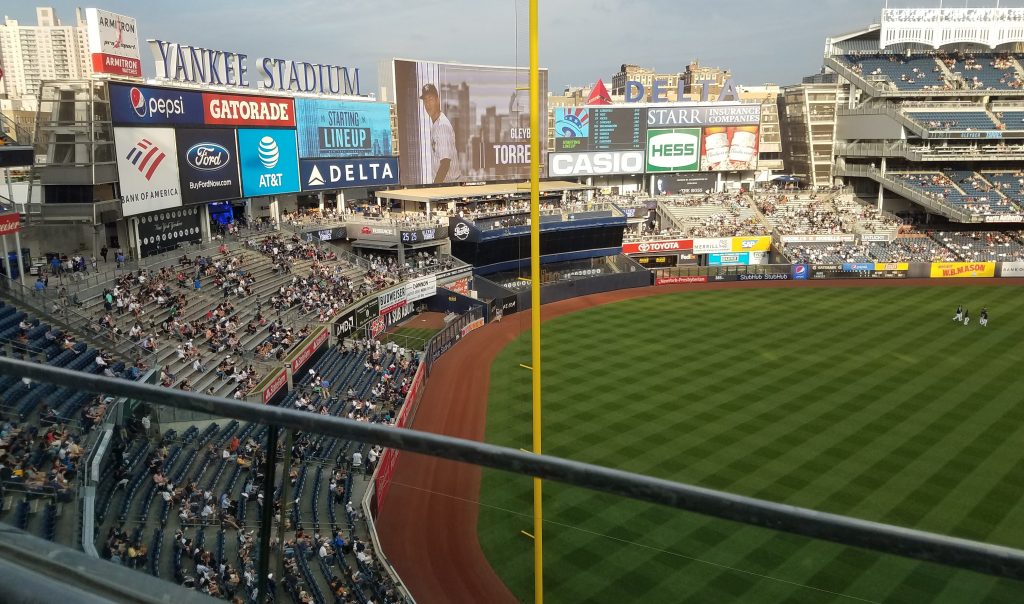
Old Yankee Stadium certainly cost a lot to make for the time, though at $2.4M (all covered by the team) it wasn’t the most expensive venue in the world. Its successor would change that. Yankee Stadium cost a whopping cost of $2.3B to build, with $1.2B (more than the total cost of any other current MLB ballpark) of that funding coming from public subsidies. This makes Yankee Stadium by far the most expensive ballpark in MLB, even without adjusting for inflation (though the Athletics’ future Las Vegas ballpark may at least come close to that mark). That cost also made it the most expensive stadium project in the world at the time, and it still sits in the Top 5 today, surpassed only by NFL stadiums, three of which haven’t even been built yet. As part of this expensive project, more than 56 suites were constructed in the ballpark — triple the amount from old Yankee Stadium. These include the Legends Suite, located right behind the dugouts and home plate. These are the most expensive luxury seats in the entire ballpark and perhaps in all of MLB. Depending on who’s in town to hit pop-ups turned home runs over right field, prices for the Legends Suite can range from $7,500 to over $30,000 per game. It’s in this pricing that we start to get to the heart of the problem.
The growing cost of attending sporting events is a much larger and far-impacting problem than its impact on baseball. My beloved Red Sox are one of the worst offenders, and I’ll go into that issue further when their ballpark comes up. The same goes for the Los Angeles Dodgers, especially in the Shohei Ohtani era. But the Yankees have always been among the richest and highest-spending ball clubs, and never have they tried to pass on the cost of their ballpark to the fans like they have with Yankee Stadium. All of that food I mentioned earlier may be good, but at quite the high price. Beer prices are absurdly high, with much less return on investment. Then we get to ticket prices, which are among the Top 10 highest in MLB. When it comes to seats, some views were blocked by certain angles or even part of a restaurant. While most if not all of that has been remedied, it was by turning those seats into concourse offerings that further reduced capacity. Of course, the most expensive are in the lower level, which — given the ratio of seats compared to the upper level — means a higher spread of costs. The most expensive sought-after non-luxury seats are right behind home plate. In what may be the most on-the-nose metaphor for income disparity at a MLB ballpark, there is a literal divider — described as a “concrete moat” — between Legends Suite seats and other lower bowl seating, complete with a vigorous security patrol to keep the riffraff away from those with real money.
So, what are fans who manage to cough up enough dough for a ticket getting for their money? In two words, not enough. There are admittedly several places in Yankee Stadium that look spectacular, at least for Yankees fans. But there are others with barely anything going on. I remember seeing the NYY Steakhouse, then walking through the concourse. Not even 30 seconds later, I was surrounded by gray walls with little to no displays or branding. Some parts clearly had a lot of effort put into it. Others appeared completely looked over. If they had spread that out throughout the whole ballpark, it would be much better. Even for the former, they could be much improved. If you didn’t know where to look, you could almost miss Monument Park. Look towards the center, and while there is a large 59-by-101 foot scoreboard (twice the size of the one at old Yankee Stadium), it’s surrounded by ads, and blocks what could be an average panorama of various nondescript buildings in northern New York. Then there’s the fact that, while imposing, old Yankee Stadium was not what you’d call pretty. The same outside design was built for Yankee Stadium, continuing the tradition of Yankees fans pretending giant walls of concrete more fit for a mausoleum than a ballpark are endearing.
Overall, it seems they just tried to copy old Yankee Stadium, but only executed that plan on paper. They ended up missing the most important aspect of old Yankee Stadium: the soul. Everything about Yankee Stadium seems like a shinier yet more expensive version of what came before. It may be of better quality, but it may not be better quality, if you know what I mean. The seats, while comfier and safer, are reduced and further back from the action. The growing cost of seats means younger, poorer, louder fans are being increasingly priced out. Those rich enough to afford sitting in the Legends Suite often leave them unfilled due to enjoying the other parts of what they paid for. This leaves the ballpark looking empty on TV. All of this has led to criticisms over a lack of fan noise, with even visiting teams saying Yankee Stadium feels much less intimidating than before. Yankee Stadium — and therefore the Yankees themselves — are missing the critical edge old Yankee Stadium gave off. There has been some return to form in recent years (only took a decade), but it’s still far from what it once was. In fact, in order to try to bump up crowd noise, Yankee Stadium operators have begun playing sound effects and music clips in between pitches at a deafening tone (louder in the stands than on the field). These sounds are rarely those fans have become familiar with, like classic organ tunes. Fans have taken to them like a fish to oil, calling them obnoxious and saying they’re even audible on TV broadcasts. However, they’re not going away anytime soon, with Yankees officials saying they want to increase the tempo and pace, creating an arena atmosphere similar to NBA games. This refusal to let a moment breathe and reinvent baseball (in the home of the Yankees of all places) is just one sign that off the field, the Yankees are losing the plot.
There is one sound that perfectly illustrates what’s wrong with Yankee Stadium and the Yankees in the post-George Steinbrenner era. This is an extreme nitpick, but it’s an important one. In the game I attended, the Yankees hosted the Tampa Bay Rays. While the Rays’ lineup was being introduced, “The Imperial March” was played over the loudspeakers. It’s a classic move by home teams to make the visitors seem like the bad guys, and many teams — including others in MLB — do it right before they introduce the home lineup with a hype video. But the Yankees are the one in all of sports where this doesn’t work. By playing “The Imperial March” for the visiting team, the Yankees are indirectly comparing themselves to the upstart Rebel Alliance fighting against their oppressors. There’s just one problem: in baseball, the Yankees are the oppressors. They’re literally known as the “Evil Empire.” You do not get to buy the best players, have one of the highest payrolls, play in New York City, build the most expensive baseball stadium in the world, and (along with your obnoxious fans) incessantly rub your 27 World Series titles in everyone’s face — and then paint yourselves as the plucky underdogs. It’s not just a misguided move — it misrepresents the Yankees’ very identity.
Yankee Stadium is far from a bad ballpark. Its modernity and budget alone will not let it be that. It also achieves perhaps its most important goal: it is undisputedly the home of the Yankees. But what exactly that means and the level to which it achieved that is different than before. I grew up in an era where the Red Sox and Yankees wanted to kill each other, and in order to break the Curse of the Bambino, Boston had to go into the lion’s pit of old Yankee Stadium. I myself wanted to visit old Yankee Stadium, not because it had suites or a steakhouse, but because it had aura, history, and prestige. Unfortunately, that opportunity is now gone, and the Yankee Stadium I visited in the end was disappointing. The only aura it gives off is one of corporate dystopia. Sure, winning changes everything. But the Yankees won the World Series in their first year in Yankee Stadium, and these issues have continued ever since. Now, in the midst of a nearly 20-year title drought (during which time the Red Sox have won more championships than the Yankees have won World Series games), things don’t look like they’re changing anytime soon. The Yankees, content with making as much money as possible, don’t see a reason to change. Maybe in another 80ish years fans will be forced to cough up the collective GDP of a small nation so their team can try again.
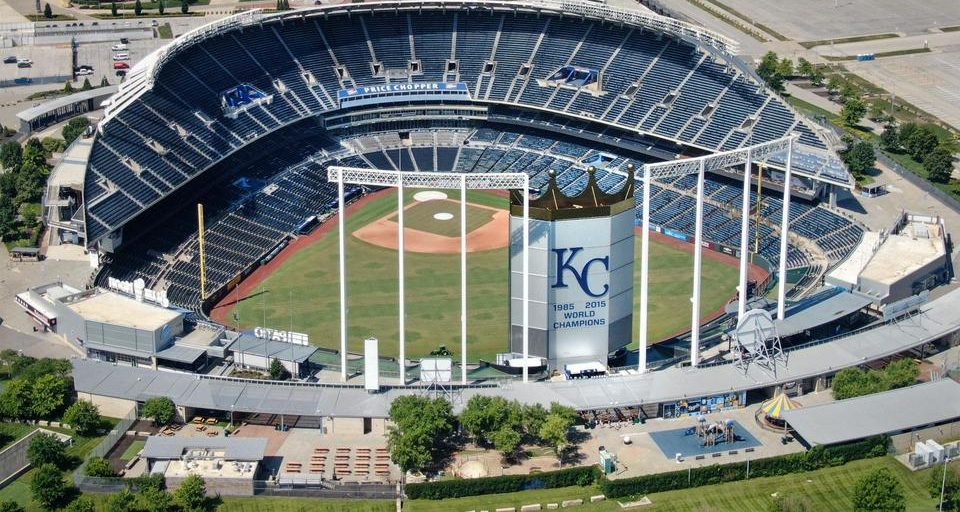
21. KAUFFMAN STADIUM
HOME TEAM: KANSAS CITY ROYALS
LOCATION: KANSAS CITY, MISSOURI
OPEN SINCE: 1973
ORDER VISITED: 28 (04/01/26)
GAMES I HAVE SEEN THERE: 1 (1-0 HOME TEAM RECORD)
Although it might be overlooked or even forgotten by the average fan of an MLB team, Kauffman Stadium is one of the most unique ballparks in the league. It’s the fifth-oldest active venue in MLB and has the sixth-lowest capacity, at just about 38,000. Based on its age and design, it seems like a relic of a bygone era. But actually, it’s the exact opposite of what a ballpark built in its era would look like. As far as I can tell, it’s also the only MLB ballpark originally intended for a team that would never play in it. That original team was the Kansas City Athletics, who signed up to play in the ballpark in 1967, as their lease at Municipal Stadium was about to expire. But before shovels could even be put in the ground, owner Charley Finley — who just a few years earlier changed the Athletics’ colors from red and blue to green and yellow — moved his team to Oakland and its brand new Coliseum. But Kansas City wouldn’t be without a team for long. Under pressure from Missouri senator Stuart Symington, who threatened a legal challenge to MLB’s antitrust exemption and reserve clause, a bid backed by pharmaceutical magnate Ewing Kauffman was picked to be one of four new expansion spots. The debut of that team, the Kansas City Royals, was later pushed up from 1971 to 1969, a decision which indirectly led to the creation of the Milwaukee Brewers. After four seasons at Municipal Stadium, the Royals moved into their new home in 1973.
Royals Stadium, renamed after the team’s original owner 20 years later, was built smack dab in the middle of the era of cookie cutter concrete donut multipurpose stadiums. In fact, it’s also one of just two current ballparks built in that era (and the only one built from 1966-91) to neither be built nor converted into a multipurpose venue. On the contrary, it was part of the Truman Sports Complex (named after former president Harry S. Truman), which also includes Arrowhead Stadium, home of the NFL’s Kansas City Chiefs and a venue which I, a Las Vegas Raiders fan, enjoyed flipping off as I walked up to Kauffman Stadium. The two ballparks not only share a vast parking lot, but they also almost shared a roof as well. The original design of the Truman Sports Complex featured an enormous roof that would roll between the two venues to cover one as needed. It would’ve been the first retractable roof in sports history, but the decision to separate the two venues instead of combining them into one paid off in the end, as no multipurpose venues currently exist in either MLB or the NFL. But while their lifelines were extended, it wasn’t done so indefinitely (more on that later).
While Kauffman Stadium bucked the biggest architectural trend of its era, it was still a product of its time. It was originally built with AstroTurf, though it has since switched to natural grass. As for the building itself, tt may not be a concrete donut, but there’s definitely a lot of concrete in its stands. It has a pair of classic spiral walkways and a smooth concrete facade. Its seats and built and laid out just like a multipurpose stadium, though because Kauffman Stadium is just a home for baseball the seats actually face the proper direction. Looking at it from the main entrance, it looks like a generic concrete stadium. In contract, the other side is almost entirely different. There are only a handful of rows of seats in the outfield, with the bullpens almost taking up as much space. The concourse stretches around the back just like the outfield walls, which are nearly a perfect uninterrupted arc (unusual in MLB). It has floated from being a hitter’s park to being somewhere in the middle, with its dimensions giving Kauffman Stadium a relatively deep center field and a relatively short left and right field. Its light fixtures and overall design also harken back to the past, with a Google style design more commonly affiliated with old school Southern California buildings.
Speaking of deep center, that’s where we find Kauffman Stadium’s two most unique design features. The first is the giant scoreboard in the shape of the Royals logo, complete with a gold crown on top. Whereas most scoreboards are oriented landscape style, Kauffman Stadium’s opts for a taller, portrait position. It’s been that way since the opening and used to feature an old school analog display, with a separate big screen behind left field. New renovations, finished in 2009, completely redesigned the area behind the outfield wall, including the scoreboard, which was upgraded to a fully HD display. It may seem unusual, but it’s impressive in person and quite cool to look at. That renovation also included work on the ballpark’s other famous feature: the Water Spectacular. The largest privately owned fountain in the U.S., the Water Spectacular is a two-tier, 322-foot fountain behind right center field that holds about 1.5M gallons and shoots water up to 70 feet in the air. The fountain puts on a colorful show before and after games, as well as in between innings or after a Royals home run. The fountain is certainly a fun and unique feature for a MLB ballpark, if a little bit overhyped by the Royals faithful (boy, do they love their fountains in Kansas City).
Altogether, the scoreboard and fountain and old school light fixtures and overall lack of other super tall structures behind center field make for a unique look. The same can be said for the panorama, which shows Interstate 70 (the George Brett Super Highway) surrounded by a lot of trees. But that’s not all the renovation did to the outfield concourse. While it doesn’t look like much, a lot goes on that the average fan might not know about. That includes the Royals Hall of Fame, which was established in 1986 but converted into a multi-level complex behind left field. It’s a beautiful, colorful, well done tribute to the team’s past, with plenty of in-depth exhibits including lockers for every player whose number has been retired by the Royals. Those three players also have statues located behind right field, while a fourth statue — depicting Kauffman and his wife, Muriel — sits near the Royals Hall of Fame behind left field.
There are a few other activities available for fans who don’t want to actually watch baseball. The Royals offer what they call the Outfield Experience — a set of activities and offerings catered to children. Those include a miniature baseball diamond, interactive pitcher’s mound and batting challenge, pop-a-shot, base running course, mini-golf and playground. Kauffman Stadium is also one of just two MLB ballparks that have a carousel, with this one featuring a rideable version of the Royals’ mascot, Sluggerrr (spelled correctly), that looks like a sleep paralysis demon. Overall, it seems like a fun place to take the little ones should they get bored during a game. I would’ve spent more time observing the area, but I would’ve started to look like a creep. Plus, it started raining, and the area is not covered. Speaking of wetting one’s whistle, conveniently for parents, not only are there food stands nearby, but places that serve alcohol as well.
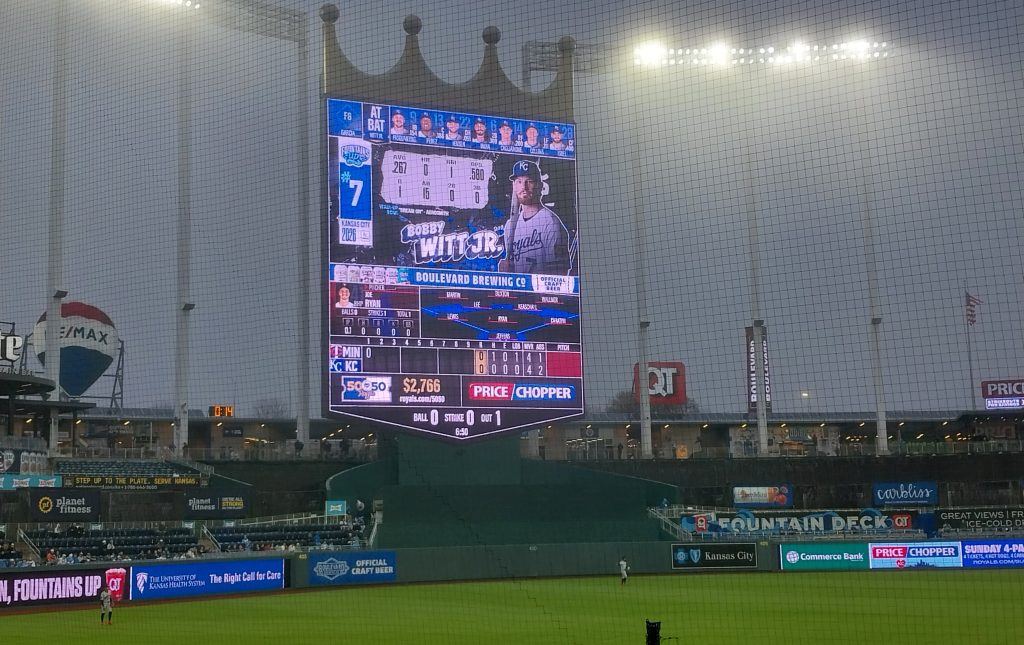
When it comes to the food you can get inside Kauffman Stadium, it’s best to stick to the basics. That’s not just because the more creative offerings tend to either miss the mark or simply whelm, but because the basics are quite good. Hot dogs and sausages are done well, as are the burgers and chicken. Since you’re in Kansas City, you might as well try what the area is famous for: barbeque. Joe’s KC Bar-B-Que is an iconic restaurant in the city and it has a spot at Kauffman Stadium. Everything there is probably delicious (I can only testify for the pulled pork sandwich). There’s also the famous Z-man sandwich — brisket topped with melted provolone, onion rings, and BBQ sauce. But that might not be the most famous sandwich at the ballpark. It has to compete with Vinnie’s Italian Beef Pasqwich — essentially an Italian beef sandwich with bacon and hash browns — named after Royals first baseman Vinnie Pasquantino. The Royals also have an official craft beer partner, meaning their beer selection is top notch. The Craft and Draft sections serves plenty of those, as well as decent pizza.
While beer is relatively cheap at Kauffman Stadium compared to most other MLB ballparks, that doesn’t stop fans from tailgating in the parking lot before games. Tailgating may be more of a football tradition, but it can develop at baseball games as well, especially when the ballpark shares a parking lot with a football stadium. Actually, they share more than just one. Both Kauffman Stadium and its football counterpart sit amid a sea of no fewer than ten parking lots, another throwback to a different time (albeit an unwanted one). While most aren’t exactly looking for entertainment there, the parking lots are dull, just more concrete amid patches of grass. This contributes to an overall boring and lacking atmosphere outside of the ballpark, complete with a random line of large boulders/rocks that serve as a facsimile of a barrier once you get into the sidewalk immediately surrounding Kauffman Stadium. The baseball had better be entertaining, because there is almost nothing else in the immediate area apart from like a pizza shop, a gas station, a Taco Bell, and a couple of mediocre hotels.
It would hardly surprise you, then, to learn that pretty much the only way to get to and from Kauffman Stadium is by car. The ballpark is located east of Downtown Kansas City, southeast of the connector between Interstate 70 and Interstate 435. It’s about eight miles away (a little more than a ten-minute drive) from Downtown Kansas City proper and there are no convenient routes to get there apart from taking I-70. The only public transportation that comes close is a Kansas City Area Transportation Authority (KCATA) bus route that drops you off at the edge of the parking lot, and the only people able to walk to games are those who live nearby and psychopaths. For the rest of us, it’s either drive yourself or use a rideshare app. This means a heap of traffic, especially for major matchups or playoff games (I can only imagine how insane traffic can get for Chiefs games). In the modern era of downtown and more centralized sporting venues, Kauffman Stadiun’s location stands out for all the wrong reasons.
That location is far from Kauffman Stadium’s only weakness. While there are certain parts of its era that are charming and unique, it is in fact from a long time ago. Kauffman Stadium has been showing its age, in spite of the renovations that did a lot to bring it into the modern era. What sets it apart doesn’t exactly sit among some of the most iconic aspects of ballparks across MLB, and its detractions are among some of the worst features a ballpark can have. It’s far from a bad place to catch a ballgame and I’d be proud of it if I were a Royals fan. But I also wouldn’t be blind to its shortcomings, the least of which being its horrible location. I can’t imagine wanting to sit in that much traffic to watch a team that has tallied two winning seasons in the past decade in an overall slightly below average ballpark. I’m far from the only one pointing out Kauffman Stadium’s faults — the Royals themselves have been aware of this as well, which is why the ballpark may in fact be in the final few years of its time in the show.
For several years now, the Royals have been exploring opportunities to build a new home ballpark. Those plans have hit various roadblocks, with voters rejecting a 2024 ballot measure that would’ve funded a new venue. Then, this past April, just weeks after I visited Kauffman Stadium for the first time, the Royals and Hallmark Cards unveiled a partnership to build a new ballpark at the current site of Hallmark’s corporate headquarters in the Crown Center area of Kansas City. It’s smack in the middle of downtown — a stone’s throw away from the likes of Union Station and the World War I Museum — and includes 85 acres of development to build a new ballpark district. Renderings for the project have been revealed, showing a futuristic-looking version of Kauffman Stadium complete with a massive fountain behind center field (not sure how that would work as a batter’s eye). Right now, it seems like everything is clear to move forward. It’s expected to break ground next year and be ready by 2030. I’ve learned to not take anything as a certainty until not only shovels are in the ground, but the first pitch at the new ballpark is thrown. But especially given the Chiefs leaving Arrowhead Stadium for a new home in Kansas, it seems like only a matter of time before the Royals vacate the Truman Sports Complex as well.
Of course, when that happens, Kauffman Stadium will join Oakland Coliseum and (probably) Sutter Health Park among the ranks of former MLB ballparks and highlights of my journey that have been relegated to the past. Among all of the plans for a future Royals ballpark, nothing has been said of what could happen to Kauffman Stadium, whether it would continue to stand or be torn down. If it’s the latter, then it would be a sad move. For all of the negatives said about it, Kauffman Stadium is a unique part of baseball and sports of yesteryear that lives on today. It’s one of the last of a dying breed of ballpark, and it’s unique charm can’t be replicated by whatever’s going to follow it. Kauffman Stadium is a pleasant place to catch a ball game, one whose stands should be packed while it’s still around, so more people will be able to properly miss it when it’s gone. Will that time indeed come around in 2030, or will the ever-evolving battle between sports and regional politics somehow keep Kauffman Stadium alive a little bit longer? Whenever Kauffman Stadium does become a thing of the past, whatever venue that replaces it will have its work cut out for it — not just to replace that classic ballpark, but to compete against the rest.


Leave a Reply