Our ballpark journey is now in the final stretch. After more than 20 venues from across the country (and Canada), we’re finally in the single-digit part of the rankings. From now on, it’s all killer, no filler. These are all excellent ballparks any team would be proud to play in. But there is enough of a difference between some of these ballparks to have three different tiers, starting with a quick but necessary one.
A+ TIER
The two ballparks in this tier are absolutely fantastic places to watch a baseball game. They have few weaknesses and a long list of tremendous strengths. I have also seen multiple games at these ballparks, which wasn’t originally the plan. But they were so good that I made up my mind to come back for more. That being said, for as amazing as both of these ballparks are, they’re missing something that’s keeping them from being in the upper-most echelon of MLB ballparks. I’m not quite sure what that is, and given that I’m writing all of this in order, I hope to define it in their respective entries. This shouldn’t take away from their overall value, which is of course great. I would more than happily return to these ballparks and the cities they’re in to catch another game in the future. They’re also both a lot alike and incredibly different at the same time. Without further delay, let’s begin Part 3.
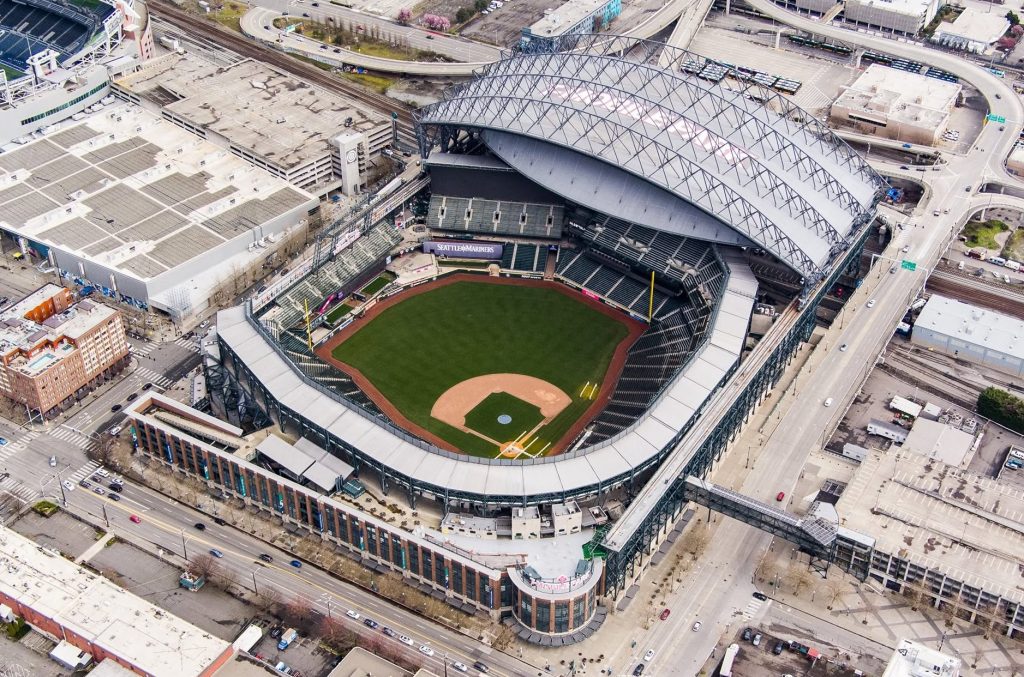
9. T-MOBILE PARK
HOME TEAM: SEATTLE MARINERS
LOCATION: SEATTLE, WASHINGTON
OPEN SINCE: 1999
ORDER VISITED: 3 (07/07/17)
GAMES I HAVE SEEN THERE: 3 (2-1 HOME TEAM RECORD)
Major League Baseball has not been kind to Seattle. It’s more than 600 miles away from the nearest MLB team (easily the longest such distance for any team) and the furthest road trip for more than a third of the league. This isolation is part of why MLB didn’t expand into the Pacific Northwest until 1969, when the Seattle Pilots were brought into the league prematurely due to the Kansas City Royals being added in (following pressure from Missouri lawmakers), had one awful season, then got bought by Bud Selig and became the Milwaukee Brewers. The city of Seattle, King County, and the state of Washington had to sue MLB in order to get another team, building a new venue — the Kingdome — before the Seattle Mariners were even announced. The Kingdome also served as the home of the NFL’s Seattle Seahawks, NBA’s Seattle Supersonics, and NASL’s Seattle Sounders. But after the latter two left for new homes, revenue dropped dramatically. Then, as cookie cutter concrete donut multipurpose venues fell out of favor in the 1990’s, an incident in 1994 saw four 26-pound acoustic ceiling tiles fall into the seating era. While the Kingdome was closed at the time, the incident led to the Mariners being forced to the road and calls for a new home for both the Mariners and Seahawks reached a fever pitch.
While the Seahawks had their own saga that eventually led to what is now Lumen Field being built, the Mariners had to literally fight for their existence. Having never even made the playoffs, the Mariners had generated nothing but apathy and a public vote to fund a new ballpark project failed. But then the Mariners went on a run and found themselves in contention for the American League West title, creating a strong fan buzz for the first time. The Mariners not only won the division and made the playoffs, but defeated the New York Yankees in a legendary American League Division Series. While the Mariners ultimately fell in the American League Championship Series, they had garnered enough fan support that the Washington state legislature approved a separate funding package to build a replacement ballpark for the Kingdome. The Mariners played their final months in the Kingdome in 1999, then, after the All-Star Game, moved into their current home of Safeco Field (since renamed T-Mobile Park).
The facade of T-Mobile Park is made out of a nice mix of brick, glass and steel, designed to mimic the buildings in Seattle’s Pioneer Square. However, the vast majority of that steel — and the attention — goes to what sists on top of the facade. Like the Kingdome before it, T-Mobile Park has a roof. However, this one is retractable, with the 22M-pound structure sliding east on wheels and rails to expose the field below. When open, most of the roof sits above the BNSF Railway tracks that border the ballpark to the east, with the roof helping to amplify echoes of train whistles. A sliver of its left-most side hovers above the right field bleachers, with the right side of the ballpark’s panorama being blocked by the bleachers and roof, as well as the videoboard (among the largest in MLB). T-Mobile Park’s designers have said they took inspiration from American Family Field’s roof. However, T-Mobile Park’s roof actually looks good, with its design fitting in well with that of the seaport area to the west of the ballpark. That being said, it’s also the least-used retractable roof in the league, with an average of less than a quarter of Mariners home games each season (by far the fewest among roofs at similar ballparks). This is partially due to Seattle’s infamous rainy season not actually taking place during the vast majority of the regular season.
This lack of usage has caused some to wonder why the ballpark even has a roof. These arguments are backed by the fact that due to high steel costs at the time of T-Mobile Park’s construction, the size of the roof was reduced by about a quarter of its original design. While the roof it still large enough to cover all of T-Mobile Park’s nearly 48,000 seats (the third-highest capacity in MLB), wind and cold temperatures are still able to sneak in and impact play, even with the roof closed. As a result of the chilly weather and humid air (Elliott Bay is just a stone’s throw away), T-Mobile Park is arguably the most-pitcher friendly ballpark in MLB (along with Globe Life Field and another ballpark we’ll get to soon), despite its relatively average dimensions (which are moved in a bit from where they were at first). It’s a sharp reversal from the Kingdome, which as a dome made things easier for hitters. In fact, this drastic switch was part of the reason why Ken Griffey Jr. (who had played in the Kingdome for his entire career up until T-Mobile Park debuted) ended up leaving to sign with the Cincinnati Reds the following offseason. The fact that T-Mobile Park is referred to as “the house that Griffey built” is all the more ironic because of this.
This isn’t to say Griffey doesn’t have a place at T-Mobile Park. In addition to his number being retired, Griffey was the first former Mariner to get a statue outside the ballpark, followed by Edgar Martinez and Ichiro Suzuki. There’s a fourth statue in the ballpark, and it came several years before Griffey’s. Located in the main center field concourse, it depicts legendary Mariners broadcaster Dave Niehaus sitting at his desk, with his notes from that deciding 1995 ALDC Game 5 and his famous catchphrase, “Get out the rye brad and mustard, grandma, it’s grand salami time!” embedded in bronze. The desk is extended to allow fans to sit next to the statue and take pictures with it. Tributes to Mariners history don’t stop there. On the other side of the ballpark in the third base side concourse lies the Seattle Mariners Hall of Fame, which is not only well-put together, but also includes the Baseball Museum of the Pacific Northwest. Meanwhile, there’s another smaller tribute — an engraved statue of Fred Hutchinson (a pitcher and local hero who died of cancer in 1964) on every aisle seat.
The concourse itself is one of the widest in MLB — up to 40 feet in some places. Walking around it, not only do you get an pretty much unobstructed view of the action on the field, but you also get a taste of Seattle culture. T-Mobile Park is littered with various pieces from local artists, and this starts inside the main rotunda. On the ceiling is The Tempest, a chandelier made up of 1,000 resin baseball bats arranged in a singing motion, cascading down. On the floor is a 27-foot compass rose mosaic depicting several famous moments in baseball history, along with signatures of every player on the Mariners roster when they moved into T-Mobile Park. “Quilts” depicting every MLB team logo made out of recycled metal — including license plates from every team’s home state (as well as the District of Columbia and Ontario province) — can also be found hung up throughout the ballpark. There are several more pieces in an around the ballpark, with my favorite being The Defining Moment — a mural depicting Griffey scoring the winning run after “The Double” in Game 5 of the 1995 ALCS.
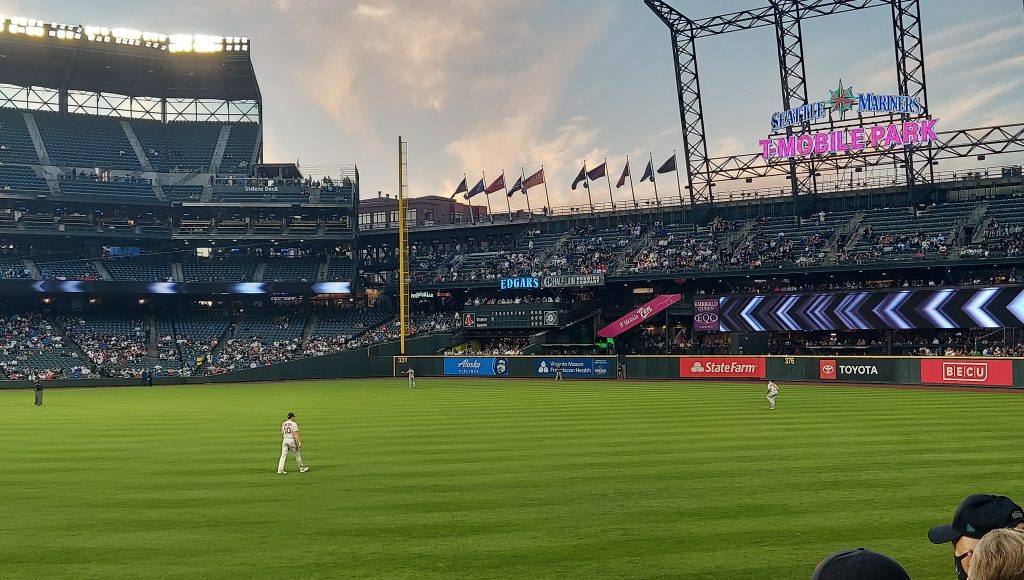
Also along the concourse is a multitude of food options. T-Mobile Park has one of the best menus in all of MLB, with an emphasis on quality, diversity, and local fare. Along with a few chain restaurants, local spots like Ivar’s, Kidd Valley, and Salt & Straw has stalls in the ballpark. The local focus also applies to beer, with Rainier, Bale Breaker, and pFriem all offering up tasty brews. Overall, the menu at T-Mobile Park does both ballpark classics and unique items quite well. From onigiri and ube Rice Krispie Treats to birria burritos, curry katsu, ribs, and pizza, you’ll be able to find something you’d enjoy. You’ve also probably heard of the actually floatable ferry boat that doubles as a holder for things like crab nachos and fish and chips (plus dip). But the original viral menu item at T-Mobile Park is toasted grasshoppers, also known as chapulines. I’ve had them and while I don’t mind the taste of grasshopper, the spice they use is a bit overpowering. I’d be remiss not to mention the Dungeness crab sandwich, which is my pick for the tastiest item and should be my pick for favorite ballpark food in MLB. However, that honor goes to another crab sandwich we’ll get to later.
There are plenty of places for fans to enjoy that grub, including one of the more acclaimed gathering spots in MLB. That would be The ‘Pen — a standing-room area towards the bottom of the center field concourse adjacent to the bullpens, letting fans get an incredible view of relief pitchers warming up. The area also has several restaurants, including Edgar’s Cantina, and is open before the game, with fans taking advantage of happy hour deals. Up and to the right — in the second level right behind right field — is the Hit it Here Cafe, a sit-down restaurant with staggered seating, allowing fans to watch the game unobstructed behind panes of glass. On the main concourse behind center field — near the Dave Niehaus statue — is the Moose Den, the “home of the team’s mascot, Mariner Moose, which also includes a kids play area. As for the left field concourse, there are also several options to choose from, such as the Bullpen Market, which includes an open pit barbeque. But perhaps the most notable feature is the view, with the upper deck concourse along the left field line offering up a spectacular look at Downtown Seattle, the shipping yard, and Puget Sound.
Of course, T-Mobile Park offers something for fans with a bit more cash to spend. There are plenty of luxury suites along the terrace level, which are a bit more laid back than others (but still pretty darn nice), with a distinct Pacific Northwest color and feel. The Emerald City and Home Plate Suites offer the best location and amenities. The Terrace Club on the first base side offers a two-tiered private setting, complete with a bar and other offerings. Behind home plate is the Press Club, which is infinitely better than the Press Club most of us in Sacramento are used to. Located just below T-Mobile Park’s actual press box, the Press Club offers arguably the vest views in the ballpark, along with indoor/outdoor seating and an upscale menu, including high-grade sushi and seafood. For fans who want to spend a bit more, but can’t afford any of the above in this paragraph, there’s the All-Star Club, which still offers a buffet, plush seating, and VIP parking.
T-Mobile Park was build in Seattle’s SoDo neighborhood, which originally stood for “south of the (King)dome” but after its demolition has been redubbed “south of downtown.” Like T-Mobile Park itself, the surrounding area is a mix of old fashioned buildings and modern businesses. Before T-Mobile Park’s construction (as well as that of Lumen Field), the area was mainly industrial, with a few bars scattered among the seaport and other businesses. But the addition of these venues has completely revitalized the area. There are plenty of bars and restaurants along 1st Avenue, which runs directly west of the ballpark, not to mention a hotel and the upgraded WAMU Theater in between the two venues. 1st Avenue is extremely walkable allows for a straight shot into downtown not too far away. This doubles as an easy way for drivers to get to the ballpark, with plenty of parking nearby as well. T-Mobile Park is also located right by the start/end of Interstate 90 — near the connector with Interstate 5 — and just east of Highway 99 (no, not that one). It’s also good for public transport, with Seattle’s 1 Line and Sounder rail systems, as well as Amtrak, having a station just to the east of the ballpark. If that’s not all, a Greyhound bus station is also within walking distance. The ballpark’s position also lends itself to a lovely panorama of Downtown Seattle (the left half, anyway), which also includes Lumen Field.
So, what prevents T-Mobile Park — an objectively excellent all-around ballpark — from creeping up into the top tier of ballparks? Ultimately, for as cliche as it may seem, the roof provides a ceiling for how good a ballpark can it be. Granted, it’s my highest-rated ballpark with a retractable roof and it actually blends in well with the surrounding area in both aesthetically and practically terms. But a necessary evil is still evil, and not only does T-Mobile Park’s roof block whatever was left of the right half of the panorama, but it doesn’t even fully do its job, letting temperature and wind impact the game. T-Mobile Park has also had few chances to show just how good of a ballpark it can be at full power. The Mariners have gone on a 21-year postseason drought during their time at T-Mobile Park, and most of that time was filled with a mix of mediocrity and heartbreak. As such, the overall aura and prestige of T-Mobile Park isn’t as high as it should be or deserves to be. Granted, this is all compared to the upper crust of MLB ballparks, as even with these weaknesses T-Mobile Park is still easily better than two-thirds of MLB ballparks. But these nitpicks get more crucial the closer we get to the top of the list.
During its more than a quarter-century in existence, T-Mobile Park has been one of the better ballparks in the league, and it hasn’t rested on its laurels. Just this year, the videoboard received a huge upgrade, with the Mariners partnering with Seattle-based Amazon to make it the largest Fire TV in the world. This isn’t the first time Amazon has helped its Seattle brother, as in 2022 T-Mobile Park debuted the Walk-Off Market — MLB’s first cashier-less store. It’s another way the ballpark continues to evolve and integrate new into the old. It’s a way that T-Mobile Park — much like the Pacific Northwest as a whole — continues to be a hidden gem (or at least greatly overlooked) in the wider baseball world. Who knows, maybe the Mariners can finally be consistently good and help shine a spotlight on one of the better ballparks in the league. But even if it’s another two decades or longer, T-Mobile Park is in prime position to remain high on the ballpark rankings as a fantastic place to enjoy a baseball game, even if it can get a bit chilly.
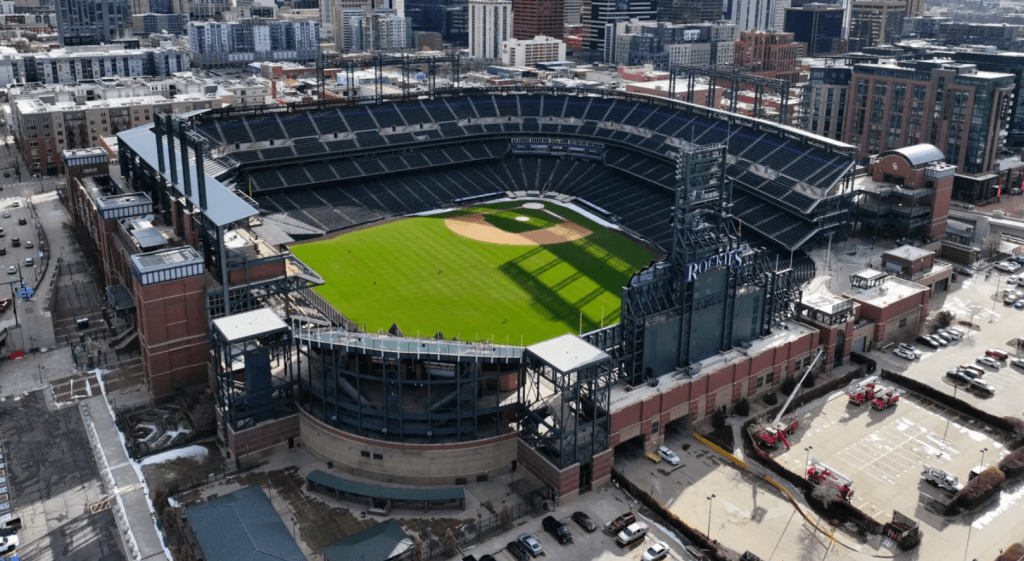
8. COORS FIELD
HOME TEAM: COLORADO ROCKIES
LOCATION: DENVER, COLORADO
OPEN SINCE: 1995
ORDER VISITED: 20 (07/22/24)
GAMES I HAVE SEEN THERE: 3 (2-1 HOME TEAM RECORD)
Here’s another fun ballpark fact you may not know: Coors Field is the third-oldest ballpark in the National League. Debuting in 1995, it was also the first new baseball-specific venue built in the NL since Dodger Stadium. Its construction was shaped in part by the Denver community, and it has since transformed the surrounding area. It also helps explain why the Colorado Rockies’ mascot, Dinger, is a triceratops — small dinosaur fossils were discovered during the construction process. Coors Field was the first in a new wave of venues for the city’s major sprots teams, with Ball Arena (home of the NBA’s Denver Nuggets and NHL’s Colorado Avalanche) and Empower Field at Mile High (home of the NFL’s Denver Broncos) following in a six-year span. But the Rockies arrived first, playing at Mile High Stadium (Empower Field’s predecessor) for their first two years. This would allow fans to arrive in such large droves that Coors Field’s capacity — originally planned to be just under 44,000 — was expanded to just under 47,000 (the fourth-largest in MLB), with new seats added in the right field upper deck. But for all of the interesting parts of its creation and memories made in its life, the talk surrounding Coors Field has centered on exactly one aspect.
Since it’s debut, Coors Field has been without a shadow of a doubt the most hitter-friendly ballpark in MLB. This is due to the air in Denver being thinner due to the city’s altitude of a mile (5,280 feet) above sea level — a row of purple seats in Coors Field marks the exact mile high point. For comparison, the MLB city with the next-highest altitude is Phoenix, at just over 1,000 feet. With less air resistance, balls fly further and harder when hit, with Coors Field quickly developing a reputation as a launch pad. Within its first five seasons, Coors Field twice broke the record for most home runs hit at a single MLB ballpark in a season twice, setting the current record of 303 in 1999 (the previous record was 248). Though home run totals have fallen off since then, Coors Field is still easily the most hitter-friendly park in the lead, at or near the top of every kind of non-home run hit total. ironically, that’s because of a feature designed to help prevent home runs. Coors Field has the greatest distance between home plate and the center field wall (415 feet) in MLB and both the second-longest distance between home and the right and left field walls, meaning that at a combined 1,112 feet, Coors Field has the greatest total home-outfield wall distance, and therefore the largest outfield. The Rockies even installed humidors and raised fence heights. Nothing has worked, or will likely ever work.
All of this has impacted the way the Rockies play baseball. Pitchers have dreaded signing with the team, fearful of their ERAs ballooning during their time in Denver. Hitters have done well there over time, but their stats have an invisible asterisk next to them labeled “Coors,” and even Hall of Famers like Larry Walker and Todd Helton have had their waits for enshrinement lengthened due to this bias. The Rockies are also historically abysmal when playing at normal altitude, and this lack of adjustment factors into the worst lifetime winning percentage of any MLB team. This reputation has spread to Coors Field itself, which has become the symbol and scapegoat of thin air baseball. That’s a shame, because when in other sports, other aspects of higher altitude sports (greater vulnerability to altitude sickness, quicker exhaustion, longer recovery) are simply thought of as home field advantages for Denver’s other sports teams. If anything, you could argue the Rockies should have a seismic home field advantage, and only don’t because they have been so poorly run in their history. Also, the same people who complain about Coors Field and lament its high-altitude impact as bad for baseball are more often than not also those who wax poetic about flag poles and hills being in play at one point. Quite frankly, shove it and enjoy the show.
The facade of Coors Field is made up largely of red brick, with steel and glass woven in throughout. The bricks also extend to the plaza, which features designs fans can sometimes miss when they walk over them. The design overall evokes those of ballparks of the past, as does the hand-operated out-of-town scoreboard embedded in the right field wall. Behind center field lies arguably the most unique non-baseball related feature of Coors Field. Dubbed the “Water Feature,” it’s a collection of trees, plants, and rocks native to Colorado, lined with waterfalls, fountains, and a pond. It’s a lovely natural feature straight out of the actual Rockies, and members of the bullpen next to it also keep a miniature garden in the area. What isn’t lovely (or at least, in my opinion, aesthetically pleasing) is the “Rockpile” — a section of seats deep behind center field which were tacked on at the last minute to increase capacity. Not only is it a rare eyesore in a ballpark as nice as Coors Field, but the very last row of seats is 600 feet away from home plate, the furthest such distance from home of any seats in a MLB ballpark.
Also behind center field is a unique way to cover Coors Field’s only blind spot. With a completely circular concourse, fans in the first level can still catch the on-field action no matter where they walk. That is, with one exception in the center field. However, this stretch is covered by a 140-foot mural called The West, The Worker, and The Ball Field, which depicts (in chronological order) the history of the neighborhood where Coors Field is located: LoDo (Lower Downtown). Another piece — an archway called Evolution of the Ball — used to stand outside the left field gate. However, it was removed during remodeling and (as of this writing) has yet to be reinstalled. In front of the home plate entrance at the southern end of the ballpark stands what is one of the few statues of someone not related to a team at an MLB ballpark. Called The Player, it’s a large version of the figure on the now-defunct Branch Rickey Award, which was presented by the Rotary Club of Denver. However, statues of actual Rockies players — Walker and Helton, specifically — are set to be unveiled this year.
There’s another piece of art called Bottom of the Ninth: a series of colorful neon signs depicting a runner sliding into home, where the opposing catcher waits to make the tag and the umpire watches on. This piece is located on the outside of the Sandlot Brewery, located at the eastern corner of Coors Field. It’s the first microbrewery to be inside a MLB ballpark, but that’s not even its main claim to fame. It was inside Sandlot Brewery that brewer Keith Villa first created Bellyside Belgian White, which would eventually become Blue Moon. If that’s not enough for you, the Coors Light Silver Bullet Bar offers dozens of taps of Molson Coors products, which include Blue Moon. That Bar is just one of the offerings at the Rooftop — a huge multi-level area on top of the right field side of the upper deck that also includes restaurants, patios, and standing rails that help give fans quite the view of both the city and sunsets over the Denver area.
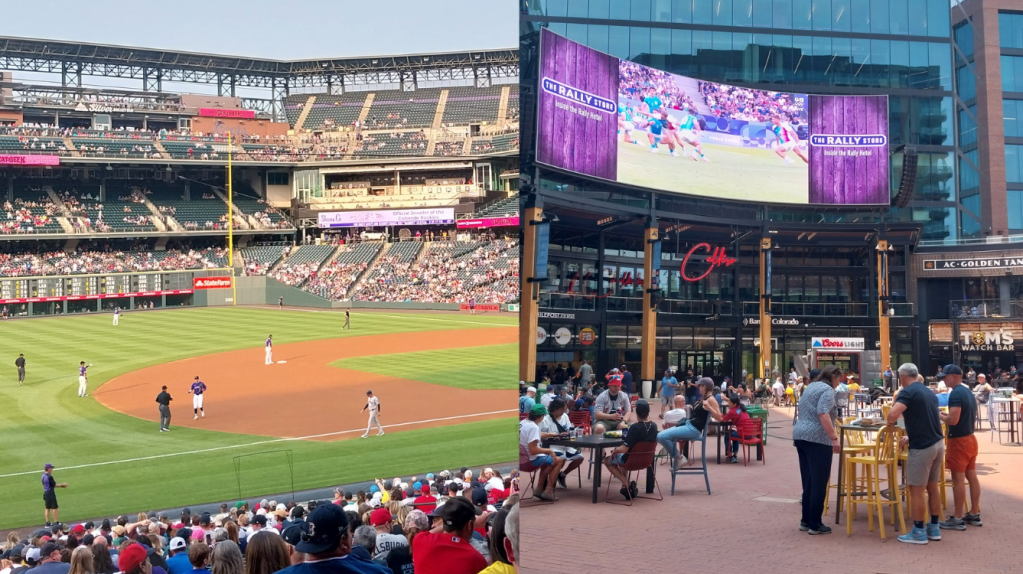
While the drink offerings steal the headlines at Coors Field — due to both the naming rights sponsor and Denver’s fantastic craft brewing scene — the food offerings aren’t exactly lacking, either. The menu at Coors Field is extremely solid all around, hitting the basics well. But Denver is a bit weird, an attitude reflected in even this part of the menu, such as the Glizzilla — a two foot, one pound hot dog — pizza donuts and boozy ice cream. Then we have walking nachos — meet and cheese served with crushed Doritos served inside the bag — and strawberry and brownie/cheesecake kabobs. Both are awesome and the latter is one of my favorites. I have seen it at other ballparks since, so I don’t know if it’s a Coors Field original or not. But it’s the first place where I saw it. There are various items around the ballpark featuring green chili, a Colorado staple. Try what you can get, because green chili is tasty. Sadly, Coors Field no longer features Biker Jim’s, which sold hot dogs made from things like ostrich, boar, rattlesnake, rabbit, veal, and elk. Don’t worry though, you can still buy Rocky Mountain oysters at Coors Field. Be warned though: Rocky Mountain oysters are deep fried bull testicles. No, I was not nuts enough to try them, though once I saw it on the menu I knew I would have to write the word “testicles” in my Coors Field review.
Whether or not you enjoy some balls while watching balls and strikes, there are other parts of Coors Field to enjoy if you have enough (family) jewels to pay for it. The Warning Track Party Room lies below the right field bleachers and allows fans to view the action through the right field wall/fence at field level. The Mountain Ranch Club in the right field corner may not have as good views, but offers a six-tier fine dining experience. For arguably the best mix of views and amenities in the ballpark, you’ll have to shell out for the PNC Press Club, located right next to the actual Coors Field press box behind home plate. I say arguably because also right behind home plate lies the most expensive seating area in Coors Field: the Toyota Clubhouse. In addition to the killer seats, the area offers luxury food, drinks, and other amenities, while also featuring a new mural showcasing Rockies history (one of the few homages to Rockies history inside the ballpark).
When it comes to the offerings around the ballpark, you have your pick of the litter. Perhaps no other ballpark in MLB has done a better job of revitalizing the surrounding area than Coors Field, with the once-largely run down and lacking LoDo area becoming a thriving, business-filled region. In fact, there are so many bars and restaurants offering everything from classic pub fare to unique items (like empanadas and pozole) over the span of multiple blocks surrounding Coors Field in almost every direction. While there aren’t as many hotels in the immediate vicinity as you’d think, the area is so walkable (or, in my case, e-scooterable) that you can easily get to the neighboring River North (RiNo) Art District to the north, which includes plenty of hotels and other bars/restaurants (including the main Blue Moon brewery). While you can easily walk to and from Coors Field, its location — just north of the 20th Street exit to the southeast of Interstate 25 — makes it easy to get to by car as well. A series of parking lots and an EV charging lot nearby help as well. Coors Field is also located within a short walk from Denver’s Union Station, not only a historic landmark but also a train station. That provides a convenient station for the Regional Transportation District (RTD)’s rail (A, B, G, and N Lines) and light rail (E and W Lines) services.
There are two other places near Coors Field worth talking about. The first is Denver’s version of St. Louis’ Ballpark Village: McGregor Square. Located directly southwest from Coors Field across from 20th Street, McGregor Square is a one block-sized mixed-use development featuring hotels, restaurants, and bars centered around a large plaza. It features a range of diverse eating and drinking options and serves as a popular gathering area for fans before, during, and after games. Opened in 2021, while it may lack the historic tenure, team-based amenities, and comparative intimacy of Ballpark Village, McGregor Square makes up for it in terms of quality, scale, and convenience. One other pre-game activity (or, if you want, a non-game day activity) lies a short walk away from McGregor Square, directly south of Coors Field. The National Ballpark Museum offers a series of exhibits of ballparks of the past and present, featuring several seats and other artifacts from venues of old. I would give a proper review, but I somehow failed to spot it during my Denver trip planning and I kick myself for missing it.
Now, it’s time to answer that same question from the previous entry: what about Coors Field prevents it from cracking the uppermost tier of MLB ballparks? Well, for many, the answer is nothing. Others rank Coors Field even higher — in the Top 5 for some — and I totally get it. This ranking is just, like, my opinion, man. But in my opinion, Coors Field both lacks enough aura and looks too much like the classic retro-style ballpark to stand out. Part of that is due to the Rockies being utterly awful, but another part is a bit more subjective. Coors Field feels like someone built a perfect ballpark by following a guide book on how to do so, without making anything unique or quirky that while potentially not being perfect would give it some color. The sheer size of it also somehow makes it feel a bit cavernous, despite it not having a roof. Also, for as good of a ballpark Coors Field is, it’s lacking when it comes to a proper panorama. The part of Denver Coors Field faces isn’t particularly interesting, but the upper right field deck blocks off a lot of whatever view there is. The same goes for the Rockpile, which sticks out as both unnecessary and something that also blocks the view. It’s clear that it was just slapped on at the last minute, and the extra seats aren’t worth it.
Of course, these are all relative nitpicks compared to the major things Coors Field gets right with flying colors. In fact, one could argue that Coors Field is so good, it actually contributes to the Rockies being consistently terrible. Rockies fans have proven incredibly loyal, consistently packing Coors Field, in part because of the wonderful experience it provides. Attendance is seemingly always strong, meaning that unlike other terrible teams — whose fans will refuse to show up to home games due to anger, apathy, protest, or a combination of the three — the Rockies don’t face financial consequences of their lack of on-field success. Sadly, given the history of the Rockies, this is unlikely to change. But at least fans can take solace in their ballpark being the exact opposite of their team: one of the best in MLB. Coors Field is a fantastic ballpark that’s nice to look at, offers plenty of good food, drinks, and views, and is situated in a perfect area to get to, surrounded by plenty of other things to do. It’s a highlight of an already impressive city that I could see myself living in someday, if only the Broncos didn’t exist.
We are now at the peak of MLB ballparks. I consider every one of the following ballparks to be baseball’s crown jewels, venues which are not only a highlight for visitors to their cities as a whole, but are actively reasons why tourists come there in the first place. The thing with this list going forward is that due to the quality of the remaining ballparks, I have to make some tough decisions. While one entry may be a surprise to some, most of you can probably figure out the other six, which are justifiably as high on most if not all other lists. In fact, many will be upset that at least one of those six are not in my Top 5. The problem lies in the numbers: there are six such ballparks on most lists (seven in my case), meaning at least one is getting left off and at least one fan base will be pissed. This shouldn’t be the case. Instead, look at it like this: there are so many great ballparks in MLB that at least one deserving Top 5 ballpark won’t make it there due to pure math. Let’s find out which one (or ones) I’m talking about.
S TIER
This tier consists of three ballparks that are phenomenal baseball venues and truly great representatives of the sport. If you ranked these ballparks higher on your list, I completely understand. These ballparks are objectively incredible on virtually every level and their order ultimately comes down to personal taste. That being said, there are small, sometimes minute details which have these ballparks in the second-to-highest tier, instead of the highest overall. I’ll explain as we get through them, but I don’t want the rest of these entries to serve as critiques. Instead, they should be celebrations of the wonderful venues that can only come from a sport like baseball. Without further stalling, let’s begin our stroll through sports venue royalty.
7. WRIGLEY FIELD
HOME TEAM: CHICAGO CUBS
LOCATION: CHICAGO, ILLINOIS
OPEN SINCE: 1914
ORDER VISITED: 25 (07/20/25)
GAMES I HAVE SEEN THERE: 2 (1-1 HOME TEAM RECORD)
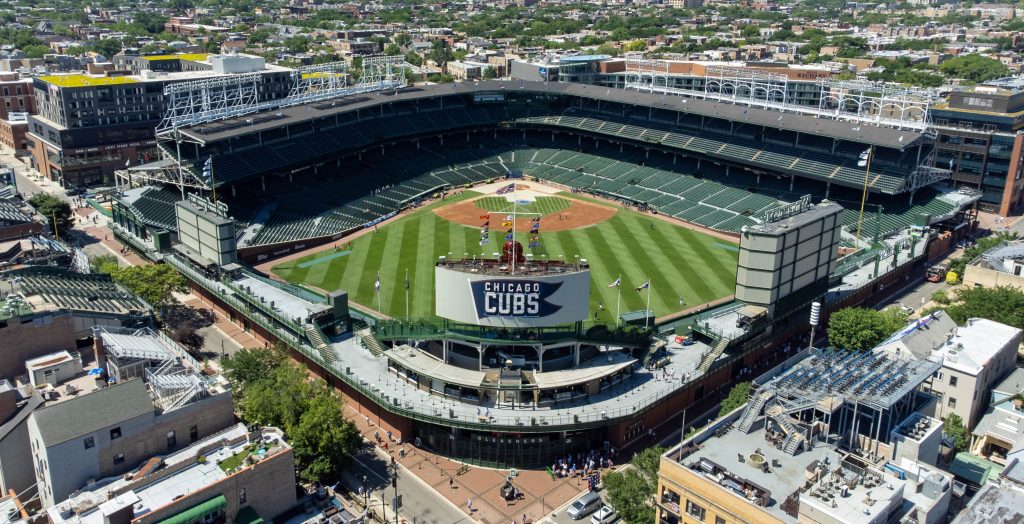
Here’s another fun ballpark fact for you: Wrigley Field is the only current MLB ballpark not originally built for an American League or National League team. It opened in 1914 as the home of the Chicago Whales of the Federal League, which served as a “third major league” from 1913-15. But in 1915, the AL and NL owners bought out half of the Federal League owners, causing the league to fold for good. However, two Federal League owners were allowed to buy struggling AL/NL teams. One of them, Phil Ball, bought the St. Louis Browns (which later became the Baltimore Orioles). The other, Whales owner Charles Weeghman, bought the Chicago Cubs, moving them into his two-year-old ballpark. Weeghman would later sell the Cubs to William Wrigley Jr., who would add his name to that of the ballpark. No one at the time could know that Wrigley Field would endure for over a century, remaining active as the second-oldest MLB ballpark and one of just two “jewel box” ballparks remaining. But Wrigley Field has become far much more than that, and exists as an iconic, treasured piece of sports history.
First off, what exactly is a jewel box ballpark? These were the first ballparks truly built to be as permanent as possible, with the same kind of steel and brick that “retro” ballparks try to emulate today. Part of that steel can be seen in pillars that hold up the upper deck (ballparks didn’t introduce a third deck until old Yankee Stadium), with those pillars blocking the views of people behind them. They were also squeezed into the constraints of city blocks, resulting in odd and quirky field dimensions and irregularly-shaped walls. All of this prevents some of the modern comforts we’re familiar with today. There are some slightly uncomfortable seats at odd angles and with obstructed views. There’s also little — if any — you can see of the actual field from the main concourse. You also get things you straight up do not see in any other ballpark. For example, Wrigley Field’s most unique feature is the ivy that covers most of the outfield walls. Despite MLB mandating padding on outfield walls for safety purposes, Wrigley Field’s ivy was grandfathered in, though to make up for it any ball that goes into the ivy is a ground rule double. While I’m not necessarily a fan of its impact on the actual baseball being played, the ivy is nonetheless a one-of-a-kind spectacle.
That’s the kind of thing you get with a venue like this. Fans willingly endure the lack of modern features and amenities described above to step back in time and experience the history that seeps out of every pore at Wrigley Field. The ivy — and the hand-operated scoreboard behind the center field bleachers — were installed in 1937, making them a quarter-century older than the next-oldest ballpark, Dodger Stadium. Three years before the ivy and scoreboard, the Cubs installed the large red art deco marquee above the main entrance behind home plate. In 1970, the Cubs installed a basket separating the ivy and first row of fans — a direct response to the rowdy “bleacher bums” in center field interfering with potential pop ups and home runs. On top of the scoreboard, foul poles, and atop ballpark itself fly dozens of flags, marking everything from pennants and championships to standings to retired numbers and other notable Cubs accomplishments. Many visitors also immerse themselves in the culture that has been curated over the past century-plus. Harry Caray and green apples. Guest conductors of “Take Me Out to the Ball Game.” Flying the W and singing “Go Cubs Go” after a victory. Being at Wrigley Field is a truly special experience. There first game I saw there (in which my beloved Boston Red Sox were playing) is one of only two MLB games I’ve watched in person without once leaving my seat.
Incredibly, for as one-of-a-kind an experience as a trip to Wrigley Field is, some argue that it’s actually worse than it used to be. Baseball purists, by definition, cling to tradition and are reluctant to change. This was the case with Wrigley Field, as the Cubs were by far the last MLB team to install lights at their ballpark (and in the end had to be threatened by the league to do so). Maybe Mother Nature is a baseball purist, too, because in 1988, the first ever Wrigley Field night game was suspended after four innings due to rain. More, much larger changes would come starting in 2015, when the Cubs embarked on “1060 Project” — a massive $575M Wrigley Field renovation effort. In addition to necessary infrastructure and facade replacements and restorations (the ballpark had kind of started to fall apart), various changes were made to bring Wrigley Field into the 21st century, including the addition of videoboards behind left and right fields, modern concourse and luxury amenities, and a Cubs Hall of Fame under the left field bleachers. While many have praised the work done as vital to keeping Wrigley Field going for the foreseeable future, others lament the upgrades, claiming the muddle the overall old school aesthetic. I’m of the former mindset, though maybe I’m just too young. After all, I’m four years younger than Wrigley Field’s lights.
One aspect of Wrigley Field that hasn’t changed is the way it plays — or, rather, the unpredictable nature of it. Historically, despite having an average capacity of just under 42,000 and fairly small foul territory, Wrigley Field has been more of a pitcher’s park, due in part to its large dimensions. The distance between home plate and both its left field wall (355 feet) and right field wall (353 feet) are the longest in MLB, and its combined distance of 1,108 feet is second only to Coors Field. That’s despite a short center-left to center-right field area, punctuated by the outfield walls jutting inward as they move towards the middle. This is more prominent in right field, which is part of the reason Wrigley Field is prone to triples. But the biggest factor is the wind, which varies throughout the year. In the spring, gusts blowing in from Lake Michigan to the east help keep would-be home runs from going over the wall. But in the summer, winds come from the opposite direction, turning fly outs into dingers. There’s also the chance of cross-wind, which generally blows from left to right field and creates chaos. This volatile variable leads to uncertainty, except for those aforementioned night games, when the wind is much calmer.
Another largely unchanged aspect of Wrigley Field is the neighborhood it was built into. The ballpark is in the Lake View area on the North Side of Chicago — west of Lake Shore Drive/Highway 41 and south of Irving Park Road/Illinois Route 19. It’s been a working class neighborhood for decades and remains the second-most populated community area in the city. The area around Wrigley Field is mostly devoid of large-scale hotels and parking lots, with only a handful of the latter amid a mass of housing and local businesses. You can drive to the game, but will either have to pay a premium or get lucky. Walking is a more preferred option and biking has been a popular alternative, but the main way fans get to games is via Chicago’s “L” rail system. The Red Line stops one block to the east of Wrigley Field, and taking the L is figuratively and literally a longtime Cubs tradition. You might also get a bit of ribbing from the conductor if you’re wearing gear of the visiting team — I’ve got experience in that territory. In addition, the Purple Line stops a few blocks away before weekday night games, and the Chicago Transit Authority has multiple bus routes that serve Wrigley Field.
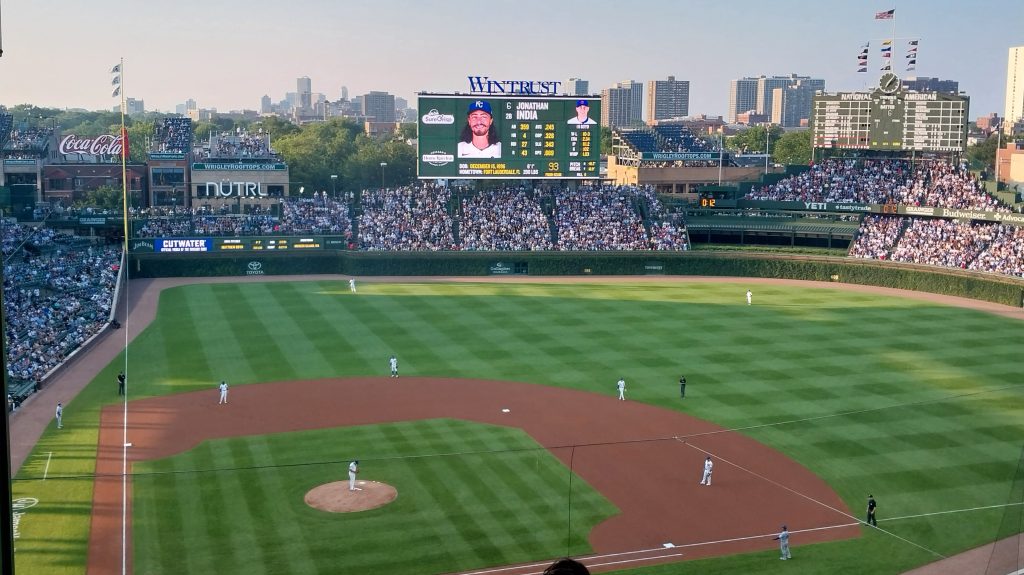
Of course, you can’t talk about Wrigley Field or the area around it without mentioning Wrigleyville. That’s the name for the area in Lake View mainly around Wrigley Field, and specifically the places surrounding the ballpark. Along Clark Street to the west and Addison Street to the south lie dozens of bars and restaurants, some of them serving as pre- and post-game watering holes for Cubs fans for generations. Going to them is almost as crucial as going to a game at Wrigley Field itself. The kind of culture and comradery that comes from these places is akin to the best pubs in the U.K. or best tailgates in the NFL, and it’s a treat to see. Before first pitch, Clark and Addison are absolutely swarming with fans, many of them crossing off this bucket list destination, traveling from near and far. That being said, the area has gone through a similar renovation to the ballpark itself, with newer, more expensive and corporate restaurants and hotels popping up along these roads. It’s a mixed bag, though I’ve seen a majority of fans and experts agree that the area needed some sprucing up, both from an economic and safety perspective. I’m not going to pretend I know more than I do about it.
What I do know about and have explored is the biggest part of the 1060 Project: Gallagher Way. Located directly outside the western side of Wrigley Field, Gallagher Way is half open-air plaza, half hotel/restaurant/bar development. Throughout the year, Gallagher Way operates independently with multiple places to eat and drink, not to mention a Cubs team shop. It also hosts its own concerts and other events during the offseason or when the Cubs are on the road. But during home game days, the plaza becomes a popular place for Cubs fans to gather, even among the rest of Wrigleyville. There are plenty of basic party accessories you’d find at a typical college plaza, as well as places for kids to run-through water fountains. Bringing some history to this new (especially for Wrigley Field) area is a line of statues honoring Cubs greats — Ernie Banks, Fergie Jenkins, Ron Santo, Billy Williams, and Ryne Sandberg. Some of those statues were moved there from other areas around the ballpark, but they’re not the only ones in and around Wrigley Field. A slightly Cronenberg-looking statue of Harry Caray remains in its spot on the opposite corner of the ballpark, in front of the bleachers entrance behind center field.
Along those streets which cross at the Harry Caray statue — Waveland Avenue to the north and Sheffield Avenue to the east — fans often wait in the road beyond the ballpark walls, hoping to snag home runs that sail out of Wrigley Field. But it’s the homes on those streets that represent another unique aspect of Wrigley Field culture. When the ballpark was built, people living in the homes along those streets could see into the ballpark, allowing them to watch games from their own roofs. What started out as people simply bringing out their lawn chairs to watch some baseball morphed into a full-blown business, as the roofs of these homes are now decorated with rows of bleacher seats, which can be bought just like regular game tickets. One of these homes — which has since been torn down — featured the famous “Eamus Catuli” (roughly meaning “Let’s go Cubs!” in Latin) sign. But it was another construction effort, the 1060 Project, that brought a battle between the rooftop owners and the Cubs. Frustrated over construction possibly blocking their views into the ballpark, the owners threatened to sue the team. In the end, the owner of the Cubs, the Ricketts family, straight up bought the majority of the rooftop buildings, incorporating them into the overall collection of Cubs ticket offerings.
When it comes to the food and drink offerings, it largely doesn’t matter, because those are some of the last things you’re going to Wrigley Field for. It also doesn’t matter because they’re pretty basic as a whole. Probably the most popular item is only so because it’s unique to the area: a Chicago-style hot dog. Now that I’m no longer in Chicago and out of harm’s way, I’ll confess to being one of those ketchup-loving monsters, especially on hot dogs. So, I didn’t get one, and can’t offer my critique of it. What I did try is part of Wrigley Field’s rotating menu, which is based off what team is visiting at the time. When the Red Sox were in town, they served lobster rolls, which were fine. The beer and other drinks were about what you’d expect as well. What some may not know is that last year, the Cubs introduced a new area behind center field called the Yard at Wrigley Field. It’s a set of semi-private rental areas featuring an exclusive table with all-you-can-eat beer, seltzer, wine, and non-alcoholic drinks, as well as a ballpark meal for every guest. In addition to the Yard, there are other newer places to go to at Wrigley Field if you have even more money than others. Those range from basic suites to the upscale Catalina, Markers Mark Barrel Room, and W Clubs to the most expensive American Airlines 1914 Club. But those features honestly seem more out of reach than those at other ballparks, and kind of drag down the aura a little bit.
Unfortunately, there are some 1914-related features that present the lion’s share of the negatives of Wrigley Field, such as not being able to access the bleacher area without a bleacher ticket (which I kind of get but am nonetheless annoyed by). In addition to the aforementioned obstructed views and odd seats in the lower deck, sitting in the upper deck (seats most fans can afford) presents another problem. All of the concessions are in the lower part of the ballpark, meaning you have to inconvenience yourself to nourish yourself. Getting to and from the upper decks is a bit of a pain as well, and something I tried to limit once I did so for the first time. The main concourse itself isn’t exactly spacious, either. Jams can form easily and, as I tried to leave after my second game there, I had to wait shoulder-to-shoulder with other fans, packed like sardines in a can as we waited for some movement near the exits. The wait was partially due to the post-game insanity of everyone leaving. If you don’t get on the first two or three Red Line trains after the final out, and aren’t willing to walk to the next stop, be prepared to wait a long time. Unless you have a plan or get lucky, the trip home from Wrigley Field can quickly become problematic.
However, as also mentioned above, you have to kind of expect and be willing to endure some of these aspects to be able to experience a trip to Wrigley Field. Now well into its second century of existence, Wrigley Field is a living piece of sports history, an institution that has seen generations of everything baseball has to offer. Even if you’re not a Cubs fan or don’t want to visit every MLB ballpark, catching a game at Wrigley Field should be on every baseball fan’s bucket list. Perhaps no other ballpark in baseball or venue in sports — except for one other ballpark still to come — has as much hype and aura surrounding it than Wrigley Field. I am pleased to report that all of that hype and aura is completely valid and well worth the trip to Chicago, which is in itself a wonderful place to visit. But even beyond all of that, Wrigley Field as a pure ballpark is one of the more unique options in the sport and more often than not leads to memorable moments. It’s a one-of-a-kind experience, a ballpark that lives up to the lofty expectations around it and then some. While some may argue the more modern touch-ups both in and around the ballpark mess with that aura, it still seems to be as strong as ever. May Wrigley Field live on for another century — and more!
6. ORIOLE PARK AT CAMDEN YARDS
HOME TEAM: BALTIMORE ORIOLES
LOCATION: BALTIMORE, MARYLAND
OPEN SINCE: 1992
ORDER VISITED: 15 (08/18/22)
GAMES I HAVE SEEN THERE: 1 (0-1 HOME TEAM RECORD)
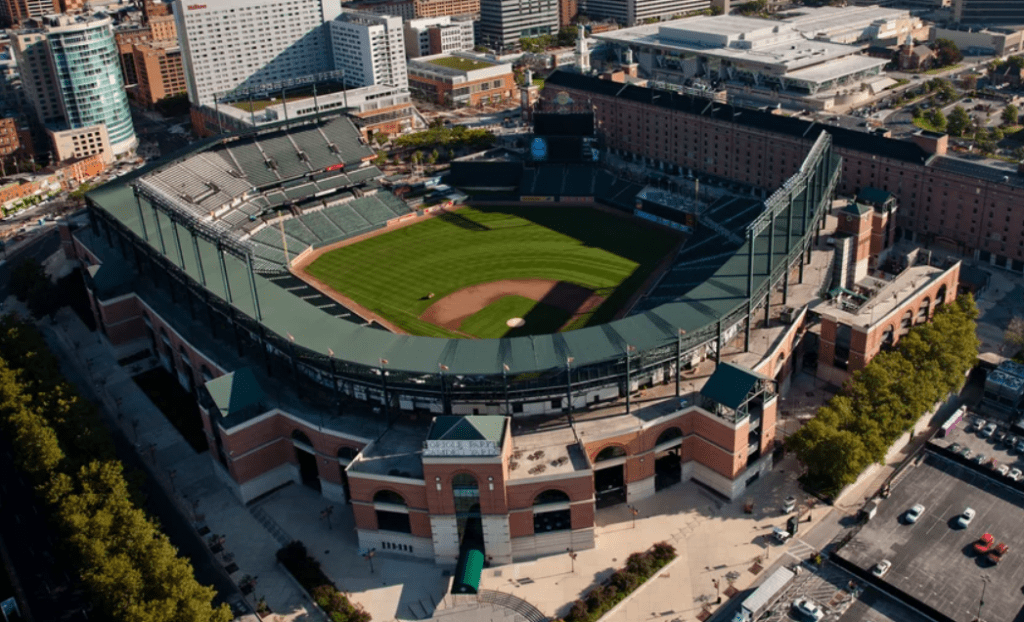
There have been many words spilled describing the historical significance of Oriole Park at Camden Yards. Many, including Paul Goldberger, author of Ballpark: Baseball in the American City, have called it the most influential ballpark since old Yankee Stadium. George Will, Pulitzer Prize-winning political commentator for The Washington Post, ranked its opening among the three most important things that have happened in baseball since the end of World War II, along with Jackie Robinson breaking the color barrier and the implementation of free agency. That sentiment was echoed by former MLB Commissioner Bud Selig, who said the ballpark, “may be one of the two or three most powerful events in baseball history.” While it’s tough to contextualize the opening of a ballpark among major evolutions, those comparisons aren’t wrong, especially from an architectural perspective. Oriole Park at Camden Yards’ 1992 debut marked a dividing line for — everything that was around before, and everything that has opened since. There’s a reason why the it’s been copied so much in the decades after its arrival, and despite hitting a grand slam as MLB’s first “retro” ballpark, it’s remained at the top of many lists for that same reason, among others.
In the preceding decades, the vast majority of ballparks that had been built were multipurpose cookie cutter concrete donut stadiums, largely devoid of personality and not baseball-specific. That included the then-home of the Baltimore Orioles, Memorial Stadium, which also housed the NFL’s Baltimore Colts. But after the Colts skipped town for Indianapolis (in part due to city and state officials refusing to commit funds towards a replacement for Memorial Stadium), those same officials began planning for a new ballpark to keep the Orioles in Baltimore. Architectural firm HOK Sport (now Populus) originally designed the ballpark to be like new Comiskey Park (now Rate Field), which — while not another concrete donut — wasn’t exactly appealing, surrounded by pedestrian ramps and street parking. Then-Orioles President/CEO Larry Lucchino rejected the design and, with the backing of then-Orioles owner Eli Jacobs, hired architect Janet Marie Smith to help inspire a new vision. They were inspired by another HOK Sport ballpark: Pilot Field (now Sahlen Field) of the Triple-A Buffalo Bisons, the first true “retro” ballpark. The Orioles wanted the concept executed on the MLB level, while making it look like the Orioles there for years, instead of arriving as the St. Louis Browns in 1954. The final product was something never before seen, but also something that would be aped for years to come.
Part of what makes the ballpark unique is where it was built, and how it was incorporated into it. The one thing officials couldn’t agree on was a name, with Oriole Park at Camden Yards being a compromise between what Jacobs wanted (Oriole Park) and what then-Maryland Governor Willian Donald Schaefer wanted (Camden Yards). The latter was derived from the site of the ballpark, the former rail yard for the Baltimore and Ohio Railroad’s Camden Station (which is still in operation). The historic station building itself remains on the northeast corner of the ballpark, as does the B&O Warehouse. In a stroke of genius, the Orioles added the warehouse to the design, rather than tearing it down. It dominates the right side of the panorama, providing a unique, historical look for the ballpark. Today it serves as the location for team offices and other events. Located about 60 feet east of the ballpark proper — 439 feet from home plate — it also serves as an enticing target for batters. To this day, no player has hit the warehouse in a MLB game.
Then there’s what lies between the B&O Warehouse and the ballpark proper. Eutaw Street is a real major street in Downtown Baltimore that, when it gets to Oriole Park at Camden Yards to the south, turns into a pedestrian walkway (the road also continues separately for a bit towards parking for the ballpark and Camden Station). The pedestrian walkway runs alongside the warehouse, effectively serving as the center field through right field concourse. On game days, Eutaw Street becomes a vibrant orange and black hub of activity unlike areas seen at most other ballparks. Bars and restaurants — notably Boog’s BBQ — stretch across both the warehouse and ballpark sides, along with one of the larger team stores. While Eutaw Street is open on non-game days, when the Orioles are in town you need a ticket to get in. That ticket also provides access to Flag Court, a standing room only area behind the out-of-town scoreboard in right field. Its name comes from the 15 poles bearing flags of every American League team, arranged in the order of the current standings. Eutaw Street is also dotted with plaques marking where home run balls have landed. Behind the main scoreboard in center field, Eutaw Street serves as the home to the Orioles Wall of Fame, featuring dozens of plaques honoring Orioles greats — from players and coaches to even clubhouse and front office staff.
That’s far from the only tribute to Orioles history at the ballpark. Behind left center field, statues of six Orioles greats — Eddie Murray, Jim Palmer, Frank Robinson, Earl Weaver, Brooks Robinson, and Cal Ripken Jr. — stand among Orioles Legend Park, a courtyard littered with bricks, trees, and picnic tables — complete with the iconic orange umbrellas. It’s a popular area for fans to hang out during games, made even more so by it’s position looking down into the bullpens, which are double-tiered for optimized sightlines (another feature Oriole Park at Camden Yards came up with first). In addition, two seats among the sea of dark green stands are painted orange — in honor of the landing spots for Ripken’s 278th home run (breaking the team record for most as a shortstop) and Murray’s 500th career home run. But perhaps the most notable statue isn’t of a former Oriole. Outside the northeast corner of the ballpark — at the north entrance of Eutaw Street — stands Babe’s Dream, a statue of Babe Ruth, who was born and raised in Baltimore. In fact, the Babe Ruth Museum — the house where he grew up — is just a block west of the ballpark. Interestingly, the statue has an error — it depicts Ruth with a right-handed fielder’s glove, when he actually threw left-handed.
The area around Oriole Park at Camden Yards is also important to its story. In addition to pieces of the historical neighborhood being integrated into the ballpark itself, they also serve a purpose. Camden Station is still in use, meaning you can get to the ballpark via the Maryland Area Rail Commuter (MARC) train and the Baltimore Light RailLink (which also stops at the nearby Baltimore Convention Center. The Baltimore Metro SubwayLink has multiple nearby stops as well, and the Maryland Transit Administration (MTA) has several bus routes in the area. There’s also plenty of parking, with most of the lots located in between the ballpark and M&T Bank Stadium (home of the NFL’s Baltimore Ravens) to the south. The parking area is bisected by Martin Luther King Jr. Boulevard and Interstate 395/Cal Ripken Way, which connects Highway 40 to the north with Interstate 95 to the south. All of this makes Oriole Park at Camden Yards easy to get to, without even mentioning walkability. To the north, Eutaw Street opens up into a variety of bars, restaurants, hotels, and other forms of entertainment — not to mention the University of Maryland, Baltimore campus. Oriole Park at Camden Yards was the first in MLB to demonstrate just how effective a downtown ballpark can be, and few have arguably done it better since.
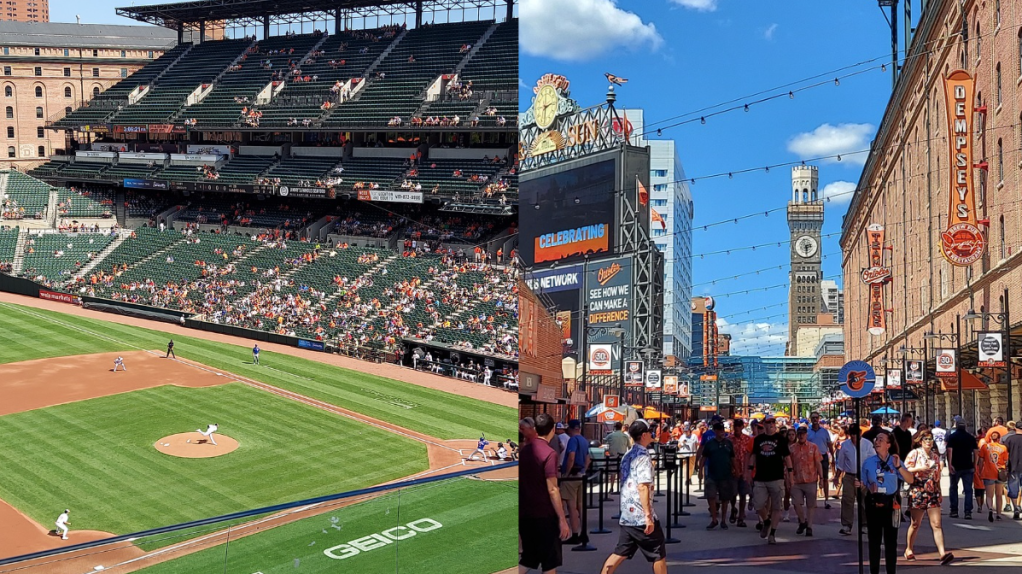
All of these fantastic aspects, and we haven’t even really talked about the ballpark itself. This isn’t to say that it’s subpar — far from it, in fact. The main facade of the ballpark is made out of similar brick and concrete as the B&O Warehouse. With a simple “Oriole Park at Camden Yards” signage and an understated design, the front of the ballpark isn’t really talked about, mostly because of most fans entering via Eutaw Street instead. But compared to other retro ballparks that have come after it, it’s a bit underwhelming. That’s the bad part about going first, with everyone else getting a chance to copy and improve upon your design. The old-school vibe continues when you get inside the ballpark. As would be continued by the ballparks to come in the following decades, Oriole Park at Camden Yards uses steel and concrete to evoke a sense of turn-of-the-century ballparks of the past. This was done as a nod to the team’s lengthy history, though much of it was spent in St. Louis. Another nod to this design can be seen at the top of the videoboard, where a 19th century-style clock (with “ORIOLES” in an old school font) is perched.
Perhaps the part of Oriole Park at Camden Yards that has changed the most recently has been the field of play — specifically, the outfield dimensions. The first MLB ballpark to have entirely straight outfield walls since Ebbets Field, Oriole Park at Camden Yards has historically been a hitter’s park — particularly when it comes to its left field. Over the past decade, the left field wall had been moved back, though due to the position of the bullpens the left-center wall had to remain in place. That wall means the ballpark has the deepest left-to-left center dimensions in MLB. It also creates an unusual scenario in that the left-most part of the left field wall (373 feet) is actually further away from home plate than left-center (363 feet). All of this work has done little to reduce the actual offensive ballpark factor, which remains among the highest in MLB. It did, however, result in about 1,000 seats in the left field area being removed. That being said, Oriole Park at Camden Yards still ranks in the Top 10 in MLB for capacity, at over 42,000.
Though it may be unofficial, Oriole Park at Camden Yards ranks in the Top 10 (if not Top 5 or higher) in MLB when it comes to food. The highlight is without a doubt the aforementioned Boog’s BBQ — the absolutely tasty Eutaw Street staple that’s even sometimes operated by former Oriole Boog Powell himself (the pit beef and pulled pork sandwiches . The menu also takes advantage of Baltimore’s proximity to the water by putting crab all over it. The jumbo crab cakes are incredible and other offerings like crab chips (with Old Bay seasoning) and tacos, complete with crab consommé for dipping. Ballpark staples are also done well there, in particular hot dogs (diverse and somewhat cheap) and burgers (big and delicious). Dessert is another highlight, with newer options like banana pudding and dulce de leche bites. But something that truly surprised me was something I haven’t seen at another ballpark before or since — Oriole Park at Camden Yards makes its own gummi snacks, which are actually pretty good and come in baseball-related shapes. When it comes to beer, local offerings like Natty Boh and Key Brewing are good and readily available. However, be prepared to dish out a lot of green for that amber — Oriole Park at Camden Yards has some of (if not the) highest beer prices in MLB.
As you stroll through the concourse to get a bite to eat or beer to drink, you might notice one of the chief complaints about Oriole Park at Camden Yards. Unlike the ballparks that have come after it, there are few spots along the concourse to see the field of play as you wait in line. There are also a surprising lack of TVs as well (at least while I was there), meaning you really don’t know what’s happening during the game unless you’re in your seat. Also, the upper level concessions are, by comparison to the lower level, quite lacking. Work is apparently being done and preparations are apparently underway to try to fix those issues, though it hasn’t been done yet, so I have to bring it down for that. However, arguably the biggest complaint has officially been taken care of. For years, Oriole Park at Camden Yards’ videoboard the smallest in MLB and at least two generations out of date. However, a new videoboard was just installed this year — two-and-a-half times larger than its predecessor and, while not among the largest in MLB, a massive improvement. There are some complaints the Orioles can’t fix, chief among them being a large Hilton hotel that has been built and takes up a lot of the left side of the ballpark’s panorama, which is diminished as a result.
The much larger videoboard isn’t the only new part of Oriole Park at Camden Yards this year. The Orioles announced a brand new club level seating plan for right behind home plate where the press box — now relocated further up the third base line — used to be. Called the Truist Club, the so-called first-of-its-kind indoor/outdoor experience that includes VIP parking, a rotating upscale menu, a private entrance, and more. It’s the latest development in Oriole Park at Camden Yards’ evolution, and the original retro ballpark luxury box and suite offerings needed some work as well. That being said, the news was not well-received among Orioles fans. While Oriole Park at Camden Yards has seen a lot of money and work in recent years, much less funding has gone towards the actual on-field product, with the Orioles only making the playoffs seven times in the ballpark’s 30+ years of existence. Although Oriole Park at Camden Yards has remained a popular place for MLB fans to visit, its also more fitting for a much better-run franchise.
Now among the Top 10 oldest ballparks in MLB, Oriole Park at Camden Yards’ impact on baseball continues to grow. Only loanDepot Park and the Athletics’ future Las Vegas ballpark cannot be described as either retro-classic or retro-modern, meaning Baltimore’s has influenced the construction of two-thirds of all current MLB ballparks. On that merit alone, Oriole Park at Camden Yards deserves a high rank on this list. But even then, only a small handful of those ballparks have even arguably surpassed the original. Though there are certainly places where Oriole Park at Camden Yards’ age is showing, it’s honestly kind of incredible that it got so much right at the start that it remains in the upper echelon of baseball venues. In fact, many say it’s still the best ballpark in MLB, and to be frank I don’t have much of an argument against those claims. It’s a fantastic and innovative ballpark in a phenomenal location that planted the seed for a much-needed revolution for the sport. It was the first designed to look like it’s been there for almost a century, and hopefully it lasts another century at least. If it does, it will still probably rank among the best ballparks MLB has to offer.
5. TARGET FIELD
HOME TEAM: MINNESOTA TWINS
LOCATION: MINNEAPOLIS, MINNESOTA
OPEN SINCE: 2010
ORDER VISITED: 29 (04/04/26)
GAMES I HAVE SEEN THERE: 2 (0-2 HOME TEAM RECORD)
Surprised to see Target Field this high? Well, if you’ve been there, you shouldn’t be. In 2010 (the year of its debut), ESPN The Magazine ranked Target Field as the best ballpark experience in MLB. While I personally wouldn’t go that far, I don’t think they’re far off. Target Field is a Top 5 MLB ballpark. It’s better than the ones that came before it and has some great arguments for being better than the ones ranked ahead of it. You might look at the date I visited Target Field for the first time and claim recency bias. But I say I had more than two dozen MLB ballparks under my belt when I arrived in Minneapolis, and Target Field still impressed me a lot. It also had a lot going against it — the Minnesota Twins lost both games I saw (dampening the atmosphere) and it was so cold during the first game that it snowed (being from NorCal, I wasn’t prepared). Still, I knew it was Top 5 as soon as I was finished with it. It’s an incredible ballpark — pretty, tons to offer, nice views, and a marvel in city planning. It’s also kind of a miracle that it even exists, because at one point, the Twins themselves nearly stopped existing.
After the Washington Senators became the Twins upon their arrival to Minnesota in 1961, they played at Metropolitan Stadium for 21 years before moving into the Hubert H. Humphrey Metrodome, a roofed stadium they shared with the NFL’s Minnesota Vikings. Despite winning two World Series titles in their first decade at the Metrodome, the team and its fans soon wanted a new ballpark. However, multiple attempts to build one failed and, with the Metrodome’s poor baseball amenities (especially amid the retro ballpark revolution) and the Twins’ lack of revenue from it playing into sparse crowds, the team nearly moved to Greensboro, North Carolina. However, an even worse fate seemed to be in store. After the 2001 season, MLB owners voted to contract two teams for the 2002 season, with the Twins and Montreal Expos projected to be the teams to cease to exist. However, legal action soon followed that vote, with the Metrodome (rather, the Twins’ lease, which included 2002) ironically leading to a judge declaring the Twins must play in 2002. Not wanting to only contract the Expos (which would leave an odd number of teams) MLB tabled contraction talks, which were then forbidden until at least 2006 thanks to a new collective bargaining agreement. That was enough time for the Twins and regional officials to agree on a new ballpark plan, with Target Field (named after the retail company headquartered in Minneapolis) being built in the northern part of the downtown area.
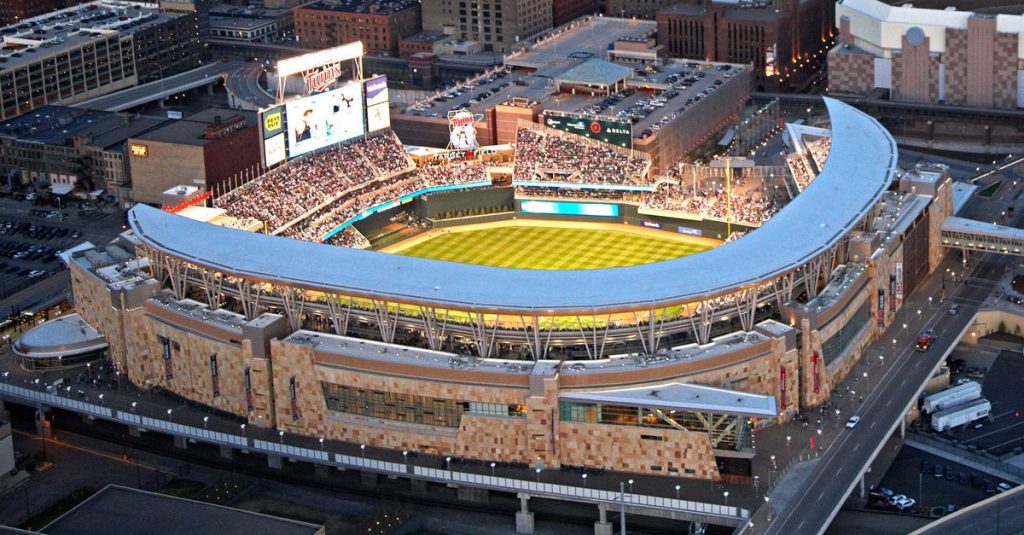
The fourth-newest ballpark in MLB may have been another retro-style ballpark, but Target Field did something that most of those that came before it did, which helped to set it apart. Unlike most retro ballparks that use bricks in their facades, Target Field’s is made up of Kasota limestone, which is found in southern Minnesota and covers many of the walls in the ballpark, giving it a distinct look. The rest of the ballpark is largely made of steel and glass, and like many retro ballparks the bullpens are multi-tiered. In a sharp rebuke of the Metrodome, Target Field does not have a roof (though it was discussed during planning), despite the sometimes frigid conditions in Minneapolis. Instead, Target Field has a sleek-looking canopy above the upper section, which includes the largest soffit (the part that extends off to the side, unsupported from below) of any canopy in MLB. While that can’t completely protect fans from the weather (a decision baseball purists were more than okay with), there are also warming shelters and heaters hanging throughout the ballpark, which are exactly what tourists from NorCal who didn’t pack enough warm clothes need to survive the chillier games (I may be speaking from personal experience on this one).
Despite all of that extra power needed to keep people warm, Target Field is incredibly sustainable, becoming the first ever sports venue in the U.S. to be LEED Gold certified in 2017. Even Target Field’s one true mistake — placing 14 black spruce trees in the batter’s eye (with the swaying branches proving distracting) — was rectified sustainably, with most of the trees replanted at Minnesota state parks. Another sort of contradiction comes from the fact that while having a Top 10 large scoreboard in MLB, Target Field has the seventh-smallest seating capacity in the league (likely moving up to sixth upon the debut of the Athletics’ Las Vegas ballpark) at just over 38,500. The seating does stretch across most of the ballpark, save for a concourse in center field, but it’s not as tall, leaving plenty of room for a lovely panorama of Downtown Minneapolis. Also, despite having one of the furthest left field walls from home plate in MLB — not to mention a relatively deep center field and average right field — Target Field has largely proven to be a hitter’s park, despite initial concerns from Twins sluggers. This has happened in a somewhat unusual way, as despite not giving up many triples or home runs, Target Field has seen some of the most doubles in the league since its debut.
What Target Field doesn’t get enough credit for is being one of the more incredible architectural and planning achievements of the modern era. It’s located at the site of a former parking lot directly northwest of where Interstate 394 begins and southwest of the North Loop, which connects to Interstate 94 (which runs north/south to the west of the ballpark). The complex nature of the roads and the overall small space to work with (about eight acres), designers had a big challenge ahead of them. What they came up with was genius. They elevated the ballpark to the point where I-394 partially runs underneath it, with several pedestrian paths and roads running over the freeway and connecting Target Field to the rest of the downtown area. They also positioned it with the outfield directly in front of an older parking garage, which naturally blends in with the panorama. This — in addition to other lots/garages nearby — helps with parking, which is convenient given the ballpark’s great position with traffic flow. Target Field is also positioned directly above the existing rail lines, allowing for Metro trains to drop off passengers on its Green and Blue Line routes off directly at the ballpark. All told, this makes Target Field one of the smartest and best-positioned ballparks when it comes to traffic and commuting. The latter can also be done by walking, with plenty of hotels nearby.
Target Field’s location is also convenient when it comes to pre- and post-game entertainment, with a wide array of bars, restaurants, and other activities well within walking distance of the ballpark. These range from old school and long-lasting watering holes to newer, more corporate offerings. A lot of those places can be attributed to the presence of the nearby Target Center (home of the Minnesota Timberwolves and, if you can believe it, the second-oldest active venue in the NBA), with plenty of skyways — elevated, enclosed pedestrian walkways used across Downtown Minneapolis due to it being so freaking cold all of the time — connecting it and many of the surrounding buildings. But one popular place fans hang out came as part of Target Field’s construction. The aforementioned Metro station doubles as an amphitheater and is both naturally and architecturally stunning. It’s become a popular gathering place for community events and is just a nice place to visit. The Metro Line also means you can easily get from one Minneapolis sports venue to another, as U.S. Bank Stadium (the Vikings’ replacement for the Metrodome) is just a few stops away.
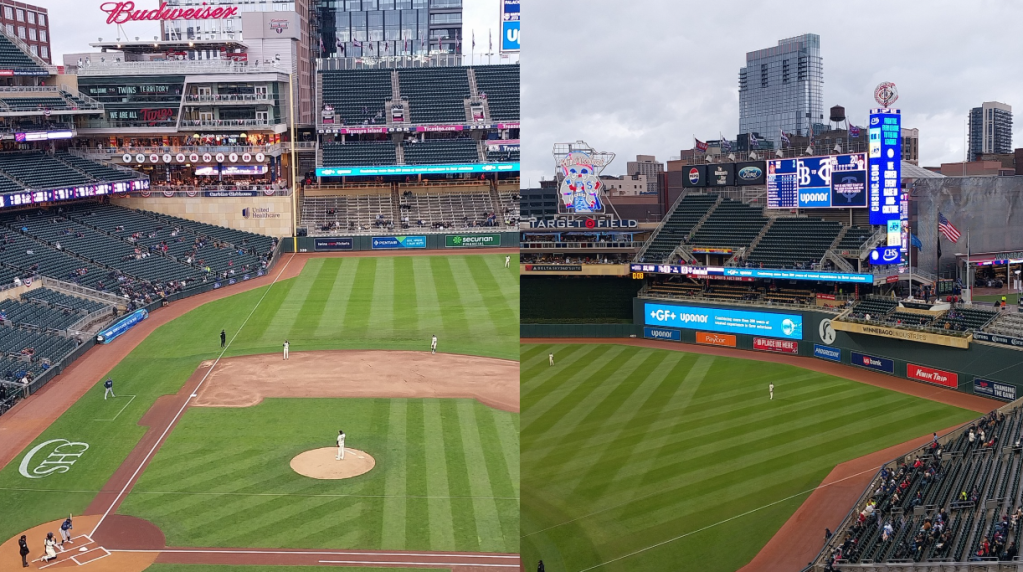
Just because the Metrodome has been demolished doesn’t mean it’s completely gone forever. Target Field’s home plate is the same one used at the Metrodome, while the main flag pole in the right field plaza is the same one from the Twins’ old home as well. The area also has other flag poles highlighting the Twins’ achievements since their arrival in 1961, as well as the current American League Central standings. Other such tributes to Twins history come in the form of the admission gates, which are named after the numbers of Twins greats — 3 (Harmon Killebrew), 34 (Kirby Puckett), 29 (Rod Carew), 6 (Tony Oliva), and 14 (Kent Hrbek). Each of these players have also been honored with statues, with other additions coming in the form of Tom Kelly, Joe Mauer, and Carl and Eloise Pohlad (the latter isn’t exactly quite as popular due to recent free agency decisions). Perhaps the biggest and most well-know feature of Target Field is the towering replica of the Twins logo behind center field, featuring mascots Minnie and Paul shaking hands (this lights up whenever the Twins hit a home run). Other, smaller pieces of art can be seen throughout the ballpark, including murals (such as A History of Minnesota Baseball on the exterior behind left field) and laser-etched wood carvings of Puckett and Carew in the club level.
Another artistic piece can be seen draped across the parking lot behind right field — a wind veil that makes waves and “shimmers” whenever the wind blows. That’s just one appeal of Target Plaza, the main area located behind right field that has become a popular place for fans to gather before and even during games. Many of the aforementioned statues are located in Target Plaza, along with nine 40-foot high topiary frames shaped like baseball bats with hops growing out of them. These frames are lit up in order to depict the current inning and are color-coded to match up with the veil at night. When it comes to colors, there is also plenty of green (in the form of grass and plants) and gold (a statue honoring every Twins Gold Glove Award winner, which fans can sit on and pose with). Fans can also look up and see another big attraction — Truly on Deck, which sticks out on the right side of the Target Field. Looking over Target Plaza, Truly on Deck is a large, open brewpub open to all ticket holders that offers great views and neat memorabilia, including the Twins’ two World Series trophies (not including the one won as the Senators in 1924).
The left field area isn’t exactly lacking, either. Directly to the left of the left field foul pole is a multi-level collection of bars, restaurants, and even the Twins’ team offices. There are several good places to visit, chief among them Town Ball Tavern, which not only serves the Minnesota-famous Jucy Lucy burger, but whose floor is made up of the same wooden panels used on the basketball court of the Minneapolis Armory, where the Minneapolis Lakers played before moving to Los Angeles. The left field area is topped, literally, by the Budweiser Roof Deck, which offers fantastic views of downtown Minneapolis. There are other good dining and drinking options elsewhere in Target Field, such as Hrbek’s in the main concourse behind home plate, Carbliss Clubhouse along the third base side, and Sun Cruiser 10,000 Lakes Bar along the first base side. Perhaps the most unique and beloved bar is Pyres Homeplate Taproom, located behind home plate on the terrace level. The bar has one main attraction: Twins organist Sue Nelson, with fans able to watch her play live and chat with her when she has a quick break.
Across all of these restaurants and bars, you can sample some of Target Field’s large and tasty menu. Everything I had at the ballpark — from your ballpark classics to the Minnesota-specific items — was delicious. Among those was a new offering from Red Cow in the Double Barrell burger: two beef patties with American cheese, grilled onions, burger butter, and horseradish sauce. Red Cow also features a ballpark favorite in 60/40 sliders (60% beef, 40% bacon). Target Field also has a build-your-own mac and cheese bar, which is just something more places should have in general. There are also more diverse offerings like elote, taiyaki, and boba — things you might not think would be good in Minnesota of all places, but are actually quite enjoyable. Of course, there are Minnesota-centric offerings, including the aforementioned and delicious Jucy Lucy burger, as well as walleye, wild rice soup, and cheese curds. Target Field also has plenty of vegan options, which earned an honor from PETA in 2018. For those who prefer otherwise, arguably the main favorite is Kramarczuk’s, which offers a variety of delicious bratwursts and sausages, including one with melted cheese inside. Be warned — that one can unintentionally cause a cheese discharge that may coat your beard in melted cheese and disgust the attractive woman behind you on the escalator (again, speaking from personal experience). Either way, you can wash it all down with one of Target Field’s several tasty beer options.
There are, of course, several options for fans with a bit of money to spend. Behind center field lies the Delta SKY360° Suite, which offers tapas-style concessions and padded cabana lounge seating. There’s also the Thrivent Club, a massive, spacious climate-controlled room with seating and memorabilia that stretches all the way from beyond first base to beyond third base. Then there’s the Champions Club, which includes its own separate entrance to the ballpark, a gourmet buffet, bar, coffee bar, and padded seats just ten rows up. Interestingly, the Champions Club is the only luxury offering unavailable for single-game purchase. Instead, you either have to either buy a season ticket package or get one from a third party (a dilemma most of us will surely have to deal with in our lifetimes). Another interesting view Target Field offers is for fans on the opposite end of the economic spectrum, the ones with no money. Along the northwest side of the ballpark (along 5th Street), there are several “knotholes,” allowing fans to take a peek at what’s happening inside the ballpark without a ticket.
Maybe it’s the frigid spring/fall and sweltering summer. Maybe it’s being MLB’s northern-most ballpark not located in Seattle. Maybe it’s the fact that the Twins have been mediocre for much of its life. For whatever reason, Target Field doesn’t immediately spring to mind for the average fan when it comes to the best ballparks in baseball. Even those who have been there sometimes rank it towards the middle of the pack. For the life of me, I can’t understand why. Target Field is a modern sporting venue marvel, in terms of its design, functionality, looks, everything it offers, and as a place to play and watch baseball. It’s genuinely fantastic and a no-brainer for my Top 5. It’s about as close as any MLB ballpark can get to a 10/10 in every category. So, why isn’t it even higher than it is? Unfortunately for Target Field, there are a few ballparks that surpass that scale in some categories, which if anything is a compliment in that you have to literally break the typical rating system in order to beat it. Of course, this is no knock on Target Field, which in my mind is a Top 5 ballpark and one of the many reasons you should visit Minneapolis in general. It’s a nice and pretty place with friendly people. Just remember to bring some long johns and an extra jacket or three.
Eight tiers down, one more to go. We’re officially in the end game, entering the Top of the 9th, so to speak. Our journey is finally at its long-anticipated conclusion, and the final four ballparks await us. Without further ado…
S+ TIER
These are the four best ballparks in MLB, bar none, hands down. These are the best of the best — the most incredible and fantastic venues the sport of baseball has to offer. For whatever faults they may have, they succeed so spectacularly everywhere else that they more than make up for them. Without a doubt, the toughest part of putting this overall list together was deciding on a final order for these four ballparks. If you disagree with what I ultimately came up with, not only would I understand, but I’d probably agree with you. Any order is valid, and every single one of these ballparks deserves to the No. 1. Unfortunately, there can only be one, and I have to stand by the difficult decisions I made with sorting them out. Perhaps no decision was more agonizing than settling on the ballpark that just misses out on a spot on the podium, which was painful for one big reason.
4. FENWAY PARK
HOME TEAM: BOSTON RED SOX
LOCATION: BOSTON, MASSACHUSETTS
OPEN SINCE: 1912
ORDER VISITED: 7 (06/09/19)
GAMES I HAVE SEEN THERE: 2 (0-2 HOME TEAM RECORD 😢)
There are some of you whose jaws are hitting the floor right now. After all, how can I, a Boston Red Sox fan, not rank Fenway Park No. 1, let alone rank if fourth? First off, don’t get it twisted. Fenway Park is my favorite ballpark and as a Red Sox fan going there for the first time was the closest I’ve felt to a religious experience. I think it’s the best in the world, but I can’t think like a Red Sox fan, as tough as it may be. If I was objective for the Yankee Stadium entry (and yes, I was), I have to be for Fenway Park as well, though that may be an even tougher job. Even from an objective prospective, Fenway Park is one of the very best ballparks in MLB, overflowing with history and prestige. It’s the oldest active ballpark in the league and there’s more aura than there are drops of green paint in and around it. That being said, it’s not perfect (no ballpark is), and even the most diehard Red Sox fan will admit that. But we are the only ones allowed to criticize it, so watch your mouth, even if you agree with me. See, this is getting complicated already. Why not keep it complicated by going through the history of a ballpark that hosted World Series games before World War I began?
For their first 11 years in existence, the Red Sox played at the Huntington Avenue Grounds, a ballpark made of wood. Seeking a more permanent home ballpark, then-owner John Taylor purchased a plot of land in the southwest part of Boston, largely bordered in sort of a triangle by Lansdowne Street to the north, Van Ness Street to the south, and Jersey Street to the west. Located just south of the Charles River and what would eventually become the Massachusetts Turnpike (Interstate 90) 35 years later, the ballpark that was built out of red brick, reinforced concrete, and steel would be known as Fenway Park, named after the Fenway-Kenmore neighborhood where it stood, Taylor’s Fenway Realty Company, or maybe both. Less than a year after construction began, Fenway Park made its MLB debut in 1912 (five days after the sinking of the RMS Titanic), complete with a single bowl of seating, a ten-foot, 45-degree dirt incline (called Duffy’s Cliff, after outfield Duffy Lewis) and 25-foot wall in left field, and wooden outfield bleachers. Those bleachers would catch fire in 1926 and remain burned until 1933, when incoming owner (and noted terrible person/racist) Tom Yawkey bought the team. The ballpark would go through major renovations in time for the 1934 season, which saw the bleachers catch fire again. But it was those changes made in the offseason that would see the debut of several iconic Fenway Park features.
Chief among those would be in left field, with Duffy’s cliff flattened and the 25-foot wall replaced by something more… monstrous: a 37-foot wall — complete with a hand-operated scoreboard. The wall (along with Fenway Park as a whole) would be painted in a now-iconic shade of Dartmouth Green, earning it the famous name of the “Green Monster.” The dimensions were also significantly shortened to largely their current form. An upper deck was added about a decade later, and for a large period of time there were no major changes. But as the decades passed, Fenway Park aged and many people, including Yawkey himself, called for a new home for the Red Sox (one plan had a domed venue of all things). But thanks in part to unexpected runs to the World Series in 1967 and 1975, love for the ballpark was reignited. However, amid the ballpark revolution at the turn of the century, calls grew loud again, especially after owner John Harrington (who took over after Yawkey’s death) called for the city to seize land next door and fund a new ballpark. The city agreed, but enough neighbors threw a fit to shut the plan down. Harrington eventually sold the team to a group led by John Henry, who not only vowed to keep Fenway Park, but brought in Larry Lucchino and Janet Marie Smith, two key figures in Oriole Park at Camden Yards’ design and construction. They led the effort to improve and modernize Fenway Park, which remains a beloved baseball attraction to this day.
Of course, much of that attraction is directed towards Fenway Park’s quirkiness, which comes from the size and shape of the land it was built upon. Fenway Park is baseball’s example of thinking inside the box, with the lack of space from home plate to the left field wall (due to the proximity of Lansdowne Street) causing the Red Sox to try to make up for it by making the wall higher. The Green Monster is without a doubt Fenway Park’s most unique and popular feature, an attempt to compensate for the shortest home-left field distance in MLB (310 feet). Hitting a home run over the Green Monster is always a memorable feat, with sluggers truly earning it due to the height they have to get on the ball. But even if they don’t hit it out, the Green Monster still greatly impacts the offense, with balls that hit (no matter how far up) and fall back still in play. This creates a huge advantage for the Red Sox left fielder in particular, who over time learns how to play the balls that bounce off it, as opposed to left fielders on visiting teams. But even for newbies, the Green Monster still turns hits that may have been pop-ups into doubles or triples, due to the sheer time it takes to hit the ground. Fans can get a better perspective from on top, as over the past couple of decades, the Red Sox have installed seating on top of the Green Monster. To the surprise of no one, those are the most expensive seats in the ballpark (more on that later). Beyond being a part of the game, the Green Monster is also iconic for its hand-operated scoreboard (which fans can tour and sign), as well as for its unique green shade.
The Green Monster is not the only outfield wall that contributes to the offense. The right field pole (nicknamed Pesky’s Pole, after longtime Red Sox player/coach Johnny Pesky) is only 302 feet from home plate — the shortest distance in MLB, which of course leads to home runs that would only be home runs in Fenway Park. The right to right-center field walls range from five to three feet, in theory giving outfielders a better chance to catch the ball. But looking at Torii Hunter’s failed attempt at robbing David Ortiz’s game-tying grand slam in Game 2 of the 2013 ALCS, that comes with a few risks. That area where Hunter flipped in particular — where the bullpens sit in front of the right-center field bleachers — is known as Williamsburg, with the area primarily built to benefit left-handed Red Sox players like the great Ted Williams. The far center field area, by contrast, juts away from home plate, with its shape giving it the nickname “the Triangle.” Though not technically true center, the furthest point in the triangle (420 feet) is the listed center field distance. While tough to hit home runs to center field, the distance allows for a lot of extra base hits. All of this leads to Fenway Park being an easy Top 5 ballpark for hitters, often second only to Coors Field.
However, the same jewel box ballpark era that gave Fenway Park those quirks also gave it the same problems that impact Wrigley Field. Although some of the concourses (most notably the Gate D concourse behind home plate on the corner of Van Ness and Jersey Streets) have been greatly upgraded and allow for easier pedestrian flow than you’d think, most of of the time, when you need to get some food, you have to dip below the bowl, with the action out of view. While the main concourse at Fenway Park is notably more spacious than at Wrigley Field (in large part due to its entrances), it’s still a far cry from the modern style. Also, like Wrigley Field, Fenway Park has a few seats which are obstructed by the steel beams holding up the upper deck. If also, if you sit higher up in the lower bowl, your view will be slightly obscured from above by the upper deck. You’ll also have to deal with slightly annoying seating, with the lower concourse having the same (albeit refurbished) wooden seats from those 1933/34 renovations. Not only do they not completely face home plate, but the wood and smaller than modern average size can be a bit uncomfortable. Still, many people will willingly put up with these comparative minor inconveniences to be able to see a game inside such a remarkable ballpark.
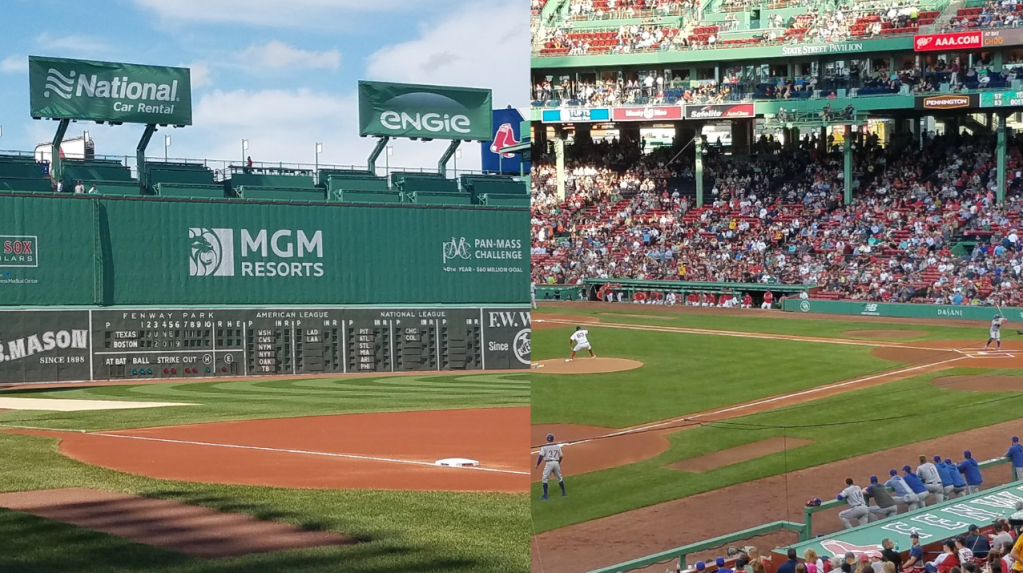
You navigate your way through the tortuous maze that is the Boston road and highway system, then park your car at one of the several lots near the ballpark. Or, you take the Massachusetts Bay Transportation Authority (MBTA)’s Framingham/Worcester commuter train or Green Line light rail train to the Lansdowne or Kenmore stops, or one of the several bus routes. Or, maybe you bike or walk there from one of the several hotels within the area. Maybe you pass by The Teammates statue of Williams, Pesky, Bobby Doerr, and Dom Dimaggio at the corner of Ipswich and Van Ness Streets (or the solo statue of Williams nearby), or you stop and take a picture with one of the giant retired numbers scattered along the path to the ballpark (like I did with Ortiz’s No. 34) as you make you way to one of the many bars and restaurants surrounding Fenway Park. You take in the sights, satiate your hunger and thirst (at least a little bit), and get giddy as you see the green ballpark get a little bit closer with every step. Then you turn the corner onto Jersey Street and the Fenway Park experience truly begins.
Instead of doing so at the ballpark building itself, you scan your ticket on Jersey Street and step into a carnival, complete with performers on stilts and clowns juggling bowling pins. On game days, Jersey Street becomes a cousin of Eutaw Street, full of entertainment and hustle and bustle, but instead of orange and black it’s red and navy blue. You walk through taking it all in, admiring the tasteful red brick facade of Fenway Park itself, lined with red and blue banners celebrating the Red Sox’s championships. You stop and get some food and another drink at some of the many stalls offering them, and maybe decide to commemorate the trip by stopping at the huge official team score across the street from the ballpark. Then, it’s time for the main event. You walk into the concourse of the ballpark proper, finding the proper route to your seat, which includes emerging into the lower bowl, the vast green surrounding you, along with the red seats and beautiful panorama. You gasp, realizing you’re at Fenway Park, and maybe even cry a little (who’s to say?). You get your slightly uncomfortable seat and proceed to take in the show that’s been running for any longer for any other in MLB: a Red Sox game at Fenway Park. You take part in the traditions, including some newer additions like belting “Sweet Caroline” in the middle of the eighth inning and jamming out to “Dirty Water” following a Red Sox win — at least the last part is what I’ve hear happens, with the Red Sox losing both games I’ve been at Fenway Park. You then exit either back to where you came, or to one of the aforementioned watering holes to continue the good times into the night.
When it comes to the Fenway Park experience, you’re going to want to actually do the eating and drinking beforehand, because one of the weaknesses of the ballpark is its overall food selection. It’s not bad, just kind of mediocre. Probably the best-known item is the Fenway Frank, a hot dog that I’m going to say is better than a Dodger Dog just to further piss off Los Angeles Dodgers fans. There are some local classics, such as clam chowder, Boston cream pie, and lobster rolls and various other things to do with lobster. To that end, newer items include lobster poutine served in a mini (non-floatable) duck boat and a surf & turf dog, not to mention the spicy Cabot grilled cheese (from the neighboring Vermont). The steak sandwich from Savenor’s is also pretty good. That being said, the restaurants and bars along Jersey, Lansdowne, and Van Ness Streets are better bets for taste and price. The latter is especially the case with beer, which, while very good, is incredibly expensive at Fenway Park.
There, we get to arguably the main drawback of Fenway Park. Despite their recent reluctance to spend on acquiring or keeping good players, the Red Sox have taken full advantage of their overall success in the 21st century (more World Series titles than any other team, as of this writing). Fenway Park is more popular than ever, and partially because of the capacity of just over 37,700 (the fifth-lowest in MLB today) tickets are incredibly sought-after, especially for fans visiting from out of town or even overseas. So the Red Sox have absolutely jacked up the cost of everything from food and drinks to parking to souvenirs to, of course, tickets. When it comes to the latter, depending on which recent study you look at, tickets to a game at Fenway Park rank at least in the Top 5 in MLB, if not second behind Dodger Stadium or even No. 1 overall, and well above the league average. This hasn’t stopped the strong ticket sales, as the Fenway Park experience is either the best in MLB or only topped by Wrigley Field, depending on who you talk to. But prices are getting to the point where the average fan is being forced out and having to defer their dream until they get a few more paychecks in the bank. That’s not how it should be and while I know the Red Sox are far from the only team doing this (looking at almost every team whose ballpark is in this part and some in the previous parts), but if I’m going to call it out elsewhere, I’m going to do so for my team as well.
Perhaps some of that money can go to more upgrades for the ballpark, which to be fair have played a positive roll in Fenway Park’s popularity. That includes a large concourse behind the right field bleachers, which was doubled in size and beefed up in other ways in 2003. There’s newish seating at the top of the right field stands called the Sam Deck (after Samuel Adams — the beer, not the Founding Father), which includes the 502′ Club, near the red seat marking where Williams’ famous home run (the longest in Fenway Park history) landed in 1946. The Lansdowne Pavilion offers great views of both the ballpark and Boston skyline, beat only by the Dell Technologies Club Reserved — behind home plate and with a pre-game tour of Fenway Park included with each ticket. A ballpark tour may be one of the only ways to see one of Fenway Park’s hidden gems: the Volvo Royal Rooters Club behind the center field bleachers. It’s a private space with a built-in bar and a rotating collection of memorabilia from famous Red Sox moments, such as a ball thrown by Roger Clemens during his 20-strikeout game or the second base Dave Roberts stole in Game 4 of the 2004 ALCS.
It’s that kind of history that, without even looking at the memorabilia or artifacts, lives within every pore of Fenway Park and puts it in a league with only Wrigley Field. Both are quite comparable, not just for their age but for their aura and lack of modern comforts. If I were a Chicago Cubs fan, I’d probably swap their places on this list, and if I were a fan of neither team I’d put them right next to each other. But I am a Red Sox fan, so Fenway Park gets the advantage here. Still, being a Red Sox fan isn’t the reason I have Fenway Park so high on this list. It absolutely objectively deserves this spot, and anyone who even so much as looks at it knows it should be up here. That being said, I feel like it would be kind of a cop out for the Red Sox fan to have Fenway Park in the No. 1 spot on their MLB ballpark rankings, and I’d hate for this entire journey to end with a feeling of “sigh, of course.” Of course, Fenway Park deserves to be ranked above all other ballparks on this list or any other, and I almost did so in spite of my own reservations, which I may be honoring more than I should in my goal to remain as objective as I can. However, for as spectacular and amazing and incredible and as legendary as it is, there a few other ballparks that have those modern comforts and do enough with their own beauty, features, and amenities to surpass what Fenway Park can put together. But let’s see what happens to those ballparks in a century or so. A recent study found Fenway Park can last until at least 2061, when it’ll celebrate its 150th anniversary. Let’s hope it lasts even longer than that, as Fenway Park deserves to be eternal.
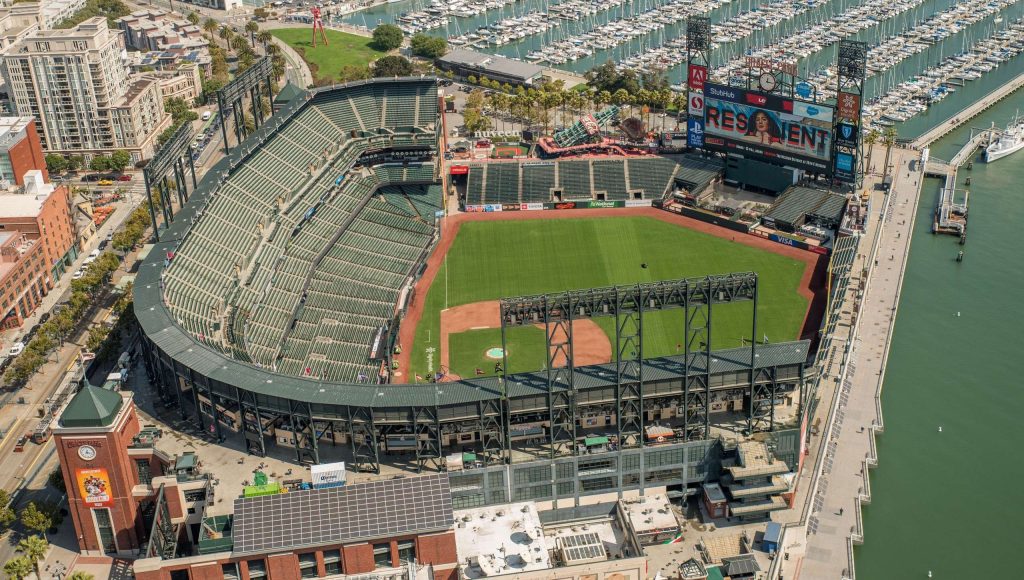
3. ORACLE PARK
HOME TEAM: SAN FRANCISCO GIANTS
LOCATION: SAN FRANCISCO, CALIFORNIA
OPEN SINCE: 2000
ORDER VISITED: 2 (08/21/13)
GAMES I HAVE SEEN THERE: 4 (1-3 HOME TEAM RECORD)
A few years after New York lost its two National League teams to the West Coast, the now-Los Angeles Dodgers moved into Dodger Stadium and have neither changed venues nor nearly changed their home since. The other team didn’t have as smooth of a sailing. After spending a couple of years at Seals Stadium — home of the departed Double/Triple-A San Francisco Seals (who ironically were once affiliated with the New York Giants) — the now-San Francisco Giants moved into Candlestick Park, which immediately proved problematic due to Mother Nature. Cold weather, damp air and grass, and most notably strong winds gave hitters, pitchers, and fielders fits. Things got worse after the NFL’s San Francisco 49ers moved in, forcing the venue to become enclosed. Not only did this give Candlestick Park an oblong, uneven look, but it made the wind problem even worse. Also, while Candlestick Park may be looked back upon fondly by Giants/49ers fans, it’s largely due to the actions of the fans themselves and less due to the quality of the venue and its amenities (which were terrible). In fact, things were so bad that a new ballpark was all but a necessity for San Francisco to keep the Giants, who almost moved to Tampa Bay in the 1990’s. Fortunately, new ownership not only committed to staying in San Francisco, but privately financed a new ballpark (the first since Dodger Stadium). That ballpark would mark a dramatic reversal of fortune, as the Giants went from having one of the worst home ballparks in MLB to one of the absolute best.
Debuting in 2000, Pacific Bell Park (now called Oracle Park) has been influenced the most — both in its initial design and life since then — by its location. The site Oracle Park was built upon was an industrial area on the eastern shore of San Francisco — in the China Basin area of the South Beach neighborhood. By that, I mean it was built right along the shore — the furthest edge of right field is about 50 feet from the San Francisco Bay. There’s only a small section of right field bleachers — and a concrete path behind it — in between the outfield dirt and the water. Given the restrictions when it came to the nearby streets, this means that it’s just 309 feet from home plate to the right field foul pole, the second-shortest distance in MLB. To try to make up for it, there’s a 24-foot (in honor of Giants legend Willie Mays) high brick wall — complete with a hand-operated scoreboard — that’s sort of a mini-Green Monster, with the few rows of seats on top of it known as Levi’s Landing. The part of the bay behind right field is known as McCovey Cove (named after Giants great Willie McCovey), and there’s a counter on the right field wall keeping track of the amount of Giants home runs that have landed in the water (known as “splash hits”). The fun doesn’t stop when the ball gets wet — dozens of kayakers and other boaters paddle around to try to snag these home run balls. McCovey Cove has grown to be quite popular, with some kayakers even bringing grills and other items to help pass the time.
Unlike the other parks with a tall wall trying to compensate for a short side of the outfield, Oracle Park isn’t a hitter’s park. Rather, it’s one of the more pitcher-friendly ballparks in MLB. Just look at the home run totals of the home team — since Barry Bonds hit 45 bombs in 2004, only Willy Adames last year has hit 30 in a single season. Plus, the right field layout overly favors left-handed hitters, with Heliot Ramos in 2024 being the only righty to hit one into McCovey Cove. Meanwhile, the distance between home plate and left field is 339 feet (one of the furthest in MLB), with one of the advertisements — a Chevron spot featuring its claymation cars — sticking out over the left-most part of the wall, creating a weird ground rule scenario. But center field helps provide the real drama, starting at 399 feet at slightly left-center and going in a straight line, ending at 415 feet in right-center. Made in tribute to the long center field of the Giants’ old home of the Polo Grounds, that right-center area, while highly impervious to home runs, adds another factor to Oracle Park, making it one of the most triple-friendly ballparks in the league. In fact, that part of the field is known as “Triples Alley.” Incredibly, the left-center and right-center dimensions were actually moved in for the 2020 season, and it has done little to help pick up the offense. Throw in wind (not nearly as much of a problem, but still notable) and the cold and wet air, and Oracle Park is truly one for the pitchers.
There’s another obvious benefit to the ballpark’s location so close to the water: a fantastic view. The panorama of Oracle Park is one of the most unique in MLB, featuring the San Francisco Bay and the boats and piers nearby (most notably Pier 48). You can also see a bit of Pier 40 and the South Beach Yacht Club, which borders Oracle Park to the north. The area in general is also quite pretty, though that may be a personal bias given I love being on the coast. The path along the shore that borders the ballpark to the east makes for a nice leisurely stroll, while the area directly behind the center field bleachers (as well as the main entrance behind home plate) are lined with palm trees. Then there’s the ballpark itself, which is absolutely gorgeous. The facade of Oracle Park is mostly made out of red brick, striped widthwise with preset concrete and lengthwise by tall columns of panes of glass. On either end of the western side of the ballpark — along King Street between 2nd and 3rd Streets — stand two clocktowers, giving off an old school vibe. The rest of the ballpark — including the main entrance — is made up of dark green steel, which stretches up along the main seating area. Even some of the upper concourse has a bit of ornate arching openings and designs. The vast majority of the seating is in between the foul poles, providing an impressive presence in spite of Oracle Park’s capacity of about 41,300 being average across MLB.
The setting is also amplified by the many tributes to Giants history. That includes a statue of McCovey, which actually stands on the other side of the cove named in his honor. Another statue, this one of a seal (in honor of the Seals minor league team), stands behind the center field bleachers. The rest of the statues lie at the front of the ballpark. The most prominent is that of Mays, surrounded by 24 palm trees at the home plate entrance. King Street also has statues honoring Orlando Cepeda, Juan Marichal, and Gaylord Perry. Elsewhere along the King Street side of the facade, fans can check out the San Francisco Giants Wall of Fame, honoring the greats of yesteryear. A commemorative walkway also showcases iconic moments in team history. There are also several tributes and showcases of Giants history spread across the concourse, which you can look at while still getting a good view of the game. Oracle Park has another interesting showcase of love to the Giants, inside the Giants Dugout Store along 3rd Street. This shop not only offers San Francisco Giants hats, but also New York Giants hats and even hats for Tokyo’s Yomiuri Giants, the oldest professional sports team in Japan and the most successful Nippon Professional Baseball team.
Very few ballparks, if any, have a kids play area as one of their most iconic features. But not every ballpark has a giant Coca-Cola bottle that doubles as a slide, which is just one of the features of the Coca-Cola Fan Lot in the concourse behind left field. The area also includes a miniature baseball field, other kids play features, and another iconic part of the left field area: a large statue of a baseball glove made out of steel and fiberglass. The general center field plaza area also includes a retired San Francisco cable car (No. 44, in honor of McCovey), not to mention the enormous videoboard directly behind center field — one of the Top 10 largest in MLB. Attached to the videoboard is a foghorn, a carryover from Candlestick Park which blows for every Giants home run and win. Another center field-based feature some fans may not know about is a garden filled with numerous planters. Located just behind the bleachers (themselves right behind the center field wall), the garden is a place where fans can gather and eat, not to mention it grows some of the food served to fans at Oracle Park.
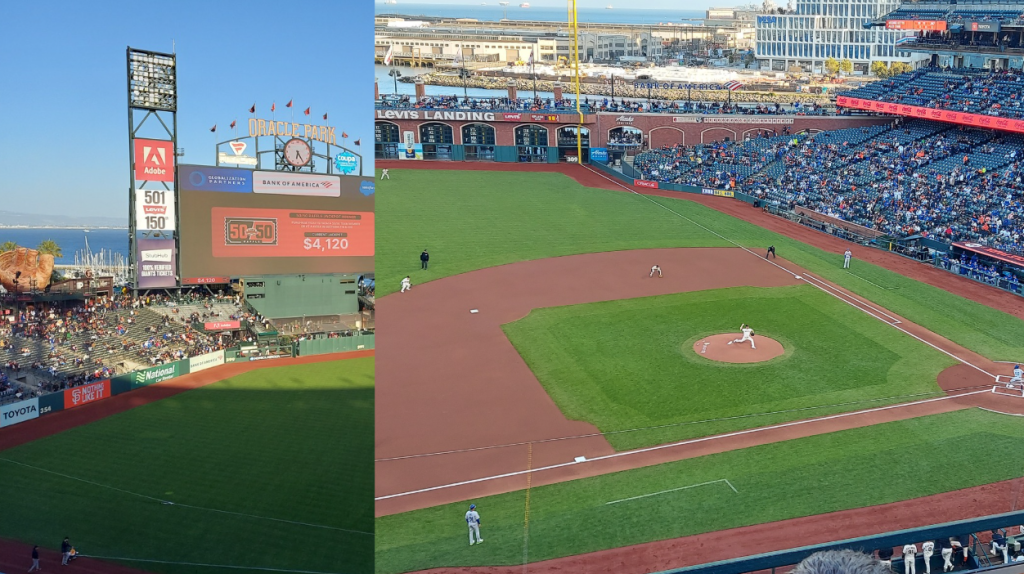
This naturally sets us up for one of Oracle Park’s most talked-about features: its menu, which is one of the best in MLB. I have yet to eat anything at Oracle Park that I’ve found worse than “really good.” They nail ballpark favorites like sausages/hot dogs, pizza, and burgers, while also offering more unique but also delicious items like lumpia, Asian chicken, birria grilled cheese, poke, and s’mores. This being San Francisco, there are also plenty of hip and healthy items as well. But there are three main items baseball fans from across the country seek out more than any other, and for good reason. The Gilroy garlic fries are a Bay Area staple and a notch above any other kind of fries I’ve had. The Ghirardelli Chocolate Company has a stand as well, offering a hot fudge sundae perfect for anyone with a sweet tooth. Then, we have the king, the pièce de résistance of Oracle Park’s menu, my personal favorite food item not just at any ballpark, but any sporting venue in the world: the crab sandwich at Crazy Crab’z. It’s simple, containing only Dungeness crab and tomato slices on buttery, toasted garlic bread. These sandwiches are phenomenal and, while quite expensive, are worth the money every single time. I would go to a Giants game just to eat another sandwich and I’m debating getting tickets as a I write this. If you want to wash it all down, Oracle Park has a great selection of drinks, from samples of wine from nearby Napa Valley to craft beer from breweries like Sierra Nevada, Lagunitas, Firestone Walker, and Russian River.
Also this being San Francisco, there are a few technological amenities at Oracle Park, which was one of the first MLB ballparks to provide good wifi throughout (creating one of the largest public hotspots in the world back in 2004). Chief among them is the @Cafe, which (in addition to serving coffee) allows fans to follow coverage and chatter surrounding the game on a variety of social media platforms and large screens. You can also watch the Giants’ social media team in action. For some more old school fun, the Bullpen Boardwalk under the bleachers offers classic games like skee-ball, pop-a-shot, and cornhole. Not to mention, Bullpen Boardwalk is also home to two more statues — LEGO versions of modern Giants greats Buster Poesy and Madison Bumgarner. Fans can also watch the game for free through small “knotholes” in right field, another tribute to older ballparks. Another unique feature is a fish tank installed by Animal Planet, containing fish native to the San Francisco Bay.
There are other, more private areas to enjoy the game, or at least your time in Oracle Park. Chief among them is the Gotham Club, a speakeasy-style social club located behind the right field scoreboard, letting visitors watch the game through a fence. There are other, more suite-like areas located in the right field area, a choice made in part because of the ballpark’s structure. That stretches down to the Press Club (no, Sacramento drinkers, not that one) with padded seating, and a promenade area with tables and chairs, not to mention the Coors Light Silver Bullpen. Closer to the field — much closer, right behind home plate in fact, the Batter’s Box and Audi Dugout Clubs offer some of the best seating in the ballpark. Meanwhile, the Club King area offers perhaps the most private, indoor setting in the ballpark, while the Flight Deck outdoor terrace not only has one of the only fire pits at a MLB ballpark, but incredible views of both the game and San Francisco skyline. There’s also a special section where fans can cheer on South Korean sensation Jung Hoo Lee, as part of the Jung Hoo Crew, on Friday, Saturday, and Sunday games (fans will also get a foam finger in the shape of the popular “heart” gesture that’s popular in Korea).
One main reason for selecting where exactly Oracle Park was built was for it to help revitalize the surrounding area, much like many other ballparks from the 1990’s/2000’s were tasked to do. Oracle Park has accomplished this goal in spades, with the ballpark surrounded by thriving restaurants, bars, and breweries. In addition, there’s a Cooperstown SF Baseball Hall of Fame exhibit within walking distance. There are also hotels and apartments nearby, though a lot of the former are a bit further out. This isn’t much of a problem on paper due to the several ways you can get to and from Oracle Park. Sure, you can get there by car, via the Bay Bridge and Interstate 80, which runs northwest of the ballpark. But driving in San Francisco is… complicated (more on that in a minute), meaning parking is sparse and traffic is terrible. Instead, you’d be better of taking public transportation. That includes the Muni Metro light rail (multiple stations nearby), Caltrain, and Bay Area Rapid Transit (BART), though you’ll have to hoof it a bit if you use the latter. Oracle Park is one of the few ballparks you can commute to via boat, with the Golden Gate and San Francisco Bay Ferries offering passage to and from the North and East Bay, respectively. It’s a similar manner to how some people who work in San Francisco commute every day.
It’s there that we touch on one of the biggest problems with Oracle Park, which, to be fair, is more of a problem with San Francisco as a whole. Getting there and getting around one there is painfully complicated, having to navigate complex mazes of road and rail. It’s a hassle to get to and the sheer effort alone (not to mention the fact that at some point you will have to run into traffic) turns a lot of people off. There’s also the safety factor. San Francisco is in the midst of a public safety crisis, with a huge spike in thefts, violent crime, and homelessness. Not only does this force you to look over your shoulder if you walk around even safer spaces like Oracle Park, but it means taking public transportation (BART in particular) is a frightening prospect. Given that the nature of San Francisco means public transport is by far the most efficient way to get around the city, you have to weigh safety and convenience in ways you don’t have to in other places. You also have to weigh in expenses, with San Francisco having a reputation of being among the most expensive places to live in the U.S. This is seen in transit costs, tolls, and — of course — ballpark amenities. The latter is something you can blame Oracle Park and the Giants for. Unless the Giants are terrible, tickets are incredibly expensive, with those price hikes matched by the cost of food and drink. While I’m willing to shell out for a Crazy Crab’z sandwich, I’m not happy about doing so for other, more basic options. All of this has put a bit of a damper on the overall desire to go to a game, which at some point has to take away from the total ballpark experience.
But if you do have the means to attend a Giants game at Oracle Park, you’ll get an incredible experience. Oracle Park is now around the middle of the pack in terms of the oldest ballparks in MLB, built in the middle of the retro ballpark revolution. Having the chance to see what others had done well, it’s laid out a venue that few have been able to match. Oracle Park not only takes advantage of a gorgeous setting, but is gorgeous itself, not to mention smartly and stylishly put together. It has incredible — albeit expensive — amenities and terrific offerings for all sorts of fans. While the Giants have been one of the more successful baseball teams of the 21st century, even they took a while to become truly elite. Oracle Park on the other hand was amazing out of the gate, and it’s gotten even better with time. With the Giants seemingly locked in San Francisco for good, it’s hard to imagine them ever leaving Oracle Park, and for good reason. It’s one of the true shrines to baseball and a place that any baseball fan should want to visit. Still, even with all of that said and even considering how fantastic it is, Oracle Park somehow isn’t even the best ballpark in California, or even its own division.
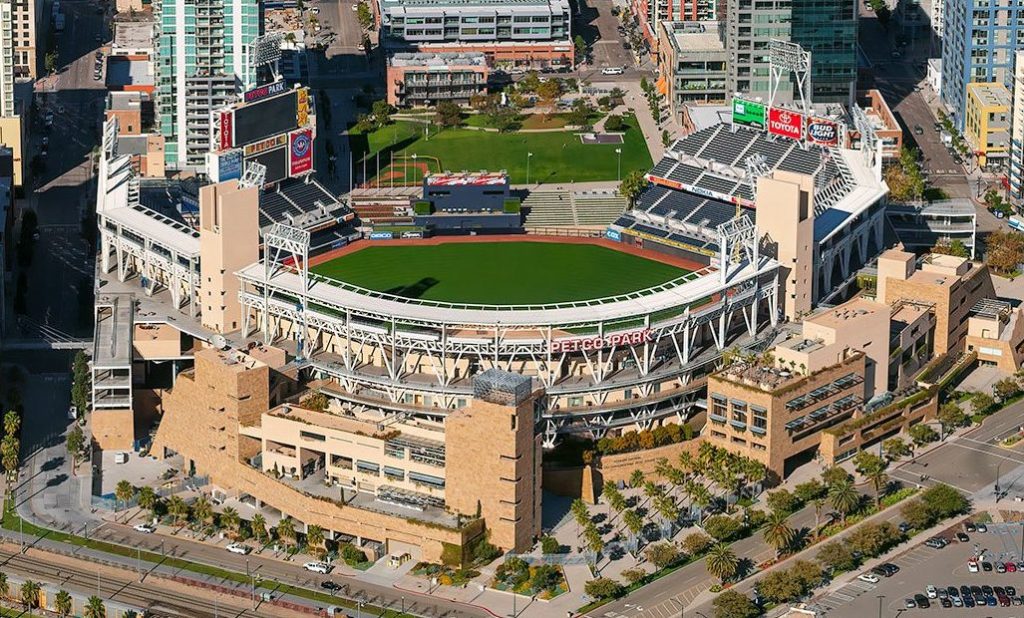
2. PETCO PARK
HOME TEAM: SAN DIEGO PADRES
LOCATION: SAN DIEGO, CALIFORNIA
OPEN SINCE: 2004
ORDER VISITED: 10 (08/24/19)
GAMES I HAVE SEEN THERE: 2 (1-1 HOME TEAM RECORD)
My first game at Petco Park was more memorable than the usual baseball game for three reasons. First, that trip officially took me into double-digits for MLB ballparks visited for the first time. Second, that game took place on the same day and at the same time that news of Indianapolis Colts quarterback Andrew Luck’s shocking retirement broke, so I was having to balance exploring and reviewing a brand new ballpark while freaking out and calling/texting my friends and family who were also freaking out about it. Thankfully, I went to the game the following day as well, going without major breaking sports news that time. Finally, it was memorable because Petco Park is an absolutely incredible ballpark, as evident by its placement on this ballpark list. I had a few friends who had visited Petco Park before me and could not stop talking about how awesome it was, so this was also the first time a ballpark was hyped up for me ahead of time (besides Fenway Park, obviously). To say that the hype was justified would be a huge understatement, as Petco Park not only immediately shot up towards the top of my rankings, but remained there even after I had seen a game at the two-thirds of MLB ballparks that were still on my list at the time.
For the first 30+ years of their history, the San Diego Padres played at San Diego Stadium (also known as Jack Murphy Stadium and Qualcomm Stadium). It was your classic cookie cutter concrete donut multipurpose venue, home to both the Padres and the NFL’s San Diego Chargers. While it was of a more innovative “octorad” style than your typical venue of this kind and was actually exposed on the right side for much of its life (looking somewhat like an actual ballpark), it still had your usual faults, and by the time the 1990’s ballpark revolution began it was clearly out of date. In fact, it would be those very issues with San Diego Stadium — as well as an inability to get a new stadium planned and funded — that the Chargers would cite among their reasons for leaving for Los Angeles in 2017. As for the Padres, the planning process was a bit easier, with voters approving funding for a new ballpark following San Diego’s run to the 1998 World Series. However, the project ran into massive problems and was actually halted for over a year due to financial issues. Eventually though, enough funding was secured to finish construction, with Petco Park making its MLB debut in 2004 and quickly establishing itself as one of baseball’s premier ballparks.
With the risk of turning this part of the ballpark reviews into a tribute, I must mention Larry Lucchino for a third time. You see, after he helped with the revolutionary design of Oriole Park at Camden Yards but before he helped renovate Fenway Park, Lucchino was with the Padres and played a big role in both that 1998 National League title and the construction of Petco Park. Turns out, he went 3/3, as Petco Park is a lovely place. Built with a retro-modern aesthetic, instead of the typical retro red brick and green contrast, Petco Park’s facade is made out of Indian sandstone and stucco, with its steel beams painted white and seats a dark blue. The design was meant to pay homage to the cliffs and sandy beaches, ocean water, and sails of boats going by off the coast of San Diego, respectively. While the color combination worked better when the Padres had a similar color scheme, it’s still a nice combination to look at (plus, the Padres objectively made the right decision to go with the classic brown and yellow look). Plus, with the way Petco Park arranges its just under 40,000 seating capacity (among the ten lowest in MLB) — the vast majority of them in between the foul poles — it kind of looks like a big blue wave about to crash down upon the field.
Perhaps that illusion of a wave is intimidating for opposing batters — that could help explain why Petco Park has historically been a pitcher’s park. At 339 feet, the distance from home plate to left field is relatively deep, though the 396 feet to center field and 322 feet to right field certainly aren’t. Still, one you start moving from right to center, the outfield wall just back pretty obtusely, and the left-center to right-center area is pretty deep. In addition, while not exactly spacious, Petco Park has a decent chunk of foul territory. All of this leads to a trend that, while there tend to be a decent amount of home runs in Petco Park, hits (particularly extra base hits) are limited. You’ve also got to imagine that Petco Park’s proximity to the ocean — the San Diego Bay is just several hundred feet to the south of the ballpark — plays a role in it. Plus, with the all too perfect weather in San Diego, air conditions aren’t likely impacted by excess heat or cold. While I’ve said I won’t give bonus points to ballparks for the weather conditions around them, I can at least point out how they’ll impact the actual baseball being played there. Maybe they’re distracted by the beautiful panorama of Downtown San Diego.
There are two main design features which set Petco Park apart from the rest. The first and most apparent is the seemingly random building jutting its way into left field. The area where Petco Park was built was once home to the Western Metal Supply Company. A four-story brick warehouse was among the buildings set for demolition. Instead, the warehouse was saved and integrated into the left field bleachers, with seats being added to the top three levels (as well as the rooftop). The Western Metal Supply Co. building is also home to bars, restaurants, a team store, and the San Diego Padres Hall of Fame, with the latter also highlighting the Pacific Coast League Padres team that came before the MLB version. The other notable design feature is located behind center field. On non-game days, Gallagher Square is a public park shaped like a baseball diamond. But on game days, you need a ticket get in. However, those tickets are the cheapest the Padres offer and fans can bring lawn chairs, blankets, or just sit down on the grass and watch a game (as a Sacramento native, I must say that, technically, Sutter Health Park did it first). It also includes a sand box for kids to play in. The sand used to be right behind the center field wall, with beach chairs acting as a sort of “beachers.” But, it was moved back due to safety concerns.
Gallagher Square isn’t the only nice thing in the immediate vicinity of Petco Park, which is located west of Interstate 5 and north of the San Diego-Coronado Bridge. Directly across the railroad tracks and Harbor Street, just southwest of the ballpark, is the San Diego Convention Center, a popular venue and home of the biggest annual event in the city: San Diego Comic-Con. By proxy, that means Petco Park is easy to get to. In addition to the several parking lots aimed at cutting down some of the notorious San Diego traffic, Petco Park is served by the Blue, Green, and Orange Lines of the San Diego Trolley. The proximity also means that the area is not only quite pretty, with countless palm trees dotting the plaza in front of the ballpark, but also that there are several hotels nearby, most notably the Omni San Diego Hotel at the Ballpark directly west and the Hard Rock Hotel San Diego directly west of that. But it’s directly to the north of the ballpark, past Gallagher Square, where most of the attention is focused. Petco Park opens up right into the Gaslamp Quarter, one of the more popular areas in Downtown San Diego when it comes to restaurants, bars, shops, venues, and other forms of entertainment and nightlife. It’s also quite stylish, with many of its buildings constructed in the Victorian era, an influence felt well across the pond.
While the Gaslamp Quarter has plenty of tasty offerings that are (probably) cheaper and better than what Petco Park can offer, it’s not by much, at least when it comes to the latter. Not only is Petco Park’s food and drink menu among the best in MLB, I’d argue that it’s actually the best, especially when it comes to alcohol. San Diego has a fantastic craft beer scene, with Petco Park offering brews from the likes of Alesmith, Ballast Point, Pizza Port, and Societe. A lot of these can be found along Craft Row in the main concourse behind home plate. Throw in a good selection of domestic and import options and there’s plenty of amber to go around. Fans are also spoiled for choice when it comes to food. Petco Park utilizes one of the go-to ballpark food groups, barbeque, and a local specialty, Hispanic food, to create options like the tri-tip nachos, elote hot dogs, ribs, burgers, and other meat-based sandwiches. San Diego-centric venues like Puesto, Hodad’s, Blue Water Seafood Market & Grill, Seaside Market, Pizza Port, and Dockman’s offer quality and variety, with the rest of the menu highlighted by things like Japanese curry, boba tea, gelato, and mini donuts.
To find some of these food and drink options, you may have to do a bit more hunting than you’d think. The third base side of the main concourse is what you’d imagine for a retro-style ballpark, with wide open spaces lined by steel beams and enough room to watch the game while waiting in line. But behind home plate and along the first base line, you’ll find a row of buildings that house many of Petco Park’s food stands. The gap in between these buildings creates a canyon-like concourse area, effectively serving as a food court. The area is multi-level, with long vines flowing down towards the lower level from plant boxes on the upper level. I’m of two minds about this. On one hand, it makes sense from a logistics standpoint, while providing a quieter spot for fans who need a bit of a break. But on the other hand, I don’t like that this big of a chunk of food and drink options is so far from the actual field of play. I’ve criticized other ballparks for doing this and for as good as it is, Petco Park isn’t immune. That being said, Petco Park does have hundreds of TVs throughout the concourse, letting fans watch the game in that sense. There are also TVs on some of the lower level seats further from the action, not to mention the videoboard behind center field (to the right of the multi-tiered bullpens), which has its own standing room only and bar stool seating.
While technology is scattered throughout Petco Park, there are also plenty of nods to history. Three statues of Padres greats stand outside of the ballpark proper. Two of them are located in Gallagher Square, with “Mr. Padre” Tony Gwynn’s statue facing off with Trevor Hoffman’s statue in a batter vs. pitcher formation along the diamond portion of the park. The other statue — of Jerry Coleman — can be found at the northeast part of the ballpark, outside the East Village Gate entrance at the corner of 10th Avenue and K Street. Inside the ballpark, there are tributes to a critical part of San Diego history and culture: the U.S. military. Behind the right field bleachers are displays to the city’s military history, as well as a shrine to the late Jerry Coleman, World War II and Korean War veteran and longtime Padres radio broadcaster. Sections of those same bleachers are typically reserved for military members and recruits every game. In addition, for every Padres home run or win, a ship’s whistle blows. That whistle is a recording of the whistle of the USS Ronald Reagan, which was ported in San Diego.
In addition to the Western Metal Supply Co. building rooftop, there are other specialized seating areas in Petco Park. The Estrella Jalisco Landing, Baja California Porch, and Skyline Patio on the third place side, along with the Kona Patio and Sunset Patio on the first base side, offer nice views and more comfortable seating. The City Cruises Home Run Deck and The Point give you close, unobstructed views, while the Picnic Terrace sits fans right behind the bullpen area. The Toyota Beach area behind right-center field is an open space that looks like a beachfront patio. For those with a bit of cash to splash, Petco Park has plenty of more private and comfortable options, particularly inside the Western Metal Supply Co. building. There are also plenty of options close behind home plate, while offering patio options that include the kind of chairs and tables typically seen in hotel lobbies. The Terrace Luxury Box is the best of both worlds, offering premium seating behind home plate next to the press box, which is named after Coleman.
One of the more unique and enjoyable aspects of Petco Park is something that can’t really be measured, only compared to the overall feeling you get while visiting San Diego in general (aside from when you’re stuck in traffic). The vibes at Petco Park are unlike any other at a ballpark I’ve visited — calm and overall relaxed. Granted, Petco Park is capable of transforming into an intimidating place to play for visiting teams in the rare instances that the Padres actually make the playoffs. Just being in San Diego, in a near-perfect climate, relaxes you enough. But the area surrounding Petco Park is nice and the ballpark itself is a looker. From the time you enter through Palm Court Plaza (the front area with the load of palm trees) through your time enjoying the nice sights inside the ballpark proper during the game to the time you exit through Gallagher Square into the Gaslamp Quarter, you get a sense of calm and chill vibes. I wasn’t even that stressed out watching my Boston Red Sox play, though that was largely due to sitting in a part of Petco Park where the sun shines annoyingly due to the ballpark facing the north. I know that’s not really chill but I wasn’t sure where else to put that.
Enough time has passed for Petco Park to barely be hanging on as one of the ten newest MLB ballparks. It had a difficult route to its debut, but once fans had a taste of it, they couldn’t get enough. Petco Park does the whole downtown ballpark thing better than arguably every other ballpark, with enough modern tweaks to set it apart and make it unique to San Diego and the Padres. Yet it doesn’t rest on its looks, offering high-quality amenities and quality views of baseball. Petco Park is just about as perfect of a ballpark as you can get, and it not only deserves its spot in this tier and high on this overall list, but rating it second overall somehow feels like a bit of a slight against it. Of course, it isn’t, and only having one ballpark above it is quite the honor. But many people rank Petco Park at the top of their lists, and the reasons are quite clear. Like I said at the start of this tier, if you have another ballpark in the tier as No. 1, I would agree with you. Still, when it comes to my own personal preference, there’s just one — only one — MLB ballpark that just about ranks one spot higher.
1. PNC PARK
HOME TEAM: PITTSBURGH PIRATES
LOCATION: PITTSBURGH, PENNSYLVANIA
OPEN SINCE: 2001
ORDER VISITED: 30 (04/06/26)
GAMES I HAVE SEEN THERE: 3 (1-2 HOME TEAM RECORD)
The Pittsburgh Pirates and their ballpark are in vastly different states than they were 30ish years ago. At the start of the 1990s, the Pirates were one of the best teams in baseball, narrowly losing in the NLCS for three straight seasons. However, for as good as they were, their ballpark was severely lacking. After leaving their longtime home of Forbes Field in 1970, the Pirates — along with their former Forbes Field co-tenants, the NFL’s Pittsburgh Steelers — moved into Three Rivers Stadium, which was (one more time!) a cookie cutter concrete donut multipurpose stadium. Like the many others like it, Three Rivers Stadium went for function over aesthetics, with its poor look and amenities — as well as location issues — leading to team officials calling for a new home, especially as the retro ballpark revolution began. It took until a new group of owners — led by Sacramento native Kevin McClatchy — took over the team for a plan to come to fruition and funding. A new home for the Steelers (now Acrisure Stadium) would be built next door to the east, while a new ballpark would be built a bit further to the west, both along the northern shore of the Allegheny River. Fast forward to today and the Pirates, now under the underwhelming ownership of Bob Nutting, have largely become an afterthought in the baseball world, having made the playoffs just three times since 1992. But when it comes to the Pirates’ home ballpark, well… just take a look at where it ended up in these MLB ballpark rankings.
PNC Park debuted in 2001 and was immediately considered to be one of the best ballparks in all of baseball, if not the best. In the quarter-century since then, its reputation has only grown even better. That starts with its looks, as PNC Park is one of the more aesthetically pleasing ballparks in MLB. Its facade was the first in MLB history to be made out of stone, specifically the same Kasota limestone lining Target Field. The limestone isn’t uniform, with lines of unevenly cut stone striping an overall smooth surface on the way up, while serving as the main base on the bottom as well. Several small arches are carved into the base as well, with the space serving as natural places for entrances, windows, ticket booths, and more. The rest of the facade is lines with panes of glass and, naturally (for both retro ballparks and Pittsburgh) steel. That steel is painted black (or at least very dark blue), serving as a natural contrast with the limestone, with that contrast also mirroring the Pirates’ color scheme. That black/dark blue color spreads to the seats as well, the vast majority of which are in between the foul poles. With a capacity of less than 39,000 (among the ten lowest in MLB), PNC Park’s seating layout creates an intimate environment, with it being the first two-level MLB ballpark built since Milwaukee County Stadium in 1953. This design also lets the ballpark’s most famous feature take center stage.
The one thing most people know about PNC Park is what’s beyond its outfield walls. The ballpark faces east, with Allegheny River, the Three Sisters (three yellow suspension bridges stretching over the River), and the Downtown Pittsburgh Skyline visible in that order in the distance. The result is without a doubt the best ballpark panorama in MLB, providing an incredible view that will leave anyone with working eyes stunned at its beauty. You almost forget to watch the actual baseball being played, which, given the state of the Pirates, is kind of a good thing. The large videoboard is located behind left field, the least beautiful part of the view, an intelligent design I don’t see a lot of praise for. The closest bridge to PNC Park — the one immediately in the background — is the Sixth Street Bridge, also known as the Roberto Clemente Bridge (after the Pirates icon). As nice as it looks in the panorama of PNC Park, part of the experience is also walking across the bridge to the ballpark, which also looks nice from that angle. Still, it’s not as nice as the main panorama. In fact, the skyline view is so nice that PNC Park is one of only a few ballparks with its home team dugout on the third base line, rather than the first base line, so players can take a look at it.
Of course, there’s like 1,000 bridges in Pittsburgh, the Roberto Clemente Bridge is far from the only way to get to the ballpark. A lot of that does come down to walking, with the ballpark’s proximity to that and several other bridges making it walkable despite not being in downtown proper. It helps that the Roberto Clemente Bridge is closed to vehicle traffic on game days. When it comes to traffic, there are plenty of parking lots right by PNC Park, which is good given that the ballpark’s location — just south of Interstate 294 in between the Roberto Clemente Bridge and Fort Duquesne Bridge. The Pittsburgh Light Rail system has a stop right by the ballpark, while the Pittsburgh Regional Transit has a stop along several routes nearby. I supposed it’s technically possible to travel to the ballpark by boat, parking it along the Three Rivers Heritage Trail. But if you do, you’ll have a bit of a hike, with a ten-foot grassy incline leading up from the picturesque walkway to the actual ballpark. This is so PNC Park could be protected if the Allegheny River flooded. On your way up, you’ll also encounter one of the more unique ways a MLB team displays part of its history: a winding path lined with large-scale versions of the Pirates’ retired numbers, complete with displays of the players who wore them. It’s like walking through Pirates history.
That’s far from the only tribute to Pirates of the past. Like most other teams, the Pirates placed statues of former greats outside of their ballpark. Starting from where you’d be after you walked from the river up through the path of numbers, you’d get to the center field gate, just east of the ballpark. That’s where you’ll find a statue of Roberto Clemente, followed by the Willie Stargell statue by the left field gate further up Federal Street. On the other side of PNC Park, behind the main home plate entrance, stands the famous Honus Wagner statue, a carry over from Three Rivers Stadium. Then, near the Allegheny River, is the statue of Bill Mazeroski, which commemorates his walk-off home run in Game 7 of the 1960 World Series. Naturally, it stands at the end of Mazeroski Way. That’s far from the only tribute to Pirates history at the ballpark, which is littered with them. The most prominent can be found near the left field gate. Legacy Square is the site of the Pittsburgh Pirates Hall of Fame, and was originally dedicated to the history of the Negro Leagues (specifically, Pittsburgh’s history with them). There are still tributes to those players today, though several statues of players for the Homestead Grays and Pittsburgh Crawfords (such as Satchel Paige and Josh Gibson) have since been relocated to the Josh Gibson Foundation.
Homages to Pirates history can also be found in PNC Park’s construction. The outfield light fixtures are reminiscent of those at Forbes Field, while the right field wall, which contains a detailed out-of-town scoreboard, is 21 feet high, a tribute to Clemente’s No. 21. The wall helps make up for one of the shorter home plate to right field wall distances, at 320 feet. It’s the same case for home plate to left field (325 feet) and center field (399 feet). So, PNC Park would naturally be one of the more hitter-friendly ballparks in MLB, right? Wrong — it’s relatively neutral and actually trends more towards being pitcher-friendly. That’s due the left-to-center field configuration. From the left field foul pole, the wall just backwards pretty significantly, going as far back as 410 feet in left-center before cutting back inward. This helps neutralize the impact of right-handed power hitters, limiting the amount of home runs given up. That being said, PNC Park has one of the higher rates of doubles in the league, with many more doubles than any other ballpark rated as hitter-friendly (or at least in that same neighborhood).
One of the more unique aspects of PNC Park’s design is how it manages to make typically negative aspects of other ballparks good, and even make its own negatives as positive as possible. For example: pedestrian ramps. I have written about how much I despise long pedestrian ramps that just go back and forth on the edge of ballparks. PNC Park has them as well, but these were built in a non-annoying way. There are major differences in levels between the home plate entrance and main concourse, and the third base side of the concourse to the left field bleachers. At both areas, you can either ride an escalator or go up a circular ramp that actually gives fans the feeling they’re making progress walking up or down it. Plus, they’re built in a cool style that looks like a giant black steel gazebo. Also, to get from the right field bleachers to the first base side of the concourse, you have to take the stairs, with a decent chunk of the walkway located behind the right field bleachers themselves. Instead of just leaving this area as one of the only places you can’t see the field of play, PNC Park double down by putting much of the kids playground area in this section, providing a natural reason for this isolation: a space to provide some calm for patents.
If there is a possible weakness to PNC Park, it comes in a surprising category: the food. This isn’t to say that PNC Park has a bad menu or anything, though it is a bit of a step down from most other ballparks in this part of the rankings. The biggest sin this menu commits is focusing on items that don’t quite fit my palate. I feel like PNC Park relies a bit too much on traditional ballpark foods, with even some of the local offerings focusing too much on these items. A lot of these local stands can be found along the first base side of the concourse, including Primanti Bros., a Pittsburgh staple. The pierogis, chipped ham fries, and crab fries are also pretty good. Ballpark Burghers offers plenty of interesting hot dogs, though I didn’t care to try their sausages. That’s mainly because they all came with a heap of toppings and I am one of those sick freaks who enjoys ketchup on hot dogs. Still, I think PNC Park managed to overcome my being the writer of these reviews, in large part because of the offerings in the outfield concourses (such as Manny’s BBQ in left field). That area is also home to the Rivertowne Brewing Hall of Fame Club, which offers plenty of tasty brews, as Pittsburgh’s craft brewery scene is placed on a proper pedestal at PNC Park.
Towards that end, there are some good public spaces to enjoy a drink or three. The Crow’s Nest, located in the main concession area along the first base/right field side, offers both good drinks and great riverfront views. The Surfside Iced Tea + Vodka Skull Bar on the edge of the right field area is one of the larger bars in the ballpark and offers similar views and drinks, but in a slightly more private setting. The Rooftop, high above the concourse in the left-center field area, has one of the better views of the ballpark proper, as well as sets of comfortable chairs and couches. Picnic Park — just off the riverfront area behind the outfield concourse — is full of places to sit and get away from the action. There are also a number of restaurants which are able to be accessed both from the main concourse as well as from the streets surrounding the ballpark.
For some of the fancier action, I actually have some experience. For the second game I attended at PNC Park, I accidentally got tickets to the club level, which I guess shows it’s not too expensive. For my money, I got access to the entire level from third base to first base, which is lined with carpet and fancy wood, as well as prime Pirates memorabilia, pool tables, and several bars and restaurants. You also have multiple porches where you can stand and watch the game from around the ballpark, in addition to your actual seat. Even fancier (read: actually expensive) options include the Left Field Lounge, which features a large dining area and full service bar. The Home Plate Club and VIP Lounge also offer luxury settings, some of which were so exclusive that I couldn’t even see what they were like on the inside by looking at the Pirates website. I can’t say the same for perhaps the fanciest offering at PNC Park: the World Series Suites located down the left field line. Weirdly, these suites seem to not only highlight the World Series which the Pirates won, but all of the ones they appeared in (even if they lost).
If you don’t have the cash to spend on these amenities or a ticket in general (which are kind of expensive), there are plenty of places to go around the ballpark. Like other retro downtown ballparks, PNC Park was meant to uplift the neighborhood around it, and it has indeed done just that. There are plenty of bars and restaurants long General Robinson and Federal Streets to the north and east, with hotels and other attractions like the Andy Warhol Museum in the area. To the west, there are tasty places like SugarBird, which offers fried chicken and donuts. But the main area for pre- and post-game entertainment is to the west, along North Shore Drive between PNC Park and Acrisure Stadium. In addition to multiple hotels and attractions like the Museum of Illusions Pittsburgh, there are a large number of newer bars and restaurants, offering everything from traditional Pittsburgh fare to the generic kind of burgers and beer you can find near many other venues. Still, the area is at least quite nice to look at, being near the river and all.
As you wait in line outside the home plate entrance, perhaps standing next to the Honus Wagner statue, you’ll hear a message from the PA announcer, which says, “welcome to PNC Park — the best ballpark in baseball!” While I initially found that to be a bit arrogant, after experiencing the ballpark for the first time — in freezing weather as the Pirates lost, no less — I had to admit that while it was a little pretentious, that claim wasn’t a lie. PNC Park isn’t without its faults, or at least areas that don’t quite reach up to those of other ballparks. However, it not only gets the vast majority of what it means to be a ballpark right, it blows expectations out of the water. PNC Park is beautiful and offers views so incredible they verge on distracting. It’s intelligently built and serves as the perfect home to the Pirates, who don’t play nearly well enough to deserve such an incredible ballpark. Its design is timeless, with few fans imagining the Pirates ever moving on from it. I certainly hope they never do, or at least don’t in my lifetime. PNC Park seems to be designed for the long haul, which can only benefit the Pirates. It’s easily the team’s most valuable asset, even considering Paul Skenes. While some may look at the date of my first game at PNC Park and claim recency bias, consider that I had nearly all of the current MLB ballparks under my belt and was still blown away by what PNC Park has to offer. It’s simply the best, and PNC Park rightfully takes the crown as the No. 1 ballpark in MLB.
So, there you have it. My MLB ballpark rankings are officially in the books. In case you don’t remember or don’t want to go back to the previous two parts for reference, here’s my full tier list, in order in each tier from left to right. I didn’t feel like doing all of the work with uploading my own pictures, so I tried to update the logos on the one I found as best as I could.
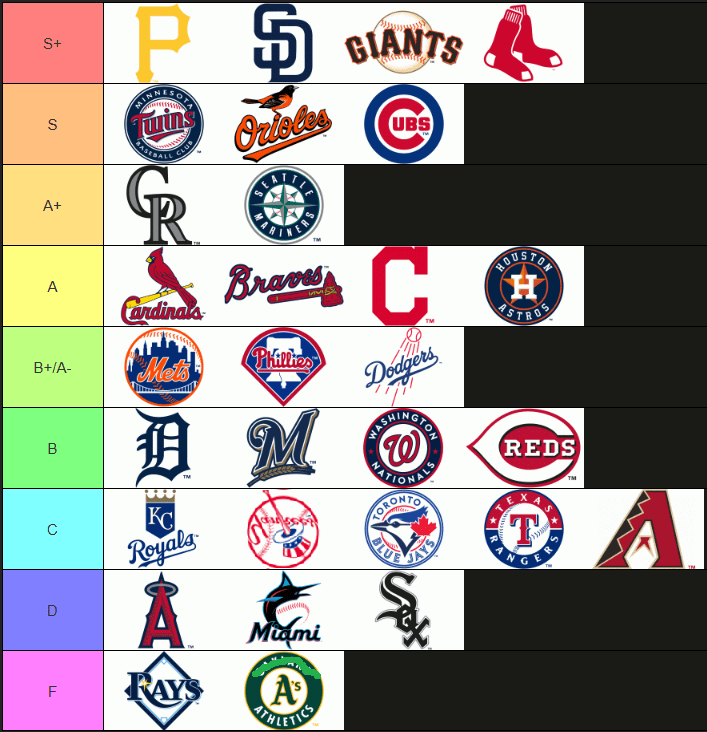
If you want to just scroll onto the very end, go ahead. But I’ve got a little bit more to go. Baseball fans are, among other things, a fan of deep dives into seemingly random statistics. So, I thought I would break down my rankings to see which league and divisions have the best ballparks. Here are the results based on average rankings.
| AVG. RANKINGS | American League | National League |
| East | 16.8 | 17.2 |
| Central | 16.6 | 11.2 |
| West | 20.4 | 10.8 |
| Total | 17.9 | 13.1 |
The National League is the clear winner here, with the NL West and NL Central being the best two divisions overall. Meanwhile, the AL West is notably the worst overall division, though that could change if the Athletics nail their new Las Vegas ballpark. Also no, I’m not sure how the total average rankings of 30 ballparks add up to 31. Just ignore it. I mean, I reviewed 31 ballparks, anyway.
I also thought it would be fun to look at how each team has done when I’ve seen them play, by tallying up the record of my 50+ MLB games attended, based on the home team’s performance. I lost track of how many times I wrote “GAMES I HAVE SEEN THERE: 1 (0-1 HOME TEAM RECORD)” across all three parts. So, let’s see just who benefits from my presence.
| TEAM | TIMES SEEN | BALLPARKS SEEN AT | OVERALL RECORD | HOME RECORD |
| Angels | 4 | 3 | 3-1 | 1-0 |
| Astros | 2 | 2 | 1-1 | 0-1 |
| Athletics | 8 | 3 | 5-3 | 5-2 |
| Blue Jays | 1 | 1 | 1-0 | 1-0 |
| Braves | 1 | 1 | 1-0 | 1-0 |
| Brewers | 1 | 1 | 0-1 | 0-1 |
| Cardinals | 3 | 2 | 2-1 | 1-1 |
| Cubs | 5 | 4 | 4-1 | 1-1 |
| Dbacks | 2 | 1 | 1-1 | 1-1 |
| Dodgers | 2 | 2 | 1-1 | 0-1 |
| Giants | 4 | 1 | 1-3 | 1-3 |
| Guardians | 2 | 2 | 0-2 | 0-1 |
| Mariners | 3 | 1 | 2-1 | 2-1 |
| Marlins | 2 | 2 | 2-0 | 1-0 |
| Mets | 3 | 3 | 1-2 | 0-1 |
| Nationals | 3 | 2 | 1-2 | 0-1 |
| Orioles | 1 | 1 | 0-1 | 0-1 |
| Padres | 7 | 3 | 4-3 | 1-1 |
| Phillies | 2 | 2 | 1-1 | 0-1 |
| Pirates | 3 | 1 | 1-2 | 1-2 |
| Rangers | 3 | 3 | 1-2 | 0-1 |
| Rays | 5 | 4 | 4-1 | 1-0 |
| Red Sox | 19 | 13 | 8-11 | 0-2 |
| Reds | 2 | 1 | 1-1 | 1-1 |
| Rockies | 3 | 1 | 2-1 | 2-1 |
| Royals | 3 | 3 | 1-2 | 1-0 |
| Tigers | 3 | 3 | 2-1 | 1-0 |
| Twins | 3 | 2 | 0-3 | 0-2 |
| White Sox | 2 | 2 | 0-2 | 0-1 |
| Yankees | 2 | 2 | 1-1 | 1-0 |
| TOTAL | 102 | 52-52 | 24-28 |
I knew I had a negative record when it came to seeing the home team win, and this confirms it. The Athletics’ home record keeps that ratio from being abysmal, and given my luck at their games, it’s a wonder my many A’s fan friends don’t pay me to attend. Also, not only are the Red Sox definitively the team I’ve seen play the most (as expected), but they’re closer to 20 games seen than anyone else is close to ten. That being said, the Red Sox are one of just two teams (along with the Twins) who I’ve seen play at home multiple times but have yet to win while I’m there. That and a losing record overall are the prices I pay for that World Series win. By the way, the Twins and the Guardians are the only teams I’ve yet to see win despite seeing them play multiple times. On the flip side, the only two teams I’ve yet to see lose are the Braves and Marlins, with the Marlins of all teams being the sole unbeaten team that I’ve seen play multiple times. Finally, while I knew the Red Sox would be the team I’ve seen play the most, I thought the A’s would be the clear second. But, the three-game series I saw the Padres play in Pittsburgh pushed them into a near tie. The rest of the Top 5 isn’t surprising, with the Rays seemingly popping up everywhere and the Cubs benefiting from my trip to Chicago to be tied with five games each — as well as identical 4-1 record. Shoutout to the Cubs for providing one of the times I got to see the Red Sox win on the road.
Looking back at those 50+ games, you’d have to imagine that I’ve seen some pretty interesting things on the diamond. You’d be right, and given that I can’t seem to write anything without a Top 10 list, you know what’s next.
TOP 10 MOST NOTABLE THINGS I’VE SEEN AT A MLB GAME
To be specific, these are moments that took place during the actual games or experiences I had while the games were taking place. Everything here happened between the first pitch and the final out. That includes things that technically didn’t take place while the game was happening.
HONORABLE MENTION: RAIN DELAY RAT
The first rain delay I experienced was in 2021 at Progressive Field. My dad and I were sitting in the upper bowl, and had to run back into the concourse and find a small covered space by the entrance to one of the restrooms to hide in. As we waited out the rain, I looked out onto the empty concourse and saw that it actually wasn’t empty — a small mouse had emerged and was scurrying across the concrete. As I was wondering if I had ever even seen a mouse in person before (I had seen a few rats), the mouse scampered away, and the rain stopped soon after.
HONORABLE MENTION: MILESTONE REACHED
Being able to see a player reach a personal milestone is pretty cool, even if you don’t really care about that player. This has happened to me twice. The first came in 2017 at then-Safeco Field, when me and two of my friends were in the house to watch Nelson Cruz hit a three-run bomb over the left-center field fence for his 300th career home run. Unfortunately, my friends and I were rooting for the Athletics, who were the visiting team, so it wasn’t as fun. Still, that was also the game where I tried chapulines (toasted grasshoppers with chili and lime) for the first time.
HONORABLE MENTION: THE CHEESE BRAT INCIDENT
Brats are my go-to ballpark food, but during my first game at Target Field in 2026, they betrayed me. Seeking sustenance and warmth, I purchased a brat with melted cheese in it. Some of the cheese drizzled out as I was eating it on the way back to my seat. But then, while I was on an escalator, I took a bite — a hot stream of cheese shot out and not only got in my beard, but hit the wide of the escalator. I turned to see if anyone saw that, and three steps behind me was an attractive woman with a look of pure disgust on her face. I wonder why I’m still single…
T10. TANTALIZING TANAKA
Even though I try not to do so, I’m the kind of baseball fan that starts thinking about things like no-hitters and perfect games after the first inning. Unfortunately, I have not seen any such sort of pitching performances, though I have been in person for a complete game shutout. But even more unfortunately, that complete game shutout was thrown by a member of the Yankees. The one game I attended at Yankee Stadium in 2019, Masahiro Tanaka took the mound and was magnificent, shutting down the Rays offense. Throwing 111 total pitches, Tanaka gave up only two hits and allowed just one walk, while striking out ten batters in a 3-0 Yankees win. I didn’t actually see the final result, as my dad and I, not wanting to see the Yankees win in person, left before the ninth inning. Objectively, this entry should be a lot higher, given the whole complete game shutout thing. But this is my list and I am a Red Sox fan, so it’s here. Also, did I include a tie for 10th so I can technically claim a Yankees win didn’t make the Top 10? I plead the fifth.
T10. SPECTACULAR SKENES
To be fair, this game deserved its own entry. My second game at PNC Park in 2026 was the game where I unintentionally bought a club seat and got to enjoy the luxuries of the ballpark, while having access to indoor heating on an incredibly cold night. But that wasn’t even the best part. What truly stood out was being able to see Paul Skenes pitch. The (as of this writing) reigning National League Cy Young Award winner was absolutely electric, and brought a notable change in the atmosphere at the ballpark compared to the night before. Skenes was at the top of his game, carrying a no-hitter against the Padres into the sixth inning. One out away from the end of the sixth, a woman near me said out loud that Skenes was throwing a no-hitter. Another woman near my openly asked why she would say that out loud. Not even five seconds later, Fernando Tatis Jr. hit a single into left field to break up the no-hitter. Skenes still went six-and-a-third innings and struck out six, but I blame that first woman for ruining the no-hitter.
9. EXTRA-INNING AFFAIRS
I’ve seen a few extra-inning games, averaging just over 10% of the games I’ve attended. The longest any of those games have gone is 12 innings, which has happened to me twice. The first was at the Oakland-Alameda Coliseum in 2021 — the first sporting even I attended after the COVID-19 pandemic broke out. The Athletics rallied from down two runs in the 12th inning to win on a walk-off sacrifice fly to left field by Tony Kemp. It was good timing, because had the game gone on another inning, we would’ve risked missing our train back to Sacramento. Then, in 2024, I was at Coors Field as the Rockies rallied from deficits in both the tenth and 12th innings to walk off on a bases loaded single to right-center field by Ezequiel Tovar. So, why is this entry this low? Guess who was the visiting team on both occasions. Yep, the Red Sox. If I had a nickel for every time I’ve seen my favorite baseball team lose on a walk-off in the 12th inning, I’d have two nickels, which isn’t a lot, but it’s weird (and painful) that it happened twice.
8. THE DUMBEST GAME
While you can make an argument for several options when it comes to the best MLB game I’ve ever seen in person, there is no contest when it comes to the dumbest. That honor goes to the game between the Twins and Royals at Kauffman Stadium I saw in 2026. First off, it was incredibly foggy and got worse throughout the night. There were multiple times where the fog impacted the game, including the Twins dropping an infield pop-up, allowing the Royals to score. Then the rain began, getting worse to the point where in between innings, the grounds crew had to pour bags of dirt onto the pitcher’s mound and home plate to keep them dryish. At the end of the sixth inning, the Royals were leading 12-1, giving enough of an excuse for the game to be suspended, if not called outright. But for some reason, they kept on going, keeping everyone cold and wet. Then the Twins scored eight runs in the final three innings and kind of made a game of it, before ultimately falling 13-9. It was so cold and so incredibly dumb.
7. A GOLDEN WEEKEND FOR GOLDSCHMIDT
In 2024, I could’ve seen three games at Busch Stadium. But wanting to watch the St. Louis City FC game on the day of the second game in that series, I didn’t. It was a good decision, as that game was a blowout and the other two were compelling. The first game, the Nationals rallied to force extra innings, where they held on to beat the Cardinals 10-8 in ten innings. The Cardinals scored twice in the bottom of the tenth, courtesy of a two-run home run to left-center by Paul Goldschmidt. That home run happened to be the 2,000th hit of Goldschmidt’s career, and I had no idea he was that close until the graphic flashed on the videoboard afterwards. Two days later, I was back in Busch Stadium, where it would be the home team’s turn to rally. Tied entering the bottom of the ninth, Goldschmidt came to the plate first and slapped a walk-off home run over the left field wall, as the Cardinals won 4-3. I happened to be in the left field concourse at the time, so I got to see the ball land in the stands from a pretty close distance.
6. A TALE OF TWO HOME RUNS
Before the second game I went to at Fenway Park in 2019, my dad and I took a tour of the ballpark. While we were on the Green Monster, Xander Bogaerts gave a ball to a hitting coach, who threw it up to where we were — and I caught it! Had this happened during the game, it would easily by a Top 2 moment. But at least it set up what happened in the second inning of that game. Bogaerts stepped up to the plate and, in his first at-bat, smacked a home run to center field. I launched into a series of swears that were drowned out by the noise at the ballpark, as Bogaerts became my favorite Red Sox player since David Ortiz retired three years earlier (I will never forgive the Padres for taking Bogaerts away from me). However, the Red Sox would go on to fall to Rangers 9-5, with the lowlight coming in the sixth inning, when Hunter Pence somehow managed to hit a standing up inside-the-park home run. What Brock Holt did on that play might’ve been the dumbest thing I’ve ever seen on a baseball field as well.
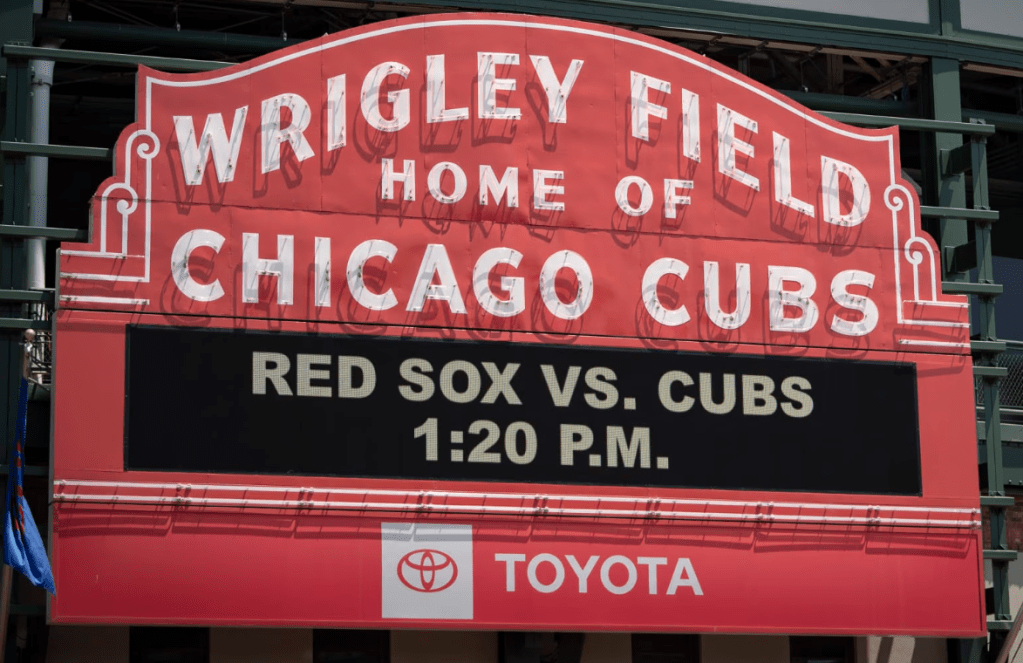
5. A SPECIAL OCCASION
Sometimes, you know a game is going to be special even before you walk into the ballpark. That was the case in 2025, when I walked into Wrigley Field to watch the Cubs host the Red Sox. That is the kind of matchup that screams “baseball” — two of the sport’s oldest and most popular teams facing off in one of the most historic venues in sports. I had wanted to go to Chicago for a long time and finally picked that game to make it happen. The feelings began as soon as the Red Line train pulled into Addison station, at which time the driver got on the loudspeaker and wished everyone but Red Sox fans good luck. That got a laugh out of me and the rest of the train, but thankfully for me, I would end up with the last laugh as well. Wilyer Abreu homered twice and Alex Bregman added a three-run bomb of his own as the Red Sox won 6-1. Knowing just how special this occasion was, I made sure to get my sightseeing and food/drink purchasing in before the first pitch, as I watched all nine innings from my seat.
4. SISTER SISTER
In 2021, my little sister said she needed a vacation, so I organized a trip for us to Seattle. We ended up catching two Mariners games at T-Mobile Park, which was part of the plan, as the Red Sox were in town. Before the second game, we attended a Seattle Sounders game, which ended with a stoppage time winner for the home team. We then made our way to the ballpark, where the Red Sox were losing 2-1. They managed to tie it shortly after, but the score remained the same when we went to get food in the eighth inning. The Red Sox strung some offense together and loaded the bases with one out. We ran back to our seats just in time to watch Kyle Schwarber double deep to right center, bringing home all three runners. Alex Verdugo followed it up with a two-run home run, as my sister and I silently went crazy as to not piss off the many Mariners fans around us. The Red Sox won 8-4, which was nice. But it was even nicer to share that rally and victory with my sister, who simply deserves all the happiness in the world.
3. A CRISP CATCH
Looking back, it’s pretty wild that the third ever MLB game I attended was a playoff game. Going with a pair of friends — one of them a diehard Athletics fan — we went to the Oakland-Alameda Coliseum to catch Game 3 of the 2012 ALDS, which the A’s needed to win to keep their season alive. The game had a rowdy and raucous atmosphere, with our seats among the right field bleacher creatures putting us right in the middle of the chaos (we may have taken park in a “DUI” chant when Miguel Cabrera came up in the bottom of the ninth. It was also a close contest, with every play mattering. Perhaps no play was more significant than in the top of the second, when Prince Fielder hit what seemed to be a game-tying home run to center field. Enter Coco Crips, who rose up to snatch the ball at the wall. Of course, the Coliseum having obstructed views, I didn’t actually see the catch happen. But I reacted to the cheers of the crowd when it did. The A’s won 2-0 and we high-fived several people on our way to the parking lot.
2. WHAT A THROW
Only once in all of the MLB games I’ve ever attended have I feverishly texted friends and family to watch what had just happened in front of me. In 2025, I traveled to Truist Park to (hopefully) watch the Braves take down the Yankees. In the top of the third, the Braves were up 3-0, but the Yankees were threatening with runners on first and second and one out. Up came Cody Bellinger, who hit a deep fly ball to right field. Ronald Acuña Jr. was able to make the catch, but the runner on second, Jorbit Vivas, tagged up for what seemed to be an easy steal of third. But as it turned out, Acuña had a cannon for a right arm. Acuña unleashed a 301-foot frozen rope from right field directly to third, where Nacho Alverez Jr. made the tag to get Vivas out and end the inning. The jaw of every fan in attendance (including mine) dropped to the floor at the incredible defensive play. Yes, Vivas did slow up towards the end of his attempt. But Acuña’s throw was simply otherworldly and, no hyperbole, remains among the greatest defensive plays in MLB history.
1. A FAN’S ULTIMATE DREAM
I mean, what else was it going to be? I could go to 500 more MLB games in my life and never experience a moment as incredible as I did that night at Dodger Stadium. Taking the gamble of a lifetime, I bought a ticket to Game 5 of the 2018 World Series less than 24 hours before first pitch without any confirmed way of getting there or back to Sacramento. I managed to make those arrangements, being driven down to Los Angeles with little sleep but plenty of nerves. I sat behind left field as Steve Pearce (twice), J.D. Martinez, and Mookie Betts hit home runs, while David Price was a beast on the mound, going seven innings and retiring 14 batters in a row at one point. In the end, Chris Sale got Manny Machado to hilariously strike out on his knees for the final out, as the Red Sox won the 2018 World Series. My gamble had paid off, as I achieved the ultimate dream of any baseball fan: see your favorite team win the World Series in person. It’s not just my favorite moment as a baseball fan, but as a sports fan in general.
One thing I’ve learned through all of this is that games are much more enjoyable when you have someone to enjoy it with. So, for one last look back, I thought I’d tally up just who I went with for all of (well, most of, anyway) these games. Below, I’ve noted every single person I’ve gone to multiple games with — including everyone I’ve gone with to at least one game would be almost impossible, as I don’t remember everyone who was in the large parties of some games I attended and I don’t want to put that much effort into figuring out. For those that did make the list, I’ve included the amount of games they’ve gone to with me, as well as the number of different ballparks we’ve been to together, the home teams’ combined record, the team we saw the most often together. I’ve also included myself, because while I would’ve rather gone to all of these ballparks with someone, I had to get the job done and solo traveling is fun. Plus, you have to learn how to live with yourself at some point in life, and living includes going to baseball games.
Anyway, with apologies to the likes of my mother, Uncle Jerry, Camille, Aly, Arik, Patty, Riaz, Danelle, Darla-Tess, and anyone else whose name I forgot, here’s the current tally.
| PERSON | TOTAL GAMES | HOME TEAM RECORD | TOTAL BALLPARKS | MOST SEEN TEAM |
| Me (solo) | 27 | 11-16 | 18 | Red Sox |
| Dad | 9 | 3-6 | 8 | Red Sox |
| Jimmy | 6 | 5-1 | 4 | Athletics |
| Kyle | 5 | 3-2 | 4 | Athletics |
| Ewing | 4 | 1-3 | 3 | Giants |
| Allison | 4 | 3-1 | 3 | Athletics |
| Chriss | 3 | 2-1 | 3 | Athletics |
| Gabby | 3 | 1-2 | 2 | Red Sox |
| Nick | 2 | 1-1 | 2 | T-4 |
| Gee | 2 | 2-0 | 1 | Athletics |
Yeah, those group trips to A’s games are doing numbers. As it turns out, the games I’ve seen at the two worst ballparks on my overall list were some of my most memorable, because they all happened with friends and family. That would be my advice to those trying this quest for yourself: try not to go alone. These ballparks all make for great experiences (or at least memorable ones), and experiences are best shared with those you care about.
Well, at long last, we’ve finally reached the end of our journey. If you’ve read along with all of my ballpark ramblings throughout all three of these parts, I sincerely thank you. This trip was a passion project, as was putting this all together. I highly encourage any baseball fan to try to do this if they have the means to do so. Not only is it a neat way to experience all of what the majors have to offer, but it’s fun and enriching to spent time in all of the MLB cities and experience the history and culture they have to offer. It’s also allowed me to keep my overall urge to travel satiated. Many people have asked me what’s next. To be honest, I’m not sure. I have no urge to see every venue for the rest of the major sports leagues. I supposed maybe seeing all 50 states, a goal which these ballpark trips definitely helped.
What I can definitely say is that not only am I not done going to MLB games, but I’m also not done with exploring new ballparks. After all, Las Vegas is coming in 2028, not to mention the new ballpark on the horizon for Kansas City. I plan to keep this list updated and adjust my rankings as new ballparks are built and debut in MLB. I’m excited to see what the future of ballparks has to offer, and how America’s past time continues to evolve into the future.
 Ruben's Writings
Leave a comment