We are one third of the way through our journey across the MLB ballpark landscape. Spoiler alert: we will be through the second third by the end of this part. Fortunately, this part doesn’t not include an introduction longer than a pre-pitch clock playoff game. So, let’s pick up where left off. To do that, we have to go up a tier.
B TIER
As I mentioned in the previous part, my main takeaway from this journey is that MLB has way more good ballparks than bad ones, forcing good ballparks into the bottom half of these rankings due to nothing but pure math. That’s what every entry in this tier is: a pretty good ballpark. Fans of teams who call these ballparks home should be happy that they can visit a good place to watch their favorite team play a game at least 81 times a year. While these ballparks all certainly have their faults (and I will definitely address those), we’re starting to enter the territory of comparing ballparks not just by whose weaknesses are worse, but more so whose strengths are better. I did think about separating this tier into two separate ones, but ultimately I thought there wasn’t enough of a distinct difference between enough of these ballparks to warrant a move. Plus, I will get more nitpicky towards the top of the list. We’ll save that for then. As for this tier, we’ll begin at the place my quest for 30 came to an end for the first time.
20. GREAT AMERICAN BALL PARK
HOME TEAM: CINCINNATI REDS
LOCATION: CINCINNATI, OHIO
OPEN SINCE: 2003
ORDER VISITED: 31 (04/10/26)
GAMES I HAVE SEEN THERE: 2 (1-1 HOME TEAM RECORD)
Here’s a trivia question for you: what was the first professional baseball team? Given that this section is about the Cincinnati Reds’ home ballpark, you may be surprised to discover the answer to that question is… the Cincinnati Reds (back then, they were called the Red Stockings and won 130 straight games). During their nearly 160-year professional history, the Reds have played in seven different home ballparks, including Riverfront Stadium. That venue (opened in 1970 and renamed Cinergy Field in its final years) served as the home of the Big Red Machine, as well as the Reds’ most recent World Series-winning team in 1990. But despite the success of the team and fans’ appreciation, it was among the multitude of generic turf-filled cookie cutter concrete donut multipurpose stadiums, also being the home of the NFL’s Cincinnati Bengals and (briefly) the University of Cincinnati’s football team. But in 1996, voters approved a sales tax increase to fund new individual venues for their teams. Paul Brown Stadium (now Paycor Stadium) was opened for the Bengals in 2000, just to the west of Riverfront Stadium’s location along the Ohio River. Three years later, despite having been converted to an all-baseball venue and getting natural grass, Riverfront Stadium was officially replaced when, directly to the east, Great American Ball Park opened as the new home of the Reds.
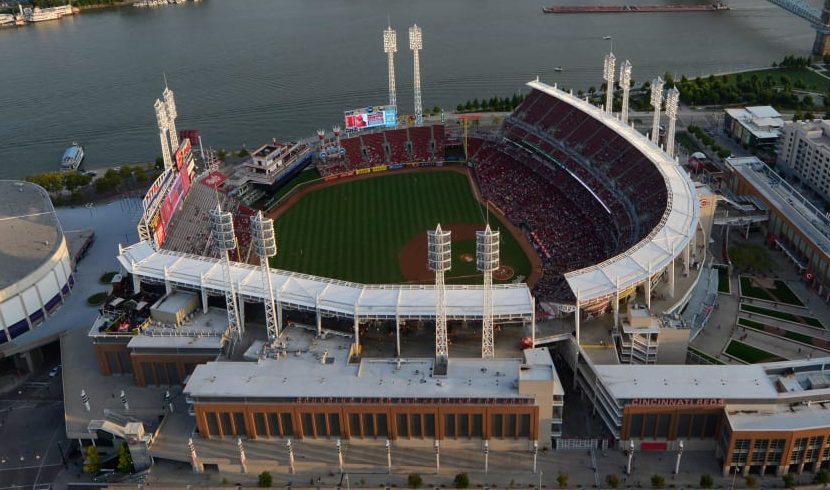
Perhaps no ballpark integrates and displays the history and culture of its home team better than Great American Ball Park does for the Reds. The north side of the ballpark area along East Second Street (Johnny Bench Way) features a three-story brick and limestone building adorned with former Reds player/longtime broadcaster Joe Nuxhall’s iconic sign-off, “rounding third and heading for home.” The side of the western half of that building (I’ll explain why it’s cut in half in a minute) features “The Spirit of Baseball” — an Indiana limestone bas relief carving depicting a young child looking up at several baseball players flanked by Cincinnati landmarks in a way that kind of reminded me of old school propaganda posters (maybe McCarthy was onto something…). The plaza outside the main entrance on the northwest side of the ballpark has one of the coolest displays of team history I’ve ever seen. Dubbed Crosley Terrace (after Crosley Field, the Reds’ longtime home before Riverfront Stadium), the plaza features several long grass islands with dirt shaped like an infield adorned with statues of several Reds legends, including Nuxhall, Frank Robinson, Ernie Lombardi, Ted Kluszewski, and even former broadcaster Marty Brennaman. New this year: a 16-foot custom red street clock, gifted by Joey Votto, that plays an instrumental version of “Take Me Out to the Ballgame” at the top of every hour.
Right by that same entrance on the west side of Great American Ball Park is the Cincinnati Reds Hall of Fame and Museum, a two-story building that’s perhaps the best individual team hall of fame in all of MLB. The first floor (which connects to a team shop) features an exhibit dedicated to the Big Red Machine and their back-to-back World Series titles from 1975-76, as well as a giant wall filled with 4,256 baseballs — one for every hit Pete Rose collected over his career (there is also a rose garden nearby for similar reasons). The top floor is filled with a staggering amount of Reds artifacts — everything from uniforms and equipment to programs and merchandise and all kinds of souvenirs — all arranged by era. It also includes scale models of several former Reds ballparks and relics from those venues. Another room includes a display seemingly out of Star Wars that lets you call up images and histories of former Reds players, as well as another room honoring current and former Reds media members. It is absolutely fantastic and well worth a visit before the game. If you want even more history, just look directly south of the Hall of Fame and see the 1869 Red Stockings Pavilion, a monument dedicated to that first ever professional baseball team.
The integration continues inside Great American Ball Park itself, which is a nice mix of modern architecture and classic ballpark features. Perhaps the two most prominent features are located behind center field. Known as the Power Stacks, these two giant smokestacks are reminiscent of those on steamboats along the Ohio River. Speaking of, there’s a two-level bar next to the Power Stacks shaped like a steamboat, along with a truck a fan can win if a Reds player hits a home run in a certain area. There are scoreboards behind both the right and left field bleachers — while the right field one is newer, the left field one is more iconic and includes a replica analog clock from the Crosley Field era. Just inside the Crosley Terrance entrance is a pair of giant mosaics — one featuring the 1869 team and another featuring the “Great Eight” roster of the Big Red Machine. Another display is on the floor, which also highlights the Reds being the first professional baseball team.
In addition to these pieces, Great American Ball Park also has MLB’s first in-venue team chapel and first nursing suite for fans. But arguably the most unique aspect of Great American Ball Park can be seen from afar — in fact it might’ve looked like a glitch or at least an error in construction. There is a 35-foot wide break in the stands between home plate and third base, which also separates that building on the north side as well. This space — called “The Gap” or “Gapper’s Alley” — is designed to provide people a glimpse into the ballpark from the outside — and a chance for fans to look outside at Downtown Cincinnati. It does its job well — I could see the outfield bleachers while walking along Sycamore Street several blocks away. Inside Great American Ball Park, you can also stand in that break in the concourse and watch the game from an nice vantage point. One interesting and perhaps unintended consequence of the Gap is that it allows wind to be filtered through it and into the field of play, pushing balls further from behind. This, combined with its relatively short dimensions and overall minimal foul territory (leading to a Top 10 capacity of 43,500), make Great American Ball Park one of the most hitter-friendly ballparks in MLB.
Getting to Great American Ball Park is as easy as looking into the ballpark through Sycamore Street. Downtown Cincinnati has a free streetcar system called the Connector that has a stop a block away from the ballpark. The Southwest Ohio Regional Transit Authority (SORTA) Metro has a bus stop nearby and Cincinnati’s Red Bike system has a depot there as well. Of course, there are some parking lots nearby, most notably to the east of the ballpark. But the area is still pretty walkable, and in a way you might not think. Great American Ball Park is the first ballpark so far where we need to consider commuting from another state. Cincinnati is located on the border of the Ohio River, with Kentucky on the other side. There are several bridges along the river you can drive over from Kentucky to get to the ballpark, as well as a purple bridge just for foot traffic. The two closest bridges to the ballpark — the John A. Roebling Suspension Bridge to the west and the Taylor Southgate Bridge to the east — are good for both foot and road traffic and take you the cities of Covington and Newport, Kentucky, respectively. The latter area is much nicer, though the former does have a stop along the Transit Authority of Northern Kentucky (TANK) route to the ballpark.
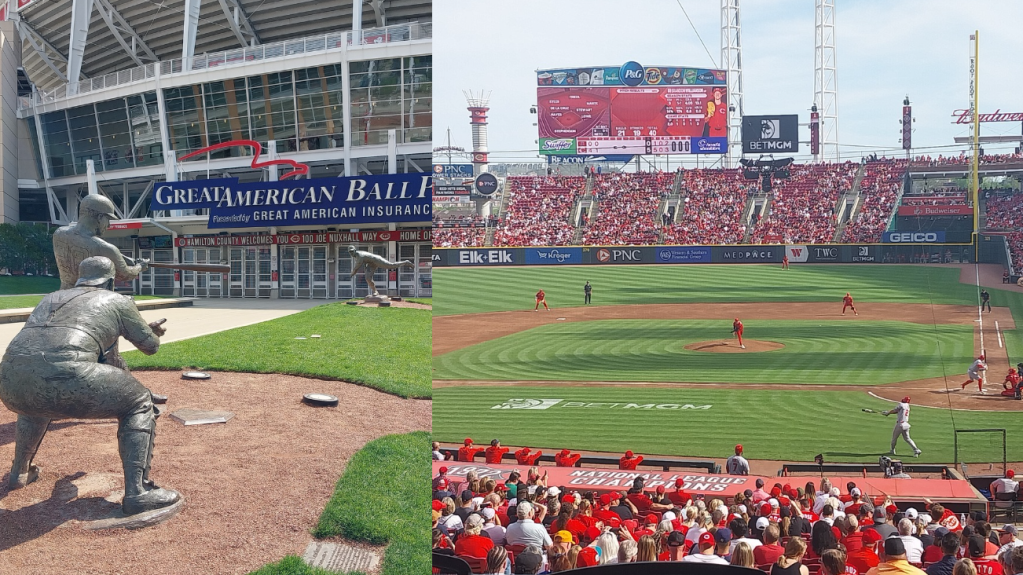
Great American Ball Park’s location along the Ohio River not only provides a wonderful panorama (which includes the Southgate Bridge and sort of the purple bridge), but a great opportunity Cincinnati didn’t take advantage of until the ballpark and Paycor Stadium were built. When Riverfront Stadium was around, the entire immediate surrounding area was filled with pretty much nothing but parking lots for it and Heritage Bank Arena, home of the ECHL’s Cincinnati Cyclones. But with their construction, the area around the two venues (south of Interstate 71 from the Southgate Bridge to the Clay Wade Bailey Bridge) began to transform. Not only did it end up producing Smale Riverfront Park along the river’s edge — beautiful and with great views — but also the Banks, a mixed-use development project filled with apartments, street-level retail, and even the National Underground Railroad Freedom Center museum. When it comes to that retail, there are several bars and restaurants that, while a bit generic, are perfect for your garden variety pre- and post-game festivities.
When it comes to amenities inside the ballpark, we start with the type of mustache rocked by the psychotic-looking Reds mascot, Mr. Redlegs. The Handlebar at The Riverfront Club is an upscale private bar along the club level at the end of the first base line. It provides a buffet and open bar that you can either get on its own or as an add-on to your ticket. If you want to spend much more money, you can enter Great American Ball Park’s former press box — now a fancy bourbon lounge called the BCL Press Box that even lets guests keep their own alcohol locker. If you’re a normal person and don’t want to spend that much money, head to the lower concourse near the Gap and find the Brewery District — a 85-foot bar containing 60 taps of more than 20 brands of beer. Pair that up with the All You Can Eat Stand — which gives you five hot dogs and unlimited soda, peanuts, popcorn, and chips for less than $30 — and you’d be set. You can find those stands in the right field and first base concourses. The various food and drink stands along the latter concourse are situated between the main field and a small family area filled with a miniature diamond and a playground. Some of them offer their dishes buffet style and can be accessed through multiple entrances, something I can’t remember seeing at another ballpark.
However, it’s when we talk about the food that we get to some of Great American Ball Park’s weaknesses. The overall quality and variety of food outside from the typical sporting event fare is subpar. There are few (if any) unique and creative ballpark dishes, and I do not include the main offering of Cincinnati in that. I’m talking about Cincinnati-style chili: spiced meat sauce and shredded cheddar cheese (as well as onions and beans, if desired) on top of spaghetti noodles. This dish is served at the Skyline Chili stands and is delicious (yeah, I like Skyline Chili — fight me). However, it’s not unique to the ballpark (there are locations all over Cincinnati) and the more common ballpark form is served on top of small hot dogs you can probably buy at the store. There are good dessert options, namely in the form of Graeter’s Ice Cream (another Cincinnati staple) and a Slushie stand. But when we talk about the main course — meat and starch — the options you’ll find at the ballpark are mainly disappointing.
There are a few other reasons why many find fault with the ballpark and rank it lower on their own lists. As I mentioned earlier, Great American Ball Park is a mix of different styles. But it seems less of a blended and planned combination and more like a bit of a jumble. There is no distinct style or design, rather there’s a mix of a bunch of them. It reminds me of loanDepot Park in that it seems like a bunch of ideas thrown at a wall to see what stuck. Granted, a lot more ideas stuck in Cincinnati than Miami. But it still means the ballpark lacks a true identity. It also lacks elements that can attract the average fan. I also mentioned earlier that Great American Ball Park does a fantastic job of showcasing Reds history and culture and is therefore a perfect home for the Reds. But in terms of making itself a destination ballpark for MLB as a whole, there really isn’t anything to showcase to the casual fan. Given this and the Reds’ overall lackluster performance over the past few decades, many simply forget that the ballpark exists. There’s also the fact that, despite being just over two decades old, it’s already showing its age with some wear and tear. Maybe it’s because it’s near the river and that’s doing extra damage to it or something. I don’t know, I’m not a scientist. But there are more than a few team color-specific displays that look a lot more pink than red due to being worn out.
Still, I can overlook a lot of this and see a flawed but overall quality ballpark. That being said, I must acknowledge some potential bias in my analysis. You see, Great American Ball Park was the last venue I visited to achieve the mark of seeing a game at all 30 current MLB ballparks for the first time. As I got close to the end of my journey and realized I had single-digit ballparks remaining, I had to map out the rest of my trips to end on a memorable note. So, seeing Great American Ball Park among those still on the list, I decided to pay homage to my dad’s old rivalry from his days as a Los Angeles Dodgers fan. After all, it’s the reason I became a Boston Red Sox fan (seeing all of the Red Sox artifacts and references in the Reds Hall of Fame and Museum was definitely a full-circle moment). Considering all of this, Great American Ball Park will always hold a place in my heart as the place I finally hit 30/30. So, admittedly, I may look back at this ballpark with rose-tinted (or, rather, red-tinted) glasses.
Having said that, Great American Ball Park objectively has plenty of merit and good aspects to it, and is an underrated ballpark. If I was a Reds fan, I wouldn’t care about attracting other fans — after all, it means more room for people rooting for my favorite team. Ballparks are meant to provide a good home environment for their teams, and Great American Ball Park does an excellent job of that. It’s not the ballpark’s fault that the Reds have been a mediocre franchise for 30+ years, creating a general apathy towards the franchise from the greater baseball world. Great American Ball Park definitely has its flaws and deservedly ranks below more solid and complete ballparks. But it’s better than those that have come before it on this list, and I’d argue by a wider margin than you’d think. It’s a good ballpark with plenty of good aspects and a few notable bad ones. Still, it ranks below the other ballparks on this tier by a similarly-sized margin.
19. NATIONALS PARK
HOME TEAM: WASHINGTON NATIONALS
LOCATION: WASHINGTON, D.C.
OPEN SINCE: 2008
ORDER VISITED: 14 (08/16/22)
GAMES I HAVE SEEN THERE: 1 (0-1 HOME TEAM RECORD)
When it comes to our nation’s capital, the history of baseball is almost as complicated as the history of politics. There have been no fewer than five American or National League franchises that have called Washington, D.C. home, and four of them were called the Senators. The third Washington Senators team played in D.C. for 60 years before moving to Minnesota and becoming the Twins. Another Senators team then took its place, playing at the former’s old home of Griffith Stadium before moving into the new multipurpose RFK Stadium in 1962. A decade later, the Senators left again, with this team moving to Texas and becoming the Rangers. So technically, three current MLB teams have called Washington, D.C. their home for at least a decade. That third team came in 2005, ending a 30+ year baseball drought in the nation’s capital. It wasn’t called the Senators, but rather the Expos, crossing the border after playing in Montreal since being founded in 1969. Renamed the Washington Nationals (reviving the name the third Senators had used for the majority of their time in D.C.), the team moved into RFK Stadium, staying there until a new permanent ballpark could be built. That happened three years later, when Nationals Park made its MLB debut.
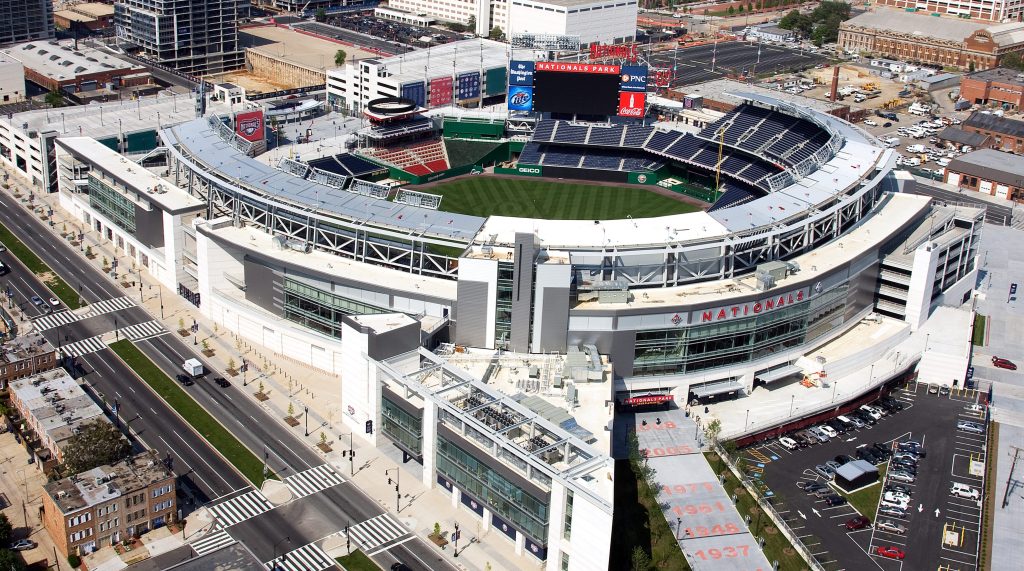
While it draws inspiration from the likes of Griffith Stadium, Nationals Park is nonetheless a very much modern ballpark, with a sleek design and a facade made up largely of steel and glass. The outer portion of the ballpark to the east and west stretch beyond the main seating bowls towards the north of the site, creating a wide open outfield concourse that, while feeling a bit too spacious, opens right into the center field entrance and entertainment directly to the north (more on that later). Given the ballpark faces slightly to the east, it means the left field area is slightly bigger than right field. While some areas stretch out further than at other ballparks, one key aspect of modern sports venues doesn’t. That would be the suites, with all of the main/major suites being located in between first and third base, rather than going further right or left. That means the suites are double-decked on top of each other, pushing things like the press box further up. In fact, the press box at Nationals Park, which was named after the late Washington Post sportswriter Shirley Povich, is the highest-located in all of MLB, with members of the media up there with the fans in the cheap seats.
Since its opening, Nationals Park isn’t just home to the Nationals — it’s also been the site of the annual Congressional Baseball Game. While the democrats held a big edge in the ballpark’s first first decade or so — going on a 10-2 stretch since 2008 — the republicans have (as of this writing) won every game since the COVID-19 Pandemic. While this may be more of a reflection of a change in American politics, it may also be due to Nationals Park, with its relatively short dimensions, becoming slightly more of a hitter’s park over time. Though it’s been relatively neutral, the ballpark has been dipping into the red (reflected as being hotter for batters), which I guess makes sense since. After all, in the words of all-time Minor League Baseball home run record holder Crash Davis, strikeouts are boring and fascist. While Great American Ball Park has communism covered (being the home of the Cincinnati Reds), Nationals Park can also boast one other color that typically doesn’t do that well in elections: green. With its debut, Nationals Park became the first LEED-certified green major professional sports venue in the U.S. (example: the two parking garages to the north covered in solar panels). It remains one of the most sustainable venues in the world today.
When it comes to getting Nationals Park built, the whole politics part proved to be something that even MLB wasn’t truly ready for. Sports venue politics are always complicated, but paired with the D.C. political scene, it’s on another level. Funding was a major source of contention, with the fact that it was entirely backed by D.C. (not to mention it went over budget) leaving the region in debt for years afterwards. Location was also a major point of contention, with the final site being one in the somewhat run-down Navy Yard district on the southern side of central D.C., just north of the Anacostia River (which sort of splits D.C. into two parts). RFK Stadium was also near the river (more eastward than Nationals Park) and had a lot more space near it (in part due to the sea of parking lots around). However, while the Navy Yard site was ultimately deemed better for the overall economy of the district (more on that later), it also forced some alterations. Notably, the Fredrick Douglass Memorial Bridge had to be renovated just so South Capitol Street (which borders the ballpark to the west) could be adjusted to run at ground level, instead of its previous height of 15 feet above ground.
That was just a taste of the how D.C. has been built and rebuilt, and its impact on auto traffic. To say that driving around the nation’s capital is complicated is to say democrats and republicans have somewhat differing political opinions. So, there is a limited amount of parking lots and garages around Nationals Park, with the resulting traffic from Interstate 395 and 695 to the north and Interstate 295 to the south creating delays on a regular basis. Instead, fans are encouraged to commute, though the Metrobus stops can get caught in that traffic. That being said, the excellent Washington Metro rail system drops you off at the Navy Yard-Ballpark station, which is a short walk away. Nationals Park is one of the few ballparks with a focus on bicycle traffic, with free valet bicycle parking, a dedicated garage, and dozens of bike racks nearby. There’s also a water taxi service to and from the Georgetown area to the north and Alexandria, Virginia to the south along the Potomac River. Quite frankly, Nationals Park needs all of those options, given the complicated nature of the area and the fact that many people who work in D.C. (and support the Nationals) live in either Virginia or Maryland.
For as complicated of a baseball history Washington, D.C. has, it’s paid tribute to well at Nationals Park. That tribute starts as soon as you walk up towards the home plate entrance, with displays of memorable D.C. baseball players — Walter Johnson, Frank Howard, Josh Gibson — and moments stretched out in chronological order. Johnson’s statue in particular — meant to showcase him in motion — instead looks like something out of a David Cronenberg film. The main concourse features several photos of D.C. baseball history from the Library of Congress. Since 2010, Nationals Park has also featured a Ring of Honor for not just Senators greats, but also those of the Negro league’s Homestead Grays (which played in D.C.) as well as the Expos. The Grays are also honored with the name of a bar inside the FIS Champions Club (formerly known as the Stars and Stripes Club), which also features memorabilia from the Nationals’ 2019 World Series championship run (such as the piece of metal they got after winning it all). Then, of course, there’s the President’s Race — perhaps the second-most well-known mascot race in MLB (spoiler alert: I’ll talk about the OG race later on in this part).
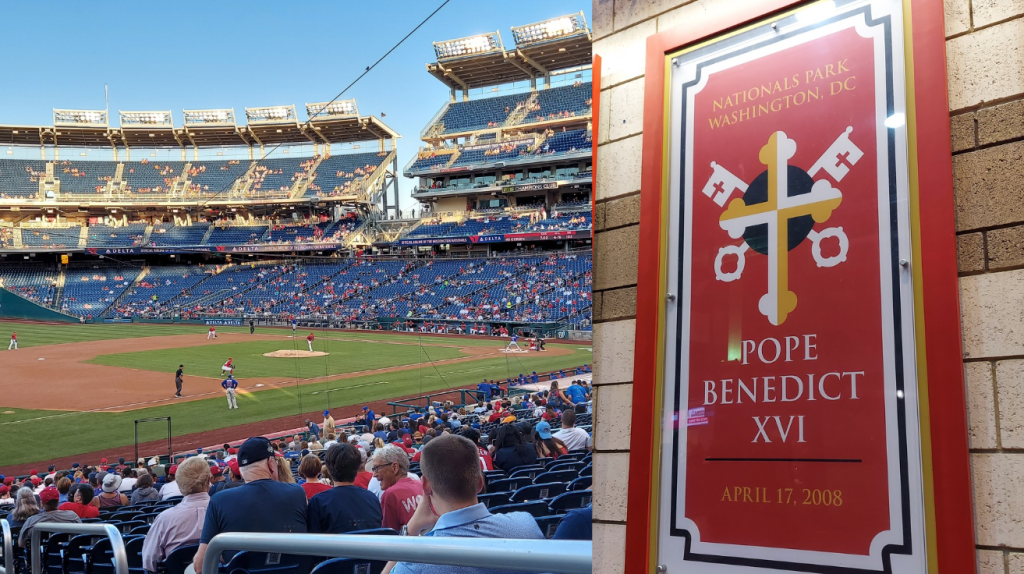
This all highlights one interesting aspect about Nationals Park. While Washington, D.C. has plenty of baseball history, the Nationals are only a small fraction of it, given that they’re just over 20 years old. So while Nationals Park definitely has plenty of homages, little is to the Nationals. This doesn’t mean Nationals decor isn’t covering many parts of the ballpark, nor does it mean that Nationals Park is deducted and points because of it. It just means that the D.C. history and representation is a bit broader. It also isn’t limited to just baseball. Nationals Park is home to the Washington DC Sports Hall of Fame, inheriting the honor from RFK Stadium. Several pieces by D.C. artists are included, including a colorful 2D display of baseball players by Walter Kravitz. The center field plaza contains 14 cherry blossom trees — a nod to the many such trees in D.C., which started as a gift from then-Tokyo Mayor Yukio Ozaki in 1912. Nationals Park is also one of just two current MLB ballparks (and the most recent) to be visited by the Pope, as Pope Benedict XVI held a mass there less than a month after its 2008 opening. By the way, Rate Field — where Pope Leo XIV attended Game 1 of the World Series — isn’t the other one, as he was not the pontiff at the time.
The D.C. display continues into the food offerings at Nationals Park. Perhaps there is no better-known D.C.-based food stop (apart from maybe We, The Pizza), than Ben’s Chili Bowl. There is a stand in Nationals Park and it is simply a must-visit, as is any place that offers Mumbo sauce (a local specialty). D.C. can often be seen as a melting pot of cultures, which is reflected in other Nationals Park offerings, ranging from Mexican, Italian, Korean, Ethiopian, Argentinian, Venezuelan, Filipino, Brazilian, vegan (shudder), and other kinds of food. There’s also some local fare like lobster rolls and crab cakes, as well as Taste the Majors — a rotating gourmet hot dog offering based on the visiting team. Nationals Park also takes advantage of D.C.’s location by taking in taps from good breweries in Virginia, Maryland, and even Delaware. As far as more upscale, private places, the PNC Diamond Club features a gourmet buffet and all-inclusive food and drink. The fanciest site is the Terra Club, which offers the above in an indoor lounge with views of the Nationals batting games and press conference room, as well as seats behind home plate. Then there’s the Change Up Food Hall, a good pre-game place that serves plenty of beer and classic ballpark food. It also has a large area of sit-down tables in the area behind center field.
If you’re looking for something to do before and after the game, Navy Yard has a lot to offer. It’s a far cry from what it was nearly two decades ago, and Nationals Park has been the main push behind the area’s revival. The main focus is right above the center field entrance, along Half Street between M and N Streets. In fact, Half Street SE is closed off to vehicle traffic before games, letting fans walk around freely between locations. Those locations range from your typical bars and restaurants to other activities, making for a lively pregame scene. There are some spots that stand out, such as The Bullpen, Swizzler, Dacha Beer Garden, and The Salt Line. Of course, there’s an &pizza location in there as well. It’s not just the food, either. There are brand new apartment complexes and hotels in and around the Navy Yard area, which might be the fastest-growing site in all of D.C. After all, Nationals Park isn’t even the newest major sporting venue — that honor goes to D.C. United’s Audi Field, just a couple of blocks to the southwest.
However, Nationals Park has become a victim of its own success and magnetism. The transformation of the Navy Yard area has definitely made it a cleaner and safer place. But gentrification is a two-way street, with the cost of living in the area soaring (yes, the district now has a Whole Foods). That’s not the only thing rising. Those hotels and apartment complexes going up near the ballpark have created an unforeseen problem. When it opened, Nationals Park had a nice panorama that included parts of National Mall, with views of the Washington Monument and U.S. Capitol building. However, that panorama began to include cranes and other construction equipment, with many of those hotels, apartments, and even some of those new restaurants and bars being located in the Capitol Riverfront area — directly north of the ballpark and right in its line of site. While most if not all of that construction is done, in its place are a bunch of tall generic new buildings that, while nice and shiny, also block some of the unique views D.C. can offer. You can still see parts of the Capitol and Monument, though only from certain sections. In hindsight, many have argued that Nationals Park should’ve been rotated to face the Anacostia River instead.
Overall, Nationals Park is an underrated, solid if not spectacular ballpark. Part of that has come from the overall performance of the Nationals, who were labeled as chokers until their incredible 2019 title win, one which could’ve led to more prestige had the following year not been plagued by the pandemic and the team not utterly sucked since then. But other reasons relate to issued that plague some more modern ballparks. While D.C. is certainly a tourist destination, there’s been little about the ballpark and the team to make it a major draw compared to what else the district has to offer. It flies under the radar despite its many positives and overall quality, though there are some signs of wear and tear. While it sits right in the middle of MLB in terms of capacity, it also does seem a bit too spacious (even for an open-air ballpark), especially in the concourses. Still, the overall newness of Nationals Park has carried it throughout its history, with upgrades coming here and there since then. Those include a submarine dive horn that blows after every home run and win, as well as a 2024 upgrade that featured a new jumbotron and other audio/video upgrades. It was the most extensive work since the ballpark’s debut, and it might be a sign of things to come.
Last year, the Nationals unveiled concept plans to transform the Nationals Park area into a major year-round entertainment hub. Much of that would focus on the northern end, with a redone center field entrance and other upgraded amenities in the already popular entertainment area along Half Street. These major upgrades would be funded through a $350M package backed by the DC Council. It would also come with a lease extension at Nationals Park until 2054. Time is ticking, as the original bonds used to fund the ballpark are set to expire next year. Though the Nationals have yet to sign an agreement, most are optimistic for a deal, as evident by renderings of the project. Another big change could also be on the horizon. For its entire life, Nationals Park has never had a naming rights sponsor. Some say the Nationals have been exploring adding a new name to the marquee, but are extremely cautious about it. That could also be impacted by a need for a funding boost for the above project. It looks like the future of Nationals Park, from its layout and surrounding area to its very name, could be just like the rest of D.C. — extremely complicated and fueled by the almighty dollar.
18. AMERICAN FAMILY FIELD
HOME TEAM: MILWAUKEE BREWERS
LOCATION: MILWAUKEE, WISCONSIN
OPEN SINCE: 2001
ORDER VISITED: 26 (07/25/25)
GAMES I HAVE SEEN THERE: 1 (0-1 HOME TEAM RECORD)
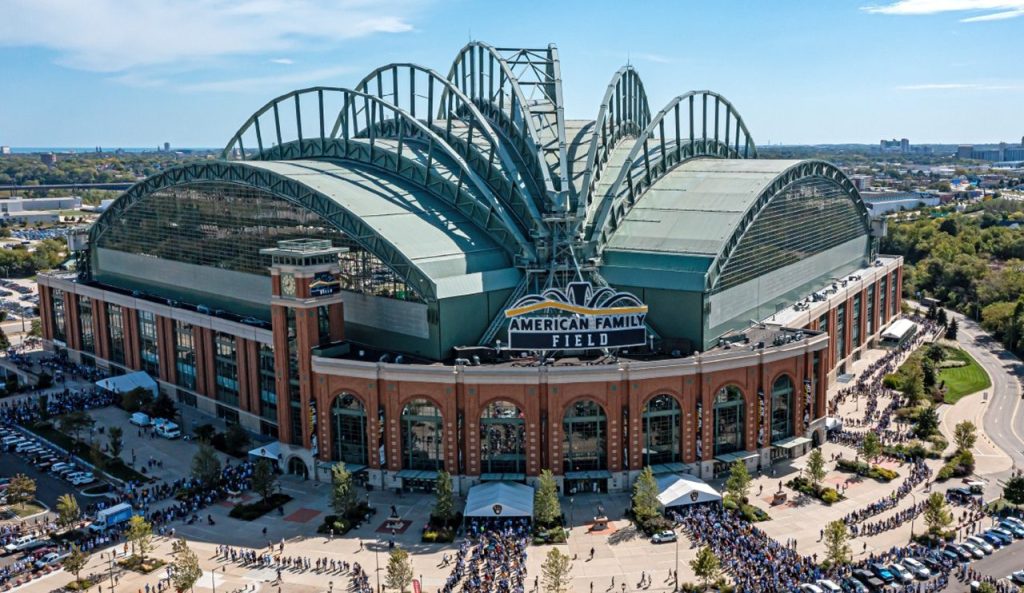
Here’s another trivia question for you: what was on the cover of the first printed issue of Sports Illustrated? It was an at-bat in a game between the New York Giants and Milwaukee Braves at Milwaukee County Stadium. That issue was published in 1954, one year after the ballpark opened and the Braves moved to Milwaukee from Boston. In the decades that followed, the stadium hosted hundreds of games for the Braves and — after they moved to Atlanta — their replacement, the Milwaukee Brewers. It also hosted several teams from other sports and was even used as the location for the movie Major League. But by the time the 1990’s rolled around, Milwaukee County Stadium was considered outdated — especially when it came to a lack of luxury boxes and a color video board. The process to get a new ballpark was long and full of political back-and-forth, but in the end the project was authorized thanks to $290M in public funds. George Petak — the state senator who cast the deciding vote — was later recalled due to his decision. Even after the vote, more trouble lay in store — on July 14, 1999, a large crane collapsed during construction, killing three workers and delaying the project. Finally, in 2001, Miller Park (later renamed American Family Field) was opened, but debate surrounding the ballpark has remained.
American Family Field seems to have one of the larger gaps between how beloved it is by fans of its home team and how fans of other teams perceive it. Brewers fans are loud and incredibly devoted, which leads to a great atmosphere in this ballpark. This is fueled by a fantastic pre-game tailgating scene — keep in mind, most Brewers fans are also Green Bay Packers fans. I got a taste of that in the one game at American Family Field I attended, which happened to be the day the Brewers celebrated 25 years at the ballpark. They offered $2 beers and brats before first pitch, and I took full advantage. Then, after the game, the Brewers held a home run derby featuring several notable former players. Let me tell you, you haven’t lived until you’ve been buzzed while watching Eric Thames hit nukes while “Du Hast” by Rammstein is blaring from the ballpark loudspeakers. Needless to say, I had a great time at the game and it was one of the better experiences of the ballpark your. So keep that in mind when I say American Family Field can’t rank any higher due to the notable problems it has, ones that keep it even lower on other MLB ballpark lists.
The first major problem can, to reuse a joke I made in Part 1, be described in three words: location, location, location. American Family Field was built right next to Milwaukee County Stadium — where Highway 175 begins south of Interstate 94. The ballpark site is several miles west of Downtown Milwaukee, not exactly in a walkable area. Given that American Family Field debuted nearly a decade after the downtown retro ballpark revolution began, this decision seems inexcusable, especially in hindsight. American Family Field is near nothing but industrial and residential areas, making it feel even more in the middle of nowhere. What’s more, the ballpark is surrounded by an ocean of parking lots, which means the only real method of getting there is by car. Granted, there is a Bublr Bike station nearby and multiple Milwaukee County Transit System bus routes (CONNECT BRT and Route 18) with stops within walking distance. Also, the Brewers offer shuttle services between the ballpark and certain bars in Downtown Milwaukee (something I didn’t see with any other ballpark) and the parking lots breed the aforementioned notable tailgating scene. However, this all means American Family Field is effectively on an island that you can only get to by car, meaning you have to suffer through traffic.
The other major problem many have with American Family Field is its roof. Some baseball purists simply can’t stand the idea of playing the sport in an enclosed space, even if it’s snowing or raining outside (like it often does in Milwaukee). American Family Field’s roof is retractable and it looks nice with it open — like it did while I was there. But open or closed, many aren’t fans of its overall design and look. The greenish-gray roof is in an unconventional fan shape, opening from the middle out to each side. In addition to its mechanical problems, its aesthetics have also gotten criticism. For me, while I’m certainly not a fan (ha) of the roof, it’s definitely not my least favorite retractable roof in MLB. Honestly, I have a bigger problem with the glass panes on either side of the ballpark. American Family Field is the only ballpark where glare is a regular problem, with half the playing field being half in the sun and half in the shade a lot of the time. The difference is quite noticeable on TV, and it’s still apparent in person — even with the roof open. I can’t imagine this stark difference is enjoyable for the players.
While American Family Field may have a non-pretty roof and be in the middle of parking lots, but there’s still plenty of eye-catching aspects, some of them paying tribute to the rich Braves/Brewers history. It’s not the only ballpark in the area — a Little League field (Helfaer Field) stands in the former site of Milwaukee County Field. Beyond the outfield of Helfaer Field, in one of the parking lots, sits a plaque honoring where Hank Aaron’s 755th and final MLB home run landed. The brick, glass, and steel facade of the American Family Field is also good-looking and seems like a modern take on classic ballpark design. The plaza outside the ballpark features the Brewers Walk of Fame, Wall of Honor, and a sculpture called “Teamwork” — honoring the three workers killed in the ballpark’s construction. In addition, statues of several Milwaukee baseball greats, such as Aaron, Robin Yount, and legendary broadcaster Bob Uecker. But there’s another statue of a prominent figure in both Brewers and Braves history, one who’s much well known for his time in another position. Let’s just say most other MLB fans don’t share the same opinion of him as Brewers fans do.
Allen Huber “Bud” Selig was born in Milwaukee and eventually became a minority owner of the Braves. While he tried unsuccessfully to keel them from moving to Atlanta, he was instrumental in bringing baseball back to Milwaukee, arranging for the city to host multiple Chicago White Sox games to show fan support was still there. He later bought the Seattle Pilots, moved them to Milwaukee, and renamed them the Brewers in honor of a minor league team in the city. While Selig transferred ownership of the Brewers to his daughter when he became acting MLB commissioner in 1992, it was under his tenure that the construction of American Family Field was greenlit. It makes sense that he’s beloved in Milwaukee, but in addition to his statue, there is also has a walkthrough exhibit (complete with a short film) called the Selig Experience within the ballpark. The whole thing comes off as a bit like propaganda, as both the film and exhibit conveniently leave out his alleged involvement in owners collusion, refusal to concede in the players strike that cut the 1994 season short, and role as overseer of the steroid era of baseball.
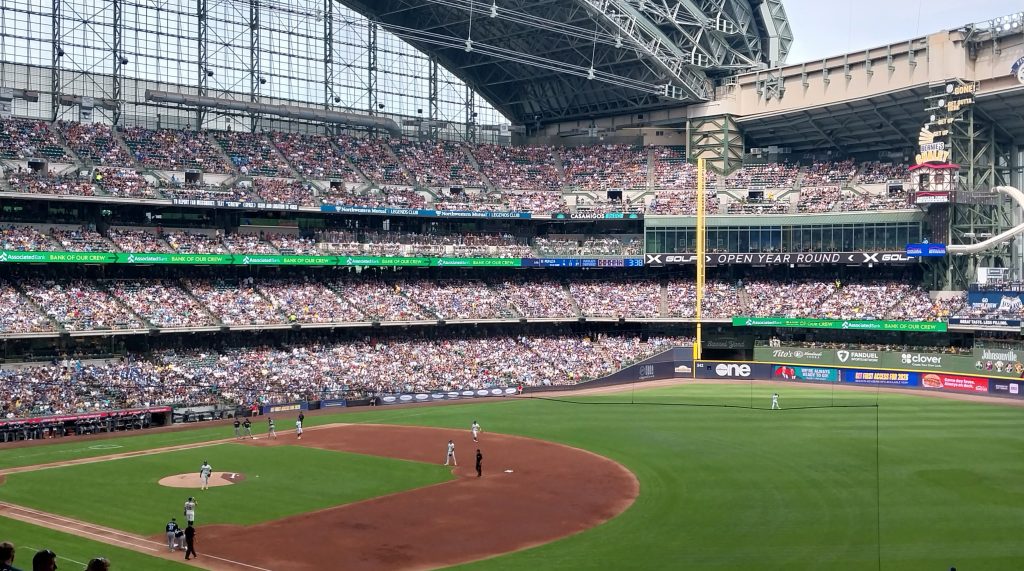
An entire section dedicated to a controversial former MLB commissioner is just one of several unique features of American Family Field. Perhaps the most prominent and well-known feature is Bernie’s Chalet — a small house perched up top near the end of the bleachers on the third base side. It’s where the Brewers’ mascot, Bernie, resides during home team at-bats. If the Brewers hit a home run, Bernie slides down a massive slide that goes down to the second level. Such a celebration isn’t as common as you’d think. Despite American Family Field being a retractable roof ballpark, its relatively deep dimensions in left and right field mean it ranks among the more pitcher-friendly ballparks in MLB. Still, this doesn’t mean big swings are discouraged. American Family Field is one of just two MLB ballparks to have an X-Golf facility in it (coincidentally, the other one is Nationals Park). The golf simulator is a popular attraction and helps keep American Family Field busy in the offseason. If you need to get your kids away from all of the action, there’s a playground located in the right field area that includes batting cages. If you need to get away from everyone, American Family Field also has a sensory-friendly “quiet area” with noise-canceling headphones, a fidget toy, verbal cue bards, and a weighted lap pad.
Walking around the concourse can be a bit confusing, particularly in the left field area. But overall you don’t get truly lost like in some other ballparks and you at least get to visit the excellent team store. Speaking of gifts, I wasn’t sure where to put this but something confused me greatly. All MLB teams have giveaway nights, where they provide a few thousand items or trinkets for the first fans who show up. The Brewers also do “theme nights” that also feature free items for fans, but they’re not handled in a traditional way. I also happened to go during a theme night, but instead of getting the giveaways at the entrance like I was used to, I had to go up to a room on the upper level, wait in line, have them scan my ticket again, and then get the item. It wasn’t bad or anything, but it was definitely a bit bizarre. Maybe I had just taken more advantage of the $2 for beers and brats deal than I realized.
Speaking of alcohol, this is one area where American Family Field absolutely shines. J. Leinenkugel’s Barrel Yard just beyond left field is a fantastic place to drink and eat before and during games, with a rotating beer tap full of quality drinks. There are plenty of other places to wet your whistle, with offerings ranging typical options like Miller Lite to 20+ local craft beers. This doesn’t mean the food scene is watered down like Miller Lite. The right field area on the upper concourse features the 3rd Street Market Hall Annex — a collection of local food vendors with tasty items. While much of American Family Field’s menu does lean heavily on more traditional ballpark fare, it does it well, particularly with some of Wisconsin’s favorite snacks. Sausages, brats, and hot dogs are all worth tasting there, while cheese curds and chili cheese tots are among Brewers fans’ go-to treats. When it comes to toppings, American Family Field offers a unique option: Secret Stadium Sauce. Created at Milwaukee County Stadium when the Brewers were running out of the traditional toppings, a vendor combined ketchup, mustard, barbeque sauce, smoked syrup into a concoction that proved to be a hit and is still served at Brewers games to this day. It’s worth a taste.
When it comes to the overall experience at American Family Field, tradition is deeply engrained in the Brewers fandom. Two of those are rooted in the items they gave away for $2 at the game I went to: beer and sausage. The former’s deeply rooted industry in Milwaukee is honored with the singing of “Roll out the Barrel” (also known as the “Beer Barrel Polka”) after the seventh inning stretch. But the greater impact has been made with the latter, specifically with the Johnsonville Sausage Race. Started in the 1990’s the race sees five people (usually American Family Field employees) race around the edge of the field while dressed in sausage costumes. These costumes are based on certain types of sausage — Polish, bratwurst, Italian, hot dog, chorizo — and on Sundays include miniature versions of themselves. The Sausage Race takes place during every game (much to Randall Simon’s chagrin) and has spawned several imitators, including the President’s Race at Nationals Park. Still, the Sausage Race remains the original and best version of these races, and a draw for Brewers games.
In Part 1, I mentioned that even if a ballpark isn’t aesthetically or functionally better than some of its contemporaries, it can be elevated by the overall aura or fan experience there. That can come from winning or over successful moments. It can also come from having a deep tradition and culture within the team and fanbase. This is what’s going on with the Brewers and American Family Field. So much of what makes American Family Field shine isn’t comparable to other ballparks in terms of amenities and statistics and design. It’s just a fun place to catch a game, backed by a great and vocal crowd. It’s also not that American Family Field is an objectively bad ballpark or anything — far from it, in fact. It’s just that its intangibles stand out more than others. However, intangibles can’t carry a ballpark high up this list, nor can they make up for some of the very real problems described earlier. Like one of those problems, there is a ceiling to how far American Family Field can go right now. Fortunately, that could be changing.
In 2023, Wisconsin Governor Tony Evers signed into effect a bill allotting $500M of taxpayer money for repairs and upgrades to American Family Field. While it’s still not good that so much public money instead of private money is being used for such an endeavor, there are some positives. First, the deal ensures the Brewers remain in Milwaukee until 2050. Also, the work that’s been done so far has definitely paid off. Before these upgrades, American Family Field’s video board was only the 20th largest in MLB. Now, its center field screen ranks Top 5 in the majors — not to mention the one in right field. Renovations also included the aforementioned team store and 3rd Street Market Hall Annex, as well as new parking technology. Future work is set to be done on winterizing the ballpark, as well as improving other functions and aspects. It’s a good thing I visited after some of the upgrades were finished — without them, American Family Field might have gone down a tier. Maybe once it’s all done, the upgrades will be enough to elevate it further, in spite of the limitations the two main problems have placed on it. While there’s still a ceiling on how good it can be compared to other MLB ballparks, much like the noise at a good party, the roof can be raised.
17. COMERICA PARK
HOME TEAM: DETROIT TIGERS
LOCATION: DETROIT, MICHIGAN
OPEN SINCE: 2000
ORDER VISITED: 11 (08/05/21)
GAMES I HAVE SEEN THERE: 1 (1-0 HOME TEAM RECORD)
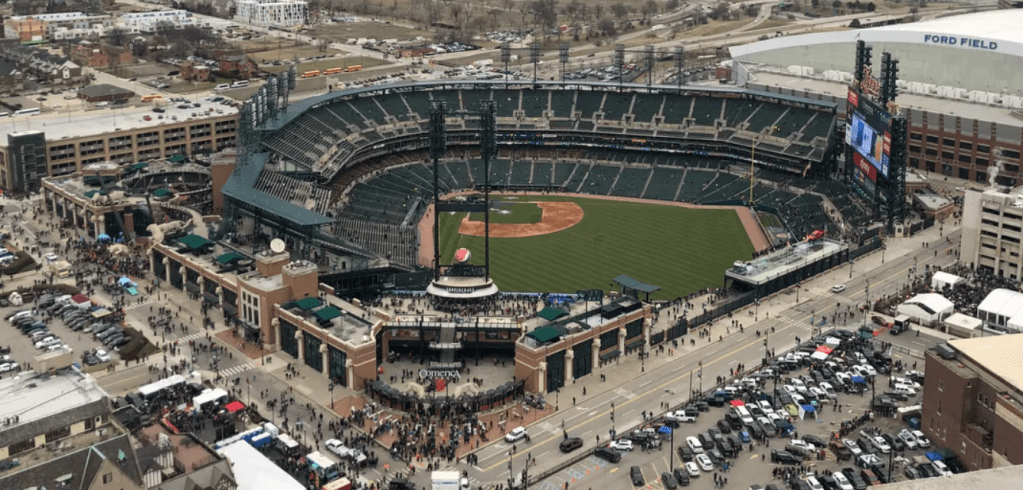
While sports fans are quick to identify venues with just a glance, the average person may need to look for something identifiable — like a logo or sign or aspect of the team — to know who plays there. When it comes to Comerica Park, even a blind person can tell it’s the home of the Detroit Tigers. At the main entrance to Comerica Park — on Witherell Street near Montcalm Street — stands a giant 15-foot statue of a tiger, which fans often take pictures in front. But that’s not the only one — far from it. Four more tiger statues sit on top of the brick walls on either end of the gate (two on each side), while two others sit atop the entrance at the corner of Witherell Street and Addams Avenue. Two more tiger statues are on top of the Comerica Park scoreboard — these ones aren’t only painted orange and black, but their eyes light up and they roar every time the Tigers hit a home run or win. In addition to these nine statues, there are 33 tiger heads along the brick walls on the outside of the ballpark. Each head has a baseball in its mouth that doubles as a light. This isn’t even to mention the various tigers inside the ballpark, including a carousel whose animals are all tigers. No doubt, this is the Tigers’ stadium, which is ironic, given the ballpark it had to replace.
Going into the 1990’s, there were just four “jewel box” ballparks from the 1910’s left in MLB. Two still stand today, while Comiskey Park was torn down in 1991. The other was Tiger Stadium, opened in 1912 and, when Comiskey Park shut down, tied for the oldest ballpark in MLB. Over time, the ballpark grew, became enclosed, and added quirk after quirk — such as a flag pole in play in center field and a right field second deck that extended ten feet towards the field over the first deck, turning foul balls into home runs. It also garnered a legion of support in Detroit, with Tiger Stadium becoming a mecca for Tigers fans (it also hosted the NFL’s Detroit Lions for several decades). However, at the end of the 20th century it was clear that Tiger Stadium was near the end of its life, with only two options left to choose. The first was a massive and complicated (but feasible) renovation called the Cochrane Plan (after former Tigers catcher/manager Mickey Cochrane), which would’ve managed to preserve the ballpark. Instead, to the chagrin of many Tigers fans, the team and city opted for the other option, which saw the construction of a brand new ballpark in a more central part of Downtown Detroit. The Tigers left in 1999 and in 2001, nearly nine decades after it was opened, Tiger Stadium was demolished. It remains the longest-tenured MLB ballpark no longer in use (89 years), and the site it was built upon had hosted baseball dating as far back as 1896.
Apart from sports venue preservation not being as prevalent as it is now, there were two main reasons why the Tigers and Detroit went in the direction they did. The first was that Tiger Stadium, being old and run down, was a reflection of the surrounding area and city as a whole. It was located in the Corktown neighborhood, which was a far cry from the once thriving place it had been. Plus, the Tigers were terrible at the time, meaning they had fewer cash to spend on a preservation effort. While the team and city didn’t have the foresight to see that the area would actually begin to see an uptick a few years after Tiger Stadium’s demolition, at the time they didn’t want to spend a tremendous amount of money on a lengthy project in a bad part of town. At least, not in Corktown they didn’t. That’s where the second reason comes in. The main downtown area was in need of revitalization, and the Tigers’ need for a new home came at the perfect time. They weren’t the only ones, as just two years after Comerica Park debuted in 2000, Ford Field opened up as well. Both the new homes of the Lions and Tigers were bearing the gamble of their centralized location, and oh my did it pay off.
Comerica Park is in arguably the most perfect spot it could be in Downtown Detroit. Located below Interstate 75 and in between Interstate 375 to the east and Woodward Avenue to the west, its position in the confluence of roads and highways makes it both a centralized spot and a point near almost everything there is to do downtown. The location also makes it great for drivers, this being the Motor City and all, with several parking lots and garages (one of them being connected to the ballpark via skybridge) nearby. Both the Detroit Department of Transportation (DDOT) and Suburban Mobile Authority for Regional Transportation (SMART)’s Frequent Affordable Safe Transit (FAST) bus lines have stops nearby, as do the Detroit People Mover (DPM) rail and QLINE streetcar systems. But if you don’t want to deal with all of the confusing acronyms — not to mention the ungodly directional oddity that is the Michigan left — you can just use your own feet.
The area of Downtown Detroit is incredibly walkable, which is good because there’s a lot of stuff to do besides taking yourself out to the ball game. The area was already home to city classics such as the Fox Theatre, The Fillmore, and the Detroit Opera House. Woodward Avenue is also one of if not the most prominent streets in all of Detroit, drawing plenty of business on its own. Then, what Detroit and the Tigers/Lions hoped would happen after Comerica Park and Ford Field debuted did in fact happen. There is a hoard of bars, restaurants, and other forms of entertainment in the immediate area, not to mention hotels for visitors and apartments for the locals. The area in general has also greatly improved since the 2008 recession, with this area in particular thriving. Not only did the choice of location prove to be good, but it’s gotten better over time. In fact, Comerica Park and Ford Field aren’t the only sports venues in the area. In 2017, Little Caesars Arena opened up on the other side of I-75 as the new home for the NHL’s Detroit Red Wings and the NBA’s Detroit Pistons.
As for the first venue to call Downtown Detroit proper home, Comerica Park is no slouch on its own. It’s easily accessible from different points, with its pretty facade made up of mostly brick (and some steel and glass) wrapping around almost the entire circumference of the ballpark — save for a stretch of metal fencing behind center field that lets those passing by take a glimpse inside. It looks even better when looking from the other end, as the historic buildings and modern skyscrapers give Comerica Park a wonderful panorama. The inner bowl of the ballpark is a somewhat unique dark green shade, matching the plants that surround the fountain behind center field (to be fair, that fountain pales in comparison to that of Kauffman Stadium). It’s a solid if not spectacular design that definitely tries its best to live up to its predecessor, and that includes having a few quirks of its own.
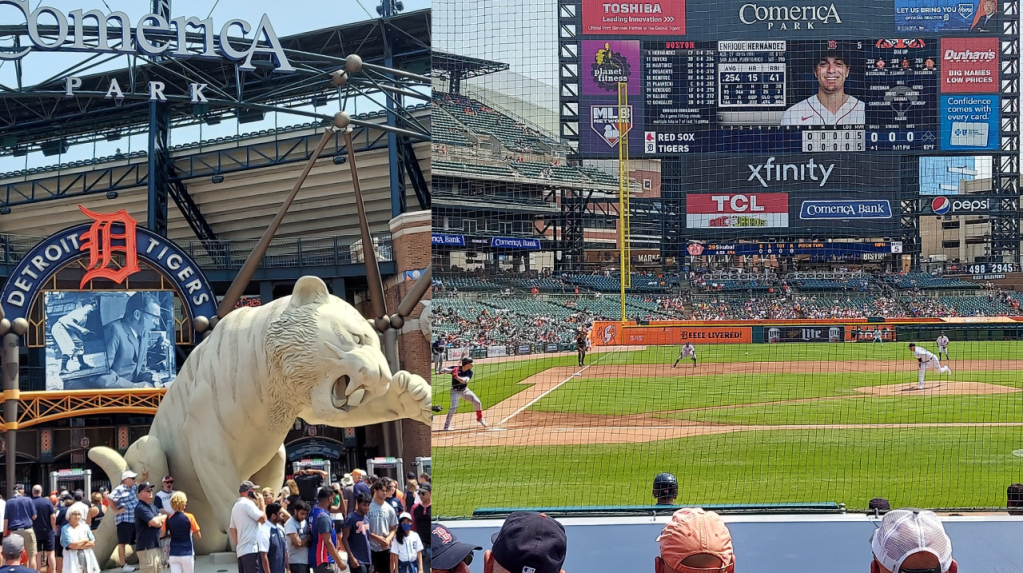
There is a flag pole behind left center field that, in a homage to Tiger Stadium, used to be in play. That changed when the dimensions were fixed for the first of several times, which makes Comerica Park somewhat hard to chart. At first it was extremely pitcher-friendly (unlike Tiger Stadium). Then in 2003 the left field wall was moved in and virtually switched the ballpark’s favorability. More changes over the years (not to mention the Tigers developing a killer rotation in the 2010’s) brought it back to a pitcher’s park. But in 2023 the center-to-right outfield walls were lowered to seven feet, the left field wall was remeasured to be 342 feet, and the center field wall was moved ten feet inward. Even with the moves, Comerica Park still has the second-deepest center field wall in MLB and currently ranks among the more neutral ballparks. Another move happened last year, when the dirt strip between home plate and the pitcher’s mound (called a keyhole) was removed and replaced with grass. Comerica Park had been the last MLB ballpark to have this feature. However, another dirt-based feature remains — the dirt around home plate is shaped like home plate, instead of a traditional circle. Comerica Park is also the southern-most facing ballpark in MLB, which, due to the geography of Detroit, means it faces Canada.
When it comes to quirks and attractions, there are few more unique to baseball than carousels. Along with the aforementioned Kauffman Stadium, Comerica Park is one of just two ballparks in MLB with one, and as mentioned earlier each animal is a tiger. The carousel is located in a circular area on the western corner of the ballpark area — well behind the first base bleachers. 90 degrees clockwise, at the end of a concourse lined with vendors and striped awnings not unlike those at carnival, sits another attraction better known at fairs. The Fly Ball Ferris Wheel features cars shaped like baseballs and carries riders up to 50 feet in the air. While the idea of a Ferris wheel and carousel in a ballpark sound fun (and probably are for kids), I’m going to be a bit of a persnickety old man here. Attractions and other forms of entertainment are often needed at baseball games, especially for younger fans. But at a certain point, we’re getting away from the main point of going to a ballpark: watching a baseball game. There’s a difference between providing something fun to do and defeating the purpose, and the location of both (not within sight of the field) isn’t helping their case. However unintentional, it gives off a vibe that’s a bit too sideshow for me.
Maybe it’s fitting that a team with a history long enough to have played at ballparks filled with much more carny attractions than that has some in their current home. Speaking of that history, it’s on proud display throughout Comerica Park. The main concourse area doubles as a Tigers “Walk of Fame,” with six large upright bats serving as the base for museum-like displays of memorabilia and other pieces of history over the decades, going in chronological order. It’s a unique and cool way to display a team’s history, instead of lumping everything together in one room or building. Along the left center field wall, several statues of Tigers greats — such as Ty Cobb, Hank Greenberg, Willie Horton, and Al Kaline — are on display, each atop a granite pedestal reaching 13 feet high. Speaking of Kaline, there is a section of the lower right field bleachers named “Kaline’s Corner” as a homage to the player who used to roam that area of Tiger Stadium.
There are also some modern comforts at Comerica Park. Above Kaline’s Corner in the right field concourse is the Comerica Landing, a picnic area featuring lounge chairs, tables, a bar, and a fire pit. A similar vibe can be found at the Tiger Den Lounge — a private area accessible both via the concourse and a street entrance. The Tiger Den features tables and private food and drink, as well as a shaded sitting area in the upper concourse behind home plate, featuring deck chairs straight out of a backyard porch. Just a couple of sections away is the Beer Hall, which… yeah pretty much is exactly what you think it is. Open to the public, the Beer Hall is a sit-down tavern that also serves food. Speaking of food, the Beer Hall is right by the Brushfire Grill — near the Ferris wheel. It’s a popular place to sit down and eat, as is the Big Cat Court area around the carousel. Vendors serve everything from Detroit style pizza to carnival foods like ice cream and elephant ears. They really lean into the orange aspect of tigers when it comes to the food, as evident by a new item this year: the Tiger Tail — a footlong hot dog hand-battered and rolled in cheese powder.
The descriptions of the food and vendor areas in general conjure images of a carnival, not a ballpark. To keep harping on an earlier point, it feels like Comerica Park focused too much on the side parts of the ballpark and less on the functional aspects of baseball. Don’t get me wrong, Comerica Park is a fine place to watch a baseball game. The problem is that it’s just that: fine. If anything, the baseball bits of the ballpark are a bit understated. Even the scale of the venue feels a bit off. It doesn’t really stick out as much as a MLB ballpark should, with the exception of the entrances — though that could be due to the giant tiger statues. When it debuted in MLB, Comerica Park was one of the better MLB ballparks and while it’s still quality — and has aged incredibly well — other better and flashier ballparks have come along. Although, perhaps some of that perception is due to the impossible task it had of replacing one of the most historic and colorful ballparks ever built.
This also doesn’t mean that the Tigers have stopped trying. When Comerica Park opened, it had the largest left field scoreboard in baseball. But that was back before colorful LED lights were a thing. But in recent years, the Tigers replaced that billboard with a much larger color LED one (now the second-largest in all of MLB), while also updating the “TIGERS” written on it with an different font (a somewhat controversial move among Tigers fans). One aspect of Comerica Park is actually a leftover from the Tiger Stadium days. In 1999, Heather Nabozny became the first female groundskeeper in MLB history (and the youngest in the league at the time). As of this writing, she remains in charge, having overseen the entire Comerica Park area. From the outside looking in, she seems to have done a nice job, as have the Tigers when it came to replacing Tiger Stadium. It may not have the history, prestige, or excitement of its predecessor, but Comerica Park seems built to last and is an overall quality place to catch a ball game. Tigers fans could do a lot worse than this, and so could Detroit.
B+/A- TIER
So, I originally had these ballparks sorted into just eight tiers, and this next tier didn’t exist — its ballparks were divided up between the tiers above and below. But the longer I looked at the ballparks and analyzed them, I decided to add this one as well. First off, a total of nine tiers mirrors nine innings in a baseball game, so there’s some nice symmetry there. Also, it makes three tiers per part (spoiler alert). Most importantly, I feel like the ballparks in this tier are too similar in that they’re great ballparks with the same glaring weakness that (among other things) prevents them from going up to the next tier. You’ll see what I mean shortly. It would just feel wrong to sort one or two of them in different tiers. As for the name of the tier, I couldn’t decide between B+ or A-, so I didn’t. I thought about calling it the “ß TIER,” because “ß” kind of looks like an A and B combined. But then I found out it’s basically called a “sharp s,” which would fly in the face of the names of the rest of my tiers. I don’t know if you can tell, but I’m rambling a bit. That’s because while I stand by it, the next entry on the list might piss a few people off.
16. DODGER STADIUM
HOME TEAM: LOS ANGELES DODGERS
LOCATION: LOS ANGELES, CALIFORNIA
OPEN SINCE: 1962
ORDER VISITED: 6 (10/28/18)
GAMES I HAVE SEEN THERE: 1 (0-1 HOME TEAM RECORD)
Okay, wait — don’t click away just yet. Give me a chance to explain. I know what you’re thinking. Most people have Dodger Stadium in their Top 10, even Top 5! You don’t even have it in your top half — and you have it in a tier with a “B” in its name, no less! Are you stupid or just trying to rage bait people? Well in the immortal words of Forrest Gump, stupid is as stupid does. But I’m not just trying to piss off the Los Angeles Dodgers or their fans, and I have an intelligent argument behind my placement. Just hear me out. Believe me, when I finalized my order I knew this placement would be the most controversial of the entire list. Part of that is some opinions I may not share with the majority of baseball fans. Another part of is, admittedly, circumstantial. Before I get into the review proper, I have to make this disclaimer. Out of every current MLB ballpark, Dodger Stadium got the short end of the deal when it came to the scenario surrounding my one game attended there, and my objective ability to analyze and judge a ballpark.
The game I attended at Dodger Stadium was Game 5 of the 2018 World Series. I had bought the tickets less than 24 hours earlier, waiting for a deal under $200. I hitched a ride with a friend of my dad’s down to Los Angeles the following morning and I was dropped off at Dodger Stadium two hours before first pitch. I tried to kill some time and calm my nerves by walking around the ballpark and trying to give it a good once-over. But honestly I was crapping myself at not only being at the World Series, but potentially seeing my beloved Boston Red Sox win a championship in person — in enemy territory, no less. Plus, I technically hadn’t called out of work later that night (I was working an overnight shift back then). For most of the pre-game activities and during the entire game, I nervously sat in my seat and tried not to either psych myself out or make too much noise, lest I get attacked by the home fans. Somehow, luck was on my side, as I got to see the Red Sox close things out and win the World Series, achieving a baseball fan’s ultimate dream. I gave myself five minutes to take it in before I ran out of Dodger Stadium, hitched a ride with that same friend of my dad, made it to LAX, and got to work an hour late. While it was well worth it and an all-time sports memory, for the sake of this review, it did skew things a bit. I haven’t been able to make it back due a mix of convenience and cost. Still, I have a job to do, and I have enough to give a somewhat competent review.
To start, Dodger Stadium has done by far the best job of any MLB ballpark that’s had to follow an iconic ballpark. That ballpark was Ebbets Field, longtime home of the Brooklyn Dodgers. But while it’s been revered and spoofed in ballparks that have come since, by the time the 1950’s rolled around Ebbets Field was hampered by its age and an inability to expand. New Dodgers owner Walter O’Malley tried to get land in Brooklyn to build a new ballpark in the area. But for various reasons, that effort ultimately failed. By that time, commercial flights had become normalized, and getting to and from the other side of the country with ease made it easier for major pro sports leagues to expand. O’Malley eyed the largely untapped Los Angeles market (imagine a time when that was true) and convinced New York Giants owner Horace Stoneham (who was having similar struggles in replacing the Polo Grounds), gambling that a two-team West Coast move would be more likely to be approved. That assumption would be proven correct, as the moves were approved and the now-Los Angeles Dodgers and San Francisco Giants entered the league in 1958. The Dodgers played their first four years in SoCal at the Los Angeles Memorial Coliseum before Dodger Stadium was opened in 1962. But it’s what led up to that opening — and the land where Dodger Stadium was built — that led a black eye on the city as a whole.
Los Angeles’ Elysian Heights neighborhood is a hilly, green area in the northern part of the city, south of Interstate 5 (I am not calling it “The Five”) and west of Highway 110. The southern part of the neighborhood features a canyon area called Chavez Ravine. At the start of the 1950’s, the area was populated by a poor but largely independent community of mainly Mexican-American residents. To cut an extremely long and complex story short: the city of Los Angeles used the National Housing Act of 1949 to seize the some of the land via eminent domain, while acquiring other parts by paying those who lived there using underhanded and racially/ethically questionable methods. The idea was to redevelop the area into public housing, but the election of conservative Mayor Norris Poulson in 1953 put an end to that, with public housing seen as communist (seriously). A few years passed before the Dodgers came calling, and the city and voters — the latter via a 1958 referendum — approved the land for future ballpark use. The city then spent several years bribing or straight up forcefully removing the rest of the Chavez Ravine residents, a community of low-income ethnic minorities who were tricked and sacrificed by a city which broke its promises to them. Dodger Stadium may have been built with private funds (the last to do so until 2000), but it was built on stolen land and a neighborhood’s grave.
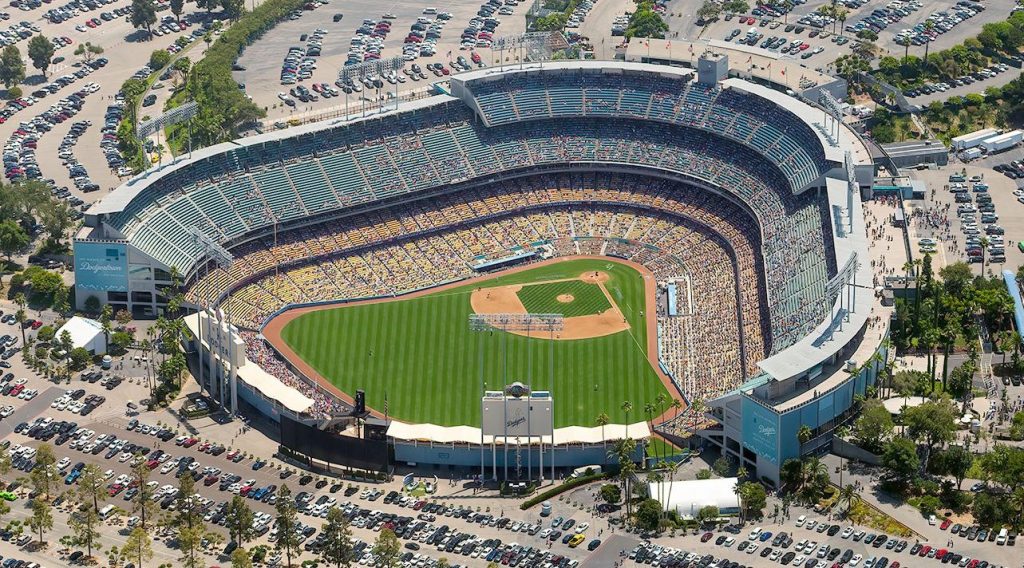
So, what exactly was ultimately built in Chavez Ravine? Dodger Stadium was one of the last baseball-specific ballparks built before the age of the multipurpose concrete donut stadium (though it does have plenty of concrete, and not a lot of it covered). It’s also by far the oldest current MLB ballpark that has never increased its capacity, which — at 56,000 — is by far the most in the entire league. It’s one of just two MLB ballparks with a symmetrical outfield wall (along with Kauffman Stadium), which both helps and hurts offense. Dodger Stadium has a historic reputation as a pitcher’s park, with just as many perfect games (two) thrown as cycles hit for in its history. The deep outfield, short corners, and smaller foul territory (post-2004) help to cut down on extra base hits. However, it’s shallow center field and low walls help with producing home runs. For most recent years, Dodger Stadium has ranked as a relatively neutral venue. However, Dodger Stadium has gradually been ticking upwards towards being hitter friendly, which could be both a reflection of baseball’s greater shift to the “three true outcomes” in recent years and a result of Shohei Ohtani swinging Mjölnir every time he comes to the plate. It was also built to be earthquake-resistant, a pretty good decision when you consider SoCal’s geology.
Dodger Stadium is also a product of its era, which sets it apart from the rest of MLB’s current ballpark lineup. It’s the third-oldest ballpark in the league, with the second-oldest coming nearly 50 years earlier. Apart from Angel Stadium (which lost its era-defining traits when it was converted into a multipurpose venue), Kauffman Stadium ballpark built in the following 25 years that’s still standing. This allows Dodger Stadium’s design and unique features to remain a permanent retro throwback to the 1960’s. The most noticeable features are the wavy roof atop each outfield pavilion and the various hexagonal videoboards, advertisements, and other signs throughout the ballpark. There’s also a ten-story elevator shaft bearing the Dodgers logo that rises up from ground level to the very top of the ballpark directly behind home plate. This kind of design is replicated throughout Dodger Stadium, from the entrances to the facade of various food and merchandise stands to the main plaza to other kinds of signage around the concourse. In a way, Dodger Stadium is preserved and designed to be a time capsule of old school Los Angeles, an era and type of architecture beloved by many.
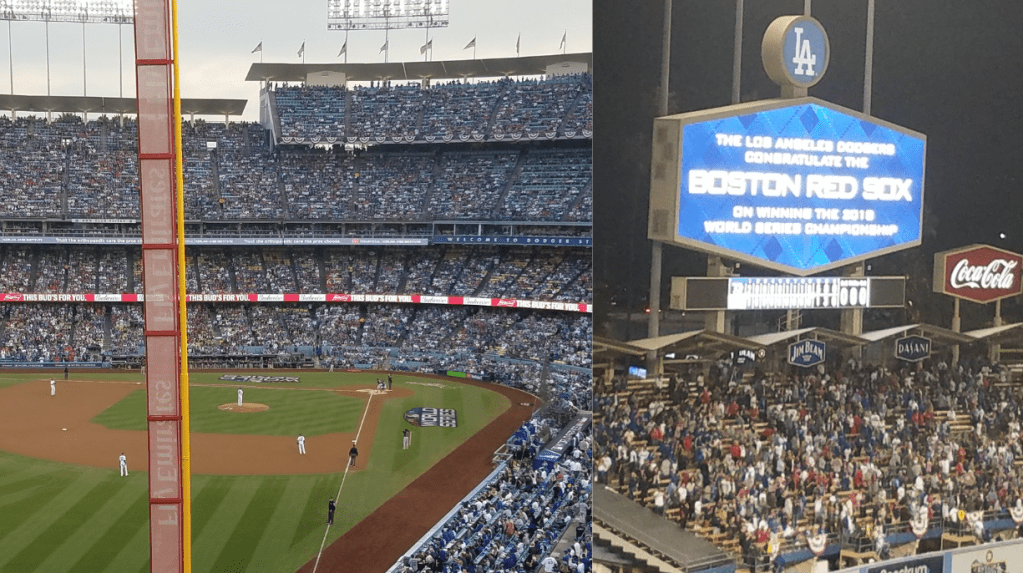
The thing is, I’m not really a fan. Don’t get me wrong — I certainly don’t find any of these features or designs ugly or unflattering or anything like that. Rather, I just don’t get the hype around it. Sure, it’s kind of cool to see this old-school design in person. But I see people fangirling over it and wonder how they can get this excited over a wavy roof and videoboards shaped like hexagons. I simply say “neat” and move on. That’s not the only thing people love about Dodger Stadium that I don’t, and I’m just going to rip the Band-Aid off and say it: Dodger Dogs are overrated. I had enough presence of mind to make sure I didn’t starve, and figured I might as well try one of the famous Dodger Dogs. As someone who loves hot dogs and makes sure to get one or a brat/sausage at every baseball game I attend, the Dodger Dog I had was alright, certainly nothing to write home about. As a disclaimer, I got mine at the stand near my seat in the third level (instead of the first level), and I think I got a steamed one vs. a grilled one (which is apparently better). But even then, I can’t imagine grilling it would improve it by that much. It’s still an okay hot dog, but I’ve definitely had much better at other ballparks.
Believe it or not, Dodger Stadium offers more than just Dodger Dogs to eat. While its food and drink menu has remained relatively basic throughout its history, recent years have seen the list of offerings become a lot more diverse and improved when it comes to quality. There are also a lot more Asian food options, which may or may not be due to the arrival of Ohtani and Co. That being said, it is also ungodly expensive, so try to bring in as much food or pre-game as much as you can. In addition, there are more private places to enjoy a drink and the game. The Gold Glove Bar in the left field pavilion has almost as many taps as it does actual Gold Glove Awards on display. Dodgers Stadium also has a speakeasy, as well as several private clubs, chief among them the Stadium Club in the second level behind home plate. Overall additions to the ballpark have also brought some much-needed modern touches. Those include the creation of the Centerfield Plaza, renovations to the right and left field pavilions, updated infrastructure and amenities, and improved tributes to the club’s lengthy history, such as statues of Jackie Robinson and Sandy Koufax and a hall of retired numbers.
However, one key aspect of modern ballpark design is completely absent. This can be reflected in Dodger Stadium’s panorama, which includes a view of the rest of Elysian Heights and the San Gabriel Mountains. But if you look closely, it also includes parked cars. That’s because Dodger Stadium not only sits in a canyon, but also in a sea of parking lots. The Dodgers have done work to make some of the greenery and walk-up areas in the parking lots more attractive, but to reuse a phrase from Part 1, it’s like putting lipstick on a pig. There is literally nothing in Chavez Ravine besides Dodger Stadium and its parking lots. There are some places to go before and after games in the neighboring Chinatown area to the south, but you have to drive there, and not just because it’s way too far to reasonably walk. It’s because you can’t really walk anywhere — the setup to get in and out of Chavez Ravine leaves it virtually unwalkable, unless you feel like dodging death by weaving through and around cars. There are also no public transportation options except for the Los Angeles County Metro’s Dodger Stadium Express bus route, which I didn’t even know existed until doing research for this entry.
Nope, the only reasonable and reliable way you can get to and from Dodger Stadium is by driving, which leads to another, more famous problem. Los Angeles traffic is legendarily terrible, and when big events take place roads and freeways become extra parking lots. Even for normal Dodgers games, funneling all of that traffic through a handful of uphill entrances leads to lengthy backups. Before the Dodgers got a Manchester City-sized injection of money and became known as the 21st century New York Yankees, their main reputation was that fans wouldn’t show up until at least the second inning, both because most people had better things to do and because those that did care were caught in traffic. Due to my unique travel situation, I had to run down Chavez Ravine, weaving in and out of the aforementioned traffic. Let me tell you, it looked as bad as advertised, which actually helped with avoiding getting run over. It honestly makes you wonder why anyone, even Dodgers fans, would willingly put up with it on a regular basis.
There is one more aspect of Dodger Stadium I haven’t talked about yet, one that may be the biggest positive factor of them all. It’s something I’ve mentioned in other entries that has helped worse ballparks rise up in the rankings more than they should’ve: aura. Dodger Stadium has aura by the boatload. It has seen a tremendous amount of history and success, with the Dodgers being one of the best teams in MLB for a lot of its existence. There is a vibe you can feel as soon as you enter the ballpark, one that even I could distinguish apart from the World Series-specific vibe I felt there. At its peak, Dodger Stadium rivals any other ballpark in terms of atmosphere, a lot of which comes from the tremendous passion of Dodgers fans (when they’re not beating up supporters of the visiting team). Dodger Stadium just feels like pure classic baseball, and if you’re solely interested in looking for the best baseball-specific experience, you’d be hard pressed to find any place better than Dodger Stadium. It is truly magnificent in that regard.
Ultimately, the question is this: are you willing to endure unholy traffic and old school amenities (for better or worse) for potentially some of the best baseball experience you’d get? Also, do you like 1960’s decor? For me, the answer is somewhere between “sure” and “no.” Don’t let is bottom half ranking fool you — every baseball fan should experience a game at Dodger Stadium at least once in their lives. But more than once? Unless you live in Los Angeles or are a Dodgers fan, I’m not sure. Beyond the traffic and other negatives, fans at Dodger Stadium these days also have to deal with insanely inflated prices, from everything to tickets to parking to food and drinks to merchandise. There are other ballparks with both incredible aura and fan experiences, as well as crazy costs to go along with that. I would be willing to deal with the negatives to go to those ballparks again. I can’t say the same for Dodger Stadium. Then again, this is just my opinion, and I understand why others would disagree and go through all of that to catch a game at Dodger Stadium. In the end, this is my list, so all of those people will have to just deal with my rankings. At least it’s better than the traffic to get to Dodger Stadium.
15. CITIZENS BANK PARK
HOME TEAM: PHILADELPHIA PHILLIES
LOCATION: PHILADELPHIA, PENNSYLVANIA
OPEN SINCE: 2004
ORDER VISITED: 16 (08/19/22)
GAMES I HAVE SEEN THERE: 1 (0-1 HOME TEAM RECORD)
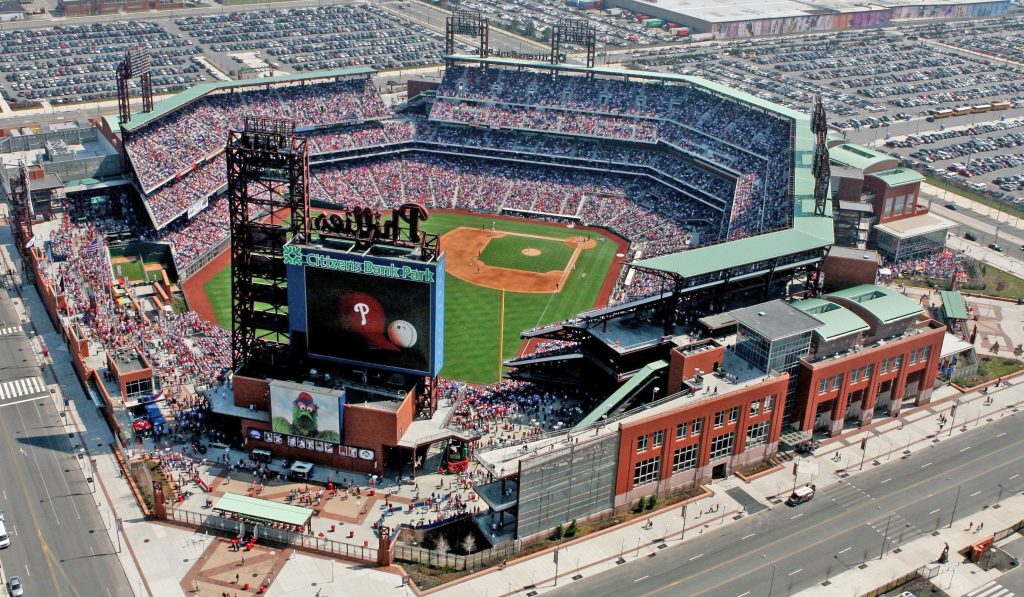
Philadelphia is not your typical sports city — just look at the fans of its teams. In fact, it was Philadelphia Phillies fans who forced the first major change to Citizens Bank Park, shortly after it opened in 2004. The bullpens — double decked and located below the right center field concourse — were switched around so that the visiting team used the upper one and the Phillies used the bottom one. This was done so that not only would the Phillies pitchers a better view of the game, but to protect them from heckling, as the upper bullpen was closer to the fans and their verbal taunting. However, they forgot to rewire the phone for both bullpens, so during the first game after the switch, dugout coaches had to communicate with the bullpen via hand signals. Certainly, Philadelphia is wired differently than most other cities (another example: Gritty). This can also be seen with where their major sports venues are located — the South Philadelphia Sports Complex. At first glance, it looks like nothing but a sea of parking lots — and in fact, it is indeed a sea of parking lots. Still, it’s not that simple, and before you write off Citizens Bank Park and its placement, I need to go a bit further into the area’s history. As it turns out, those parking lots have more sporting history than some ballparks.
Located at the south end of the city — in the pocket formed by Broad Street, Interstate 76, and Interstate 95 — the land the complex sits on was renovated as part of the 1926 World Fair, held in Philadelphia to celebrate America’s 150th anniversary. The first venue to be built there was Sesquicentennial Stadium (later named John F. Kennedy Stadium), which hosted the NFL’s Philadelphia Eagles but was mainly the site of the Army-Navy college football game from 1936-79. It would eventually be replaced on both fronts, as Veterans Stadium — a classic concrete donut multipurpose venue — was built nearby in 1971. Veterans Stadium would also house the Phillies, who left behind the beloved Shibe Park (also known as Connie Mack Stadium), for 32 years. During that time, the complex would see the addition of the Spectrum (home of the NBA’s Philadelphia 76ers and NHL’s Philadelphia Flyers), as well as the Spectrum’s replacement (now known as the Xfinity Mobile Arena), which was built upon the site of the torn-down John F. Kennedy Stadium. In those 30+ years, Veterans Stadium aged poorly and deteriorated, leading to problems such as a mouse infestation and a hole in the wall between the visiting locker room and the Eagles’ cheerleaders dressing room. In 1998, a collapsed railing that injured eight cadets during the Army-Navy game sparked a push for new, separate venues for the Phillies and Eagles.
While the Eagles picked a site slightly southeast of Veterans Stadium to built Lincoln Financial Field, the Phillies looked elsewhere. This was well into the downtown ballpark wave, and the Phillies were set on being part of it. After looking through several options, officials settled on a site along 13th and Vine Streets in the Chinatown area. Although there was support from the business and labor communities, Chinatown residents protested. Then the city and team did something almost unprecedented or unfollowed: they actually listened to the people and looked elsewhere. Ultimately, they went back to the South Philadelphia Sports Complex, building Citizens Bank Park directly east adjacent to Veterans Stadium. Looking back on it later, fans, residents, and Phillies officials have expressed regret about not building a downtown ballpark. It makes sense — these kind of venues have proven to be much better than the alternatives. But as someone who just raked the city of Los Angeles over coals for the Chavez Ravine saga, I can’t criticize the city of Philadelphia for not imposing their will on a community of minorities. That being said, Philadelphia is already a pretty jam-packed city without much room for new projects in the city proper. Plus, there were already multiple venues at the complex, with Citizens Bank Park making it a true hub for Philadelphia sports. It’s a flat hub of pavement, but a hub nonetheless.
To be fair, it’s not entirely flat. Unlike all of the other ballparks trapped in a sea of parking lots, there is actually something there besides cars. That would be Stateside Live! — a huge restaurant, bar, and entertainment area located almost equally in between the three sports venues. With an outdoor plaza and several indoor options, it’s not only an alternative to tailgating (a Philadelphia staple) and an option for post-game activities, but has become a hub for media broadcasts and a rare central gathering point in a sea of parking lots. Also, the parking lots themselves are formatted in a grid and easy to navigate. While this all leads to a heap of traffic on game days (which, given most of the city’s sports teams play there, are plentiful), the location is also easy to navigate for drivers. You can get to the Philadelphia International Airport to the west, the city to the north, and New Jersey to the east over the Delaware River and Walt Whitman Bridge. The Southeastern Pennsylvania Transit Authority (SEPTA) also has multiple bus routes and a Metro station within walking distance. Plus, while the area it’s in might seem slightly sketchy, the nearby areas — the Navy Yard and FDR Park — are actually pretty nice. What I’m getting at here is that while a downtown ballpark is much more preferable and the location/parking lot ocean bring Citizens Bank Park down compared to other ballparks, this is probably the best, most ideal outcome you can get in this situation, and it will get better. A new hockey/basketball arena is in the works, along with other renovations.
There’s one other reason fans don’t necessarily mind have to deal with the traffic and pools of pavement — Citizens Bank Park is a damn good ballpark. The outside of the facility features buildings that house fan amenities and other services, along with team offices. Plazas on all four corners of the ballpark (each with their own unique look) welcome fans once they go through the entrance. This all surrounds the main ballpark bowl, an octagonal structure that looks uniform until it isn’t. The upper deck stops at the third base line on the left side, with a break for the videoboard and left and center field plazas. But there isn’t really a full right field plaza. Instead, the upper deck on the right side has a break right at first base, before beginning again and carrying on beyond the right field pole. Those upper deck seats are actually situated closer to the field to the others as well. The distinct angles of the seating bowl are an homage to those at the Phillies’ old home of Shibe Park, while the main break in center field gives Citizens Bank Park something neither Shibe Park nor Veterans Stadium had: a pretty panorama of Downtown Philadelphia (one positive of the ballpark not being located downtown).
While all of the seats in the ballpark are blue, another big color at Citizens Bank Park is green, and not because of the field. The Phillies were the first MLB team to join the Environmental Protection Agency’s Green Power Partnership Program, a commitment to purchasing green power and minimizing environmental impact. The Phillies remain one of the Top 3 purchasers of green power in Philadelphia, reflected in their effort to power the ballpark with 100% renewable energy and make their concessions completely recyclable and sustainable. The green of the field leads to another color: red. Specifically, the heat from batters in Citizens Bank Park, which ranks among the most hitter-friendly ballparks in all of MLB. This reputation caused the left field walls to be moved in five feet shortly after its debut, and the left side in particular has been a target for hitters, in part due to the small jut inward in left center field. There was some neutrality in the 2010’s, though that may have been due to the Phillies’ excellent pitching. There’s no word if anyone’s been able to hit a foul ball far enough to the left to hit the commemorative plaque in one of the parking lots marking where home plate of Veterans Stadium once stood.
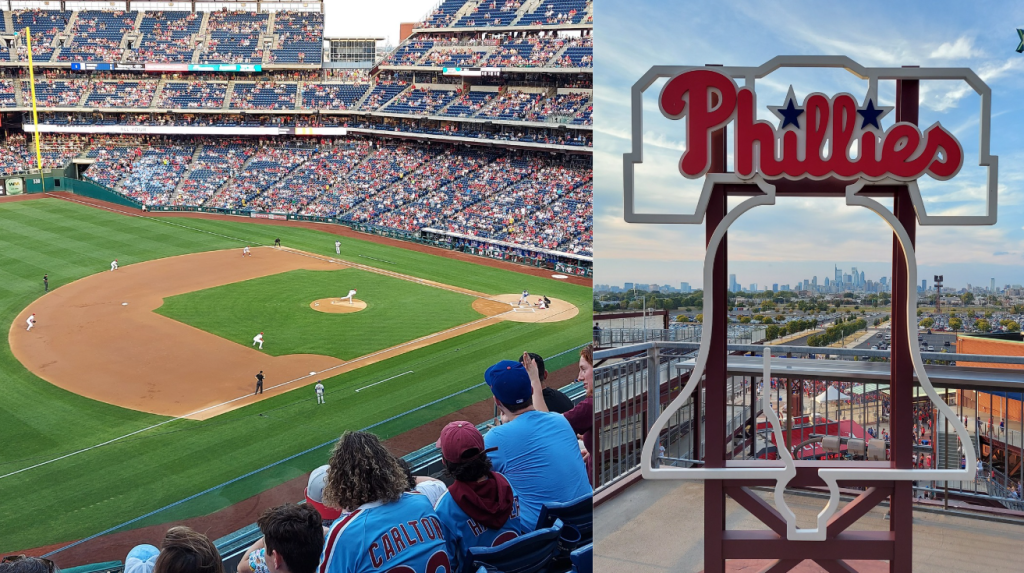
Of course, there is also plenty of red in the ballpark due to it being the Phillies’ home venue, and both the team and city of Philadelphia are well-represented at Citizens Bank Park. High above the center field concourse hangs a mechanical, lighted replica of the Liberty Bell, which “rings” and lights up for every Phillies home run and win. A second, smaller light up Liberty Bell — one that was on display at Veterans Stadium — has also been refurbished and relocated outside one of the main entrances of the ballpark. An even smaller metal outline of the Liberty Bell is in the edge of the upper left concourse, with the Philadelphia skyline in the background. Each of the plazas in the corners of the ballpark features a statue of a former Phillies great — specifically, Richie Ashburn (right field gate), Robin Roberts (first base gate), Mike Schmidt (third base gate), and Steve Carlton (left field gate). There is also a statue of former broadcaster Harry Kalas along the first level concourse next to a restaurant that bears his name.
The namesake of one of the above statues is arguably Citizens Bank Park’s most beloved feature: Ashburn Alley. Located in the left center field concourse — near where Ashburn used to play defense — Ashburn Alley is a concourse that doubles as an education of Philadelphia baseball. You can walk by granite markers commemorating every Phillies All-Star ever on your way to Memory Lane, which features the history of the Phillies, as well as the Philadelphia Athletics and Negro league teams. The Alley area also has flags of the Phillies’ championships (not to mention several geographically significant flags and the POW/MIA flag), the rooftop bleachers (another tribute to Shibe Park), a video trivia game, and the aforementioned bullpens. There’s also the Yard — a 13,000-square foot kids play area featuring a whiffle ball field, mini bullpen, climb area, and mini Philly Phanatic hot dog cannon shooter (something every ballpark needs). The Yard has something both kids and adults love: an ice cream bar, which gets into another one of Citizens Bank Park’s major strengths.
Citizens Bank Park has a fantastic selection of food and drinks, many of which take from Philadelphia’s food culture and many of which are located in Ashburn Alley. That begins and ends with cheesesteaks, and Tony Luke’s gets the honor of having its stall in Citizens Bank Park. It’s easily the longest concession line in the ballpark but, as someone thwarted by even longer lines at Pat’s and Geno’s, the wait was well worth it for me. Campo’s serves cheesesteaks as well, but is more well known for its other deli style sandwiches. Bull’s BBQ (partially owned by former Phillies outfielder Greg Luzinski) is also a popular stop, while other local vendors offer delicacies such as chicken and donuts, frozen custard, crab fries (phenomenal), and tastykakes. There are also several notable food options named after Phillies players, such as Schmidt (the Schmitter sandwich), Christopher Sanchez (Sanchez Sliders), and Kyle Schwarber (Schwarbomb Sundae). The local focus also stretches into the alcohol offerings, with Yards and Yuengling beer sold throughout the ballpark.
When it comes to the more private food and drink options, Citizens Park has some good options. Pass and Stow near the third base gate is an indoor bar and restaurant that also includes an outdoor bar and pizza oven. High and Inside Pub on the terrace level behind home plate is private before the game but open to the public after first pitch. The Philadelphia Insurance Club is a premium seating area behind home plate that has views of batting practice, not to mention exclusive food and souvenir shops. The Hall of Fame Club also has similar amenities, as well as the Phillies’ two World Series trophies and displays of Phillies and Athletics memorabilia (some of which dates back to the 1880’s). The historic parts have actually become an attraction for Phillies fans. The Hall of Fame Club also houses the A/V crew and control room that handles the scoreboard and other monitors, as well as the radio/TV booths and press box.
The visuals are part of how Citizens Bank Park has continued to improve over the years. In 2023, the Phillies replaced the ballpark’s videoboard with one that was 77% larger, which is notable considering the old videoboard was nearly triple the size of the first screen. The left field plaza also got new upgrades, including oversized replicas of the team’s World Series trophies and large displays of their retired numbers. New this year inside the first base gate is the King Swings Playground — a new and improved children’s play area that includes six climbing towers, two rock walls, four slides, and other interactive play elements. Overall, even though Citizens Bank Park has a Top 10 capacity in MLB, there is still plenty of room for activities that don’t get in the way of the main reason you’re there. Also, the Phillies have proven to be proactive with adapting and upgrading the ballpark, even though it’s still relatively young. Citizens Bank Park is old enough to drink and has shown itself to be one of the better ballparks in the entire league.
That makes it all the more of a shame to rank it this low. Citizens Bank Park is a fantastic ballpark that has a huge anchor dragging it down: the location. While it has arguably the most accepted, adapted, and overall best sea of parking lot and car-heavy situation, all of that is still not good. It’s like being happy your team has the best record out of every other team that’s in last place in their division. If Citizens Bank Park had been built in Downtown Philadelphia proper, it would’ve been placed at least two tiers higher. While I can understand why it wasn’t, Philadelphia, the Phillies, and the rest of the baseball world have to live with the consequences, good or bad. It is what it is, and it’s ultimately the reason why I can’t rank Citizens Bank Park any higher. If I were only considering the ballparks themselves and not everything else that goes into the experience, it would be up there. But I’m not, even though part of me wishes I was. Still, like I said, it is what it is, and I stand by the decision and willingly take the snowballs and batteries Phillies fans will be eager to throw at me.
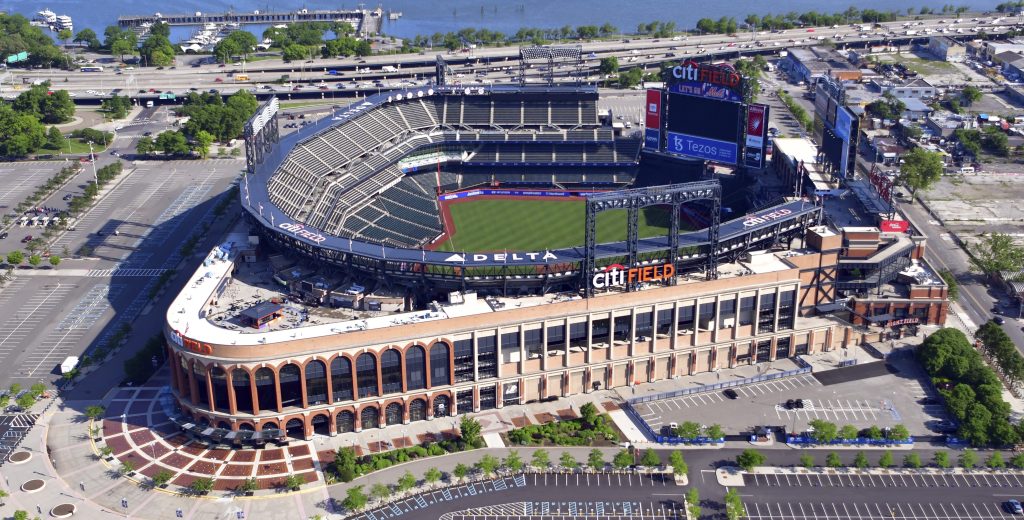
14. CITI FIELD
HOME TEAM: NEW YORK METS
LOCATION: QUEENS, NEW YORK CITY, NEW YORK
OPEN SINCE: 2009
ORDER VISITED: 8 (06/16/19)
GAMES I HAVE SEEN THERE: 1 (0-1 HOME TEAM RECORD)
Let’s go back a couple of entries. One of the reasons the Brooklyn Dodgers ended up moving to Los Angeles was that owner Walter O’Malley wanted to build Ebbets Field’s replacement in Brooklyn (and have full control over it), while New York City officials wanted them to build it at a site in the Flushing Meadows Area of Queens (and be able to rent it). Fast forward some 50ish years and the team that replaced both the Dodgers and New York Giants, the New York Mets, are playing in Shea Stadium, built at that same Flushing Meadows site. However, the Mets have been wanting a new home for a while now, as Shea Stadium — opened in 1964 as a multipurpose concrete donut venue but renovated 20 years later to be a baseball-only ballpark — has, like similar venues, aged poorly. After years of negotiations, the Mets get a break from an unexpected source: the 2012 Summer Olympics. More specifically, New York’s bid to host the games that included a planned new mega sports venue in Manhattan. When plans for that fell through, that venue was instead set to be built in the site of Shea Stadium’s parking lot, and would be turned into the Mets’ new ballpark after the games. While New York’s Olympic bid ultimately fell short, the dialogue surrounding the Shea Stadium site kept going and a deal was struck. In 2009, Citi Field opened directly northeast next to its predecessor.
However, there was an immediate problem, an unusual one for any venue. The year prior to the ballpark’s opening, Citigroup agreed to a $400M, 20-year naming rights deal, the largest in history to that point. But later that year, the greatest economic disaster since the Great Depression began, fueled in large part by excessive speculation on property values by both homeowners and financial institutions. One of those institutions was Citigroup, which received a total of $45B in taxpayer funds as a bailout loan from the federal government, having deemed Citigroup “too big to fail.” Instantly, critics jumped on the naming rights deal, calling for it to be nullified. It got so heated that Citigroup did consider breaking the deal, while the Mets distanced themselves from Citigroup, even going as far as to alter jersey patches for the ballpark to remove the name. In the end, the deal was kept and Citi Field remains the ballpark’s name to this day (as of this writing, anyway). Controversy did erupt again when then-Mets owner Fred Wilpon’s involvement in Bernie Madoff’s Ponzi scheme was brought to light. It is worth noting that Citigroup stated that no TARP funds would be involved in the naming rights deal, and Citigroup fully repaid the loan in 2014.
There was another sort of issue early on in Citi Field’s life, one related to arguably its most aesthetically pleasing feature. Wilpon was a massive Brooklyn Dodgers fan growing up, and took care to honor the team’s old home in his team’s new home. Citi Field’s facade is modeled after that of Ebbets Field, with long swooping brick arches and partial glass windows. It’s truly a magnificent facade, but the interior might be even better. Inside the home plate entrance lies the Jackie Robinson Rotunda, an ornate hall that highlights the baseball icon’s life and career, with large words and images that define Robinson’s nine values. Fans can take escalators and grand staircases to their seats. It’s absolutely gorgeous, but fans had one major criticism: it had nothing to do with the Mets. The team had never even played in Ebbets Field — in fact their first home was the Polo Grounds, home of the rival Giants. Wilpon admitted to going a bit overboard with his shrine to the Dodgers, and gradually more Mets-specific stuff was added to the area, including large displays of famous players and moments and a Mets Hall of Fame (which is now more spread across the ballpark than in one main location). Why this wasn’t all there in the first place, I don’t know.
Ebbets Field wasn’t the only non-Mets ballpark to inspire City Field. While the concourse and other areas take inspiration from Great American Ball Park, Citizens Bank Park, and other ballparks we’ll get to in Part 3. There are also some tributes to ballparks where the Mets actually played. The seats of Citi Field are dark green, as they were at the Polo Grounds. Then we get to Shea Stadium, and three key pieces are in focus (well, four, if you count the outfield walls, which were painted blue with orange trim). The first is also orange: the foul poles. Shea Stadium was the only MLB ballpark with non-yellow foul poles, and Citi Field has continued the tradition. Then we have the big red thing in the middle. Shea Stadium used to have a big apple that rose up every time the Mets hit a home run. That tradition continues as well, although Citi Field’s apple is four times larger than its predecessor, which sits in the plaza outside of the ballpark. Another piece of Shea Stadium made it into Citi Field, with the replica of New York City’s skyline that used to sit atop the scoreboard now on display on top of the Shake Shack stand behind center field. It might be the most New York thing in the ballpark.
The inspiration doesn’t stop when it comes to the actual baseball being played. In a nod to Tiger Stadium, the upper right field bleachers — known as the Coca-Cola Corner — hangs over the lower level, which helps out fly balls hit over there. But that’s about the only hitter-friendly aspect of the ballpark. Like Shea Stadium before it, Citi Field is largely a pitcher’s park, not only because of the cold wet air coming from Flushing Bay, but by its dimensions. Center Field is relatively deep compared to the rest of the league and the rest of the outfield wall isn’t much closer. Believe it or not, the pro-pitcher tendencies were actually worse, with Citi Field drawing criticism for limiting the offensive production of hitters like David Wright, Jason Bay, and Jeff Francoeur. After a few years, the dimensions were changed to make things a bit more neutral. This has largely worked, although Citi Field continues to hover in and around the Top most pitcher-friendly ballparks across MLB today.
Naturally, Shea Stadium also provided some blueprints on what not do do. The old ballpark had long been criticized for its tall upper deck and large foul territory (though the latter had somewhat been fixed by its final years), with many fans feeling far from the action. This is not the case with Citi Field, and not just with the Coca-Cola Corner. Citi Field has a capacity of just under 42,000, putting it just outside the Top 10 in MLB. But more than 40% of those seats are located in the lower deck, bringing more fans closer to the actual field of play. Still, Shea Stadium is largely shone in a positive light around Citi Field, and is the namesake for one unique aspect of the ballpark. There is a bridge that connects the right and center field plazas modeled after the Hell Gate Bridge called Shea Bridge. It’s meant to symbolize the bridge between the Mets and New York’s previous National League teams, the Dodgers and Giants. It’s also fitting because New York, like most major East Coast cities not named Philadelphia, has a seemingly endless amount of bridges. Shea Bridge also links fans to the main part of the ballpark that showcases arguably its best and highest-rated feature.
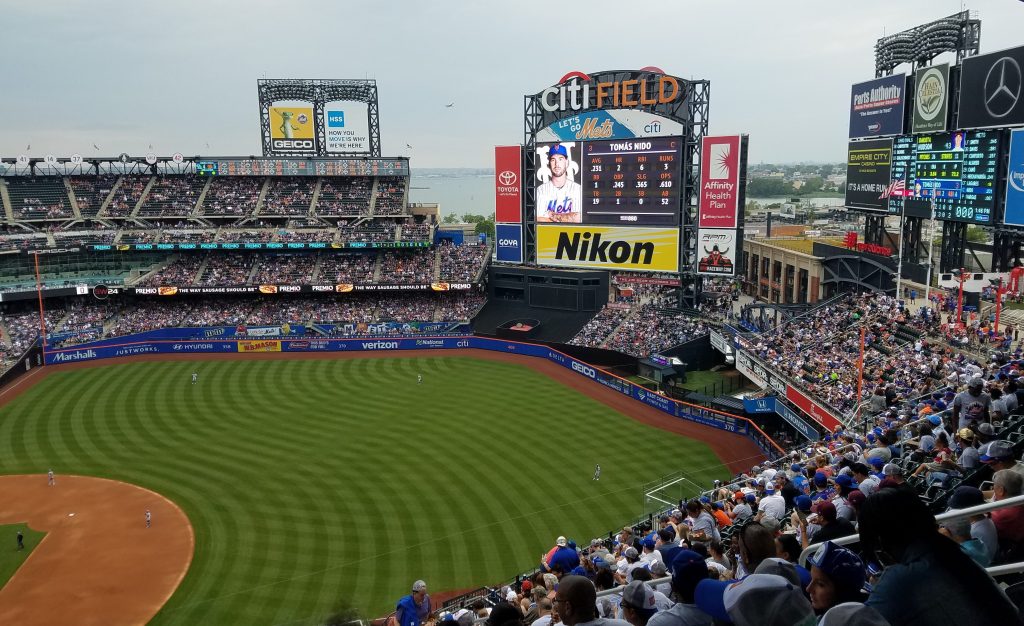
Since its debut, Citi Field has consistently been ranked near the top of MLB in terms of its food and drink offerings, and for good reason. The offerings there are absolutely delicious, whether it be the basic sporting venue fare or more local specialties. The aforementioned Shake Shack anchors “Taste of the City” — an open-air food plaza located behind center field. In addition to the popular Bases Loaded Burger (a cheeseburger topped with crispy onions and barbeque sauce), the area includes everything from chicken to barbeque to fries and sweets to Mexican, Italian, and various Asian cuisine. All of it is great, with one notable exception. One vendor, Won N’ Roll, offers custom egg rolls inspired by the visiting opponent. That includes the Cincinnati Reds, with a Skyline Chili egg roll being created in their honor. I like Skyline Chili, as does Reds reporter Jim Day, who recently tried one out and was… not thrilled. Look up what happened, it’s hilarious. At least for Day, he could wash it down with one of Citi Field’s good drink options.
There are also several tasty restaurants throughout the concourse. One of those, Adam Richman’s Burger Hall of Fame, is the product of the Brooklyn native, Mets fan, and former Man v. Food host. There’s also the Heineken Diamond Sky Lounge, a large collection of bars and restaurants that gives fans a semi-formal place to sit down. Perhaps the most sought-after (read, expensive) option is the Porsche Grill, which offers food from the Myriad Restaurant Group (which includes Nobu and Tribeca Grill), not to mention a full view of the playing field. There are also plenty of other clubs and private sections that offer these kids of amenities to fans. Recent years have also seen new offerings due to seat reconfigurations, not to mention the installation of a new 17,400-square foot videoboard, which remains (as of this writing) the largest in MLB today. Unfortunately, none of this can take away from Citi Field’s biggest current problem.
Shea Stadium sat in a sea of parking lots, one of which became Citi Field, and was then demolished to become a parking lot (that has commemorative plaques marking the bases). As for the rest of the parking lots, all of them have remained parking lots. The immediate area around Citi Field has absolutely nothing to offer, unless you count the shoreline around Flushing Bay to the north. Now to be fair, Citi Field isn’t the only attraction in the area at large. Below the railroad tracks lies Arthur Ashe Stadium, Louis Armstrong Stadium, the New York Hall of Science, and the massive Flushing Meadows-Corona Park. It’s a lovely place to be, sure. But it doesn’t offer too much in terms of modern entertainment. Fans aren’t going to head to the park to celebrate a win (or, as the case of the Mets’ 2026 season, another loss). The rest of the larger area contains residential neighborhoods and a smattering of smaller bars and restaurants, few of which are within reasonable walking distance.
Of course, that last point doesn’t matter much to New York and its people. As mentioned in Part 1, despite all of the parking lots, no one drives in New York — there’s too much traffic. A lot of that traffic comes from its location directly south of the Whitestone Expressway, in between the Grand Central Parkway and Interstate 678. It’s driving in New York in a place where a lot of cars are funneled. There’s going to be a lot of traffic. So, New York relies heavily on public transportation, and Citi Field has plenty of options. The New York City Bus has several stops nearby, but the main method is that railroad area mentioned above. The New York City Subway’s 7 Flushing Local and Flushing Express and the Long Island Rail Road’s Port Washington branch all have stops that take you right to Citi Field. With so many options, your choice ultimately determines your first impression of the ballpark. Some options take you right in front of the main entrance, which looks absolutely lovely. Others put you on the other side, looking at a bunch of metal. Still, it gets the job done, either way.
Ultimately, Citi Field has the same problem as the prior two entries. It’s a fantastic ballpark that deserves a higher spot, but held back due to its main weakness like a heavy anchor. The question comes down to whether or not you’d be willing to deal with either the bumper-to-bumper traffic or the challenge of navigating New York City’s public transportation. There’s also the negatives that comes with the subway in general (after all, my dad says that’s where all of the murders happen, according to the crime TV shows he watches). For as much sarcasm as that bit on parenthesis had, it’s still a factor for visiting fans. If I were from or lived in New York, I’d probably know how deal with it and be used to/willing to do it. But I’m not, and I’m not. In this day and age, there needs to be at least a few options to make the whole trip to the ballpark worth it, especially with the way current ballpark trends are pointing (more on that later). Quite simply, a great ballpark can be held underneath an ocean of concrete. However, that sea may soon be parted.
Late last year, the New York State government gave final approval of the Metropolitan Park project, a $8B, 50-acre park, casino, and entertainment complex in the Flushing Meadows area. The project aims to turn all of those parking lots around Citi Field into green space, hotels, restaurants, bars, a playground, a public plaza, and (yes) parking garages. It’s an ambitious plan, but should it work, it would not just eliminate Citi Field’s biggest weakness, it would also create a new strength. Unfortunately, there’s another major construction project underway directly to the northeast. Citi Field’s panorama (rather, the bit of it not blocked by the videoboards and advertisements) will also show off Etihad Stadium, the planned future home of MLS’s New York City FC. Given that the soccer club is co-owned by the New York Yankees and Manchester City, it’s one big reason for me to stay away. Still, Metropolitan Park may just be the thing that takes Citi Field up from this tier into perhaps even the single digits. But that’s in the future (planned finish date of 2030). For now, it has to remain here.
With that, the “Great Ballparks That Should Be Higher But Are Brought Down By Their Location and Sea of Parking Lots” Tier is done. Next up is a tier with a much easier name to understand and a much simpler description.
A TIER
The final tier of Part 2 showcases ballparks that are excellent — ones with either no major weaknesses. Whatever can be criticized about these ballparks is either not enough to drag them down a lot or is overshadowed by its positives to a notable extent. These are all great places to catch a ball game and while some may seem a bit of a surprising inclusion, most if not all of my friends who have also been to these ballparks agree they should feature high on this list. The first one may be the best example.
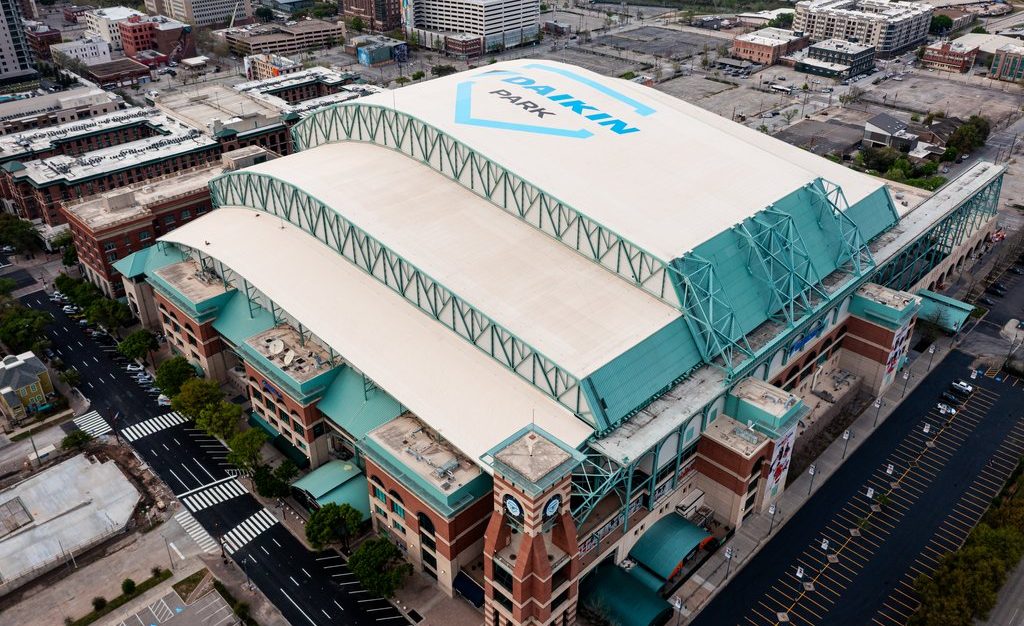
13. DAIKIN PARK
HOME TEAM: HOUSTON ASTROS
LOCATION: HOUSTON, TEXAS
OPEN SINCE: 2000
ORDER VISITED: 22 (04/12/25)
GAMES I HAVE SEEN THERE: 1 (0-1 HOME TEAM RECORD)
When it comes to the discussion of most influential sporting venues of all-time, the Houston Astrodome (originally the Harris County Domed Stadium and now the NRG Astrodome) has to be talked about. It opened in 1965 as the world’s first multi-purpose domed sports stadium — one the original concrete donuts — and was called the “eighth wonder of the world” (which shows just how far stadium design has come since then). It also became the first major sports venue to install artificial turf (which became known as Astroturf) and the home of the first animated scoreboard. It housed a variety of local teams, most notably the Houston Astros and the NFL’s Houston Oilers. But by the 1990’s it was already obsolete, with the state of the Astrodome and an inability to secure a new stadium being one of the main reasons the Oilers left for Tennessee that decade. Rumors also swirled over the Astros potentially leaving for Washington, D.C., with a new ballpark at the crux of the talks. The original plan was to build a replacement near the Astrodome site, which is well south of Downtown Houston, despite the downtown ballpark revolution having recently begun. Houston officials simply didn’t believe a downtown ballpark was viable for their city. That is, until the ballpark push crossed paths with another major project.
In 1911, Houston opened Union Station — a large, ornate train station modeled after those in New York. At the time, Houston was considered the main rail transportation up of the Southern U.S. It served the Houston area and beyond for more than six decades, but eventually declined after Amtrak moved its main services to another station. It was named to the National Register of Historic Places in 1977 and sat mostly unused except for some corporate offices until 1996, when Union Station received a $2M grant for renovation. Just a month later, the ballpark plans changed when Enron Chairman Kenneth Lay pledged to contribute a substantial amount of funding if the project was moved downtown. At some point, someone proposed the Union Station site as the location for the ballpark, and Lay was all in on it. It took a few more battles and public voting and other debates, but the final approval eventually came. Lay’s company also paid for the naming rights, and Enron Field made its MLB debut in 2000. Then, after Enron completely crapped itself, the ballpark was renamed Minute Maid Park, and then last year became Daikin Park.
Union Station’s inclusion meant to serve as a welcome to baseball fans, as it has served as a welcome to all of the rail passengers. While the symbolism is there, the actual building — which has been restored to properly display its grand marble and columns — serves mainly to hold Astros offices and other events/galas. It also becomes a team store on game days, while the top floor on the roof becomes a party deck with views into the ballpark similar to those next to a ballpark in Chicago I haven’t talked about yet. The exterior of Union Station — made of granite, limestone, and terracotta — also inspired the facade of Daikin Park, which is made and designed in a similar manner, complete with an old school-looking clocktower at the bottom corner of the ballpark (just across from Union Station, which is on the west). Of course, Union Station’s former purpose also inspired one of Daikin Park’s calling cards: an upscaled replica of the General 4-4-0 locomotive situated along tracks about 70 feet above left field/the left field concourse. It moves when the Astros take the field to start the game, when an Astros player hits a home run, and when the Astros win. In case you were wondering, this is one of the main reasons Daikin Park is so high up on my list — it has a train.
The train (which is manually driven) is far from the only quirky feature of Daikin Park. Uncs among you will remember Tal’s Hill a 90-foot wide, 20-degree incline at the back of center field. Named after former Astros president Tal Smith, the incline was inspired by similar features that used to exist at Crosley Field (among others), and also included an in-play flag pole like those at Tiger Stadium and old Yankee Stadium. Tal’s Hill was divisive among baseball fans, some of whom celebrated it as a unique feature while others (rather, people with a brain) called it a stupid, unnecessary, nostalgia-baiting gimmick that actively hurt gameplay. Thankfully, Tal’s Hill (and the flagpole) was removed and flattened after the 2016 season. Another such feature lies directly behind left field and ahead of the left side of the train tracks. The Crawford Boxes, named after Crawford Street (which borders that side of the ballpark), are the only seats in the left field bleachers. Five rows of seats on top of a 19-foot high wall (which also includes a hand-operated out-of-town scoreboard) are some of the most prime spots for fans in the entire ballpark, but provide a one-of-a-kind experience.
These quirks have also had their impact on the field of play. Tal’s Hill’s impact is obvious, though even in death it still affects the action, as the center field wall was moved nearly 30 feet close to home plate as a result. As for the Crawford boxes, they jut out from the rest of the left-center field area, not only shortening the distance from home plate but also creating a nook where bouncing balls can create a bit of chaos (it also features a small balcony, marked by a Phillips 66 gas pump, that juts out from the rest of the area a small amount of fans can watch the game). All of this sort of gives the air of another ballpark, which has the shortest left field in MLB and a much taller wall. But unlike that hallowed ground, Daikin Park (which has the second-shortest left field and one of the deeper center fields) has a relatively deep right field as well. Those right and center fields mean Daikin Park, with its league-wide average seating capacity, has actually been a pitcher-friendly ballpark for much of its duration. However, it has been creeping up to neutral and even hitter-friendly territory in recent years.
Speaking of “up,” much of the talk before Daikin Park’s construction and ever since it debuted has been about the very top of the ballpark. It took a while, but we are finally talking about a retractable roof ballpark once gain. The very idea of putting a roof on the ballpark was the subject of much debate between the traditionalists who wanted baseball played in open air and those who wanted protection from bugs and the area’s hot and muggy weather (it is said that air conditioning made Houston possible). The result was one of the better compromises in all of MLB. The roof consists of three main panels, the bottom tow of which come out from underneath and slide over to cover the field. It’s also built in a way that gets higher above the field the further it gets from home plate, following the trajectory of a hit ball. It’s an intelligent design and one that’s designed to last for some 50 years before needing major repairs/replacement. Once opened, the ballpark is actually pretty nice to look at, with the left side of the panorama highlighted by a giant series of glass panes that stretch from the concourse to the roof approximately 200 feet above the field.
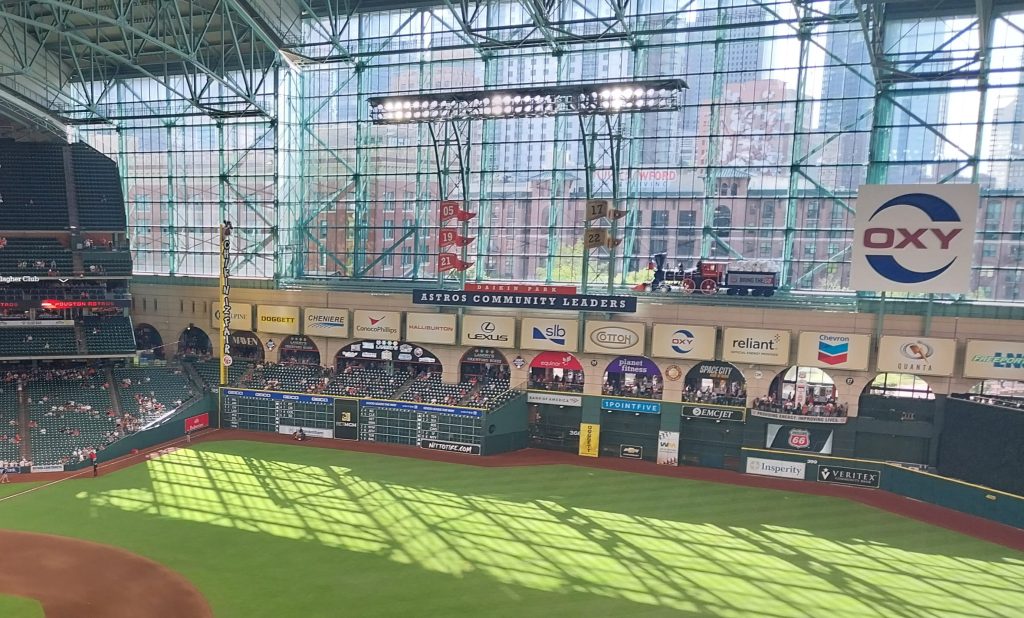
Naturally, there are some negatives about having a roofed ballpark. As you can see in the above photo, the glass can also lead to notable glare. While it isn’t as bad as it is at American Family Field for example, if I criticized that ballpark, I had to do the same here. There are also the common critiques of roofed ballparks, such as a limited panorama (just look at the left field view compared to the right field’s videoboard and advertisements) and the feeling of it being a bit cavernous. Granted, Daikin Park arguably does the best job of minimalizing the impact out of any of the ballparks like it. Still, however much of a necessary evil it is, it’s still an evil, as is the overall look from the middle-up. Roofed ballparks will never quite look right, even if Daikin Park’s roof makes the most sense from a design point. Then there’s something that is more of a personal taste: I don’t like the color of the roof. It gives off a vibe of oxidized metal, and that kind of light blue/green color practically covers the entire top half of the ballpark. The structure is also front-heavy, with the non-Union Station/clocktower half looking like the back of a strip mall rather than a ballpark. All of this means that, for as good of a job as Daikin Park does and how good of amenities it has (which puts it high above most over retractable roof ballparks), there is, ironically, a ceiling to how high it can go.
When it comes to those amenities, Daikin Park does them well. The ballpark has arguably the most underrated food menu in MLB. There are plenty of various barbeque options (notably brisket — including a brisket donut) and other Texas-based items, including Whataburger. Along with a Bloomin’ Onion, some of the new items this year focus on one of Daikin Park’s food strengths: hot dogs. There’s a banh mi dog, puff pastry-wrapped Polish sausage, and a foot-long hot dog covered in brisket, mac and cheese, and BBQ sauce. Much of this is located in Bayou City — a multi-tiered food court behind center field that offers a fantastic amount of delicious, diverse items, including tres leches cake. The drink options are also superb, with plenty of craft beer and margaritas. But the best part of the food concourse is the vast amount of trash cans — not only do they help keep the area clean, but they allow fans to meet and take pictures with the key component of the Astros’ 2017 World Series title run.
More amenities include some sit-down areas like the FiveSeven Grille — named after Astros legends Jeff Bagwell and Craig Biggio. Other bars and restaurants litter the concourse, but there are also plenty of activities for those who need to run around a bit. The right field concourse includes the Squeeze Play — a playground area where kids can burn off some steam. As for the more private and expensive options, the Six J Marketing Field Club gives fans the chance to eat and sit right behind the center field wall. Up in the third base side, the Gallagher Club provides a private bar and exclusive comfy seating. The Phillips 66 Diamond Club gives more of a front row seat, as well as offerings from a private chef. The Insperity Club offers perhaps the best views out of the premium seating, located directly behind home plate, one level below where the press box sits.
Just outside of the Insperity Club sits the Houston Together Commemorative Baseball Wall — a huge display of baseballs from all over the city organized in a unique design. That’s far from the only Houston/team-specific highlight of Daikin Park. The left field bleacher concourse also doubles as the Houston Astros Hall of Fame, with memorabilia and other items displayed alongside large images of Astros players and moments throughout the area, which also has a “HTX” sign. Further tributes to the Astros’ past can also be seen along the left field entrance. That’s where statues of Biggio and Bagwell can be found as much more typical tributes to the Astros greats. The left field entrance and plaza — already the most visually appealing part of the outside of the ballpark, is enhanced by other public art pieces and other displays.
When it comes to the surrounding area, Daikin Park was put there to try to help revitalize things, much like with other downtown ballparks. While that has happened, it has also taken a bit longer than it has in other cities. That can partially be reflected in the parking lots to the east of the ballpark, underneath Interstate 69, which aren’t exactly in the safest spots downtown. That being said, there are some restaurants and bars nearby. But location remains important due to what else is in the area — the Toyota Center and Shell Energy Stadium (home of the NBA’s Houston Rockets and MLS’ Houston Dynamo, respectively), not to mention the George r. Brown Convention Center. Those parking lots add up to about 25,000 spots within walking distance of Daikin Park, which is good because Houston is absolutely massive, and given its location in the pocket of Interstates 10, 45, and 69, there are a lot of ways to drive there. The Metropolitan Transit Authority of Harris County (METRO) has several bus stops near the ballpark, while the METRORail’s Green and Purple Lines allow for streetcars to drop passengers close by. Of course, it’s also quite easy to walk to the ballpark, especially with the hotels that have popped up in recent years.
In 2022, Daikin Park became the first ballpark in MLB to implement new contactless payment technology from Amazon, introducing the first cashier-less store in the league. It’s the latest example to show Daikin Park taking steps to the future of ballpark amenities. Some of those steps have been taken with an eye on the past, which dates back to its very foundation. It’s a ballpark featuring a retractable roof that was built into a structure that’s older than any ballpark currently in MLB. It harkens back to history, but mostly the history of Houston itself. While it’s held back by some things in and out of its control, Daikin Park does an extremely good job of using whatever it has to the maximum, creating a great and family-friendly experience. It’s also on pace to age well and continue to evolve into the future. Overall, Daikin Park has simply been sorted by many into the “retractable roofs are awful” camp and left at that. But it’s so much more than that, and a great place to catch a baseball game. Just be sure to keep your ears open for someone banging a trash can.
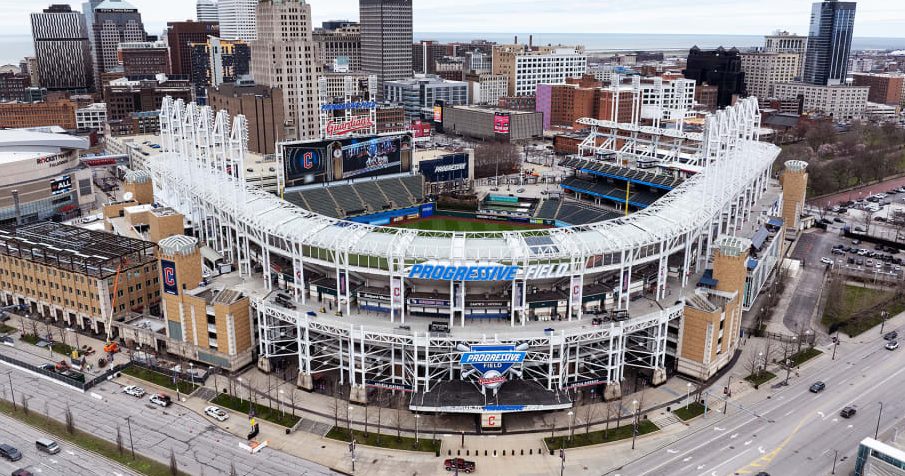
12. PROGRESSIVE FIELD
HOME TEAM: CLEVELAND GUARDIANS
LOCATION: CLEVELAND, OHIO
OPEN SINCE: 2004
ORDER VISITED: 12 (08/07/21)
GAMES I HAVE SEEN THERE: 1 (0-1 HOME TEAM RECORD)
It may not look like it, but Progressive Field (originally called Jacobs Field) is one of the unique ballparks in MLB, at least statistically. Opening in 1994, it’s in the Top 10 oldest ballparks in the league. It also has the third-lowest capacity with just under 35,000 — only more than Sutter Health Park and Tropicana Field. That’s despite it at one point having a peak capacity of over 45,000, which would be just outside of Top 5 today. It also has the third-largest videoboard in MLB in terms of square footage. Progressive Field is the only MLB ballpark to have a number retired not for a player or manager, but for the fans. The Cleveland Guardians have retired No. 455 in honor of the number of consecutive sold-out regular season games from 1995-2001, due to both excitement for the new ballpark and the team being among the best in the league. It was also during that stretch when Progressive Field became one of just two active ballparks to host both the MLB All-Star Game and World Series games in the same season. All of this, coming after Progressive Field unintentionally played a role in one of the most infamous and controversial relocation sagas in American professional sports.
Before Progressive Field, Cleveland played in Cleveland Municipal Stadium, one of the first multi-purpose sporting venues in the U.S. For about half a century, Cleveland shared the venue with a football team, most notably the Cleveland Browns. While there were certainly some high points in the early days, the stadium had, much like the city itself, been in decline for decades. By the 1980’s, the stadium was falling apart and there was a push for a replacement, which would not only house both the MLB and NFL teams, but attract the NBA’s Cleveland Cavaliers (playing at the Richfield Coliseum near Akron) back downtown. After a funding plan for that proposal was voted down, the baseball team shifted focus to a new project: the Gateway Sports and Entertainment Complex. It would be a downtown complex anchored by a new ballpark and a new arena for the Cavaliers. Separating baseball and football was now a sticking point, as baseball had long been unhappy with the revenue situation at the stadium. Despite the baseball team bringing in higher gates than football, Browns owner Art Modell negotiated a deal to assume all costs of stadium operation while raking in all the profits, even for baseball games. Modell believed those revenues wouldn’t be jeopardized by baseball’s departure, and thus declined to have the Browns involved in the Gateway Complex. A few years later, Progressive Field and the arena (now known as Rocket Arena) were opened and Modell, citing a need for a new venue, among other things, controversially moved the Browns to Baltimore.
Progressive Field was the first MLB ballpark built after another venue — which I’ll talk about in Part 3 — completely revolutionized the way ballparks are thought of and built. It was the first ballpark built in a true “retro” style — specifically, “retro classic,” designed to look like the old “jewel box” ballparks built during the dead ball era. Progressive Field followed along as a retro ballpark, but not retro classic. Rather, it was the first true “retro-modern” ballpark, designed with some jewel box elements (usually reserved for the interior and concourse), but also with modern features and other elements (the exterior and main structure). It was styled to blend in with the other parts of the city around it, with exposed white steel beams giving off an industrial look while hiding the ballpark’s main structure. Part of that white steel extends upwards in the form of 19 light towers designed to mimic Cleveland’s historic smokestacks and bridges (they also look like toothbrushes). Other elements that mimic historic Cleveland buildings — Atlantic green granite, Kasota sandstone, golden buff brick, etc — are also incorporated into the design of the main ballpark structure and other attached buildings. Progressive Field’s location also provides for a lovely panorama of Downtown Cleveland, although that’s been more than slightly blocked by the aforementioned massive videoboard (installed in 2016) behind left field.
When it comes to the old school ballpark inspiration, Progressive Field features an irregular set of field dimensions. Part of this can be seen in its left field, which is in the Top 5 shortest distances from home plate in MLB. It even has a 19-foot green wall with out-of-town scores that pales in comparison to more popular one. But while that has benefited hitters, the outfield walls jut inward at a more obtuse angle, resulting in relatively deepish left-center and right-center fields. This has all resulted in Progressive Field being one of the more pitcher-friendly ballparks in MLB. Meanwhile, the majority of Progressive Field’s seats are in the lower bowl, closer to the action. The upper bowl makes up for that with some of the steeper rows of seats in the league, reminiscent of another jewel box ballpark I’ll mention later. One aspect that was actually planned for Progressive Field first — and that other 1990’s ballpark copied and implemented (thanks to having the same architect) — was to angle the seats down the first and third base lines towards home plate. So, if you want to credit anyone for this modern ballpark feature, thank the Guardians.
As for Cleveland’s own history, it’s well represented across the ballpark, and not just in the Guardians name now strewn across it. Arguably the most notable aspect of Progressive Field is Heritage Park, set on the other side of the well-oriented batter’s eye in the center field concourse and introduced in 2007. Heritage Park is a walkable display of Guardians history, complete with plaques and displays of every player whose number has been retired by the team, as well as statues of Guardians legeds like Larry Doby, Jim Thome, and Bob Feller (not to mention an exhibit on Feller himself). It’s one of the more impressive and celebrated displays of a team’s history in its own ballpark, and even arguably puts Monument Park at Yankee Stadium to shame (I just wanted to piss off Yankee fans by saying that). That center field area not only includes both bullpens (uniquely raised so fans can get a good look inside them), but also doubles as the main entrance to the ballpark. Located to the north of the ballpark — at the corner of Eagle Avenue and 9th Street — this entrance and general area has become a popular place for fans to gather before games.
Progressive Field’s location also factors into this. Being apart of a larger entertainment district, the ballpark has several restaurants, bars, and other things to do within a short distance. A lot of that is either to the east or northwest, where there are also several hotels. While there’s not much to the south and the west is bordered by the Cuyahoga River, the location does bode well for all different kinds of commuting. Cars are, of course, the most popular method of travel, with the ballpark located just north of the Interstate 90 and Ontario Street connector. There are plenty of parking lots and garages near and connected to the ballpark, as well as a Greater Cleveland Regional Transit Authority bus stop nearby. But even then, the area is quite walkable (or rideable, given the city’s affinity for e-scooters and e-bikes). Progressive Field is less than a mile away from the shore of Lake Erie, where popular tourist destinations like the Rock & Roll Hall of Fame are located. In between is the main hub of Downtown Cleveland and other places to go and stay. Even to the west (in the direction of the West Side Market), you can either drive or walk across the Cuyahoga River via the Hope Memorial Bridge, which is lined with the famous Guardians of Traffic statues that inspired the team’s current name.
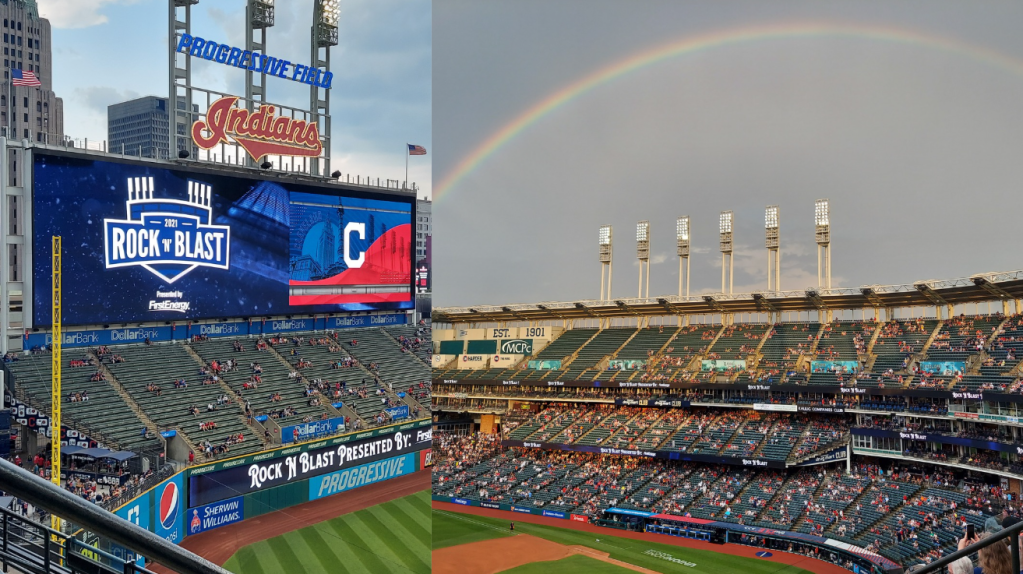
One aspect of Progressive Field that has rightfully gotten much praise since a major upgrade from 2014-16 is its food and drink offerings. Overall, there isn’t one signature item or offering the ballpark is known for, but it’s incredibly solid in terms of basic sporting venue offerings — from hot dogs and burgers to chicken and ice cream. But what it does extremely well is incorporate local restaurants and breweries to offer unique items for fans. Those include the Cleveland Pickle Sandwich Shop, one of the only pure sandwich places I’ve seen at a ballpark. There’s a similar stand called The Melt, which might be the favorite among local Guardians fans. There are also plenty of Mexican food areas, though us on the West Coast look at any Mexican food outside of our region with questionable glances. What gets no questions asked about it is Progressive Field’s beer offerings. Specifically, the Corner Bar in the right field concourse area is a multi-level watering hole offering 40 different beers and standing room only tickets. There’s also a Great Lakes Brewing Company stand in the right field area.
Going further up, the second level right field area includes one of the better child-specific places in any MLB ballpark. The aptly-named Kids Clubhouse is a two-story play area that not only includes playground equipment, but also interactive ways for kids to test their baseball skills, learn about team history, and even pose as Guardians players. Even further up — but on the left field side of the ballpark this time — lies the Terrace District, a two-level area featuring upscale dining, a rooftop patio, and beer hall-style bar. Another newly-renovated area is the all-inclusive section, with lots of table seating and plenty of private food and drink options. There’s also the Home Plate Club, located — you guessed it — behind home plate. This area offers more traditional ballpark food, but you can go elsewhere to get food from other areas and bring it back. It’s a relatively open yet cozy area premium ticket holders can enter before, during, and after games.
One of the remaining weaknesses of Progressive Field is its seating arrangements. Specifically, a non-insignificant amount of seats in the lower and upper bowls along the first base side (near the right field pole) had obstructed views, even when largely clear of fans in seats in front of them. While the team did renovations to clear much of them after fans had complained, some of them still remain. Still, the ballpark as a whole provides great views from pretty much everywhere else. Sticking with the upper level, part of the reason a minority of the total ballpark capacity is in the higher area is due to Progressive Field’s sheer amount of luxury suites — more than 100, the second-most in all of MLB. These have to go somewhere, with fans being forced up. This has led to an intentional display of class disparity, not just between the upper deck sitters and the suite holders, but the lower and upper bowls. While it’s not like this is the only ballpark with this issue — far from it — it seems weird that one of the most blatant examples exists in Cleveland of all places.
Since its construction, one of the biggest problem areas for Progressive Field has been those upper deck seats. Part of that was that, before than 2014-16 renovation, there wasn’t much other than absolute basic amenities for fans in the upper level. So, the Guardians tried to address that, while reducing capacity to create a more intimate feel. However, their solution didn’t exactly earn praise, either. In the upper right concourse, after just a few rows of seats, the team installed these standing room only areas on top of large walls that looked like shipping containers. The Guardians tried to decorate them with named of players with retired numbers, sponsors, and banners — you can see them a bit in the photo above. But it just looked weird and out of place, and I wasn’t the only one with this opinion. As fans and critics picked these structures apart, they were also part of the reason I had Progressive Field significantly lower than this originally.
However, things have changed between now and then. Realizing that Progressive Field was due for a tune up — and with the right field area in question — the Guardians initiated another major renovation just a few years ago, one that just wrapped up earlier this year. A lot of the work went into repairing and upgrading some of the essential behind-the-scenes features, such as team facilities and other amenities. But a big focus was on the right field area. Gone are the shipping containers, replaced by the Pennant District — an actual proper food and drink area for the fans in the cheap seats. The Terrace District got a bit of upgrading, while areas like the KeyBank North Coast Social were introduced, not to mention upgraded food, drink, and other gathering areas. The seats themselves also got an upgrade, with a three-year process of swapping out every dark green seat in the ballpark (which had been in place since its opening in 1994) with new ones in a sleeker navy blue design finishing before the start of this current season.
When it opened, Progressive Field became a beacon for Guardians fans and a symbol of the rejuvenation of their beloved baseball team. But especially in the wake of another new ballpark’s opening, it has gone largely under the radar when it comes to the larger baseball world. Then, as the team’s own fortunes declines, the ballpark fell down the rankings, reflecting the overall problem Cleveland had been facing when it comes to an exodus of its population. But Clevelanders are, if anything, incredibly passionate, and they and their ballpark have fallen back. Instead of enduring prolonged periods of decline like many other ballparks, Progressive Field has regularly received new work to keep it going and fix whatever weaknesses it still had. All of this, combined with its fantastic location and overall design, mean that Progressive Field is set to age incredibly well. Given that it already ranks well in the top half of this and other ballpark lists, and the Guardians definitely have a place worth bragging about. I suppose that has to do in place of a World Series title earned after the invention of the barcode. Hopefully Progressive Field will still be around when that drought ends.
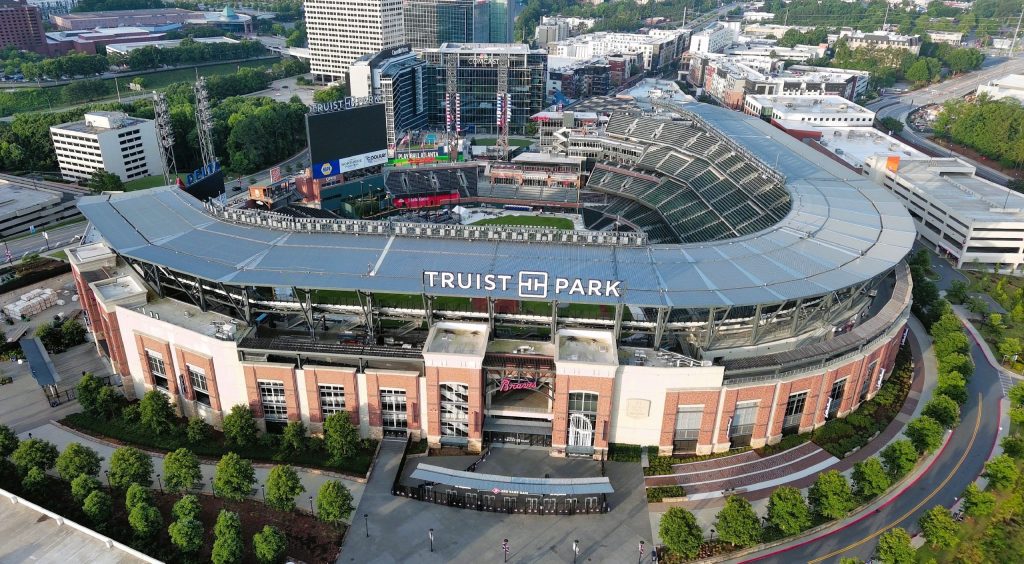
11. TRUIST PARK
HOME TEAM: ATLANTA BRAVES
LOCATION: CUMBERLAND, GEORGIA
OPEN SINCE: 2017
ORDER VISITED: 24 (07/18/25)
GAMES I HAVE SEEN THERE: 1 (1-0 HOME TEAM RECORD)
For as fantastic of a ballpark Truist Park is, most of the talk surrounding it has been about three things: when it got built, what came with it, and how it could influence what comes next. Let’s start with the first part. More than a decade before Citi Field was born from a bid to host the summer Olympics, Centennial Olympic Stadium was built for the 1996 Olympic Games in Atlanta. As designed, the stadium was converted into a ballpark after the games concluded, with the renovated venue — now called Turner Field — serving as the new home of the Atlanta Braves, who had played in the multipurpose concrete donut of Atlanta-Fulton County Stadium since they moved from Milwaukee in 1966. Turner Field debuted in 1997 and saw plenty of success. But to the surprise of many, in 2013, the Braves announced they would be building a brand new ballpark. The decision came despite Turner Field being less than 20 years old and — at the time — younger than more than half of the ballparks in MLB. However, the Braves complained that Turner Field’s downtown location was actually a hindrance due to Atlanta’s notoriously terrible traffic, claiming that fans didn’t want to deal with the commute to go to a game. The team also cited a lack of parking and public transportation, as well as an inability to secure more of the former. This — combined with an estimated $350M in projected renovation costs — caused the Braves to abandon a young ballpark and look elsewhere for a home.
By elsewhere, the Braves meant not in Atlanta proper, as the team rejected the downtown ballpark renaissance and instead went for more space to build around the ballpark (more on that later). In the end, they settled on Cumberland — a city in southern Cobb County (located to the northeast of Atlanta proper) in the greater Atlanta metro area. It’s also home to the Cumberland Mall, which at the time of its opening in 1973 was the largest mall in Georgia (it’s now the fourth-largest) but had been experiencing a prolonged economic decline. The site that was picked is located to the north of the Cumberland Mall, sandwiched between the interchange between Interstates 75 and 285 to the east and Highway 41 to the west. Work began in 2014 and just three years later in 2017, SunTrust Park (since renamed Truist Park) made its MLB debut. Meanwhile, just 20 years after its own debut, Turner Field was out of the league entirely. However, it’s still standing — one of the few former MLB ballparks in operation today. Now named Center Parc Stadium, it has been reconverted into an enclosed venue and (as of this writing) mainly serves as the home of the Georgia State Panthers football team.
As for the new ballpark, Truist Park was designed in that retro-modern format that became the go-to for many teams. The outside is designed with pre-cast stone and brick, the latter reflecting masonry patterns common in the Southeastern U.S. It was an attempt to create a feeling of warmth within the ballpark, with other features like tables and canopies going for that as well. Even though warmth was a focus, summer heat is no joke in the South, so every level has air conditioning. The batter’s eye features a few evergreen trees, along with boulders, a waterfall, and a fountain that sends water 50 feet into the air for every Braves home run and win. But that doesn’t happen as often as in other ballparks. With one of the deeper left fields in MLB and a relatively deep center and right field, Truist Park has been collectively central in gameplay, though it’s slowly grown from a slight hitter’s park to a slight pitcher’s park. Either way, the approximately 41,000 capacity crowd (about average in MLB), will be right on top of the action. Due to a more limited space in the overall area, Truist Park’s seating was laid out more vertically than usual. This means fans are positioned closer to the field, with some seats up to 21 feet closer than they were at Turner Field.
About 10% of those seats are in more special, private, and expensive sections, where the constant Tomahawk Chop chant is less audible. Chief among them is the Truist Club, a section so exclusive and fancy that actual Gold Glove Awards are used as table decor. Then there’s the Delta SKY360° Club, situated behind home plate, and the Hank Aaron Terrace Club behind left field. Truist Park even has four-person tables available towards the top of the lower bowl. There are other more premium seating options, such as the Jim Beam Lounge and Chipper’s Corner Seats, named after Braves great Chipper Jones. Then there’s one of the more unique parts of any ballpark: the Home Depot Clubhouse, a premium suite in left-center field that looks like a treehouse. There are some prime amenities for the common folk as well. For the kids, there’s the Children’s Healthcare of Atlanta Park — a 30,000 square foot play space located just outside the ballpark that includes a miniature field. As for the options inside Truist Park, The Pen behind right field includes an all-you-can-eat buffet, good until the end of the 5th inning.
With this, we get into one of the two aspects of Truist Park in contention for best of their kind in all of MLB. The first is food, with Truist Park offering one of the best overall menus in baseball. Much of this can be found in the Coors Light Chop House — a multi-level party deck and restaurant area with first come, first serve seating. Southern food is delicious, and as the main MLB team in the South proper, the Braves take advantage of this advantage well. From Southern fried food to Carolina pulled pork sandwiches to Southern takes on burgers, hot dogs, and barbeque, you’d be hard pressed to find a bad item. They even have pizza slices longer than your forearm. But for my money, the best place is a small stall on the first base side of the concourse called The Carvery. Not only does it include various BBQ/meat-based items, but also large biscuits on the side. Maybe it’s because I never had proper Southern biscuits before, but these things were better than the actual entrees. I swear, they’re the best biscuits I’ve ever had and rank in my Top 5 ballpark food list. That being said, the beer section leaves something to be desired, along with a desire for cheaper prices.
Then, we have the way the Braves honor their history. Located in the main concourse behind home plate is Monument Garden, one of the best “team museums” in the league. It’s part walk through Braves history, part fan appreciation section, filled with plenty of artifacts and memorabilia from the past. The centerpiece of Monument Garden is a statue of Hank Aaron (of when he hit his 714th home run to tie Babe Ruth’s career record). It’s complete with a video of his career highlights, a sculpture made out of 755 baseball bats (a tribute to his final career home run total), and both the bat and ball from his 715th career home run. Monument Garden — also showing off the Braves’ retired numbers and complimented by audio, light, and water elements (not to mention artwork) — is incredibly well put together and a must-see if you visit Truist Park. It’s also not the only place around the ballpark to see Braves history. Currently, three statues — of Warren Spahn, Phil Niekro, and Bobby Cox — stand outside Truist Park.
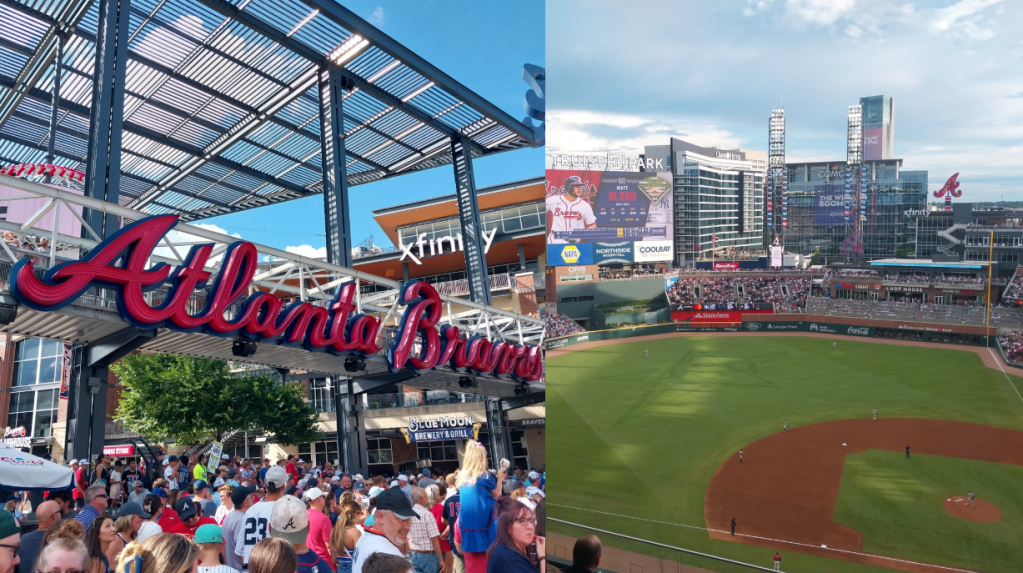
So, the Braves managed to justify their decision to abandon Turner Field in terms of a pure ballpark upgrade. When it comes to the reason of getting more fans to the ballpark, it’s a mixed bag. Truist Park is more than ten miles away from Downtown Atlanta proper, where Turner Field used to be and the other main sports venues of the city still reside. While this certainly helps thin the traffic, the sheer distance causes its own problems, even if the Cumberland area is still relatively populated. It also doesn’t completely fix the traffic problem, which despite the parking lots and garages nearby is still pretty bad (there’s only so much you can do in Atlanta). That being said, the Braves do what they can to help with getting people to and from the city. While rail and bicycle commuting doesn’t really work, the Braves have a “circulator” bus shuttle system to take fans in the city proper to and from the ballpark. The Cumberland Transit Center in the Cumberland Mall is also home to stops for Metropolitan Atlanta Rapid Transit Authority (MARTA) and CobbLinc bus routes, with the latter service also having a direct stop at Truist Park on weekdays. The area is also fairly walkable for those living or staying nearby, or who want to enjoy the other amenities of the area.
Now, we finally get to that second thing dominating talk around Truist Park. The other reason the Braves eyed the Cumberland site because while they operated Turner Field, they didn’t control the surrounding commercial area. That would change in Cumberland, as the Braves would put up $400M of their own money to design a huge entertainment district to surround the ballpark. Called the Battery Atlanta, the complex stretches multiple blocks long and wide to the southwest of Truist Park, and looks like a mini village. It’s packed with many bars, restaurants, and team stores, and acts as a place for fans to congregate before entering the ballpark on the southern side (right next to the Chop House). But that’s just be beginning. The Battery also includes multiple hotels, apartment complexes, and offices — which, as of 2020, includes the global headquarters of Papa John’s Pizza. There’s even a concert hall — a homage to the old Roxy Theatre that was torn down in 1972. Along with the ballpark, the Battery opened in stages in 2017, and is now in full force as the place to go before Braves games.
Simply put, you can’t talk about Truist Park without mentioning the Battery, and not just because the aforementioned high rises have formed part of the ballpark’s panorama. I wandered throughout the Battery before the Braves game I went to and was overwhelmed with the amount of options. Apart from the team stores, most of the businesses were something you’d expect to find in the middle of a downtown entertainment district, not near a ballpark. For example, I decided to spend some time hanging out inside a gaming lounge/bar, not because I wanted to plug in, but because they had a beer on tap that I like. That being said, you have several well-known sports bar and restaurant chains such as Yard House, Punch Bowl Social, Shake Shack, and Blue Moon Brewery and Grill. There are also some garden variety bars and eateries, each full of solid if not spectacular food. There was also both a baseball pro shop and a golf pro shop, along with a card shop. All of this was enjoyable to be sure, but it left me with an uneasy feeling.
One of the main points of putting a ballpark in an urban setting like a downtown is to have it take advantage of the entertainment/offerings already in the area, while providing an economic boost to the district. It’s supposed to be a natural process that allows the ballpark to grow with the community and create a better environment overall. But what the Braves did with Truist Park and the Battery wasn’t so much putting the cart before the horse as it was putting both in a giant hamster wheel at their destination. A brand new ballpark and a brand new huge entertainment district arriving at the same time doesn’t feel natural. It doesn’t help that few of these places to visit in the Battery are truly local. They’re generic sports bars and eateries you can find anywhere, including here in Sacramento. It gives off a corporate vibe, which isn’t helped by the fact that the Braves own the property. These aren’t decades-old staples that generations of fans have visited. They’re the kinds of businesses based on current trends that might last a few months or years before being replaced by the newest fad. The newness and corporate nature also means everything is more expensive, with the cost of eating at these places (compared to smaller local joints) pricing some poorer fans out. The sheer size of the Battery is also a big factor. It’d be one thing if it was simply one side or block of new offerings for fans, built alongside existing city space. But the Battery is by far the largest of its kind so far.
I say so far because of the third thing dominating Truist Park talk. There has been a lot of discussion of whether or not we’re still in the third era of ballpark construction (the retro-classic/modern era), or if we’re instead in a fourth era. This era would be sparked by Truist Park, which saw a team not only build a ballpark, but the area around it. This would mean that ballparks wouldn’t have to be downtown to be within walking distance of things for fans to do before and after games. It would also mean teams would get a bigger cut of everything. All of this gentrification and corporatization is camouflaged by a message of improving the overall area and revitalizing the neighborhood. Further examples can be seen with the Metropolitan Park project happening around Citi Field and the overall plan to build Kauffman Stadium’s successor in Downtown Kansas City. Don’t get me wrong, there are certainly a lot of positives to come with plans like these, they still feel a bit soulless, like we’re removing the vital heart of what it means to have a ballpark embedded in the community. They’re trying to have their cake and eat it too, while also pocketing more pieces of the pie to the detriment of locals. Personally, I hope we’re not in the fourth era, or at least that the fourth era isn’t defined like I just described.
Truist Park is an excellent ballpark, a beautiful piece of architecture filled with wonderful amenities and delicious food, and a great place to catch a baseball game. It’s a shame that it’s constantly overshadowed by factors out of its control. No matter how good Truist Park is, many Braves fans lament the loss of Turner Field and continue to wonder why the team moved on after just 20 years. It’s also kind of become just another part of the Battery, unlike other ballparks that are the main attraction of the immediate area around them. Because of all of this, many baseball fans wonder if Truist Park unintentionally shaped the future of ballpark design and overall purpose, leading to the increased corporatization of the sport. In spite of it all, Truist Park is objectively one of the better ballparks in MLB, no matter how far it is from the city proper or how soulless the surrounding area truly is. It should probably be higher up, though just missing the Top 10 shouldn’t seem like a slight or insult. But I can’t rank it any higher. Still, Truist Park is worth dealing with the Atlanta traffic and the stupid Tomahawk Chop chant.
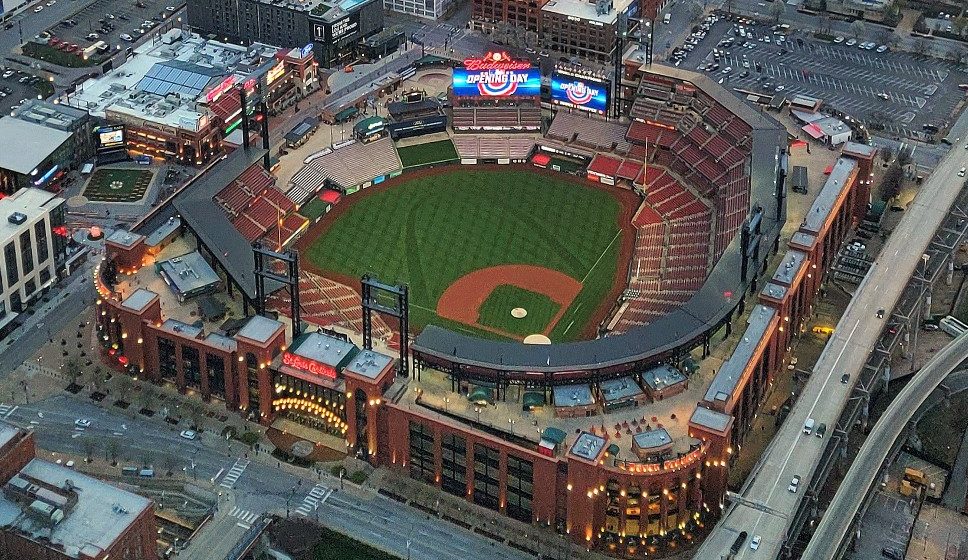
10. BUSCH STADIUM
HOME TEAM: ST. LOUIS CARDINALS
LOCATION: ST. LOUIS, MISSOURI
OPEN SINCE: 2006
ORDER VISITED: 21 (07/26/24)
GAMES I HAVE SEEN THERE: 2 (1-1 HOME TEAM RECORD)
Since they officially became the St. Louis Cardinals in 1900, the team has spent more than half of its existence playing at a ballpark called “Busch Stadium.” The first, Sportsman’s Park in the northern part of St. Louis, was renamed Busch Stadium in 1953. Then, in 1966, both the Cardinals and the NFL’s St. Louis Cardinals moved into the Civic Center Busch Memorial Stadium, later shortened to Busch Stadium. The second venue of that name was your typical multipurpose cookie cutter concrete donut stadium, though after the football Cardinals left for Phoenix in 1988, it was reconfigured to be a full-time ballpark for the baseball Cardinals. But even several years before Busch Stadium became the site where the Boston Red Sox ended their 86-year World Series title drought, the Cardinals knew the venue was out of date. After one proposal fell through, the Cardinals looked as far as Madison, Illinois (by Gateway International Raceway), before finally agreeing with the city to a financing plan to build a new ballpark in Downtown St. Louis, right next to their current ballpark. In fact, the new Busch Stadium (called Busch Stadium III by some) was built so close by that the left field grandstands were still under construction for the first three months of its 2006 debut season, due to them being in the footprint of the old ballpark. Later that year, Busch Stadium II was demolished and Busch Stadium III (which will be referred to as simply Busch Stadium from now on) officially took over.
If there is one defining aspect of Busch Stadium, it’s that it’s red. From red seats and decor to the very team on the field, there’s a lot of red (or, rather, cardinal) in and around the ballpark. That includes Busch Stadium’s face, which is full of red brick and steel and made up of classic ballpark tall, long arches. The brick and overall design is quite similar to that of the Anheuser-Busch headquarters, which is also located in St. Louis and has sponsored all three ballparks that have borne its name. It also resembles the various historic warehouses in the surrounding area. The Gate 3 entrance — to the west along 8th Street and Spruce Street — features a large bridge on top, designed to mimic the Eads Bridge that connects St. Louis and East St. Louis, Illinois. Out front is a statue of Cardinals legend Stan Musial. A collection of smaller statues greets visitors to the team store on 8th and Clark Avenue. Those statues honor players like Rogers Hornsby, Enos Slaughter, Lou Brock, Dizzy Dean, Red Schoendienst, Bob Gibson, Ozzie Smith, and Ted Simmons, not to mention Cool Papa Bell, George Sisler, and Jack Buck. The exterior also features several historic Cardinals logos and the “STL” insignia.
Busch Stadium is both in the Top 10 youngest ballparks in MLB and has a Top 10 capacity of just over 44,000. It’s a bit of a reversal of current ballpark trends, as Yankee Stadium is the only one younger than it that also has a higher capacity. Part of that size can be felt in the field of play, not including the relatively sizeable foul territory. Busch Stadium also has a Top 10 deep left field wall in the league, which combined with a relatively deep right field wall and a non-shallow wall creates a ballpark that may be hittable, but not killable. For much of its existence, Busch Stadium has been in the Top 10 and even the Top 5 pitcher-friendly ballparks in MLB. Still, while they might not be seeing much offense, the fans at Busch Stadium are getting pretty good views from most seats. But the best view of them all comes from the panorama, which is among the best in baseball, featuring a nice chunk of the skyline near the Mississippi River. It also includes the Gateway Arch, which sets the panorama apart in terms of uniqueness. By the way, you can also get a great view of Busch Stadium from the top of the Gateway Arch.
St. Louis is also well represented in the menu at Busch Stadium, which features several local cuisines. This includes entrees like pork steak sandwiches, toasted ravioli, and St. Louis-style barbeque, as well as desserts like frozen custard and the incredibly delicious gooey butter cake. This year, Busch Stadium is also putting a spotlight on local businesses with the “Made In The Lou” series, with a new vendor being rotated in every month among the other offerings, which also do the classic ballpark fare quite well. This local spotlight can also be seen in some of the drink offerings, which include various craft breweries at various points throughout. That being said, one local business dominates the ballpark, though it’s not a local business to anyone else. Because of Anheuser-Busch, the naming sponsor of the ballpark, Budweiser and Budweiser products are everywhere and are naturally the main drink on tap at the Busch Stadium.
Budweiser is also behind one of the newer features of Busch Stadium. Like the similarly-named place at Nationals Park, except on steroids, the Budweiser Terrace transformed the fourth level right field area when it was installed. It’s a huge open concourse area featuring plenty of food and drinks, as well as rows of seats and a small concert venue. But if all of that isn’t enough, you can make your way back down to the first floor concourse, where — on the third base side — there’s the Gamlin Whiskey House Bar. Other popular places include the 1764 Craft Pub (named after the year of St. Louis’ founding). Also new this year is a food and drink feature that’s inspired by another drink. These Coca-Cola Unlimited stations can be accessed by fans who purchase tickets in Big Mac Land — a section of seats located on the left-most area of the second deck. You then get a wristband and are able to pick up three eligible food or drink items at these stations at a time. You can then return as much as you want until the end of the eighth inning.
Another popular area to visit is the Ford Plaza — an open-air concourse located behind left-center field. In addition to hosting several concession areas, a stage, and the Cardinals Authentics shop, Ford Plaza is the main area for parents to take their young children. There’s the Hi-Chew Family Pavilion, a small enclosed kids area which features two themed play places, an arcade, and a virtual reality feature. But the most unique part of Ford Plaza is something I’ve never seen at any other ballpark (to my knowledge): a Build-A-Bear Workshop. Kids can come up during games and create their own stuffed animals, ranging from Cardinals-themed bears to Clydesdales to even miniature versions of the Cardinals’ mascot, Fredbird (who visits Ford Plaze from the first to third innings). The Build-A-Bear Workshop is also open on at least some non-game days.
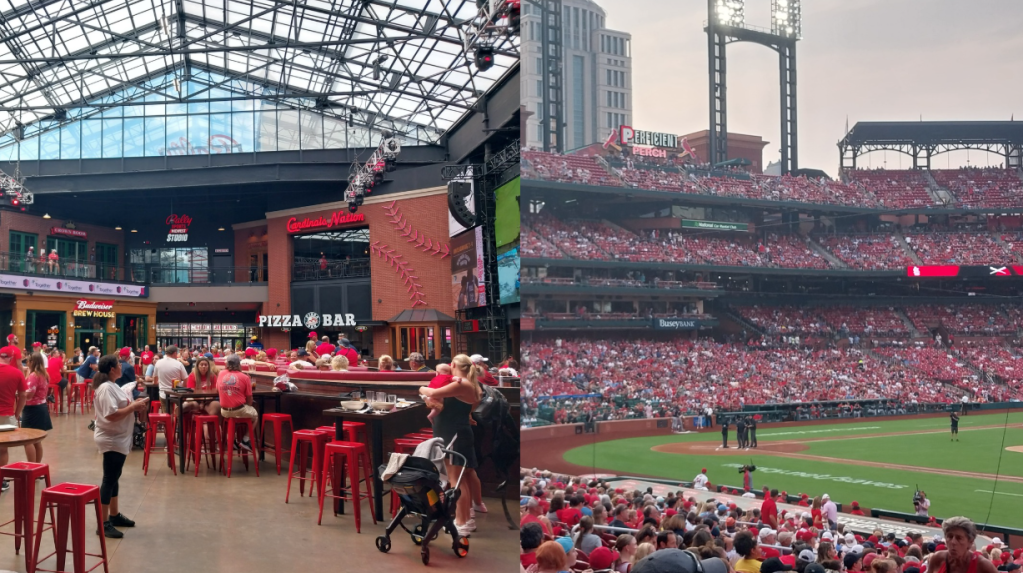
When it comes to the more private offerings, fans can visit the Budweiser 703 Club (named after Albert Pujols’ career home run total) behind left field. Then there’s the Perficient Red Jacket Club, another upscale venue behind right field that pays homage to members of the St. Louis Cardinals Hall of Fame (who get red jackets). Cunningham Corner and the National Car Rental Club are both open indoor areas with great seating and buffet service. The Redbird Club on level three is the largest indoor area of the ballpark and is mainly used to host large events. The bougiest area in the ballpark is the CommunityAmerica Cardinals Club, which has a baby grand piano, marble hallways, and rich wooden features. It’s a place with many leatherbound books and smells of rich mahogany. In addition, Busch Stadium also offers those with enough money the chance to not only rent out and dine in either the Cardinals’ or visiting team’s locker room, but the press room as well.
One reason why the Cardinals went with the site near the second Busch Stadium was that it’s a great location within the city. Located just west of Interstate 44 and north of Interstate 64, Busch Stadium is just a couple of blocks away from Gateway Arch National Park along the shores of the Mississippi River. In the heart of Downtown St. Louis, which is quite walkable, Busch Stadium is just a short stroll away from other attractions like the Field House Museum and Citygarden Sculpture Park, while a slightly longer trot away from the likes of the Enterprise Center (home of the NHL’s St. Louis Blues), Stifel Theatre, the Soldiers Memorial Military Museum, the St. Louis Wheel, the St. Louis Aquarium at Union Station, and Energizer Park (home of MLS’ St. Louis City FC). Getting around is easy enough, with plenty of hotels nearby the ballpark. There’s also plenty of parking, not to mention the MetroLink light rail system’s Red and Blue lines having a stop right next door. In addition to accommodations, there are plenty of established bars and restaurants right by the ballpark. Of course, there’s one other place to go nearby that’s become quite the talking point since its inception.
In addition to Busch Stadium itself, the ballpark construction project included a plan to develop the site of the second Busch Stadium to the north. Dubbed Ballpark Village, this mixed-use development district was first completed in 2014 and now sits on the site of the old ballpark, with the spot of its infield diamond and pitcher’s mound marked with a plaza, complete with grass. The main part of Ballpark Village is a 30,000 square foot, three-story building where Cardinals fans can gather before, during, and after games. It includes the Cardinal Nation restaurant, which includes three patios, two bars, large flatscreen TVs, and several pieces of memorabilia. The restaurant also has a roof that includes 300 ticketed seats which actually look into the ballpark from left field, complete with play-by-play audio and visual aides. The third flooralso houses the St. Louis Cardinals Hall of Fame Museum, which does a great job of telling and showcasing the extensive history of the team. It’s full of tons of memorabilia, from uniforms, gloves, and bats to other artifacts like the Commissioner’s Trophy given to the Cardinals after their 1967 World Series title win (I was only happy to ignore that).
That’s far from all Ballpark Village has to offer. The Budweiser Brew House is a 20,000 square foot beer garden serving over 100 brews, along with food and music. There are also other bars and marketplaces, not to mention stores to buy Cardinals merch. Another phase of construction — recently completed in the past few years — saw the introduction of a 29-story residential tower, a ten-story office building, an eight-story hotel, and a three-story retail building. These also feature several restaurants, including Salt + Smoke. While it can be a bit crowded, especially on game days, it’s never a bad thing to have more places to enjoy St. Louis-style BBQ. Ballpark Village can be pretty overwhelming, especially for first timers. The food and drink options — especially the beer options — are plentiful. But there’s also plenty of room for you to just chill and take everything in before making your choice of nourishment. The security checkpoint you have to go through every time you enter the main building is a bit annoying, but understandable. Overall, Ballpark Village has been a wonderful addition to the area near Busch Stadium, and it’s expected to grow even more in the near future.
Now, I can hear some of you complaining. After all, I just went in on the Battery Atlanta for doing a lot of similar things. But there are several key differences. First off, the scale is much smaller. Whereas the Battery takes up several blocks and is almost a small town on its own, Ballpark Village is restricted to one block. Therefore, while it offers plenty of attractions for fans, not the only place to go, instead offering newer options amid the already present options in the downtown area near the ballpark. I have no problem with a team creating a new entertainment district near its ballpark, so long as it complements what’s already there, instead of dominate and completely force out other options. Ballpark Village also feels a lot more organic and inclusive compared to the Battery, which was just built up in a seemingly random area. Because of all of this, Ballpark Village also feels like the perfect compliment to Busch Stadium, which is clearly the main attraction. This relationship is best represented by those 300 rooftop seats, which direct fans in Ballpark Village to literally look at the ballpark. In comparison, the Battery overshadows Truist Park in many ways, and it’s sometimes unclear which exactly is the main attraction. I didn’t feel the need to make nearly half of Busch Stadium’s entry about Ballpark Village, unlike with Truist Park and the Battery. In fact, the only reason this paragraph exists is because of Busch Stadium being ranked ahead of Truist Park, not because of the sheer scale and presence of Ballpark Village itself.
When I started this ballpark journey, if you had told me that Busch Stadium would end up in the Top 10 of my final list, I wouldn’t have believed you. This isn’t because of any perceived slight against it or the Cardinals or anything like that. Rather, when you think of the nicer MLB ballparks, Busch Stadium usually isn’t brought up in conversation. But despite its weaknesses, Busch Stadium deserves to be talked about towards the top of MLB’s ballpark discussion as an incredibly solid, well-rounded, beautiful venue. It’s in a fantastic location and both enhances the area (thanks in large part to Ballpark Village) and is enhanced by it. It has delicious offerings and does well to showcase and honor the St. Louis scene. It also does well to display the long and storied history of the Cardinals franchise. Also, St. Louis is a true baseball city, and the atmosphere at Busch Stadium enhances the experience even more. Overall, Busch Stadium is an excellent ballpark and a worthy beginning to my Top 10. But we still have one part remaining.


Leave a comment