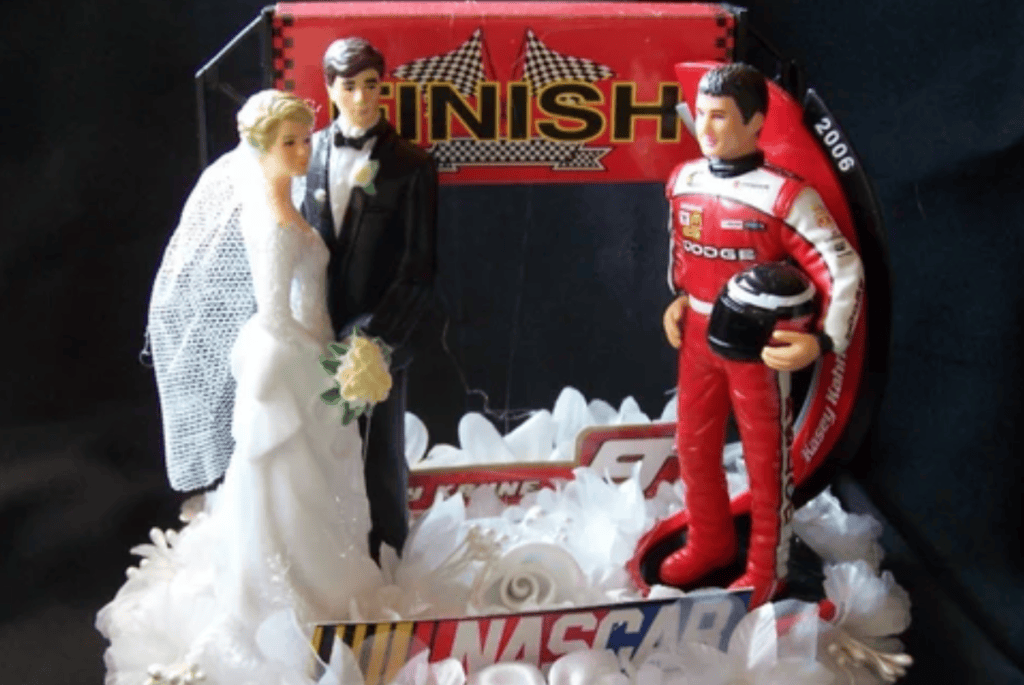
Some people show up; others arrive. Over the past few weeks, our very own Chriss arrived to the next chapter of his life in style.
Since the previous newsletter, Chriss has not only had his bachelor party, but has also officially tied the knot with his now-wife, Taylor. It’s been an eventful few weeks, which I will try my best to summarize without giving away the goose or getting anyone sued.
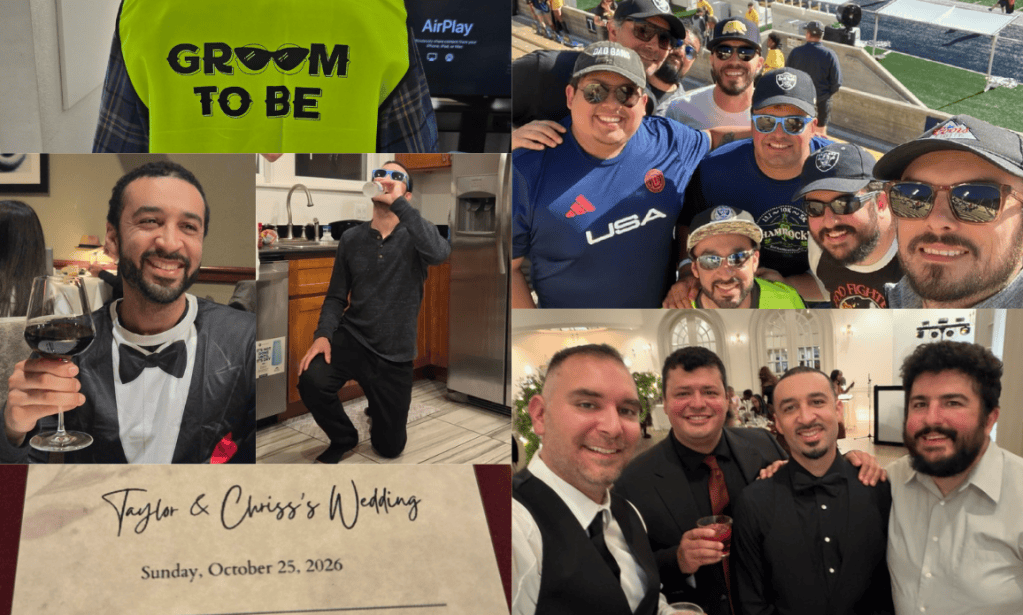
Three weeks ago tomorrow, the bachelor party crew — Chriss, Jimmy, Arik, Nick, Kyle, myself, Chriss’ brother Nate, and Chriss’ friend Michael — shacked up at our Airbnb in Oakland before heading to a lovely meal at Skates on the Bay in Berkeley. It was there most of us learned that Chriss eats about as slowly as current age Peyton Manning runs, with most of us completely finished with our meals before he got halfway through his. Somehow we made it out of there before closing time, then headed to Tipsy Putt in Emeryville, where Nick finished last in mini golf and Chriss finished last in 1-2 Putt (Michael and I finished tied for first overall). Due to the resulting drink punishments (as well as the multiple times we iced him upon getting back to the Airbnb), Chriss passed out while the rest of us played beer pong into the morning. After getting what little sleep we could (totally not my fault), we got dressed and got a ride to the Cal-Virginia Tech game. We would’ve gone wearing matching Cal shirts, but the order Jimmy placed got delayed and Chriss’ friend Greg (the final member of the crew) couldn’t come (and bring them to us) because he had to take care of his sick child. Understandable, and it made us stand out even more while playing the saddest drinking game of all-time: taking turns trying to flip a single cup. Much more entertainment would come from the football game, as from 16 rows up from the field we sat and watched the Golden Bears and Hokies try to give each other the game. Cal managed to lose that contest, which means they somehow won the game, something that confused me deeply, having seen them fall over themselves against UNLV the week before. After the game, we spent some solid drinking time at the Tap Haus in Berkeley before heading to a sandwich spot in Emeryville that Chriss picked out. Turns out, he knows what he’s doing, because Hidden Spot is delicious, serving me a possible Top 10 sandwich, beer, and even more college football. After a lengthy amount of time of eating, drinking, and traumatizing the bartender with our stupidity, we walked back to the Airbnb, where Chriss recovered and the rest of us played beer pong and a couple of board games Kyle had brought. The final day was spent yelling at the Raiders, first at the Airbnb, then at the Oakland Athletic Club. Too tired to do anything else, we all said our goodbyes after the final whistle and drove home.
Fast forward two weeks later, and we arrive at the Sterling Hotel in Downtown Sacramento, a lovely venue for an even lovelier occasion. Chriss — wearing a much better tuxedo than the spandex one Jimmy made him wear to dinner in Berkeley — and Taylor each said “I do” in front of family and friends, who I was thankful to be a part of. A fun cocktail hour was followed by a loud and proud reception, which began with Jimmy having to run during the groomsmen entrance and included Chriss in his element, strutting his stuff. A quite frankly phenomenal meal followed, after which plenty of drinking and dancing followed. Naturally, all of the league members in attendance — Jimmy, Arik, and myself — each took turns with both Taylor and Chriss during the money dance portion. No, there will not be any pictures posted. Speeches (including Jimmy bringing up Chriss’ technology problems following the 2019 fantasy football draft) were after that, while plenty of drunken dancing (mostly from Taylor’s side of the family) and attempts at dancing (mostly everyone else) rounded out the night.
Chriss, I’m not sure if you’re still in Napa for your honeymoon, but thanks again for including us all in some of the best and most important moments of your life. We’ve known each other since elementary school, and hopefully we’ll stay close for decades to come. Congrats again on marrying the love of your life. While you haven’t been able to get a ring in fantasy football (sorry not sorry for 2024), at least you have one in real life.
Come to think of it, two of the league members who have won the title twice — Jimmy and I — are single as fuck. I’m sure there’s no correlation there…
Anyway, consider the Grim officially shut.
RECAP OF LAST WEEK
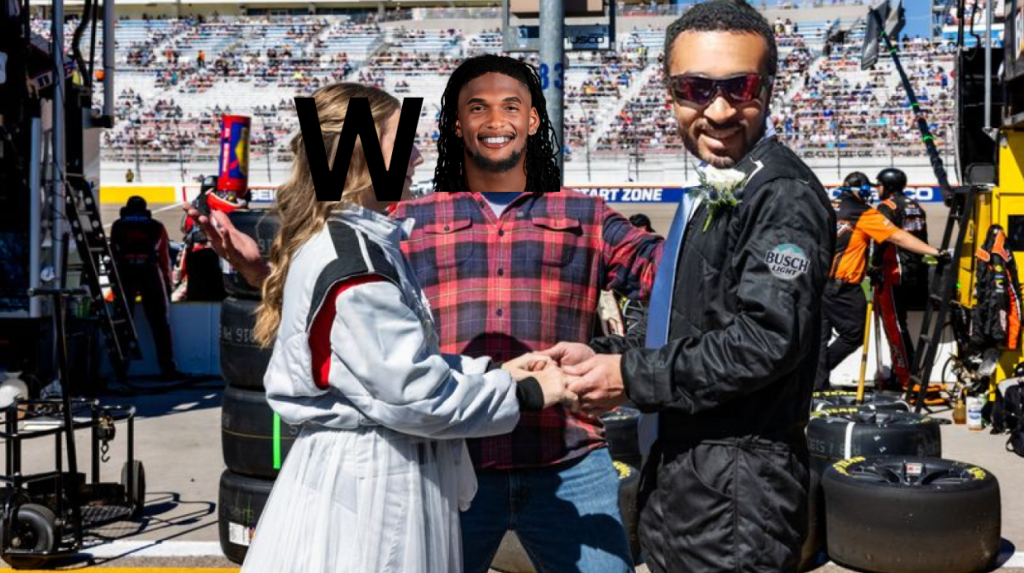
CHEST IN MY HOLE (3-4) DEF. MOM AGAINST THE MACHINE (3-4)
105.06 – 63.60
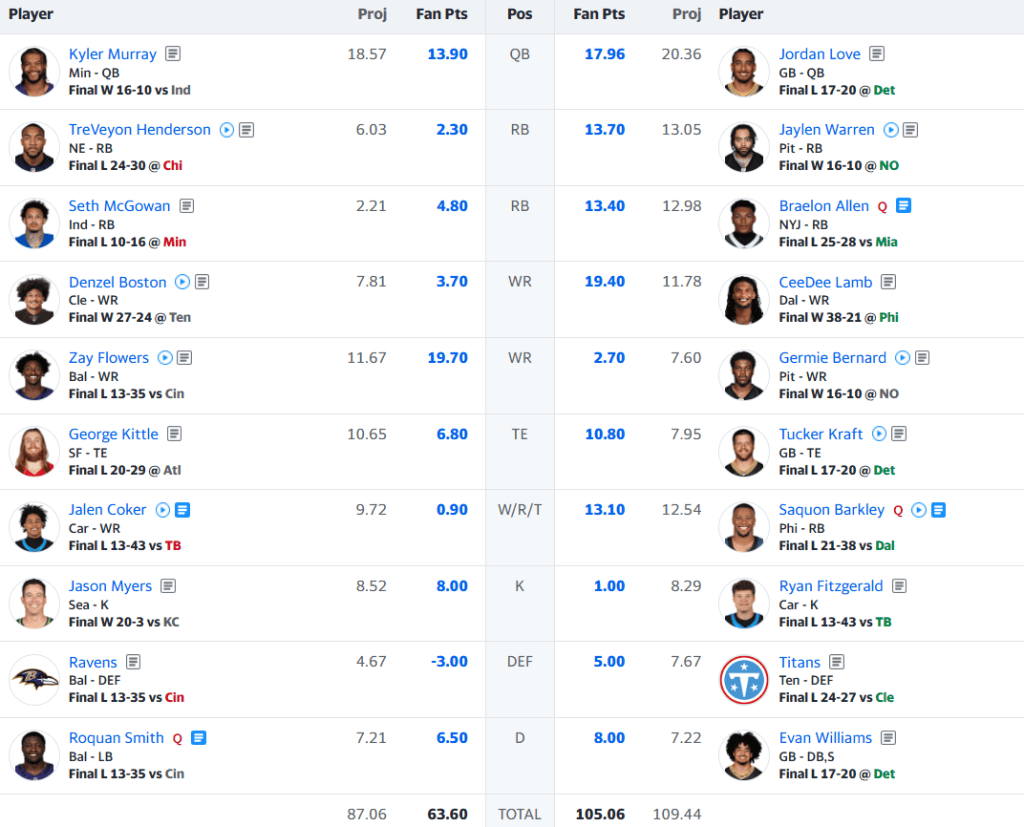
Aw, how nice of Aly to give Chriss a birthday present: a win, guaranteed by Mom Against the Machine being the lowest scorer of the week. Of course, part of that was due to the fact that Aly’s lone consistent source of points, Josh Allen, was on a bye week. Kyler Murray is not Josh Allen, though I supposed he didn’t have the worst day ever. That’s the good news. The bad news is that Murray was Aly’s second-highest scorer (behind Zay Flowers and his 19 points) and one of just two roster spots that gave her double-digit points. TreVeyon Henderson, George Kittle, Denzel Boston, and Jalen Coker all disappointed. Seth McGowan was starting due to bad bye week luck. The Ravens defense… technically took the field. All things considered, that’s all Chest in my Hole had to do to win this matchup. CeeDee Lamb (19 points) and Saquon Barkley (13 points) made the gap a lot bigger on Monday night, but Jordan Love (17 points), Jaylen Warren (13 points), and Braelon Allen (13 points) had done enough on Sunday to send the groom home happy.
FOOTBALLDAMUS (6-1) SPIDER 2 Y BANANA (1-6)
96.32 – 80.12
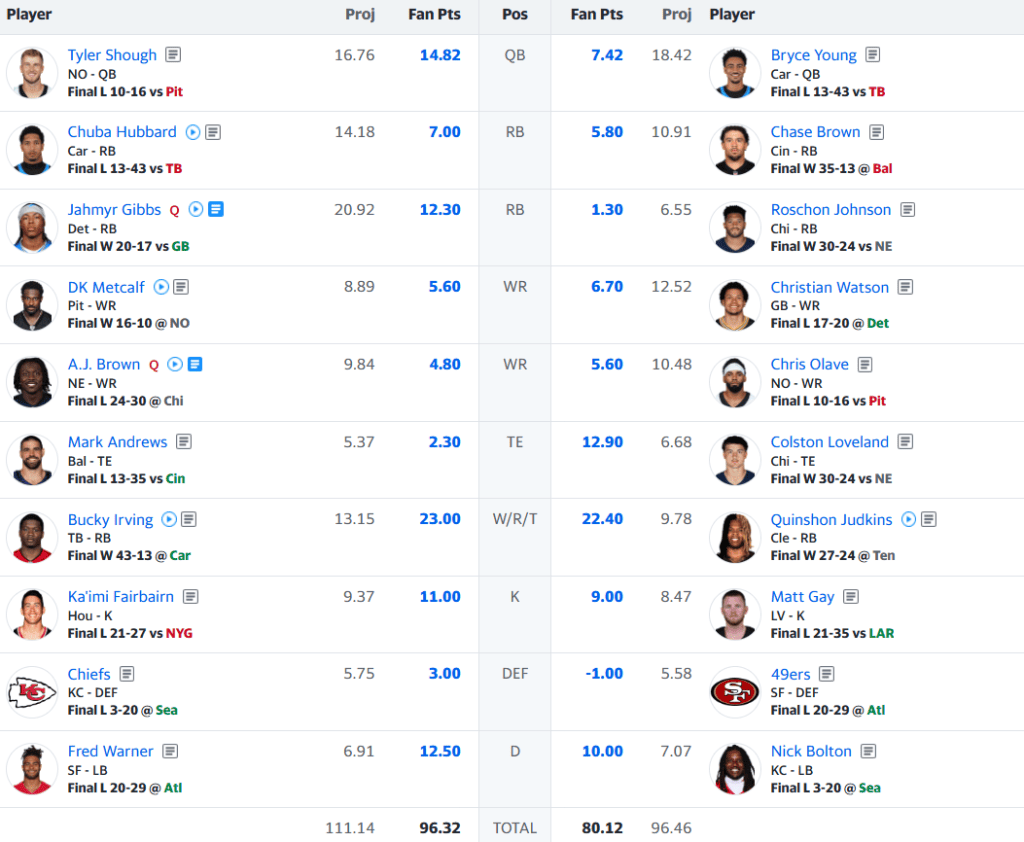
While Jimmy’s best man speech may have included a fantasy football roast of Chriss, Spider 2 Y Banana was unable to back up that trash talk on the field. To be fair, Jimmy knew about the result before he made the speech, so maybe it was just him trying to claw back some respect. But much like with Rodney Dangerfield, respect was hard to come by for Jimmy this week, with Quinshon Judkins (22 points) being the only reason he avoided challenging Aly for lowest score. Bryce Young had fewer points than Riaz’s K, while Chase Brown, Roschon Johnson, Christian Watson, Chris Olave, and the 49ers defense all disappointed. Footballdamus’ lineup wasn’t much better, with a fantastic day from Bucky Irving (23 points) being the one thing that kept Riaz from being truly threatened for the win. Riaz’s lows were not as low as Jimmy’s, which ended up being the difference. Don’t look now, but Riaz is 6-1 halfway through the regular season. Also, Jimmy is currently in position to go from first to worst. Seven more weeks to go!
THE INJURED RESERVES (4-3) DEF. FLOCK AROUND AND FIND OUT (4-3)
103.20 – 92.72
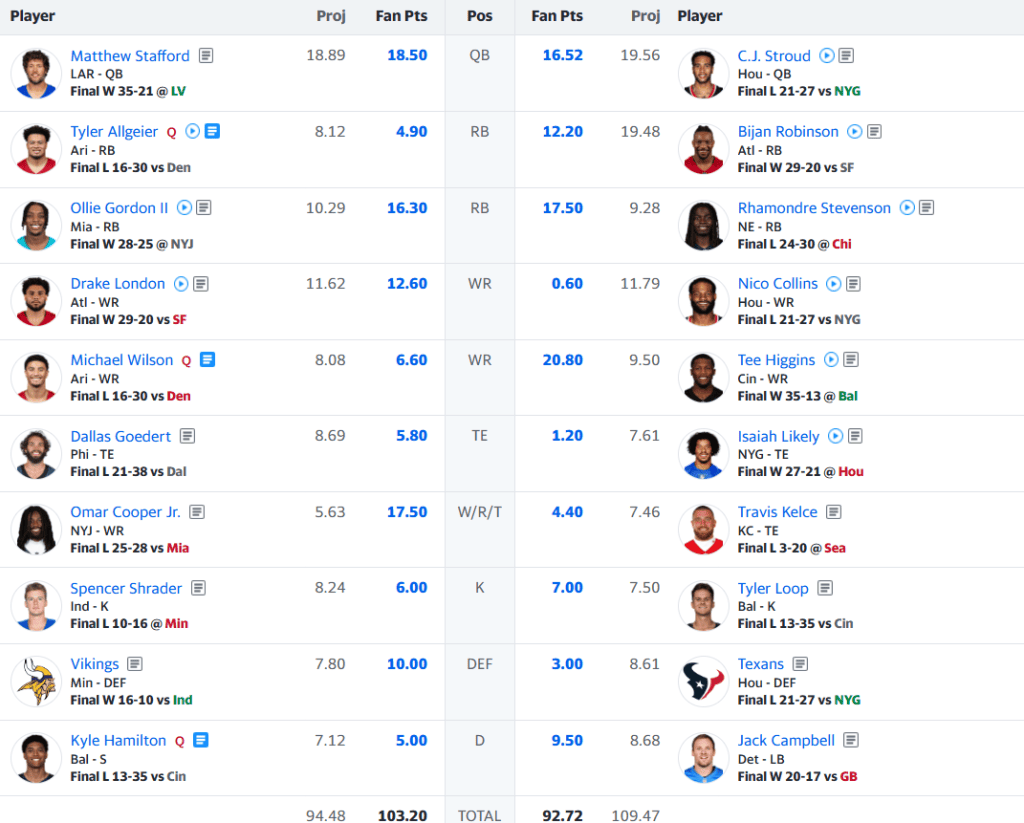
Arik may have been in attendance for Chriss’ wedding, but he was dealing with an attendance problem with his lineup this past weekend. Trevor Lawrence, James Cook, Omarion Hampton, and more were on byes, forcing the Injured Reserves to dig into their back pockets for players. Fortunately for them, it worked out pretty well, as Omar Cooper (17 points), Ollie Gordon (16 points), and Drake London (12 points) all played well and gave Arik the edge he needed. That being said, Arik hadn’t done enough to totally seal the win, and might’ve found out after flocking around. After all, Flock Around and Find Out had Tee Higgins (20 points), Rhamondre Stevenson (17 points), and Bijan Robinson (12 points), keeping Ewing within striking distance. Granted, Ewing could have had the lead had Isaiah Likely and Nico Collins gotten more than two points combined. Still, Ewing had Taylor Swift’s husband still to play, and a big game could give him the comeback victory. However, Seattle shut Travis Kelce down and Arik held on for the win.
CAN YOU HEAR THE DRUMS? (4-3) DEF. THE KRISPY KRITTERS (2-5)
134.08 – 113.08
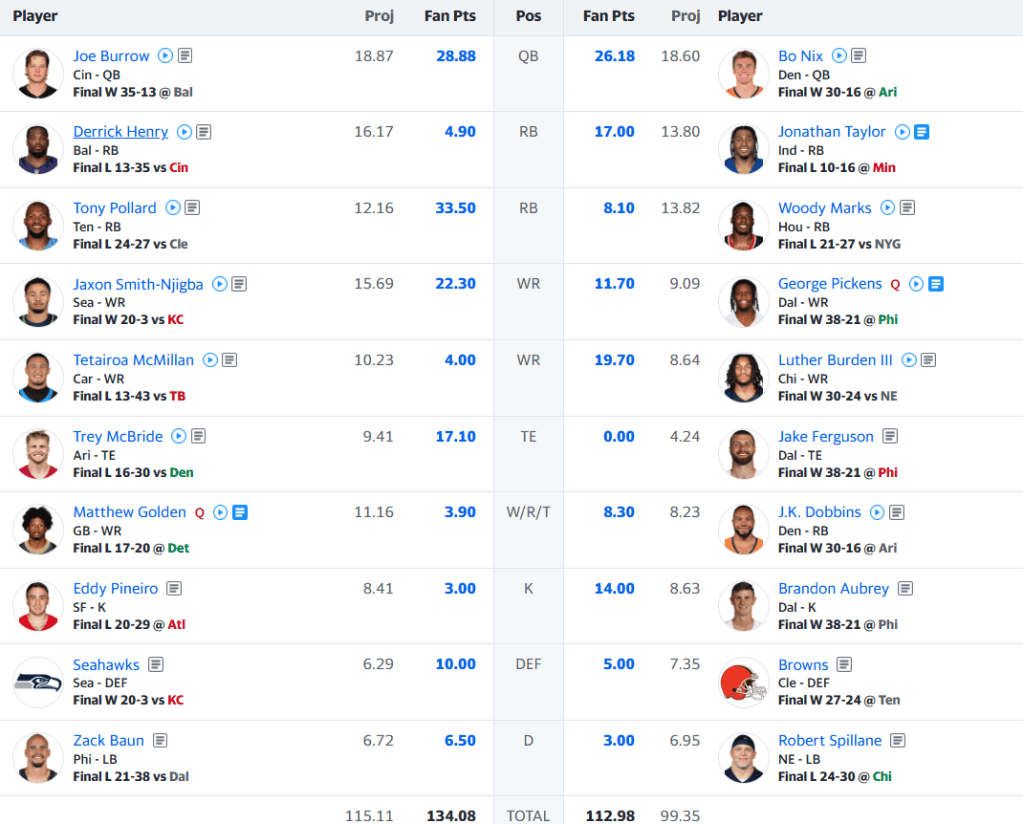
This has to be a joke at this point. Halfway through the regular season, Can You Hear The Drums? is the only team to score 800+ points, and I’m just 11 points shy of 900. At worst, I’ve been the third-highest scorer in a given week. But I’m also the only team to have 800+ points scored against them, which explains why I’m 4-3. I’ve either been the highest scoring team or played the highest scoring team all but one week, and even then I played the second-highest scoring team. I mean, come the hell on? This is insanity. Fortunately, this was one of the weeks where I did score the most points, thanks to Tony Pollard (33 points) balling out and Jaxson Smith-Njigba (22 points), Joe Burrow (28 points), and Trey McBride (17 points) doing work. But I had to have that happen, because the Krispy Kritters had by far their best week of the season, thanks to the likes of Bo Nix (26 points), Luther Burden (19 points), and Jonathan Taylor (17 points). It’s bad luck for Richard to face me, but apparently I have bad luck every friggin week.
BIG BEEFY BOY BATTALION (6-1) DEF. SUBSTATION TRUTHER (2-5)
94.94 – 93.68
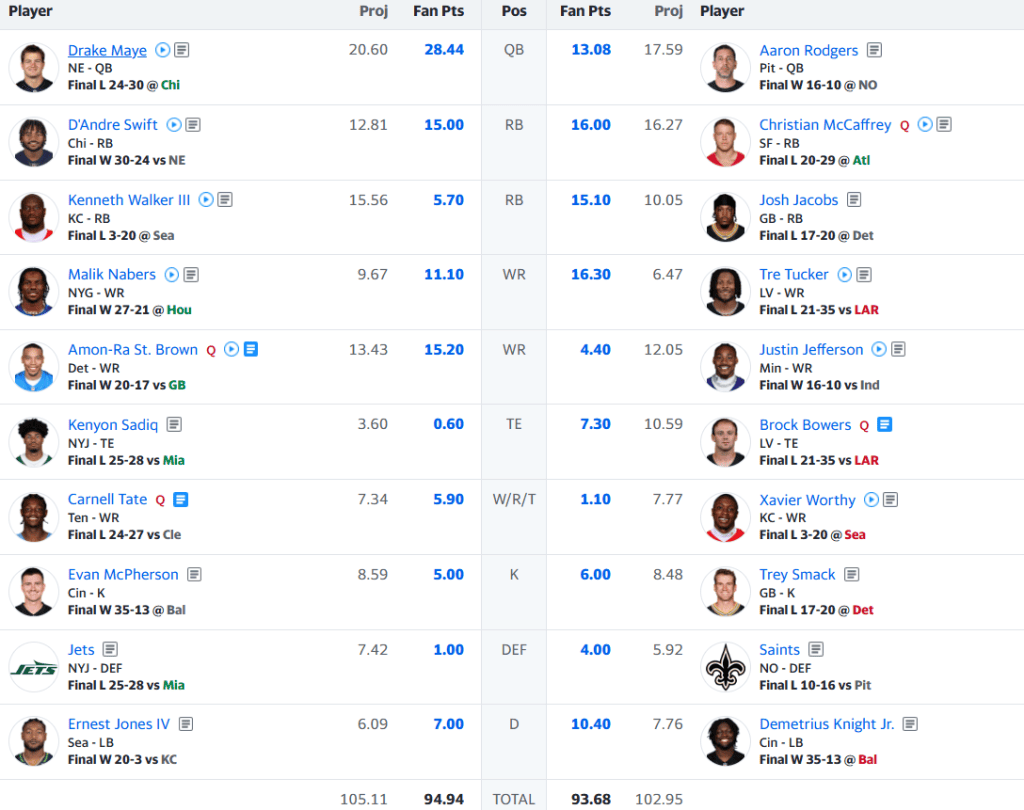
Apparently, while some of us were watching Chriss get married or Chriss himself, the rest of the league was trying to kill each other. Case in point: Substation Truther almost pulling off the upset of the season so far and taking down Big Beefy Boy Battalion. Both Kyle and Nick had plenty of ups and downs with their lineups. Kyle benefited from a huge game by Drake Maye (28 points) and good showings from Amon-Ra St. Brown (15 points) and D’Andre Swift (15 points), but was heavily let down by Kenyon Sadiq and the Jets defense (though anyone with expectations for New York should know better). Meanwhile, Nick was powered by solid efforts by Tre Tucker (16 points), Christian McCaffrey (16 points), and Josh Jacobs (15 points). However, Aaron Rodgers (13 points) left a bit on the table, while Justin Jefferson and the Saints defense suffered. Hell, Trey Smack’s short miss ended up being the difference. Still, it came down to a disappointment-off between Kenneth Walker and Xavier Worthy. Unfortunately for Nick, Worthy won, so he lost.
BIJAN MUSTARD (3-4) DEF. CABOMETYX (4-3)
99.72 – 98.42
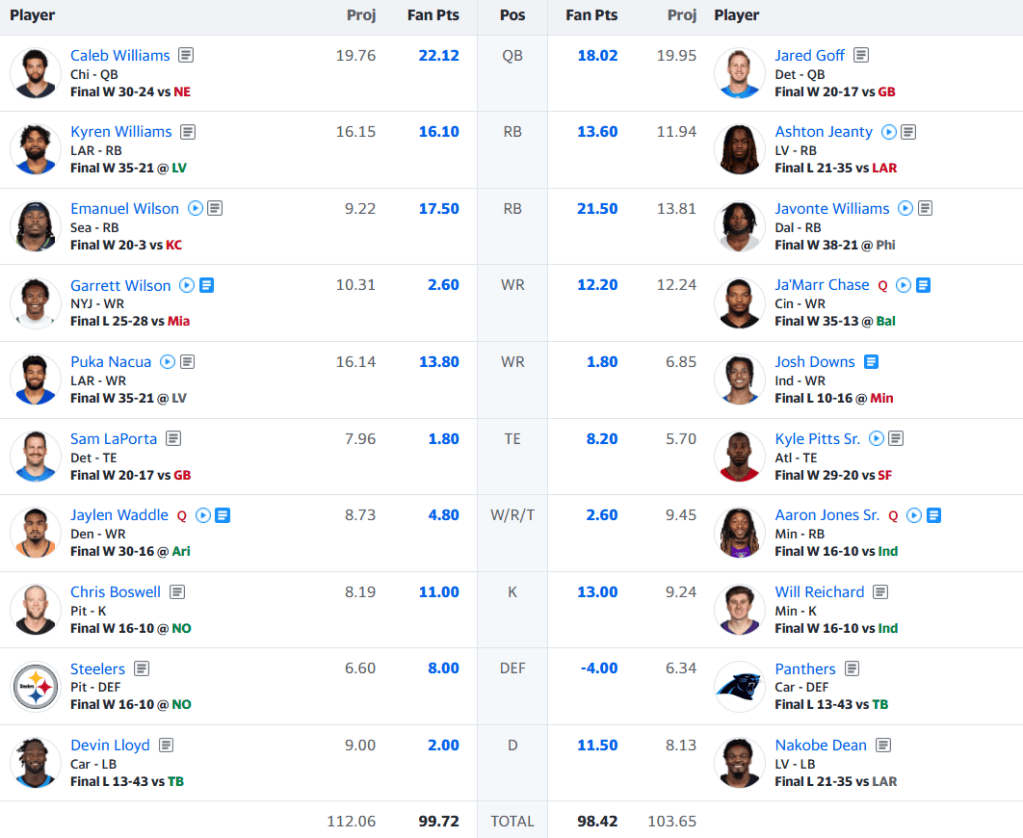
As for the other all-father matchup, it somehow came down to one poor decision. To be fair, Bijan Mustard should’ve had the win locked up before and even into Monday Night. After all, Caleb Williams (22 points), Emanuel Wilson (17 points), and Kyren Williams (16 points) gave Emilio a solid enough footing. However, bad days from Sam LaPorta, Garrett Wilson, and Jaylen Waddle prevented him from securing the win. Putting in Cam Skattebo (18 points) instead of benching him would’ve done the job, but that’s not the poor decision I’m talking about. Jared Goff (18 points), Ashton Jeanty (13 points), and Ja’Marr Chase (12 points) were not enough for Cabometyx to make up for bad efforts from Josh Downs and the Panthers defense. Indeed, Dad looked screwed until a late TD by Javonte Williams (21 points) on Monday Night suddenly put him within less than two points of Emilio. That was as close as he would get, with the Bengals defense and their ten points sticking out on Dad’s bench like a thumb as sore as his defeat.
STANDINGS
LEAGUE STANDINGS:
- Big Beefy Boy Battalion (6-1)
- Footballdamus (6-1)
- Can You Hear The Drums? (4-3)
- Cabometyx (4-3)
- The Injured Reserves (4-3)
- Flock Around and Find Out (4-3)
- Bijan Mustard (3-4)
- Chest in my Hole (3-4)
- Mom Against the Machine (3-4)
- The Krispy Kritters (2-5)
- Substation Truther (2-5)
- Spider 2 Y Banana (1-6)
MELEE FOR THE MASK:
- Can You Hear The Drums? (889.24)
- Big Beefy Boy Battalion (759.79)
- Cabometyx (745.78)
- The Injured Reserves (737.20)
- Footballdamus (735.68)
- Flock Around and Find Out (724.52)
- Bijan Mustard (719.38)
- Chest in My Hole (716.06)
- The Krispy Kritters (671.58)
- Substation Truther (640.12)
- Spider 2 Y Banana (632.04)
- Mom Against the Machine (626.16)
DRINK PUNISHMENT TRACKER:
- Ruben (138.86) –> Richard (76.36) [Hand Brewed Beer Deez Nuts Brown Ale]*
- Ruben (122.68) –> Ewing (60.34) [Podere Paganico Rosso Di Montalcino]
- Arik (121.78) –> Jimmy (71.94) [Voodoo Ranger Tropic Force]
- Ewing (156.18) –> Nick (85.92) [A light beer of Nick’s choosing]**
- Ruben (139.70) –> Jimmy (83.64) [Chugging two White Claws]
- Nick (132.52) –> Emilio (63.90) [Guinness]
- Ruben (134.08) –> Aly (63.60) [A BuzzBallz of Aly’s choosing]***
* This was the backup option after Richard bitched about being unable to obtain Los Angeles Ale Works Dead Cowboy, which was the original choice
** Nick’s choice — which he had to shotgun — was Los Angeles Ale Works Dead Cowboy, selected to show Richard how easy it is to obtain
*** It was supposed to be a Halloween-themed BuzzBallz, but Aly couldn’t find one in a reasonable time frame and received permission to pick a regular one instead
BEST & WORST
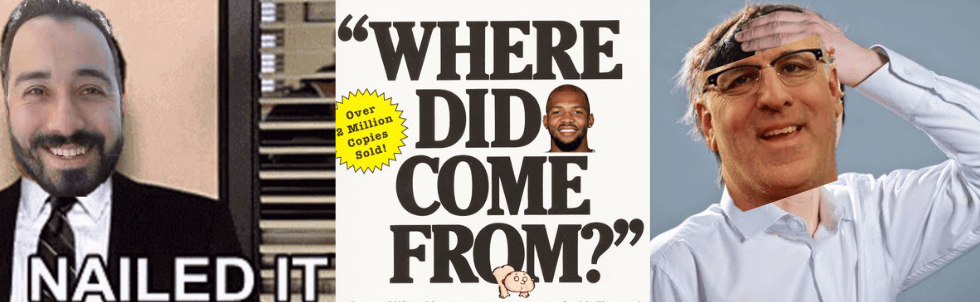
UNEXPECTED PERFORMANCE
BEST: While I’ve been consistently scoring a lot of points this season, it’s sometimes a mystery as to where those points come from. This past weekend saw perhaps the most unlikely source of my points: Tony Pollard. Forced into my lineup due to Bhayshul Tuten being on a bye, Pollard amazingly tallied 33 points — nearly as many points as his prior four games combined.
WORST: We’ll get to some of the closer contests in a second, but I feel Ewing got screwed more than the rest with underperforming talent. Case in point: Travis Kelce, Nico Collins, Isaiah Likely, and the Texans defense going for fewer than ten points combined. If half of them had a normal day or one a good day, Ewing probably would’ve gotten the win. But they didn’t, so he didn’t.
TRANSACTION
BEST: It’s not usual to see Ks or a K transaction decide a matchup. But then we have Emilio, who made a late Saturday move to cut Jake Bates in favor of Chris Boswell. It was an improvement, as Boswell scored 11 points to Bates’ nine points. While that’s not much of a difference, those two points would’ve been the deciding factor and given Dad the win over Emilio by less than a point.
WORST: Another decision was made in the narrow-thin matchup, one that ended up backfiring on the decision-maker. That would be Dad, who cut Darren Waller loose to pick up Kyle Pitts. Pitts alright with eight points. But Waller ended up with 11 points, and the three-point difference between the two would’ve flipped the result in Dad’s favor. Instead, he fell just short.
LINEUP DECISION
BEST: This could’ve also worked for the Best Transaction section, but it’s worth mentioning here nonetheless. With half his team injured or on a bye, Arik took a chance on Omar Cooper as his FLEX, based on his effort the prior week. Cooper beat that with 17 points, not only a season-high, but more than the ultimate point-difference in Arik’s win. A good pickup and lineup call, indeed.
WORST: Sorry, Dad. This is adding insult to injury, but it’s gotta be done. Instead of trying to take advantage of the Ravens being without Lamar Jackson and starting the Bengals defense, Dad opted for the Panthers defense against the stumbling Buccaneers. Carolina dipped into the negatives, while Cincinnati’s 13 points were wasted, preventing Dad from getting the win.
LUCK
BEST: Whenever you have these kind of close games, is it good luck for the person who won or bad luck for whoever lost? It’s usually a bit of both, and I feel like it’d be a bit of a cop out to reduce those two matchups from this past weekend to this. Still, I need to fill each one of these sections, so let’s give both Kyle and Emilio this spot due to each of their narrow victories.
WORST: As such, we need to put Nick and Dad in this section to balance things out. But they’re not alone. For as much as I bitch about facing the highest scoring teams, when I score the most point it’s my opponent with the bad luck, especially if they’re the second-highest scoring team. So Richard, this is the official acknowledgement of your poor luck recently. Hope it makes up for it.
MONTHLY RAIDERS RANT
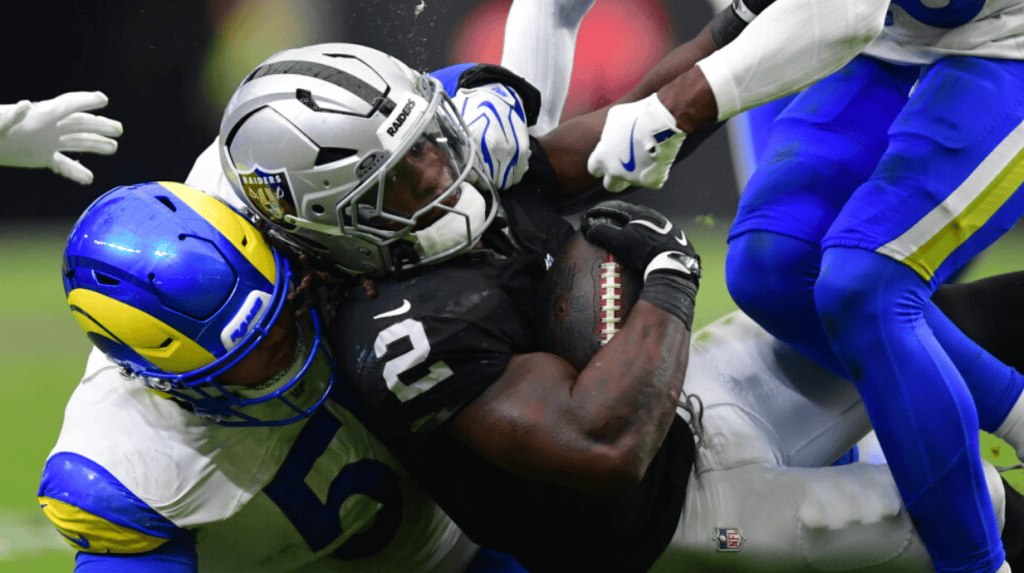
See that? That’s why I didn’t get excited about the 3-0 start to the season.
Granted, I didn’t expect the Raiders would win their first three games. Looking back, it seems reasonable, given those three opponents have combined for just three wins so far. I think the potential the Saints showed — coupled with Las Vegas barely losing to the Chiefs — gave some Raiders fans false hope. Enter last year’s AFC winner, the reigning MVP, and this year’s pre-season favorite. Now, the Raiders are back below .500 where they belong.
That’s right, where they belong. That 3-0 start may have deluded some fans, but I’ve seen false hope before. Let’s not forget that most Raiders fans would’ve absolutely taken a 3-4 record at this point before the season began. Now, suddenly it’s a disappointment? I don’t think so. The Raiders are beating teams they’re supposed to beat and losing to teams they’re supposed to lose to. They’re mid at best, and not only is that okay, but it’s a step up from last year, which quite frankly is all we wanted.
Kirk Cousins is playing decently and should no way be pulled for Fernado Mendoza, who did show some promise during his one drive of action so far. Those situations are the only ones where the Raiders should even think about playing Mendoza right now. Las Vegas is not a playoff team — the lack of a consistent running game and defense are proof of that. But we knew this going into the season. This is effectively a gap year for the team to not be completely awful (done), Klint Kubiak to show that he knows what he’s doing (done), Mendoza to develop (looking good so far), and to stock up on more draft picks (in progress). Don’t change course, especially with what’s to come.
Right now we’re in the eye of the storm, with a likely win against the Jets this weekend to officially surpass last year’s win total. But then after that it’s San Francisco, Seattle, and Denver back-to-back-to-back. The Raiders are not going to win any of those games, and they shouldn’t overreact to not doing so by switching QBs, unless Cousins looks like complete trash. I don’t see that happening, so let’s all chill out and keep the bigger picture in mind.
After all, we should probably be saving our anger for the upcoming Madden movie. Good lord, that looks like a cinematic disaster. Yes, I’ll be reviewing that when it comes out. I’m already sharpening my pitchfork.
STAT OF THE MONTH
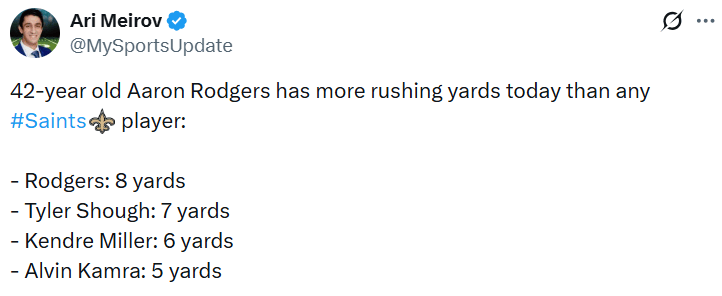
Added up, that’s 18 rushing yards. I repeat, the Saints recorded 18 rushing yards against the Steelers. A snail being used for escargot in Paris would’ve had more than that. But don’t worry, New Orleans — things are fine!
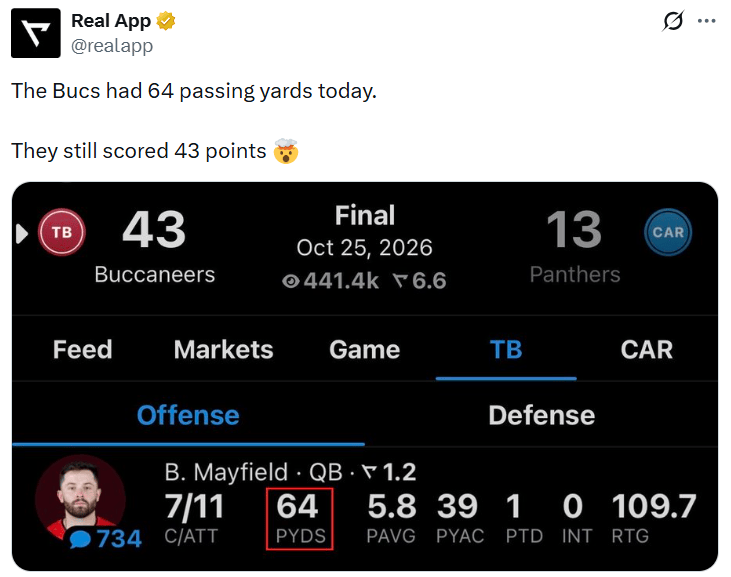
I didn’t think the Panthers defense could put together a more pathetic performance than Week 1 against the Bears. I was wrong.
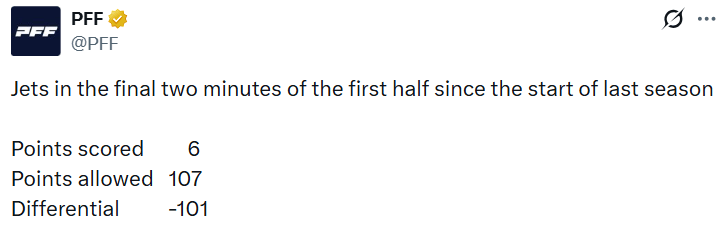
I swear if the Raiders lose to THIS team this weekend…
Still, at least neither the Jets nor the Panthers nor the Saints provided the biggest source of embarrassment towards their fans this week.
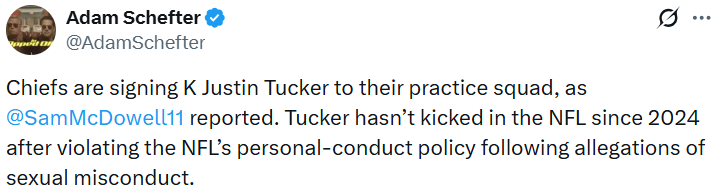
The Kansas City Chiefs, the Hunt family, Brett Veach, Andy Reid, and anyone else who took part in this decision are pathetic fucks who give no shits about the quality of men who put on their uniforms, only if they have an atom of talent. If I were a woman, I would not be able to support that team. Even if I weren’t a Raiders fan who already hated the Chiefs, this would make me hate them. This franchise is unworthy of respect or praise, but most of their fans will probably ignore it and continue their racist in-stadium chanting as the referees hand them another Super Bowl appearance. Fuck those assholes. I’m glad the Seahawks put belt to ass and knocked them from the ranks of the unbeaten. Speaking of…
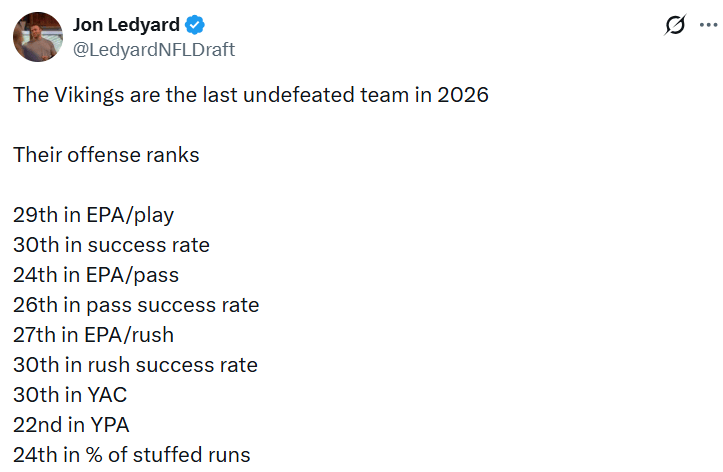
The Vikings are the only undefeated team in the NFL, with one of the worst offenses in the league. This comes as a former Vikings QB just won the Super Bowl and three more are starters on other teams. I’d say this is the most Vikings thing ever, but the next section exists.
RUBEN’S RANKINGS
TOP 10 SUPER BOWLS BETWEEN TEAMS SEEKING THEIR FIRST TITLES
Congrats are also in order for the Milwaukee Brewers, who last night defeated the Tampa Bay Rays to win the first World Series in franchise history. While the ball club’s ballpark didn’t rank that high on my list, I nonetheless had one of my favorite experiences there and am thrilled for those long-suffering Brewers fans, who finally get to experience joy. Meanwhile, the Rays remain one of just four MLB teams to never win a World Series, and are now the team to make the most appearances in the Fall Classic without winning it all.
The 2026 World Series was unique in that neither participant had ever won a championship. It’s only the eighth time it’s ever happened (the first time since 1980 and just the second time since 1920). If you can believe it, although the World Series has been around for more than 60 years before the first Super Bowl, this kind of matchup has happened 12 times in the NFL’s Super Bowl era, though not since the first Super Bowl of the 21st century. I thought it would be fun to look back at those Super Bowls involving teams seeking their first titles and rank them based on how good of games they were. You may not care, but I thought it was fun.
HONORABLE MENTION: SUPER BOWL IV (CHIEFS-VIKINGS)
Is Super Bowl IV the worst of these dozen matchups? Not even close — objectively, it should rank in the bottom half, but make the final Top 10 nonetheless. However, I cannot place it there for one main reason: the Kansas City Chiefs won. The Chiefs defense limited the Vikings to just seven points, while Kansas City’s rushing attack rolled over Minnesota for a 23-7 final score. While this would be the first and only title for Kansas City for 50 years, their dominance over the past decade has been the bane of my existence and this is my list, so it’s at the bottom.
HONORABLE MENTION: SUPER BOWL XX (BEARS-PATRIOTS)
Not only was Super Bowl XX a matchup of teams looking for their first title, but it was also the fourth (and as of this writing most recent) matchup between teams making their Super Bowl debut. It was also one of the biggest ass whoopings in Super Bowl history. This was the ’85 Chicago Bears — one of the greatest teams in NFL history. The New England Patriots stood no chance, being dominated on both sides of the ball en route to a 46-10 Bears victory. This is the largest margin of victory of these dozen games, so it’s no wonder it didn’t make the Top 10.
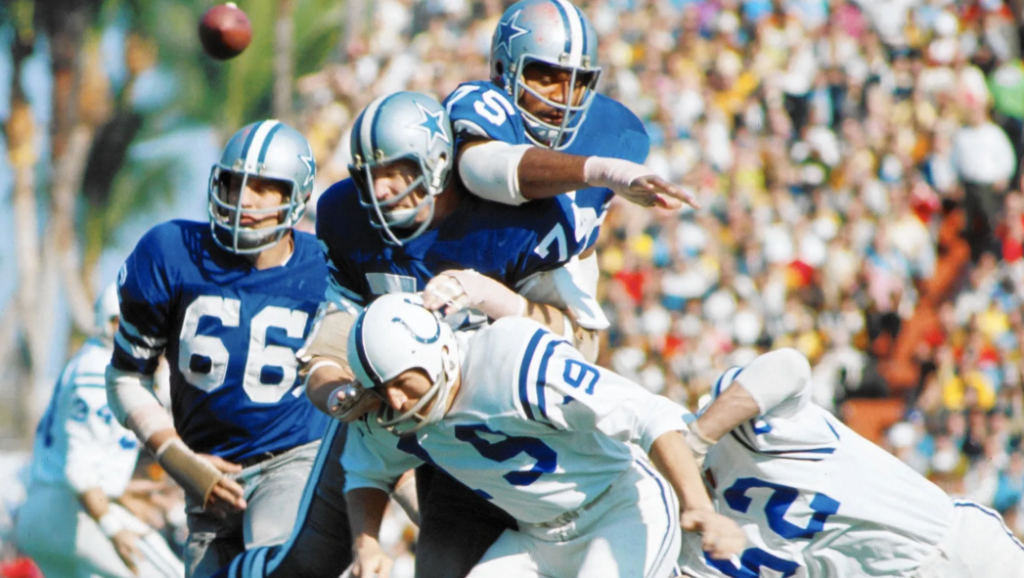
10. SUPER BOWL V (COLTS-COWBOYS)
In stark contrast to the majority of games on this list, Super Bowl V had the smallest margin of victory, being a back-and-forth battle that saw a 4th quarter comeback and a winning FG with just five seconds to go. So why is the first post-merger Super Bowl so low on this list? Simple: this may have been a close game, but it was because both the Colts and Cowboys were seemingly trying to give the game away to each other. This was a pure sicko’s game, with Dallas and Baltimore combining for a Super Bowl record 11 turnovers — five alone in the 4th quarter. There was also a blocked PAT, plenty of penalties, and your now-typical officiating errors. In the end, the Colts made a 32-yard FG to defeat the Cowboys 16-13, despite losing QB Johnny Unitas to an injury in the 2nd quarter. The game was such a crap show that Dallas LB Chuck Howley was named MVP — the first and (as of this writing) only time a member of the losing team has received the award (he was also the first non-QB named Super Bowl MVP).
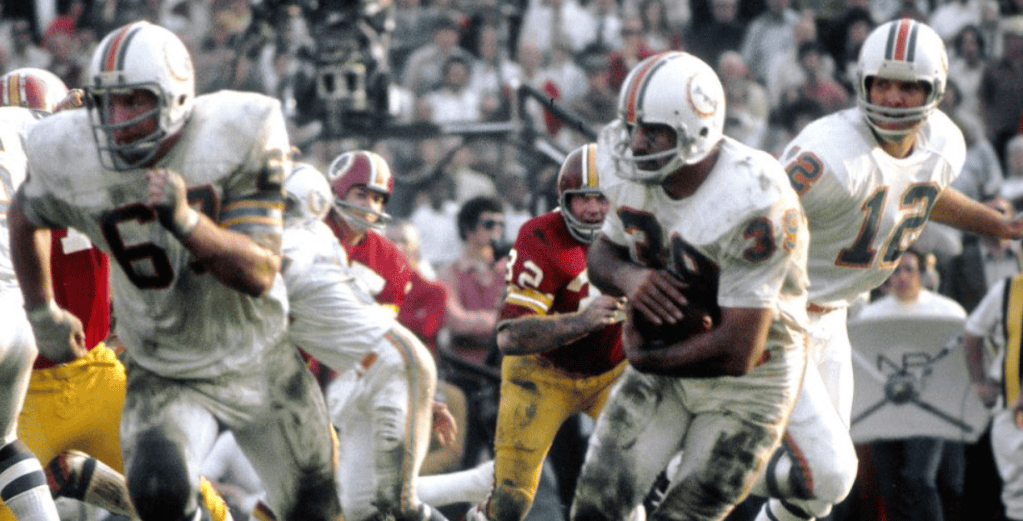
9. SUPER BOWL VII (DOLPHINS-WASHINGTON)
One of the most important Super Bowls in NFL history, Super Bowl VII was the culmination of (as of this writing) the only perfect season the league has ever seen. The Miami Dolphins beat Washington 14-7 to cement their 17-0 season, though the game itself was awful. The 21 combined points are the second-fewest to this point, and would’ve been just 17 had Miami K Garo Yepremian made a late FG. But the kick was blocked and Yepremian’s attempt to pass the ball was so terrible Washington scooped it up and scored to not be the only team ever to be shut out in a Super Bowl. It remains one of the all-time gaffes in NFL history, but it was the only reason the game was even close in the first place. Washington did drive late for the tying score, but the Dolphins were able to hold on. Still, twoish minutes of somewhat compelling football do not erase the 57ish minutes of Dolphins dominance that made the game so boring in the first place. This was also the last of five straight Super Bowls to qualify for this Top 10 list.
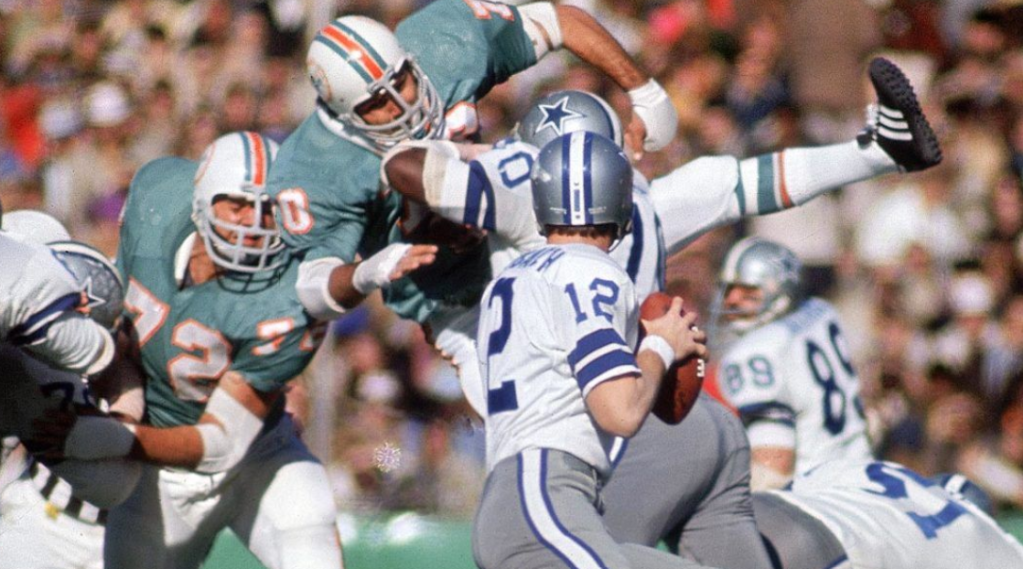
8. SUPER BOWL VI (COWBOYS-DOLPHINS)
One year after losing arguably the worst Super Bowl in NFL history, the Dallas Cowboys made it back to the title game, this time facing the Miami Dolphins. Dallas had garnered a reputation of being unable to win the big playoff game (shocking, I know), and they were hoping to turn the tide of public opinion. Indeed, Super Bowl VI would be different in a number of ways. First off, it was the coldest Super Bowl on record (and remains so as of this writing). Second off, the Cowboys offense actually showed up, setting Super Bowl records for most rushing yards (252) and first downs (23) by one team at the time. The Dolphins also set a record: fewest points scored in a Super Bowl (three). While the game was close at halftime — Dallas led 10-3 — the Cowboys rolled off 14 unanswered second half points to win their first Super Bowl — and the first major pro sports championship for a team based in Dallas. Miami did respond pretty well the next season, as evident by the entry above. Yes, these past three entries were in three consecutive seasons.
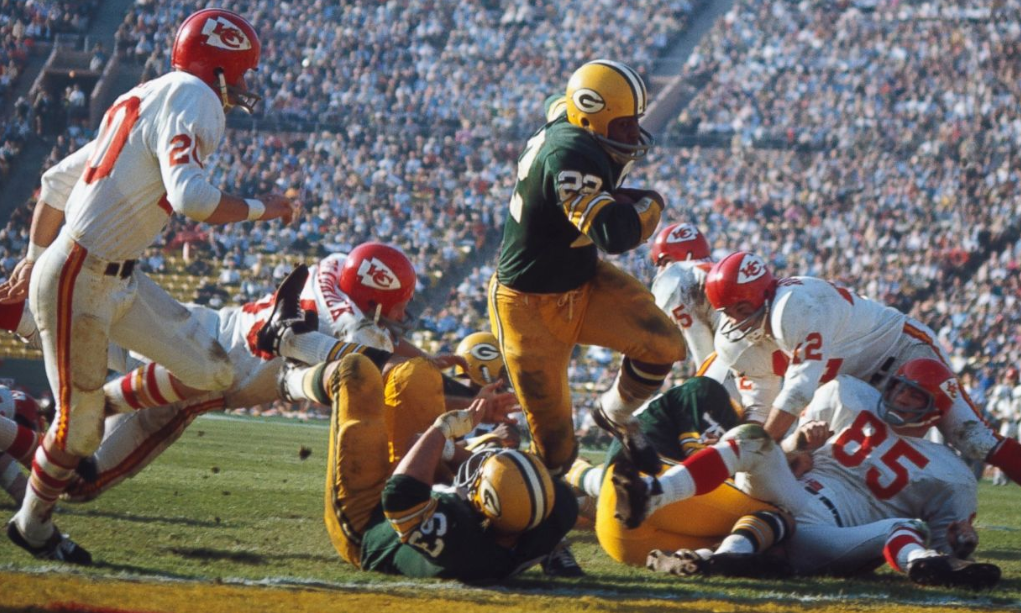
7. SUPER BOWL I (PACKERS-CHIEFS)
Naturally, Super Bowl I was guaranteed to make an appearance on this list, with no team having won a Super Bowl prior to it being played. Known at the time as the first AFL-NFL World Championship Game, it was a landmark moment not just in football history, but in sports history overall. While it was certainly a big deal at the time, it was far from the spectacle the Super Bowl has become today. This was partially due to the perception of both leagues, with the NFL seen as vastly superior to the AFL. Reinforcing this idea was the game itself, which saw the Green Bay Packers run away from the Kansas City Chiefs. While Kansas City was only down 14-10 at halftime (and had actually outgained Green Bay in the first half), 21 unanswered points in the second half gave the Packers their first trophy that would eventually bear their coach’s name by a final count of 35-10. Interestingly, because of the broadcasting rights for both leagues, Super Bowl I was the first and only edition to be simulcast on two different networks (NBC and CBS).
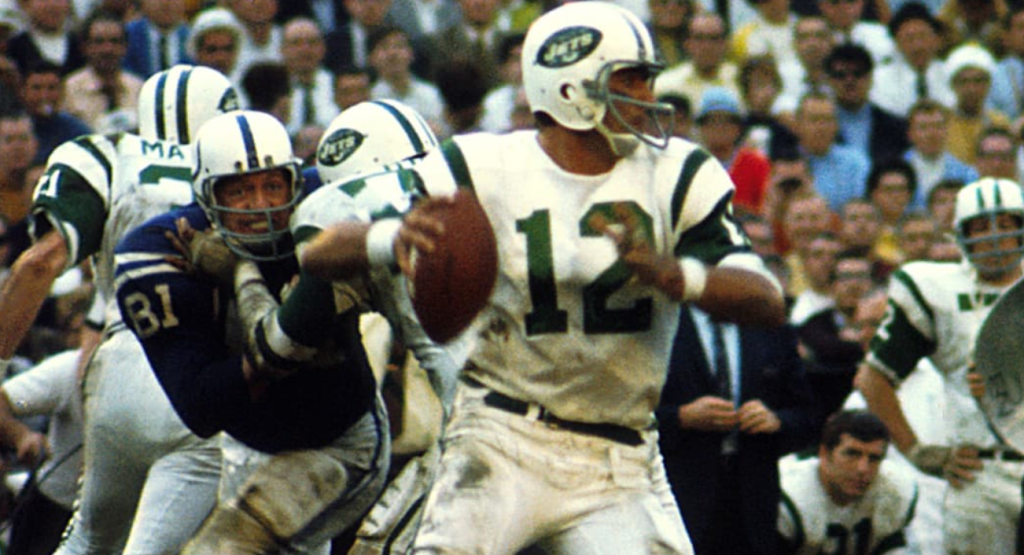
6. SUPER BOWL III (JETS-COLTS)
The first two Super Bowls (which saw the NFL champion dominate the AFL champion) only reinforced the perception of the two leagues. It also helped set up the narrative for Super Bowl III, with the NFL’s Baltimore Colts as the heavy favorites over the AFL’s New York Jets. You all know what happened next — it’s a major moment in sports history. A few days before kickoff, Jets QB Joe Namath guaranteed his team would win, and win they did, beating Baltimore 16-7 for the franchise’s first and (as of this writing) only Super Bowl. However, what’s not talked about as much is the fact that the game itself was kind of bad. New York’s defense dominated the game, intercepting NFL MVP Earl Morrall three times and only allowing a TD to the Colts in garbage time. The Jets went up 16-0 thanks to that defense and their running/kicking game (read: everything over than Namath and the passing game). New York remains one of just two teams to score only one TD during the Super Bowl and still manage to win the game.
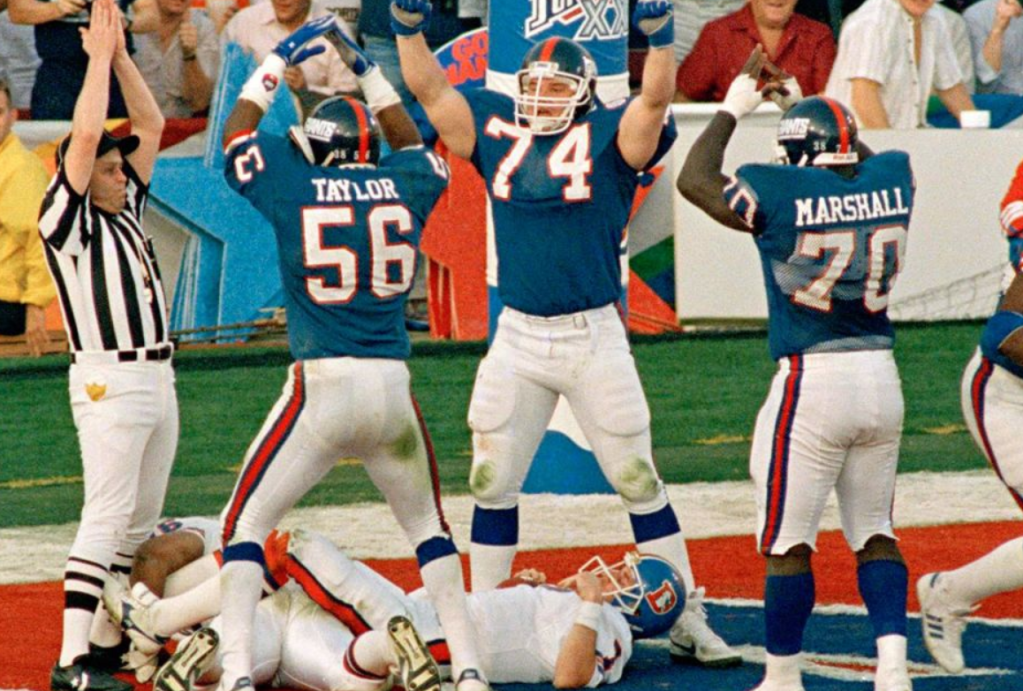
[NUMBER REDACTED OUT OF RESPECT FOR JAYDEN DANIELS] SUPER BOWL XXI (GIANTS-BRONCOS)
Despite having one of the largest margins of victory in this list, Super Bowl XXI makes the top half of the list for two main reasons. First, it was actually competitive in the first half, with the Denver Broncos holding a one-point lead over the New York Giants at halftime — New York then scored 26 straight points to turn this into a laugher and eventually win 39-20. The other main reason is simple: the Broncos not only lost, but got their teeth kicked in. A 24-yard missed FG was just the first of their troubles, with the Giants going from narrowly losing to being up by three scores in less than 15 minutes of game time. While going from exciting to boring is a negative, the fact that it was exciting at all sets it ahead of many of these games. In their victory, the Giants also made NFL history in two ways. The first was the Gatorade shower, with coach Bill Parcells being the first to receive such an honor. Also, QB Phil Simms was the first member of the winning team to state he was going to Disney World/Disneyland after the final whistle.
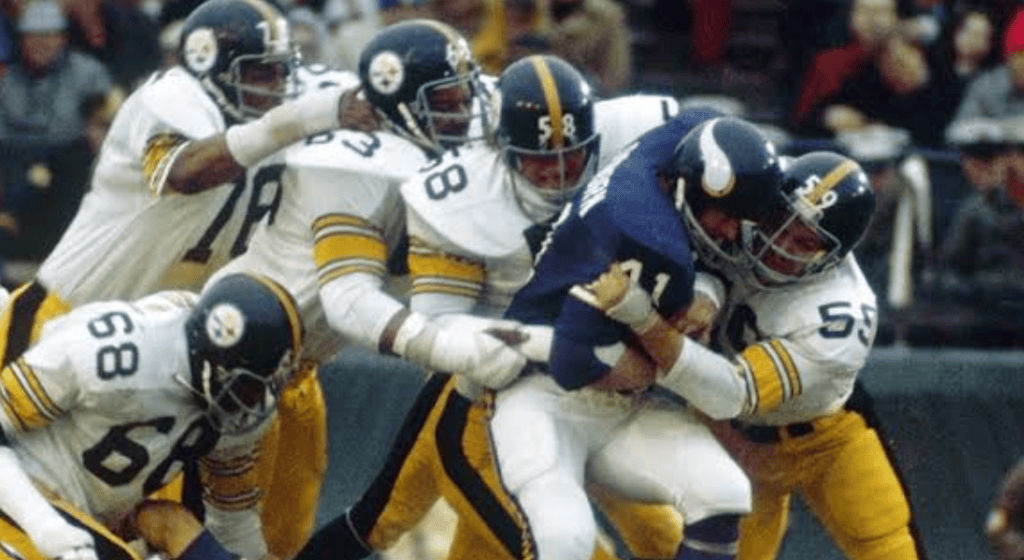
4. SUPER BOWL IX (STEELERS-VIKINGS)
While Super Bowl IX was one of the lowest scoring NFL title games ever (just 22 combined points), that doesn’t mean it was a bad game. I mean, what would you expect in a game featuring two of the greatest defenses in NFL history? The Pittsburgh Steelers came in boasting the famed Steel Curtain, while the Minnesota Vikings countered with the Purple People Eaters. As such, neither offense could get anything going. In fact, the only points in the first half came from the first safety in Super Bowl history, when the Steelers brought down Vikings QB Fran Tarkenton in the end zone. A fumbles kickoff and a blocked punt led to both teams finding the end zone in the second half, before Pittsburgh finally managed to put together a drive, which resulted in a double-digit lead (which might as well have been triple-digits given how the defenses were playing). In the end, the Steelers held on to win 16-6, making the Vikings the only team to appear on this list twice without winning. Spoiler alert: they’ll appear again.
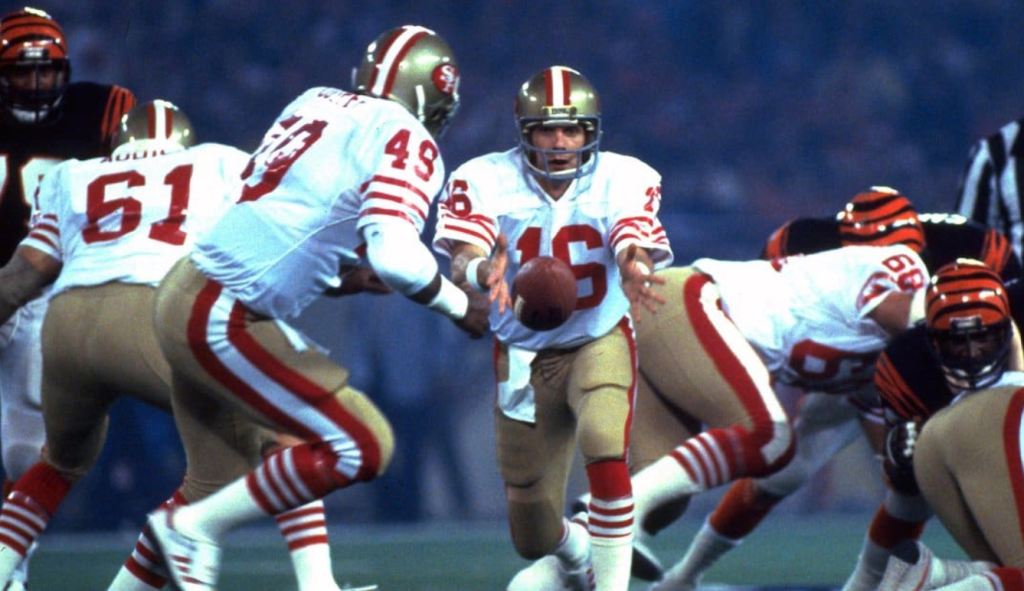
3. SUPER BOWL XVI (49ERS-BENGALS)
One of just four matchups between teams making their Super Bowl debuts, Super Bowl XVI saw the San Francisco 49ers — led by game MVP Joe Montana (or, as Dad calls him, God) — defeat the Cincinnati Bengals. It was the first Super Bowl to be played in a cold weather city, but fortunately for the offense and entertainment it was also played in a dome stadium. At first, the game looked like it would be a rout, with a Montana passing and rushing TD — combined with two FGs from Ray Wersching — giving San Francisco a 20-0 halftime lead. But Cincinnati stormed back, scoring two TDs to cut it to 20-14 in the 4th quarter. In fact, the Bengals could’ve had the lead, if not for a goal line stand by the 49ers (keyed by a crucial tackle by LB Dan Bunz). San Francisco tacked on two more FGs and, despite a late TD by Cincinnati, held on for a 26-21 victory and their first Super Bowl title. Interestingly, this remains the only Super Bowl in which the winning team scored fewer TDs than the losing team, with the game coming down to FGs.
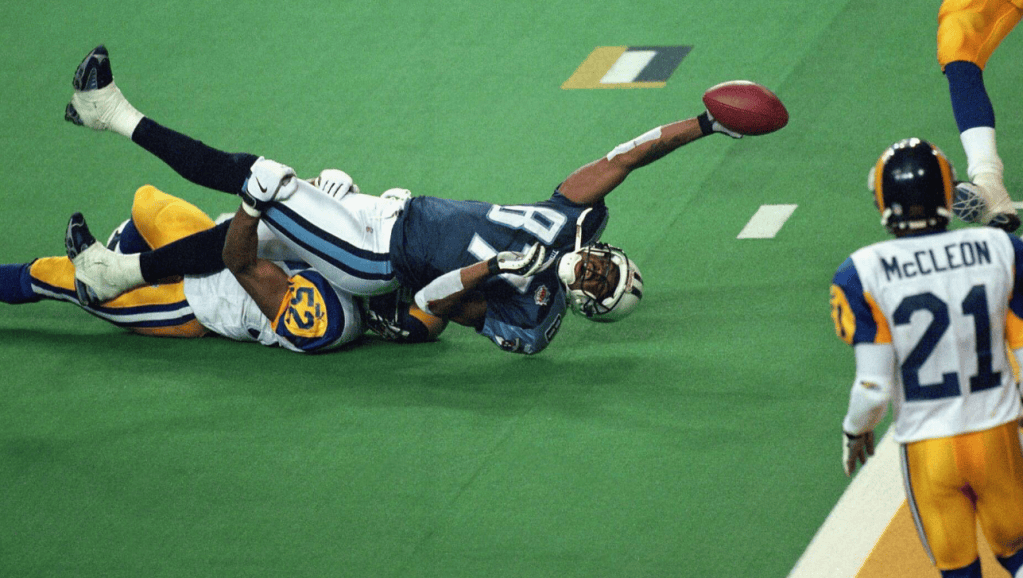
2. SUPER BOWL XXXIV (RAMS-TITANS)
The most recent Super Bowl between teams looking for their first titles, Super Bowl XXXIV has gone down as one of the greatest in history. Both participants had recently relocated — the Rams to St. Louis from Los Angeles and the Titans (formerly the Oilers) to Tennessee from Houston. The Rams were not expected to be anywhere near the Super Bowl after QB Trent Green went down with a preseason injury. But backup QB Kurt Warner, RB Marshall Faulk, and WRs Torry Holt and Isaac Bruce orchestrated the Greatest Show on Turf offense and took the NFL by storm. Meanwhile, the Titans needed a Music City Miracle to avoid early elimination. St. Louis led 16-0 in the 3rd quarter, but Tennessee rallied to tie it with just over two minutes left, only for Warner to find Bruce for a 73-yard TD strike. Steve McNair led the Titans on a drive to try to tie the game, which came down to the final play. In a now-famous play, Mike Jones tackled Kevin Dyson one yard away from the endzone, as the Rams held on to win 23-16.
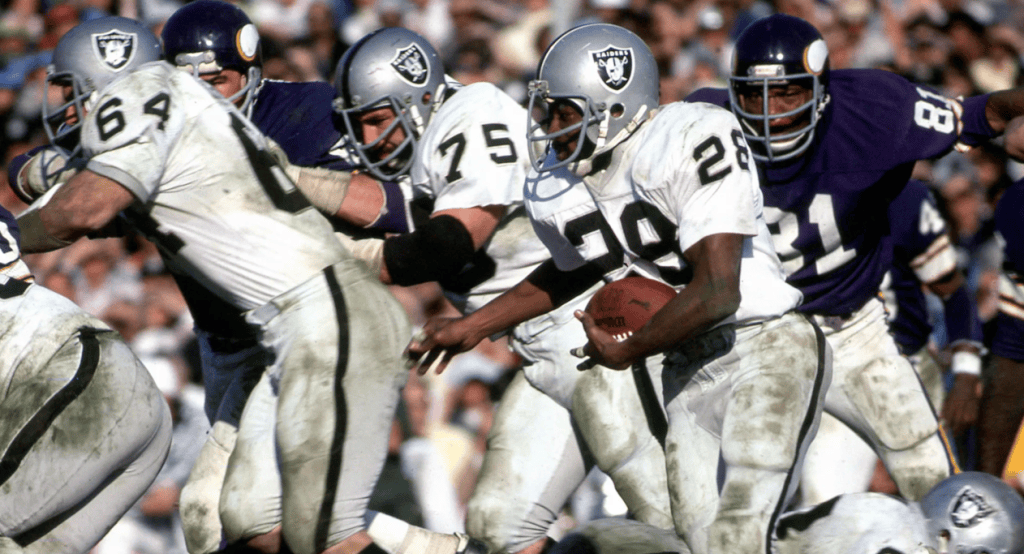
1. SUPER BOWL XI (RAIDERS-VIKINGS)
Don’t give me that look. This is my list and I’ll do what I want with it. Yes, Super Bowl XXXIV should objectively be in the top spot and this one should be four or five spots down. But this is the Super Bowl where my favorite team became champions for the first time, so it gets the No. 1 spot. Deal with it. Anyway, Super Bowl XI was a game where one team that had consistently come up short would finally get their due. The Oakland Raiders had come up short in several AFC title games (not to mention Super Bowl II), while the Minnesota Vikings were entering their fourth Super Bowl looking for their first title. Unfortunately for the Vikings (making their third appearance on this list), it would not be their day. The Silver & Black dominated proceedings, going up 16-0 at halftime and 19-0 overall before Minnesota could get on the scoreboard. By then, it was too little, too late, as two more Oakland TDs — including Willie Brown’s iconic 75-yard pick six — cemented the Raiders as winners 32-14 and, finally, as Super Bowl champs.
#THROWBACKTHURSDAY
ON THIS DAY IN NFL HISTORY:
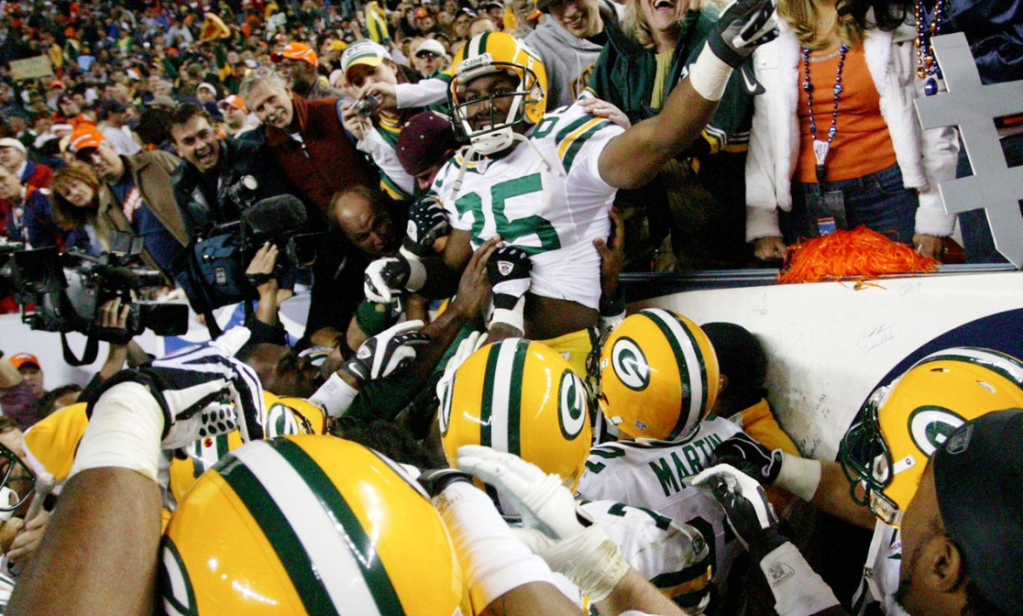
On October 29, 2007, it took a historic play for one of the NFL’s oldest teams to do something it had never accomplished before. That team was the Green Bay Packers, who in 2007 was celebrating the 50th anniversary of Lambeau Field. The team and its fans were hoping to mark that anniversary with a home playoff game, but that was dependent on the Packers continuing to improve. After five straight winning seasons to start the new millennium (as well as four playoff appearances and three NFC North titles in a row), 2005 saw a shocking dip in form for Green Bay, who finished a dismal 4-12. Speculation swirled over whether or not iconic Packers QB Brett Favre, who was getting up there in age, would retire. After all, the Packers had seemingly drafted Favre’s successor, Aaron Rodgers, before the season started. But Favre stuck with it and, under new head coach Mike McCarthy with new additions like WR Greg Jennings, improved to 8-8 in 2006. Favre decided to stick it out one more season, a move which seemed to be working out well. The Packers stormed out of the gate, entering their bye week with a 5-1 record. But Green Bay would not be returning from that bye at home. Instead, their strength would be tested in a place that had only brought them pain in the past.
The Denver Broncos may have only begun their disgusting existence by the time the Packers had already turned 40, but they still managed to face Green Bay more than ten times going into the 2007 season, including in Super Bowl XXXII. Overall, the Packers were 4-6-1 against the Broncos, but more importantly none of Green Bay’s wins over the donkeys were on the road. In their nearly 90-year history to that time, the Packers had never won in Denver. Anyway, guess who the Packers were playing coming off their bye week. That’s right, the Broncos — in Denver! The Broncos had been one of the better teams over the start of the 21st century, reaching the AFC title game in 2005 and not recording a losing season since 1999 — the year after their own iconic QB, John Elway, retired. But much like Green Bay in 2005, Denver seemingly chose their future franchise QB in the 1st round of the 2006 draft in Jay Cutler. The Broncos fell to 9-7 in 2006, though they went 2-3 after switching from Jake Plummer to Cutler. Going into the 2007 season, Plummer was traded to the Tampa Bay Buccaneers and Cutler was given the reins full-time. The campaign hadn’t gone too well so far, with the Broncos sporting a 3-3 record by the time 5-1 Green Bay came to town for a Monday Night Football showdown.
After both teams traded punts to open the game, they each took turns finding the end zone. First, Cutler led the Broncos on a ten-play drive ending in a five-yard TD pass to Tony Scheffler. But the Packers needed just one play to even things up, with Favre finding James Jones for a 79-yard scoring strike. Cutler then drove Denver to the one-yard line to end the 1st quarter, but began the 2nd by fumbling the snap, which Green Bay recovered. The Packers would convert the fumble into a short FG by rookie Mason Crosby, who — after a Denver punt — added a second FG shortly after, padding Green Bay’s lead to 13-7 at the half. The Broncos defense would clamp down on the Packers in the second half, with Denver cutting into the lead with a FG of their own. The three-point margin held until late in the game, when the Broncos were stopped short of the end zone, but tacked on a FG as time expired to send the game to OT tied at 13-13. Jennings was sent out by the Packers for the coin toss and correctly called heads, letting Green Bay receive the ball to start the extra frame. On the first play of OT, from Green Bay’s 18-yard-line, Favre launched a bomb down the left side to Jennings, who beat his defender and scampered all the way to the end zone for an 82-yard, game-winning TD. The strike gave Green Bay the 19-13 victory, which was not only the franchise’s first ever win in Denver, but also the Packers’ first regular season road OT win since 1983 — a Week 16 win over Tampa Bay that also doubled as Howard Cosell’s final MNF broadcast on ABC.
The loss dropped Denver below .500, and they would never get back to that mark, finishing 2007 with a 7-9 record — the Broncos’ first losing season since 1999. Denver would not return to the playoffs until 2011 and would not have a winning record until 2012, by which time they had fired longtime coach Mike Shanahan, replaced him with the scum of the earth Josh McDaniels, fired McDaniels, drafted another 1st round QB (Tim Tebow), and then replaced him with Peyton Manning. But it would be the Packers who had a far more interesting immediate history. Green Bay finished 2007 with a 13-3 record and wound up hosting a famously chilly NFC title game, which they would lose to the eventual Super Bowl-winning New York Giants — ironically (for this section) in OT. Favre, whose OT INT set up New York’s game-winning FG, would infamously retire, then come back, only to be denied by Green Bay (who had moved onto Rodgers) and later traded to the New York Jets. Favre would sign with the Minnesota Vikings in 2009, nearly reaching the Super Bowl. But it would be Rodgers (and Jennings) who got there in the end, winning Super Bowl XLV for Green Bay. However, neither Rodgers nor any QB who has followed him could earn another road win over the Broncos. Green Bay has since played in Denver three times (most recently last season), and their 2007 OT triumph remains their only win in Mile High. Given that next year’s matchup with the Broncos will be played in Green Bay, the Packers will have to wait even more to get another shot at win No. 2 in Denver.
OTHER NOTABLE HAPPENINGS:
— 2006: Tony Romo makes his first start at QB for the Dallas Cowboys, throwing for 270 yards, a TD, and an INT in a 35-14 road win over the Carolina Panthers on Sunday Night Football
— 1995: Jerry Rice breaks James Lofton’s NFL record for most career receiving yards (14,004) during the San Francisco 49ers’ 11-7 home loss to the New Orleans Saints
— 1989: Ozzie Smith’s 150-consecutive game streak with a reception ends as he leaves the Cleveland Browns’ 28-17 home win over the Houston Oilers early with an ankle injury
— 1950: Marion Motley (17.1 yards per carry, minimum ten carries) and Wally Triplett (294 kickoff return yards) each set NFL single-game records that would last for decades
A DRIVE THROUGH HISTORY, PART 3
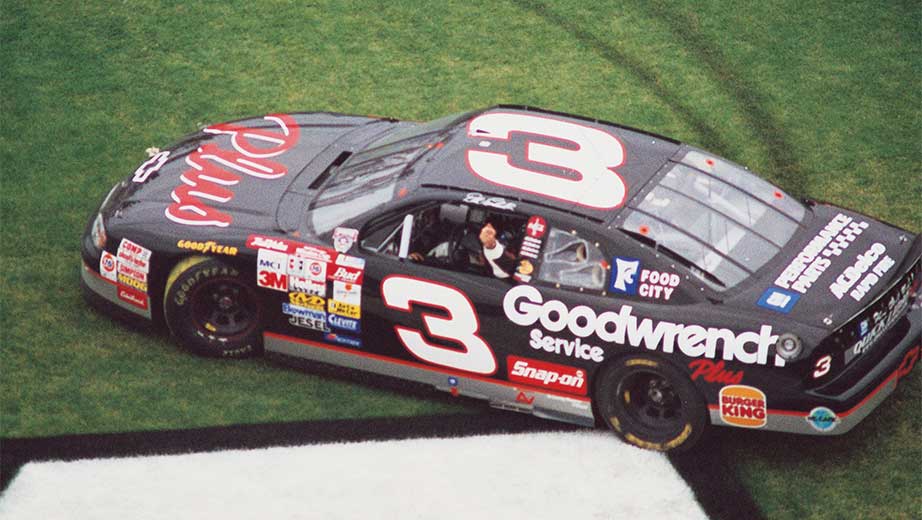
In addition to making NASCAR the season-long theme, I’m also providing a peek behind the curtain as to why I have developed a curious fascination with NASCAR. In revealing so, I’m also going to take a multi-part look back at NASCAR history, trying to both educate you all on a sport you may not be familiar with and share some genuinely incredible sports stories. For example: arguably the most celebrated result in NASCAR history.
Whenever someone says they enjoy NASCAR or they find it exciting, the stereotypical response they receive goes along the lines of this: “Why? All they do is turn left.” On paper, it’s a legitimate question. After all, compared to the twists, turns, and other complexities of a Formula One or IndyCar course for example, the vast majority of NASCAR courses (35 of 39 events this year alone) are ovals, which also somehow have corners. While those ovals vary in shape and size, to the untrained eye it does seem a lot easier to simply keep turning left (a tradition dating back to NASCAR’s bootlegging past) than to negotiate different styles of turns. But the reality is much more complicated than that. While there are far more in-depth dives and knowledgeable sources out there, below is a basic breakdown.
First, while ovals may be easier to draw on paper, it doesn’t mean they’re easier to navigate. While trying to navigate a F1 or IndyCar course can be tricky, at some point you know which turns to take next, when to brace for certain turns, and when you can relax on straightaways. But with ovals mostly being one big curve, you have to constantly be turning the wheel, adjusting the car and your body to what’s going on. No course is perfectly circular either, meaning you still have to go through certain parts of the track differently than others. Then, of course, there are different cars. F1 or IndyCar vehicles are designed to be as quick, nimble, and aerodynamic as possible. NASCAR vehicles are not. While engineers do what they can, they’re still large blocks of metal compared to F1 or IndyCar rides, making them much more difficult to maneuver. Also, while F1 and IndyCars can hit a top speed of around 230 mph, they’re rarely hitting that mark. NASCAR vehicles are constantly on the throttle at up to 200 mph, as the tracks (especially superspeedways) are designed in a way where you don’t have to hit the brake unless you’re trying to pit or avoid an accident. All of this, in a car that weighs about twice as much (3,200ish lbs. to 1,700ish lbs.). Oh, and F1 races generally cover about 190 miles and last about 90 minutes to two hours. NASCAR races on the other hand cover as much as 500 miles and last over four hours. To boil it down to a simple point, each kind of racing is governed by different kinds of racing science and strategy; F1 and IndyCar are about agility and efficiency, while NASCAR is about power and endurance.
There’s another key aspect of NASCAR that’s much different than that of F1 or IndyCar. To explain, we have to go back. Through the 1970’s and 80’s, NASCAR had been getting faster, surpassing the 200 mph barrier. Then, Bill Elliott — one of the fastest drivers in history who once came back from being two laps down under green to win a race — set an all-time NASCAR record with a 212.809 mph qualifying lap ahead of the 1987 Winston 500 at Talladega. But as NASCAR kept getting faster, it started to lose control. Drivers had unintentionally gotten closer and closer to the edge of physics — these large cars weren’t meant to go that fast. Elliott’s qualifying lap was just three mph slower than pole sitter Mario Andretti’s qualifying speed for that year’s Indianapolis 500. Turns out, when NASCAR vehicles lose control at those kinds of speeds, air gets under them and they go flying, resulting in terrifying crashes.
Things finally came to a head in the same race where Elliott set that record speed. Bobby Allison blew his engine on lap 21 while traveling around 210 mph. Pieces of the engine cut his right rear tire, sending the car backwards and airborne. As the car sailed upward, it looked like it was about to head right into the stands, which were packed with spectators. It might’ve done just that had it not been for the catch fence, although the impact of the car hitting the fence sent pieces of metal spinning everywhere. A section of the wall about 100 feet long was completely torn apart, with Allison’s car going back on the track and collecting other cars. Fortunately, Allison would be okay and only four spectators were injured. But the violent nature of Allison’s crash and the idea of just how badly it could’ve ended (bringing up memories of the 1955 Le Mans disaster) forced NASCAR to do something to try to prevent these kinds of potential disasters. The solution they came up with changed stock car racing forever, for better or worse.
In 1988, NASCAR mandated the use of an item called a restrictor plate to be installed on all engines for cars racing at Daytona and Talladega. Restrictor plates — a thin square metal plate with four small holes in the middle — are installed at the intake of the engine to limit the amount of air that can pass through. They effectively limit how fast cars can go — roughly 190-200 mph. While instances of drivers going airborne during crashes still happen to this day, the odds of it happening are dramatically cut down and the severity is often reduced. However, the introduction of restrictor plates had a major side effect: it changed how NASCAR drivers race at superspeedways. Without the ability of a driver to pull away from the field on speed alone, cars group together in large packs, with fields often smushed together so much that first and 30th could be separated by just two seconds. With the cars packed so close together — sometimes going three or four-wide at certain points — NASCAR races look and operate much differently than others. But this also means effectively trading one problem for another.
NASCAR vehicles are large, designed to take punishment, and hard to control at those speeds and turns. Putting them close together for so long means that inevitably there will be a wreck, which could be sparked by a simple mistake by a driver who didn’t know better. While restrictor plate racing at superspeedways may have reduced the risk of a dangerous crash due to speed, it also increased the risk of a dangerous crash due to proximity. Most of the time, races at Daytona and Talladega will see at least one major wreck, colloquially referred to as “the Big One,” that ends up wiping a majority of the field due to the cars being so close together. There are two ways this kind of racing has been received. The first, shared by a lot of fans, is that the close-knit, bumping, packed nature of these races creates excitement and drama only seen in NASCAR. The other, shared by a lot of drivers, is that it’s reckless (heh) and stupid, providing low brow entertainment at the drivers’ expense. That — combined with other techniques such as bumping-and-running and drafting that some driving purists despise — has created a lot of detractors over the years. But there is one driver who may have hated restrictor plate racing more than any other. He also happens to be the greatest restrictor plate racer of all-time.
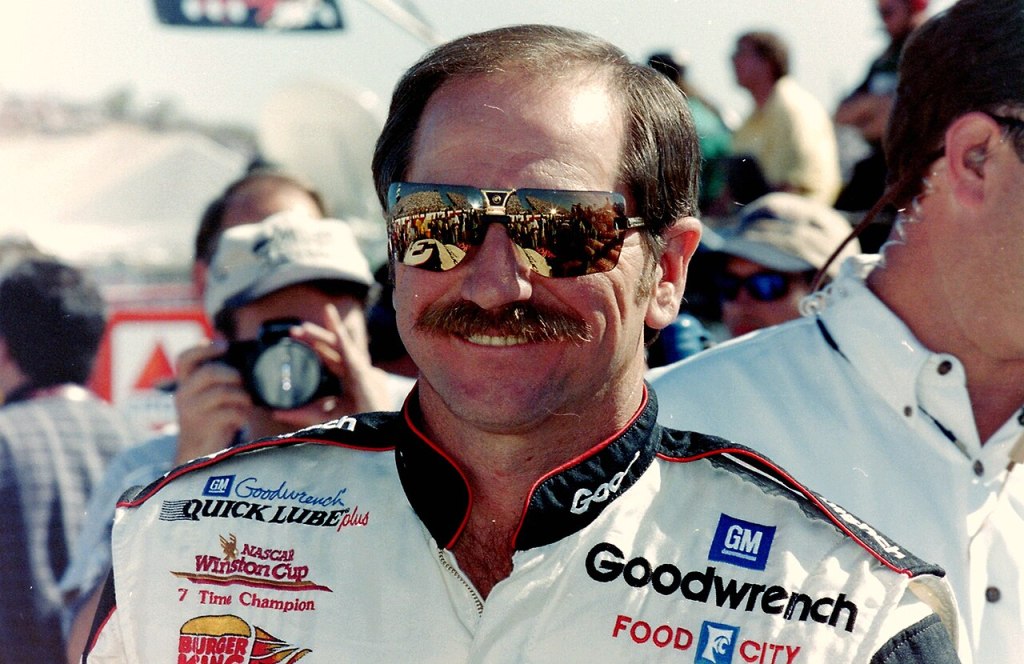
Dale Earnhardt once said, “I hate restrictor plate races. All of ’em. None of ’em are good.” That quote had followed others in which he called restrictor plate races he had been involved in “boring” and not “real racing” and that it was for “pansies.” That quote also came after he had just won the 2000 Winston 500 at Talladega, which saw Earnhardt rise from 18th place to first with just five laps remaining in one of the greatest performances of his or any career. He believed that drivers who liked restrictor plate racing used it as a crutch, weren’t worried about safety, and weren’t even real racers. Yet, Earnhardt famously used tactics like the bump-and-run to move opponents out of his way, racing with an almost ruthless determination, one which earned him the nickname “The Intimidator.” Another nickname he earned (but was probably less happy about) was “Mr. Restrictor Plate” on account of his dominance on superspeedways, where it was said he could literally see the air flowing off cars while drafting, knowing exactly when to time his passes and moves.
From 1990-2000, Earnhardt competed in 62 Cup Series races at restrictor plate tracks. He won 24 of them and finished in the Top 5 47 times, meaning he was statistically more likely to win than finish sixth or worse. In his career, Earnhardt won ten races at Talladega — including that late rally in 2000 — more than any other driver in history. But it was his mastery over Daytona that truly stands out. All told, Earnhardt won 34 NASCAR races at Daytona International Speedway, by far the most of any driver ever. That includes two victories at the Coke Zero 400 (the Daytona summer race formerly known as the Pepsi 400), a record six triumphs at the Cook Out Clash (an annual preseason race formerly held at Daytona), and a whopping 12 wins at the Duel at Daytona (a series of two races meant to determine the running order at the Daytona 500 each year). The latter total is double the amount won by the second-most successful driver there and includes ten consecutive victories from 1990-99. Earnhardt was easily the most successful driver at Daytona, which makes the crux of this story all the more incredible.
As mentioned in the first entry, the Daytona 500 is the most prestigious and important race in stock car racing, and a victory is a major highlight for a driver’s career. For drivers who never win or have yet to win a Cup Series championship, they can at least say they’ve won the Daytona 500. Even for drivers who have won a title, their career doesn’t feel complete until they’ve also won the Great American Race. Take for example Darrell Waltrip, one of the greatest drivers in NASCAR history. By 1989, Waltrip had three Cup Series titles to his name, a record four victories in another “Crown Jewel” NASCAR race known as the Coca-Cola 600 (and would add a fifth later that year), and had won the first ever All-Star Race in 1985. But he had yet to win the Daytona 500. That changed when Waltrip finally took home the checkered flag at the 1989 Daytona 500. Just listen to his post-race interview and realize what that win meant to a driver who had already accomplished so much. Indeed, almost all of the great NASCAR champions of the past — Waltrip, Allison, Elliott, Yarborough, Richard and Lee Petty, Dale Jarrett, Jeff Gordon, and others we have yet to introduce — have also won the Daytona 500.
Then, there’s Earnhardt. Even if you remove all of his amazing accomplishments and statistics when it comes to superspeedways, Earnhardt would still be a consensus Top 5 NASCAR driver of all-time, if not No. 1. His seven Cup Series titles (which include a record three instances of going back-to-back) are tied for the most in NASCAR history. By the time he won his seventh and final title in 1994, Earnhardt had also recorded wins in three of the four Crown Jewel races at the time — the Coca-Cola 600 (three times), Winston 500 (twice — with two more coming in 1999 and 2000), and the Southern 500 (three times) — and had won the All-Star Race three times. A year later, Earnhardt would add a victory in the second ever Brickyard 500 (which has since replaced the Winston 500 as a Crown Jewel race). Everything there was to win in NASCAR had been won by Earnhardt, most of them multiple times over. Everything, that is, except the fourth and final Crown Jewel: the Daytona 500.
It just didn’t make sense. Earnhardt was arguably the greatest stock car driver of all-time and had won virtually everything the sport had to offer. He was also arguably the greatest restrictor plate racer ever. He was also by far the most successful driver at races held at the Daytona International Speedway. Yet somehow, some way, one of the most accomplished and dominant drivers in NASCAR history and the best and most successful driver at the style of racing that takes plane at the track he has the most wins at could not buy a win at one specific (and incredibly important) race at that same track in that same kind of race in that same series. He could not win the Daytona 500 despite being in the midst of a ten-race winning streak at an event happening days before on the same track. It almost defied belief, and for some that empty space on his trophy cabinet became the one reason Earnhardt’s detractors could point to in their case against him being the GOAT.
It wasn’t even just that Earnhardt couldn’t win the Daytona 500. It was that even when he wasn’t caught up in a crash or hampered by mechanical problems, Earnhardt was the victim of seemingly otherworldly bad luck or unfortunate circumstances. It was like the Boston Red Sox before 2004 — falling just short of the ultimate goal in weird, almost inexplicable ways. For 20 years, Earnhardt tried and tried and tried again and again and again to take the checkered flag at the Great American Race, being denied again and again and again. This battle between driver and track, which has come to be known as “Dale vs. Daytona,” has gone down in NASCAR history for its length, incredible moments, and the unforgettable way it ended.
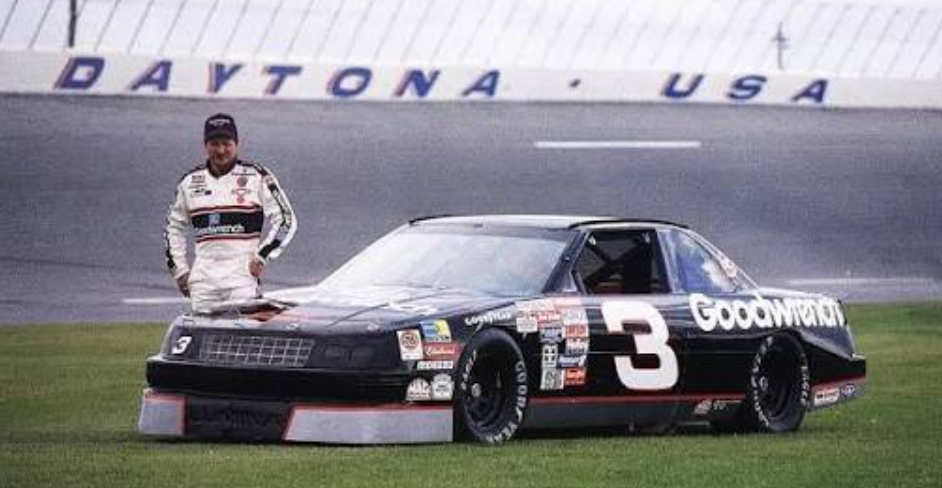
Earnhardt’s first attempt would come during his rookie year of 1979, back when no one knew who he was. He would manage to lead ten laps — a development that was so shocking to the broadcast booth that they initially believed he was a lap down when he first appeared at the head of the field. He finished a respectable eighth place in a race best known for Yarborough and Donnie Allison’s famous crash on the backstretch and subsequent brawl in the infield. The following year, Buddy Baker — who had won the pole in 1979 but dropped out mid-race due to ignition trouble — redeemed himself by winning the 1980 edition of the race in his famed “Gray Ghost.” It was Baker’s first win in 18 starts at the Daytona 500 — a record at the time. Naturally, Earnhardt was running second late when his team accidentally left a lug nut off one of his tires during a pit stop. He was forced to pit again and finished a lap down in fourth place. Earnhardt and his team would rebound, winning five races en route to his first Cup Series title, becoming the first and only NASCAR Rookie of the Year to win the championship in his sophomore year.
Another Top 5 finish at Daytona would follow in 1981, but troubles began soon after. Earnhardt’s team, Osterlund Racing, was sold to Jim Stacy. He and Earnhardt didn’t vibe at all, so the driver jumped ship to Richard Childress racing for the rest of the year. Earnhardt would spend the next two years with Bud Moore Engineering, where despite earning several wins he would have the worst point finishes of his career to that point. He would also finish outside of the Top 30 in both the 1982-83 Daytona 500s due to blown engines. In 1984, Earnhardt returned to Richard Childress Racing to drive the No. 3 Chevrolet, a ride he would remain in for the rest of his career. 1984 would also see his best finish in the Daytona 500 so far — runner-up to Yarborough. But while 1985 would see another blown engine end his Daytona 500 changes, 1986 would prove to be a landmark year, and see his best shot yet at the Great American Race.
Late in the 1986 Daytona 500, Earnhardt used an excellent pit stop to put him in second place, right behind Geoff Bodine. For the next 30 laps, Earnhardy reeled Bodine in and rode his back bumper, waiting for the perfect moment to pounce and go for the pass. With just three laps left, Earnhardt seemed ready to make his move. But then, he ran out of gas. Desperate to salvage his change, Earnhardt went to refuel, but overshot his pit box. Then, in his haste to get back on the track, he blew his engine, resulting in a disappointing 14th place finish as Bodine hung on for the win. Although Earnhardt would rebound to win his second championship, the loss at Daytona still stung. Little did he know, it would get much, much more painful.
The next three Daytona 500s — 1987-89 — saw finishes of fifth, tenth, and third. However, he wasn’t really in contention, leading just 21 of a combined 600 laps in those races. That would not be the case in 1990, as after finishing second in qualifying (and the pole sitter, Ken Schrader, dropping out early with engine trouble), Earnhard’s No. 3 is the car to beat. He led 155 of the 200 laps and seemed all but certain to finally take the crown. As the field approached the final two turns, Earnhardt was out in front, with only Derrike Cope — a driver without a win (or even a Top 5) in his career to that point — close to him in second. As they entered turn 3, Earnhardt ran over a piece of debris left over from Rick Wilson’s recently blown engine, shredding his right rear tire. Earnhardt had no choice but to pull up, allowing Cope and three other drivers to pass him. A shocked audience and broadcast crew watched as an even more shocked Cope took home just the first of what would be just two total wins for his whole career in the Daytona 500, while Earnhardt limped across the finish line in fifth.
Early in 1991, Earnhardt’s car struck (of all things) a seagull, which damaged a cooling vent and forced him to spend the rest of the race battling overheating issues. But he still managed to once again lead the Daytona 500 with less than ten laps to go. However, Earnhardt was passed by Ernie Irvan, and then tangled with Davey Allison, causing both of them to spin out. Earnhardt was also hit by Kyle Petty but managed to finish fifth as Irvan hung on for the win. After Davey Allison got his revenge by winning the following year (which saw Earnhardt finish ninth), Earnhardt was once again among the contenders in 1993, leading the majority of the laps of the Great American Race. Indeed, a Dale would end up winning the race — Dale Jarrett, that is. Jarrett passed Earnhardt and managed to hold him to the runner-up position. Some angry fans believed Jarrett’s father, NASCAR great Ned Jarrett, who was calling the race for CBS, had a radio to his son’s crew and was feeding them information from the booth. Of course, such accusations were ridiculous. But could you blame Earnhardt fans at that point?
After a seventh place finish in 1994, Earnhardt used strategy and timing to stay alive in a wreck-filled and rain-delayed 1995 Daytona 500. During a caution with 15 laps ago, Earnhardt pitted for four fresh tires despite more than 20 cars being on the lead lap. The green flag flew with ten to go and six laps later, Earnhardt was in second, with only Sterling Marlin to beat. However, he simply ran out of time, as Marlin — the 1994 winner (his first Cup Series win) — held on to join a rare club of back-to-back Daytona 500 winners. Another two-time winner would be crowned in 1996, as Jarrett would once again edge Earnhardt in a 1-2 Dale finish. For those keeping track, Earnhardt had just completed a stretch of ten Daytona 500s in a row finishing in the Top 10, which included seven Top 5s, three runner-ups, and an average finish of fifth. The now seven-time champion averaged a Top 5 finish for a decade and yet still couldn’t get the elusive win.
The 1997 Daytona 500 would see the end of that streak. With just over ten laps to go, while battling for the lead, Earnhardt got a bit loose and then tangled up with Jarrett. The impact sent his car spinning and flipping into the wall, and while Earnhardt was physically fine, the No. 3 car was wrecked, as were his chances of victory. This race had been Earnhardt’s 19th attempt at the Daytona 500 — one more than Baker had needed to finally win it for the first time all those years ago. To add insult to injury, it would be the 25-year-old Gordon taking the checkered flag in 1997 to become the youngest ever Daytona 500 winner. But in the aftermath of the wreck, Earnhardt climbed out of the ambulance and asked if his engine would turn over. It did, so Earnhardt ordered his crew to repair it and get him back on the track. While there was no chance for a win or even a good finish (he ended up 31st), Earnhardt was simply determined to not give up in the face of yet another setback. He wanted to show he wasn’t done just yet.
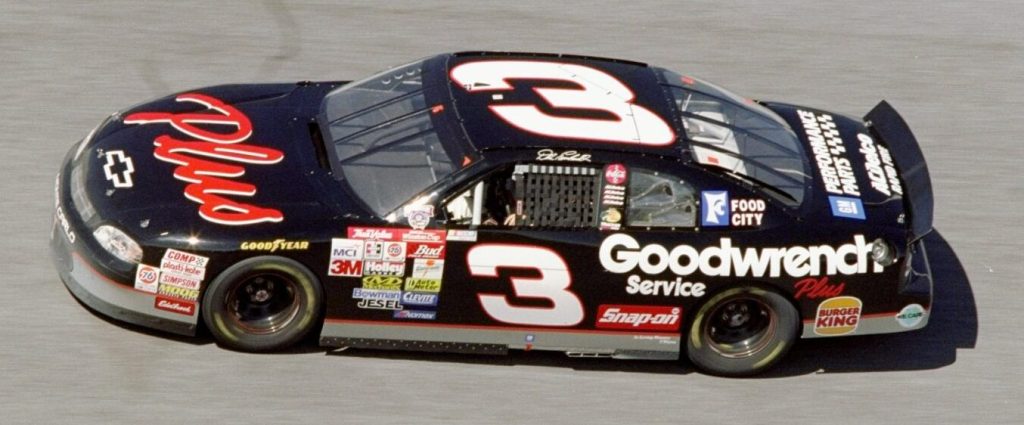
The 1998 Winston Cup Series would be the 50th season in NASCAR history, and there was plenty of pomp and circumstance to mark the occasion. Several pre-race events honored drivers and moments of the past, and there was plenty of buildup to the first points race of the year: the Daytona 500. In the lead up, Earnhardt was also doing something special: meeting with Make-A-Wish children, with the organization being one close to his heart. One of the children he met with was Wessa Miller, a six-year-old girl with a severe case of spina bifida whose favorite driver was Earnhardt. The two talked for nearly 15 minutes and before Earnhardt left to go back to the garage, Wessa handed him a penny. Confused, Earnhardt asked her why she had given him the penny. She responded, “That’s for you, to win the Daytona 500.” After saying goodbye to Wessa and her family, Earnhardt marched back into the garage and glued Wessa’s penny onto the No. 3 car’s dashboard.
For a race that has gone down in history, the 1998 Daytona 500 was fairly drama-free. The first 125 laps of the 200-lap race were run under the green flag. In total, there were only three cautions — all of which were for minor incidents. It would end up being the second-fastest Daytona 500 ever, behind 1980 — when Earnhardt finished runner-up to Baker. Perhaps that was a sign that there was less of the usual tomfoolery and Earnhardt for once was catching a few breaks. Once again, Earnhardt led the most laps on the day and as he race wound down, was in the lead once more. Fans began to believe for the first time, things may actually be different. With just two laps to go, Earnhardt was still in front, followed closely by Bobby Labonte and Jeremy Mayfield. As the leaders entered turn two, the drama finally arrived — Lake Speed and John Andretti got together and spun out, causing a caution flag to come out.
Today, NASCAR does not allow for a race to end under caution — only under a checkered flag or stoppage due to weather. For the former, if a caution flag comes out on the final few laps, then they would keep going into “overtime,” restarting the race with two laps remaining in a “green-white-checkered” situation. If there’s a wreck before the second lap, they’ll do it again until they get a green-white-checkered finish. But back in 1998, NASCAR’s rules were firm about ending the race at the advertised distance, even if under caution. So when the yellow flag waved with less than two laps to go, the 1998 Daytona 500 came down to whoever could make it back to the finish line — once across, drivers’ positions would be set in stone. Whichever one of Earnhardt, Labonte, or Mayfield crossed the line first would win the race.
As the three sped to the finish, an obstacle came into view: the lapped car of Rick Mast. While in other years Earnhardt might’ve run into Mast or something else to ruin his hopes of winning, this time was different. Earnhardt easily passed Mast, whose presence helped him fend off Labonte and Mayfield. As they came around the final turn, the No. 3 car was the first to make it across the finish line, freezing his position in the lead. As spectators started going ballistic, Earnhardt’s crew chief, Larry McReynolds, was one of the few not celebrating. Technically, Earnhardt had one more lap to go. All he had to do was keep caution pace and make it around the oval one more time, but McReynolds wasn’t going to stop sweating until it actually happened. Sure enough, it became apparent that Earnhardt wasn’t going to run out of fuel or run over debris or blow an engine or wreck out or hit a seagull or something. As the noise of the crowd surpassed that of the engines, Earnhardt indeed came around one final time, and as the No. 3 car took the checkered flag (with Earnhardt raising his fist out of his window in triumph), the call of Mike Joy (who had replaced Ken Squier [and for some arguably surpassed him] as the voice of NASCAR on broadcast) the lap before went into history.
“20 years of trying. 20 years of frustration. Dale Earnhardt will come to the caution flag to win the Daytona 500!”
NASCAR fans at Daytona and watching on TV around the world went absolutely wild celebrating a moment two decades in the making, and they weren’t the only happy ones. In a move never seen before or since, as Earnhardt pulled onto pit road to head to victory lane, every member of every pit crew came out and formed one long line. Earnhardt drove past each of them as they all leaned down to his window to congratulate him on his victory. The gesture wasn’t only special because it was all teams uniting to honor one driver. Being The Intimidator doesn’t lend itself to a lot of friendships, and Earnhardt certainly had his fair share of rivals on the track. But while some drivers may have disliked or even hated him, every one of them had immense respect for him and knew he more than deserved this long-awaited triumph.
Before heading to victory lane, Earnhardt let off some steam and celebrated his win by doing a burnout in the infield grass — right next to and on the Daytona 500 logo. While burnouts had been done before after some races, this was by far the most notable instance of it happening. Since then, post-victory burnouts — in the infield or more often on the track near the finish line — have become a common celebration in NASCAR, especially after the Daytona 500. Upon finally entering victory lane, Earnhardt climbed out of his car and stood on top of it in a more traditional post-race celebration. As Squier — now doing some sideline reporting — spoke to Earnhardt once he climbed down, several people — including McReynolds, members of his team, and even other drivers — came up to hug and congratulate him. During the post-race interview, Earnhardt thanked everyone for their support and dedicated his win to Neil Bonnett, a close friend and former driver who had died during practice for the 1994 Daytona 500. As he spoke to Squier about what the victory meant for him, Earnhardt uttered another now-famous line.
“The Daytona 500 is ours. We’ve won it. We’ve won it. We’ve won it.”
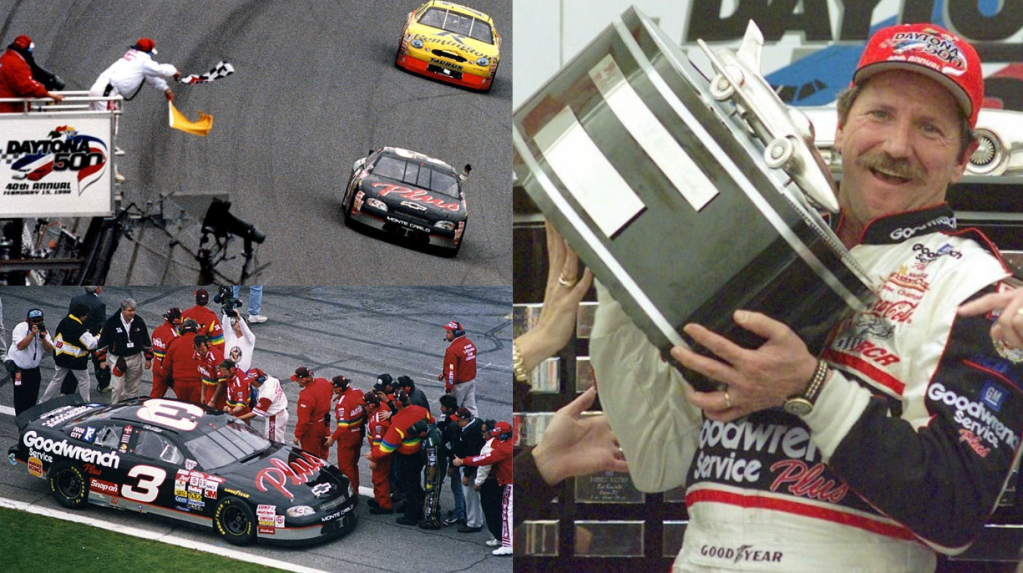
Now, as memorable as Earnhardt’s Daytona 500 was, in the grand scheme of things it was merely the first race of the 1998 Cup Series. Had the rest of the season been ordinary or fairly unremarkable, it would just be a footnote to what happened at Daytona. But Earnhardt’s victory is one of two things fans think about when they think of 1998. The other: dominance. Not from Earnhardt — the Daytona 500 would be his only victory of the season and he would finish eighth in the standings. Instead, a driver much more in the spotlight that year was Mark Martin, who Earnhardt had beaten for the 1990 and 1994 titles. Statistically and points-wise, 1998 was Martin’s best season, talling seven wins, 22 Top 5s, and 26 Top 10s, including a 14-race stretch where his lowest finish was seventh. Martin’s final total of 4,964 points was a reflection of his outstanding season and would’ve been enough to win all but one of the Cup Series seasons that had come before (since the Bob Latford points system was introduced in 1975). Instead, Martin finished second — by nearly 400 points.
What Gordon did in 1998 could only be described as one of the best and most dominant seasons in NASCAR history. Across 33 races that season, Gordon won a whopping 13 of them (or 39% — both modern era NASCAR records) while collecting 26 Top 5s and 28 Top 10s for a jaw-dropping average finish of 5.7 and an astounding 5,328 total points. While Martin’s 14-race stretch of finishing no worse than seventh was fantastic, Gordon had an even greater run. Following the 1998 Pontiac Excitement 400, in which he was taken out by Rusty Wallace with 29 laps to go and finished 37th, Gordon did not finish outside of the Top 7 for the rest of the year — a run of 20 races that lasted from June 14 to November 8. During that stretch, Gordon had ten wins (including a four-race winning streak), meaning over nearly five months, he was just as likely to win as the rest of the field and just as likely to finish in the Top 2 as he was to finish third through seventh. These were video game numbers for the time and on par with the much more packed schedules of the 1960’s and 1970’s. Gordon also did this against a pool of drivers that included Earnhardt, Martin, Jarrett, Terry and Bobby Labonte, Jeff Burton, Rusty Wallace, and more. While definitely not the focus of this entry, Gordon’s 1998 season, which brought him his third championship, was simply too great to not be at least mentioned.
Although Gordon’s 1998 season as a whole has gone down in the record books, by far the most memorable individual race that year was the first one — Earnhardt’s first Daytona 500 win. It was a story that took two decades to tell, developing as the Kannapolis, North Carolina native quickly rose to the highs of NASCAR Rookie of the Year and Cup Series champion, battled adversity within his team and performance, found his home and became one of the greatest drivers of all-time (while transforming his ride into one of the most iconic cars ever), and finally morphed into a legend of auto racing. In spite of the controversial nature of his racing, the many enemies he made out on the track, and his complicated relationship with restrictor plate racing, Earnhardt had earned the respect and admiration of everyone due to his skill, toughness, and determination. Towards the end of his quest for the Daytona 500 crown, for fans of other drivers, if their guy couldn’t win it, they were rooting for Earnhardt to win it instead.
So it came to pass on that day in 1998, Earnhardt finally slayed the last dragon of NASCAR, sparked arguably the most universally happy reaction to a race in history, and emerged victorious from his battle with Daytona at long last. But as the No. 3 crew led celebrations throughout the stock car racing world, no one could have fathomed that just three years later, this same driver and same track and same race would be involved in a much different moment in NASCAR history. Three years later, one of the sport’s brightest days would be followed by one of its darkest. As it turned out, the battle of Dale vs. Daytona was not quite over just yet. Daytona would strike one more time, and the blow it landed would change NASCAR forever.
THIS WEEK’S MATCHUPS
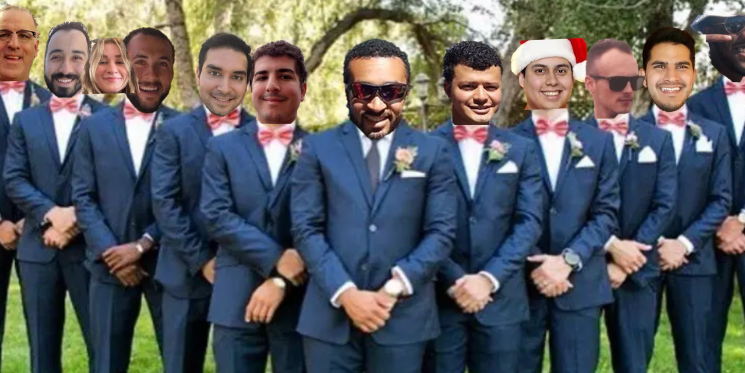
CHEST IN MY HOLE (3-4) VS. FLOCK AROUND AND FIND OUT (4-3)
While he may still be in the literal honeymoon phase of his marriage, Chriss may now get a lesson in how to avenge one’s wife. One week after taking down the fairer half of the Ewing clan, Chest in my Hole now faces the other side in Flock Around and Find Out. Ewing has the potential to do just that to Chriss, though he’s missing a solid chunk of his lineup this week. But, given how those players performed last week, it might end up being a net positive. Chriss is taking a bit of a gamble in a few spots, though maybe he’s feeling more up for it lately.
BIG BEEFY BOY BATTALION (6-1) VS. BIJAN MUSTARD (3-4)
Two teams who earned victories by the narrowest of margins last week will try to keep their luck going against each other this week. Big Beefy Boy Battalion will be relying on Drake Maye and the Patriots defense to keep the Dolphins down, while Kyle will also hope for better days from Kenneth Walker and a (potentially) returning DeVonta Smith. Bijan Mustard is hoping for the Bears-Seahawks game to be a barnburner, while Puka Nacua and Kyren Williams go off and Sam LaPorta returns to form. Someone’s luck has to change this week — who will it be?
FOOTBALLDAMUS (6-1) VS. THE INJURED RESERVES (4-3)
Like everyone predicted, Footballdamus is tied for the best record in the league at the halfway point. Can Riaz keep it up, or will a regression to the norm begin? Going up against a strong opponent would lean towards the latter, and unfortunately for Riaz, the Injured Reserves are getting Trevor Lawrence, James Cook, Omarion Hampton, and more back. Arik looks to be keeping in some guys who helped him out last week as well. Will Dak Prescott, Jahmyr Gibbs, and Bucky Irving be enough to stem the tide, or will Arik take down Riaz and defy the odds?
CAN YOU HEAR THE DRUMS? (4-3) VS. MOM AGAINST THE MACHINE (3-4)
Goddamn it, this is totally set up, isn’t it? One week after scoring the fewest points (and having me choose her drink), Mom Against the Machine is now facing Can You Hear The Drums? Oh, and Josh Allen is coming back from a bye week. Sure seems likely that Allen is going to drop like 60 points and Aly will have the game of her life against me. Because that’s what happens with everyone who I play this year. My roster looks set to score a lot of points, which it’ll have to do in order to have a chance of winning. Because I’m cursed or something this season.
CABOMETYX (4-3) VS. SPIDER 2 Y BANANA (1-6)
What in the world has happened to Spider 2 Y Banana this season? One year after winning the title, Jimmy is threatening to go from first to worst. The likes of Byrce Young, Chase Brown, Christian Watson, and Coleston Loveland have been inconsistent, and Jimmy has paid the price for it. He needs to start winning, but faces a tough foe in Cabometyx. Dad has plenty of big scorers, but choosing the right ones (Jared Goff/Pat Mahomes for example) may be the key to victory. A win is something Jimmy needs, especially given the final matchup of the week.
SUBSTATION TRUTHER (2-5) VS. THE KRISPY KRITTERS (2-5)
Both Substation Truther and the Krispy Kritters have been two of the more disappointing teams this season, sitting with just two wins apiece. To be fair, Richard has gotten a bit unluckier than Nick, whose lineup just straight up isn’t scoring. However, Nick did manage to beat Jimmy earlier this season, and he can take another step towards not finishing last by taking Richard down. Richard seemingly doesn’t need the win as badly, though one would also do his odds good. Either way, the winner could be two games ahead of last place at the end of the week.
ONE LAST THING
WARNING: this is a new contender for dumbest section in newsletter history.
Three weeks ago today, this tweet dropped on the timeline, and things haven’t been the same since for millennials. If you haven’t seen it yet or just don’t want to click the link, the post’s author put together a starting football offense and defense composed entirely of Generation 1 pokemon. As you can imagine, that kicked off a firestorm of responses, with people posting their own lineups, discussing which pokemon would be the best, and expanding the idea to include pokemon from all regions/generations. Hell, someone even made a website for you to build your own team at random. That then evolved (heh) to the point where people can custom build teams, have fantasy drafts, and even play against other teams. This is, to put it mildly, fucking insane. We were not exempted from this pokemon football firestorm, as Nick, Jimmy, and I had a spirited discussion about what pokemon we would use.
You can guess where this is going.
I’ve put together two teams: one of just the 151 Kanto pokemon (because that’s the generation we know and care about the most) and another of all pokemon. However, when I say all pokemon, I have some ground rules. First and foremost: no legendary, mythical, special, paradox pokemon, or mega evolutions. Essentially, no pokemon whose powers can basically break reality. This was kind of an accepted rule for pretty much everyone online as well. For Gen. 1, this means no Mew, Mewtwo, Articuno, Zapdos, or Moltres. I will, however, be using powerhouse/pseudo-legendary pokemon and ultra beasts.
Second off, there are certain types and abilities I need to account for both based on how they’d break how football functions and how they’d perform on a football field. When it comes to the latter, being on dry grass/turf the entire time essentially eliminates most water types and makes things difficult for most ice types. So, that will be reflected in my roster. Another type that needs discussion is ground type, specifically the pokemon who can use the move Dig. You’d think this would give them an advantage by being able to literally go underground and burrow beneath the defense and into the end zone. However, I’d have to imagine that the ball carrier would be ruled down by not only hitting the turf, but digging beneath it. So, that impacted my choices for offense (but not defense). Another type that could break how football is played is flying type, with being able to soar above the defense a benefit. As long as these pokemon don’t go out of bounds and are physically touching the end zone when scoring a TD, I will allow it. Also, with psychic types, they may be incredibly fast, but they also just use Telekinesis to move things. So much controversy in modern football has come down to possession of the ball, and I don’t want the referees to consider that when ruling it not a catch or whether my pokemon fumbled or was in the process of throwing the ball when it was hit. That’s why Alakazam is not my QB, like I have seen on so many rosters.
Finally, specific type matchups/move abilities did not play a large role in my decisions, largely because they would be too complicated to implement and I don’t know nearly enough to put those abilities to good use. Also at that point we’d just basically be playing Pokemon, not football. To that end, I largely considered the physical attributes for each pokemon and how they would translate to football, with types and abilities enhancing those attributes. For example, I favored pokemon with appendages, particularly arms. Being big and strong is one thing, but those attributes aren’t enough when you don’t have a spare limb to grab the football or swat away a pass. Also, wings may be nice to soar over the defense, but only having talons would make catching passes difficult. Sure, these pokemon could just bite down on the ball or something, but that’s just disgusting and there are enough attributes to various pokemon saliva that would make it even more so, or even damage the football itself.
Anyway, without further ado, here is my all-Kanto all-22 roster.
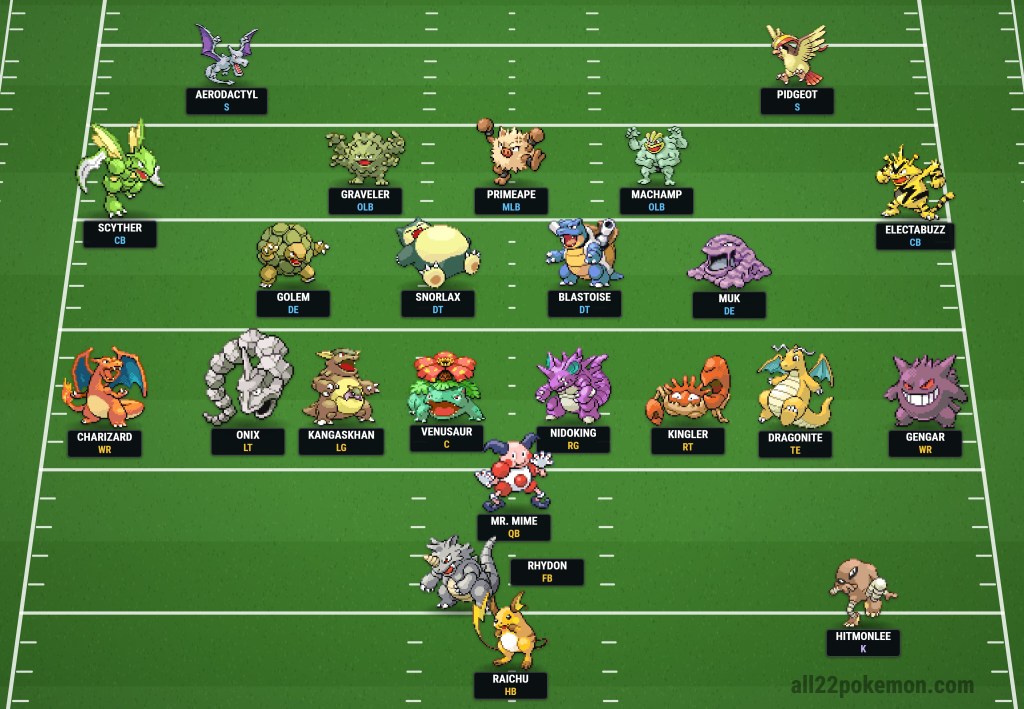
The first question you all might have is at QB, where the vast majority of others have gone with Alakazam. I have not, for multiple reasons. While Alakazam is quite quick, I’m not sure its skills translate to football well. In addition to the whole psychic type possession element I mentioned earlier, it’s holding a spoon in each hand. How can Alakazam hold a football if it’s holding those spoons? Have you ever even seen Alakazam not hold spoons? I want my QB to actually hold the ball, as well as throw it. In addition, you need elbows and fingers, which Mr. Mime has. But Mr. Mime also has another ability: it can put up invisible barriers using his pantomime motions. If it does that to its left, right, and back pre-snap, it has a wall around itself, which blocks defenders even if they manage to get past the offensive line. But even if that does happen and it has to move, Mr. Mime is both a psychic and fairy type. Could you even imagine the shenanigans Mr. Mime could pull while scrambling? Mr. Mime would make Patrick Mahomes look like Drew Bledsoe. For all of these reasons, I’m putting Mr. Mime under center.
Speaking of the center position, for as much as I’d want to stack the offensive line with as many huge bodies as possible, we have to actually snap the ball, and many of these bodies are unable to do so. But then I thought of Venusaur, whose vines can wrap around and snap the ball, then snap back up and help it block opposing pass rushers. Venusaur is also massive, making it ideal for the line. On either side of Venusaur are two simply big and powerful pokemon who would be good at most offensive line positions. Regardless, I’ve got Kangaskhan at LG and Nidoking at RG. Next to Nidoking on the right side I have Kingler, who is not only huge with big strong claws to stop defenders in their tracks, but who (being a crab) also has incredible side-to-side movement, which you need for the RT position. But what if you were simply so large that you didn’t need to move at all? That’s where Onix comes in. Not only is it a Top 5 heavy Gen. I pokemon, but Onix is also 28 feet long (not tall, which gets around my height restriction). It could be an entire offensive line on its own, but I figured why not put Onix at LT, where its body could wrap back around and essentially form a full circle around the QB?
When it comes to the skill positions, we’ve got both thunder and lightning at RB. Ironically, Raichu has both thunder and lightning as moves/abilities, but I’ll be using its speed to make it the “lightning” of the duo. As for “thunder,” Rhydon is the power back here. Have you seen how terrifying a charging rhino is? Now imagine a giant one that also knows Thunder. If I want to throw the ball, I’m probably going to my WR 1: Charizard. Its wings give us an aerial threat, plus it actually has hands to catch a pass. Plus, it has both a big body and speed, making it a threat even not counting the whole fire lizard thing. Also, Charizard just makes sense for being a WR 1, given they’re generally divas, much like Ash’s Charizard. At WR 2 I have Gengar, who is not only also big and fast, but (being a ghost type) can phase through defenders. Just try to call pass interference on that, eh? To round out the offense, Dragonite slots in at TE. With its ability to fly, hands, size, speed, and strength, Dragonite was tailor-made to be a TE.
On defense, you’ll find the one pokemon guaranteed to be on every single roster: Snorlax. Weighing in at over 1,000 pounds, Snorlax is perfect to be the run-stopping DT. Next to it is Blastoise, a large and physical presence. But in addition to that, Blastoise also possesses giant water cannons protruding from its shoulders. Tell me those wouldn’t be perfect to shoot down pass attempts. On the edges, I’m going for a mix of strategies. On one side is Golem, the second-heaviest pokemon who can literally charge at the offensive line in the form of a ball. Imagine trying to block the giant boulder from the first Indiana Jones movie. On the other side, I’m going with Muk, which may seem like an odd choice. But think about it — imagine trying to block a giant wall of sludge. Not only would that be difficult from a practical standpoint, but the smell alone would either cause opposing linemen to faint or force them to cover their noses and mouths with their hands, which then couldn’t be used for blocking.
Moving back, I’m going for two simple strategies for the LBs: arms and anger. For the latter, Im’ simply using the tried and true plan of putting the angriest, craziest member of your team at MLB. In Gen. 1, that pokemon is Primeape, who would make any opposing RB’s life hell in the C Gap. On either side of Primeape are the two Gen 1 Pokemon with four arms: Graveler and Machamp. Not only are both big pokemon, but more arms means both better tackling and more limbs in the air to swat down passes. Looking at the secondary, speed is the name of the game. Scyther is a quick and agile pokemon with long knives on its arms to block balls from getting to opposing WRs. Meanwhile, Electabuzz is speedy as well and powerful enough to handle the larger offensive players. Plus, we have options for both air and ground coverage. For the safeties, I want as much speed and agility as possible to be able to cover anything that somehow gets by the rest of the defense. You pretty much can’t find any pokemon better at that than Aerodactyl and Pidgeot. Plus — both of them can fly. As for special teams, Hitmonlee is the natural choice for both K and P.
So, that’s my lineup. There are a couple of tough cuts, in addition to Alakazam. Nidoqueen just barely missed out on being on the offensive line, while Kabutops was narrowly edged out at CB. Machoke seems like the perfect plug-and-play pokemon, but honestly its stats just didn’t stack up to any of the starters. Poliwrath is kind of the same, to a lesser extent. Finally, I thought about figuring out how best to work Ditto into the lineup, given its ability to transform. I nearly put it at DT, with the idea to transform into a second Snorlax, or RT, as a second Onix. But in the end it was too complicated and I wanted some more variety.
Now, when it comes to the all-pokemon lineup, there are a few members of the all-Kanto squad that do make the cut. However, there’s something I need you all to be aware of. Comparative to other generations, Gen. 1 pokemon are mostly kind of small. There are a few exceptions — Snorlax for example. But that’s a big outlier, especially compared to some pokemon from future generations. Those newer generations really put the “monster” in pocket monster, and are the reason I put those height requirements in place. If they weren’t, some of these pokemon would simply break any attempt to play football. For example, I could just have my QB throw it to the 30-foot tall Celesteela every time, or throw out the 47-foot tall Wailord as my defensive line, or simply give the ball to the 65-foot tall Eternatus (or its 328-foot Eternamax form). So, while trying to keep things somewhat fair and resembling football, this is my all-pokemon lineup.
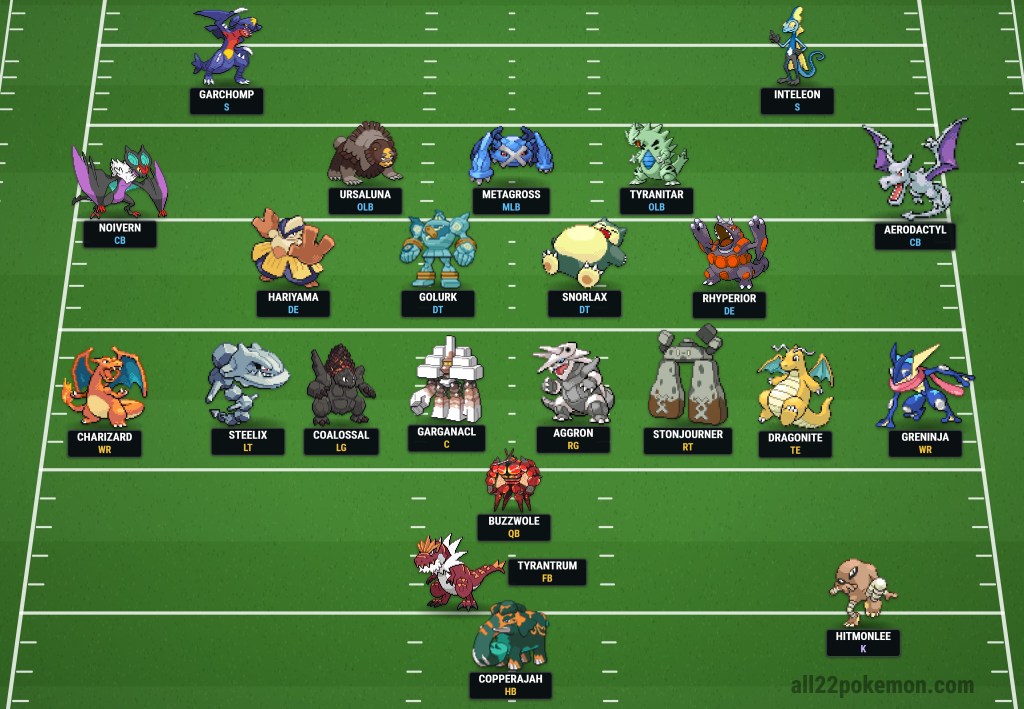
As expected, QB was a tough call, looking for a pokemon that can throw a football while being big and agile enough to deal with the quickest and strongest pokemon. Standing nearly eight feet tall and weighing 735 pounds (while being absolutely jacked), Buzzwole can throw the football, scramble with its four legs, fly if need be, and take (and deliver) a big hit. Think Ben Roethlisberger with Lamar Jackson’s speed and agility. When it comes to Buzzwole’s options, I’m keeping both Charizard at WR 1 for its overall physical skill set and Dragonite at TE because it’s the perfect TE. Joining Charizard on the WR corps is Greninja, an incredibly speedy and agile pokemon whose hands have suction cups so powerful they let it stick to walls. When it comes to the running game, I’m leaning fully into the power aspect. My “small” option is Tyrantrum, and if you can somehow stop the eight-foot tall, 595-pound T-Rex, you have to deal with my “large” option: the 9’10”, 1430-lbs. elephant known as Copperajah, whose trunk can easily hold onto a football. Good luck.
Given these are all some massive monsters, I was spoiled for choice when it came to my lines, which were the toughest positions to narrow down. Ultimately, I went with Garganacl at C, with its 7’7″, 529-point frame supported by a strong defensive rating and long hands/fingers, the latter of which make it physically able to snap the ball. To its left is Coalossal, whose nine-foot tall, 685-pound frame is a straight up obstacle. To its right is Aggron, which while “only” 6’11” weighs nearly 800 lbs. and has an incredible 180 defensive rating. At RT is Stonjourner, a surprisingly quick (for a lineman) stack of giant slabs standing eight feet tall and weighing over 1,100 lbs. I’m keeping the same strategy at LT, though I’m swapping Onix for its stronger, twice as heavy cousin Steelix. When it comes to the defense, Snorlax maintains its spot at DT, but its partner is pretty much its opposite physically. That would be Golurk, standing over nine feet tall and able to get its long arms and big hands up to deflect passes at the line of scrimmage. On one edge is Hariyama, who may seem a bit small but makes up for it by essentially being a sumo wrestler with massive hands (perfect for a defensive line). On the other edge is Rhyperior, who at 7’10”, 623-pound and with strong attack and defense was too good to leave out.
My choice of MLB may seem odd, given Metagross is only 5’3″ and only mildly fast. But, not only does it weigh over 1,200 lbs., but Metagross technically has four brains, which gives it the mental processing power of a supercomputer — perfect for the QB of the defense. To its right is Ursaluna: a nearly eight-foot tall, 640-pound bear. Enough said. To its left is Tyranitar, which may seem a bit “small” at 6’7″ and 445 lbs., but is so powerful that it can level mountains and cause earthquakes, and is basically unstoppable physically. In the secondary, we’re going for both speed and hands, with Aerodactyl moving to CB, being joined by Noivern. At S we have the speedy Inteleon, whose whole gimmick is that it’s a sniper which can take out targets from far away, with its water gun being a more refined version of Blastoise’s water cannons. Whatever Inteleon doesn’t catch will surely be met by its S partner Garchomp, which patrols the air with its ability to go as fast as a jet fighter and even reach sonic speeds. Of course, Hitmonlee retains its position as both P and K.
So, let me know what you think of my lineups, and what you would (wrongly) change to make your own lineups. We nearly held a contest during Chriss’ bachelor party, though everyone else bitched out. Maybe we can pick that up again now? Anyway, with there being more than 1,000 pokemon across nine generations, it was tough to narrow down my options. At least it won’t get any more confusing anytime soon…

… what do you mean Gen 10 is coming out in February? Goddamnit… we may need to revisit this. Until then, go catch all the points you can, which if you’re playing me is a guarantee.
Ruben Dominguez
Commissioner, Epic League of Epic Epicness
2019 & 2024 Champion, Epic League of Epic Epicness


Leave a Reply